
CHINA COAL ENERGY(601898)

Search documents
煤炭开采板块1月15日跌0.46%,大有能源领跌,主力资金净流出7961.42万元
Zheng Xing Xing Ye Ri Bao· 2026-01-15 08:58
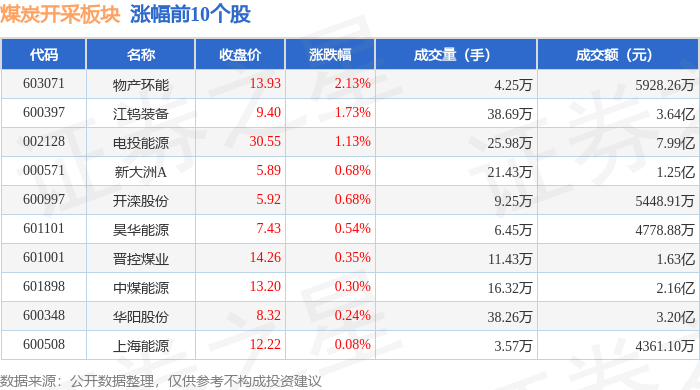
证券之星消息,1月15日煤炭开采板块较上一交易日下跌0.46%,大有能源领跌。当日上证指数报收于 4112.6,下跌0.33%。深证成指报收于14306.73,上涨0.41%。煤炭开采板块个股涨跌见下表: | 代码 | 名称 | 收盘价 | 涨跌幅 | 成交量(手) | 成交额(元) | | --- | --- | --- | --- | --- | --- | | 603071 | 物产环能 | 13.93 | 2.13% | 4.25万 | 5928.26万 | | 600397 | 江钨装备 | 9.40 | 1.73% | 38.69万 | 3.64亿 | | 002128 | 电投能源 | 30.55 | 1.13% | 25.98万 | 7.99亿 | | 000571 | 新大洲A | 5.89 | 0.68% | 21.43万 | 1.25亿 | | 600997 | 开滦股份 | 5.92 | 0.68% | 9.25万 | 5448.91万 | | 601101 | 美华能源 | 7.43 | 0.54% | 6.45万 | 4778.88万 | | 601001 | 晋控煤业 | 14. ...


中煤能源20260114
2026-01-15 01:06
Summary of the Conference Call for China Coal Energy Industry Overview - **Coal Market Trends**: In December 2024, the thermal coal market experienced price declines due to weak demand and high port inventories. The price is expected to fluctuate between 680-730 RMB/ton in January 2025, with a long-term contract price of 684 RMB/ton [2][5]. - **Coking Coal Market**: The coking coal market showed a rebound influenced by macro policies and futures markets, with prices for low-sulfur and high-sulfur coking coal at 1,567 RMB/ton and 1,219 RMB/ton respectively [2][5]. - **Urea Market**: The urea market remained stable in December 2024, but is expected to fluctuate between 1,650-1,750 RMB/ton in January 2025 due to increased supply and decreased demand [2][6]. - **Polyolefins Market**: The polyolefins market continued to decline, with expected prices for ethylene and propylene at 6,100-6,400 RMB/ton and 5,900-6,200 RMB/ton respectively [2][6]. - **Methanol Market**: The methanol market is expected to remain weak, with prices projected between 1,700-1,800 RMB/ton [2][7]. Company Performance - **Production and Sales Data**: In 2025, China Coal Energy's coal production was 135 million tons, a decrease of 2.47 million tons year-on-year. Sales were 256 million tons, down by 20.03 million tons. Urea production increased by 26.3 million tons to 2.134 million tons, while methanol production rose by 22.5 million tons to 1.955 million tons [4][3]. - **Cost Management**: The company expects costs in Q4 2025 to remain stable compared to Q3, with overall management, R&D, financial, and sales expenses showing a downward trend [3][19]. - **Dividend Policy**: The company plans to maintain a minimum dividend payout ratio of 30%, with hopes to sustain or increase this level compared to the previous year [3][16]. Future Outlook - **Coal Production Forecast**: Coal production is expected to remain stable at high levels, with a projected output of 4.7-4.8 billion tons in 2026. This stability is attributed to reduced demand and the gradual replacement of thermal power by renewable energy [10][21]. - **Long-term Contract Compliance**: The company will adhere to long-term coal contracts with a signing ratio of 75% and an execution rate of at least 90% [12][21]. - **Market Dynamics**: The demand for thermal coal is expected to stabilize, while coking coal prices are anticipated to remain stable due to steady demand from the manufacturing sector and construction industry [21][22]. Additional Insights - **Impact of Policies**: The government’s removal of unapproved capacity is expected to tighten supply, providing some price support in the coal market [10][11]. - **Production Strategy**: The company emphasizes quality over quantity in production, with a focus on maintaining operational efficiency and safety [15][22]. - **Asset Impairment**: No significant asset impairments are expected in 2025, as previous provisions have stabilized the company's asset situation [20]. This summary encapsulates the key points discussed in the conference call, providing insights into the coal industry and the company's performance and outlook.
中国中煤在安徽宣城成立绿能科技公司
Zheng Quan Shi Bao Wang· 2026-01-14 06:52
Core Viewpoint - Recently, Zhongmei Green Energy Technology (Xuancheng) Co., Ltd. was established, indicating a strategic move by China Coal Energy Group to expand its footprint in the renewable energy sector [1] Company Summary - The newly established company has a registered capital of 69.6 million yuan, which reflects a significant investment in the renewable energy space [1] - The legal representative of the company is Weng Ke, suggesting a structured leadership for the new entity [1] - The company’s business scope includes wind power generation technology services, solar power generation technology services, energy storage technology services, power generation technology services, and research and development of emerging energy technologies, highlighting its focus on diverse renewable energy solutions [1] Industry Summary - The establishment of Zhongmei Green Energy Technology aligns with the growing trend of investment in renewable energy technologies, which is crucial for meeting global energy demands and sustainability goals [1] - The involvement of China Coal Energy Group, a major player in the energy sector, indicates a potential shift towards more sustainable energy practices within traditional energy companies [1]
——煤炭行业周报(2025.1.4-2026.1.10):冷空气持续扰动,供给预计收缩,预计煤价仍将上涨-20260113
Shenwan Hongyuan Securities· 2026-01-13 11:05
Investment Rating - The report maintains a positive outlook on the coal industry, indicating an "Overweight" rating, suggesting that the industry is expected to outperform the overall market [30]. Core Insights - The report highlights that coal prices are expected to remain elevated due to persistent cold weather and improving demand, with power coal prices showing a week-on-week increase [1][6]. - The report notes that the supply side is tightening due to safety inspections and environmental checks in major production areas, which is expected to support coal prices [1][5]. - The report recommends stable, high-dividend companies such as China Shenhua, Shaanxi Coal, and China Coal Energy, while also suggesting attention to growth-oriented coal companies [1]. Summary by Sections Recent Industry Policies and Dynamics - A national safety production meeting was held to enhance safety measures in coal mining, emphasizing a systematic approach to safety governance [5]. - A new coal transportation route from Longkou to Guangzhou has been established, which is significant for energy security and regional economic development [5]. Price Trends - As of January 9, 2026, power coal prices at Qinhuangdao port were reported at 526, 613, and 699 CNY/ton for different grades, reflecting week-on-week increases [1]. - The report indicates that the average daily consumption of coal has improved, with a noted increase in coal output from production areas [1][2]. International Oil Prices - Brent crude oil prices increased to 63.34 USD/barrel, reflecting a week-on-week rise of 4.26%, which may influence coal prices [11]. Port Inventory Trends - The average daily coal inflow at the Bohai Rim ports increased to 1.4613 million tons, while the outflow also saw a slight increase, indicating a dynamic supply-demand balance [16]. - Port inventories decreased to 26.727 million tons, a reduction of 2.91% week-on-week, suggesting tightening supply conditions [16]. Shipping Costs - Domestic coastal shipping costs decreased to 31.90 CNY/ton, while international shipping rates showed mixed trends, with some routes experiencing price increases [22]. Company Valuation Table - The report includes a valuation table for key companies, indicating their stock prices, market capitalizations, and projected earnings ratios for the upcoming years [25].




中煤能源2025年商品煤销量为约2.56亿吨 同比减少10.2%
Zhi Tong Cai Jing· 2026-01-13 09:23
Core Viewpoint - China Coal Energy (601898) reported a decrease in both coal production and sales for the year ending December 2025, indicating a downward trend in the company's operational performance [1] Group 1: Production and Sales Data - In December 2025, the company's coal production was 10.91 million tons, a year-on-year decrease of 8% [1] - The coal sales volume for the same period was 21.88 million tons, reflecting a year-on-year decrease of 23% [1] - For the full year 2025, the total coal production was approximately 135 million tons, down 1.8% compared to the previous year [1] - The total coal sales for the year were around 256 million tons, which represents a year-on-year decrease of 10.2% [1]
中煤能源(01898.HK):12月商品煤销量2188万吨 同比减少23.0%
Ge Long Hui· 2026-01-13 09:20
Core Viewpoint - China Coal Energy (01898.HK) reported a decrease in both coal production and sales for December 2025, indicating potential challenges in the coal market [1] Group 1: Production and Sales Data - The company's coal production for December 2025 was 10.91 million tons, representing an 8.0% year-on-year decrease [1] - Total coal sales amounted to 21.88 million tons, reflecting a significant year-on-year decline of 23.0% [1] - Self-produced coal sales reached 10.96 million tons, which is a 16.8% decrease compared to the previous year [1]
中煤能源(01898) - 2025年12月份主要生產经营资料公告
2026-01-13 09:15
香港交易及結算所有限公司及香港聯合交易所有限公司對本公告的內容概不負責,對其 準確性或完整性亦不發表任何聲明,幷明確表示,概不對因本公告全部或任何部份內容 而産生或因依賴該等內容而引致的任何損失承擔任何責任。 1 | 1.產量 | 萬噸 | 18.8 | 195.5 | 17.4 | 173.0 | 8.0 | 13.0 | | --- | --- | --- | --- | --- | --- | --- | --- | | 2.銷量 | 萬噸 | 18.0 | 196.3 | 17.0 | 171.6 | 5.9 | 14.4 | | (四)硝銨 | | | | | | | | | 1.產量 | 萬噸 | 5.4 | 58.6 | 6.0 | 57.5 | -10.0 | 1.9 | | 2.銷量 | 萬噸 | 5.5 | 58.9 | 6.0 | 57.2 | -8.3 | 3.0 | | 三、煤礦裝備業務 | | | | | | | | | 煤礦裝備產值 | 億元 | 6.0 | 92.1 | 9.1 | 103.5 | -34.1 | -11.0 | 以上生產經營數據源自本公司內部統計,為投資者及時 ...
煤炭行业周报:冷空气持续扰动,供给预计收缩,预计煤价仍将上涨-20260113
Shenwan Hongyuan Securities· 2026-01-13 09:14
Investment Rating - The report maintains a positive outlook on the coal industry, indicating an "Overweight" rating due to expected price increases driven by supply constraints and high demand from cold weather [1]. Core Insights - The report highlights that as of January 9, 2026, the spot prices for thermal coal at Qinhuangdao port have increased, with Q4500, Q5000, and Q5500 grades priced at 526, 613, and 699 CNY/ton respectively, reflecting increases of 21, 20, and 17 CNY/ton week-on-week [1]. - Supply is expected to contract due to ongoing safety inspections and regulatory measures, while demand remains robust due to cold weather, supporting higher thermal coal prices [1]. - The report also notes that the average daily consumption of coal has improved, with a daily average of 164.79 million tons being shipped out from the Bohai Rim ports, a 0.69% increase week-on-week [1]. Summary by Sections 1. Recent Industry Policies and Dynamics - A national safety production meeting was held on January 6, emphasizing the need for stringent safety measures in mining operations [7]. - A new coal transportation route from Longkou to Guangzhou was inaugurated, enhancing coal distribution efficiency [7]. 2. Price Movements - Domestic thermal coal prices have seen a week-on-week increase, with specific grades reporting price hikes [8]. - International thermal coal prices have shown stability with slight increases in certain markets, such as Indonesia [9]. 3. Inventory and Supply - Bohai Rim port coal inventory decreased to 26.727 million tons, a 2.91% drop week-on-week, indicating tighter supply conditions [20]. - The average daily coal inflow to the Bohai Rim ports increased by 4.28% week-on-week, while outflow also saw a slight increase [20]. 4. Shipping Costs - Domestic coastal shipping costs have decreased slightly, with average freight rates reported at 31.90 CNY/ton, a 1.69% decline week-on-week [26]. - International shipping rates have shown mixed trends, with some routes experiencing price increases while others have decreased [26]. 5. Company Valuations - The report includes a valuation table for key companies in the coal sector, highlighting their stock prices, market capitalizations, and earnings projections [30].
中煤能源(601898) - 中国中煤能源股份有限公司2025年12月份主要生产经营数据公告
2026-01-13 09:00
上述生产经营数据并不对本公司未来经营情况作出任何明示或默示的预测 或保证,投资者应注意不恰当信赖或使用以上信息可能造成投资风险。 公司将在本公告披露后适时召开月度生产经营数据说明会,具体参会事宜请 询公司投资者热线 010-82236028。 本公司董事会及全体董事保证本公告内容不存在任何虚假记载、误导性陈述 或者重大遗漏,并对其内容的真实性、准确性和完整性承担法律责任。 | 指标项目 | 单位 | 2025 | 年 | 2024 | 年 | 变化比率(%) | | | --- | --- | --- | --- | --- | --- | --- | --- | | | | 月份 12 | 累计 | 月份 12 | 累计 | 月份 12 | 累计 | | 一、煤炭业务 | | | | | | | | | (一)商品煤产量 | 万吨 | 1,091 | 13,510 | 1,186 | 13,757 | -8.0 | -1.8 | | (二)商品煤销量 | 万吨 | 2,188 | 25,586 | 2,842 | 28,483 | -23.0 | -10.2 | | 其中:自产商品煤销量 | 万吨 | 1, ...
中煤能源:公布2025年煤炭及化工等业务产销量数据
Xin Lang Cai Jing· 2026-01-13 08:49
Core Viewpoint - The announcement from China Coal Energy indicates a decline in coal production and sales for 2025, alongside mixed performance in its chemical products segment, with some products showing growth while others decline [1] Group 1: Coal Production and Sales - The projected coal production for 2025 is 135.1 million tons, representing a year-on-year decrease of 1.8% [1] - The expected coal sales for 2025 are 255.9 million tons, reflecting a year-on-year decline of 10.2% [1] Group 2: Chemical Products Performance - Polyethylene production is forecasted at 71.1 thousand tons, down 8.1% year-on-year, with sales at 70.2 thousand tons, a decrease of 9.4% [1] - Polypropylene production is expected to be 67.5 thousand tons, a decline of 8.8% year-on-year, with sales at 68.0 thousand tons, down 8.4% [1] - Urea production is projected to increase to 213.4 thousand tons, up 14.1% year-on-year, with sales reaching 242.3 thousand tons, an increase of 18.9% [1] - Methanol production is expected to be 195.5 thousand tons, a year-on-year increase of 13.0%, with sales at 196.3 thousand tons, up 14.4% [1] - Ammonium nitrate production is forecasted at 58.6 thousand tons, a slight increase of 1.9% year-on-year, with sales at 58.9 thousand tons, up 3.0% [1] Group 3: Mining Equipment - The output value of coal mining equipment is projected to be 9.21 billion yuan, reflecting a year-on-year decrease of 11.0% [1]