
YONGHUI SUPERSTORES(601933)

Search documents
8.3亿亏损背后,永辉豪赌激进转型能否破局?丨大象财富
Sou Hu Cai Jing· 2025-07-19 00:09
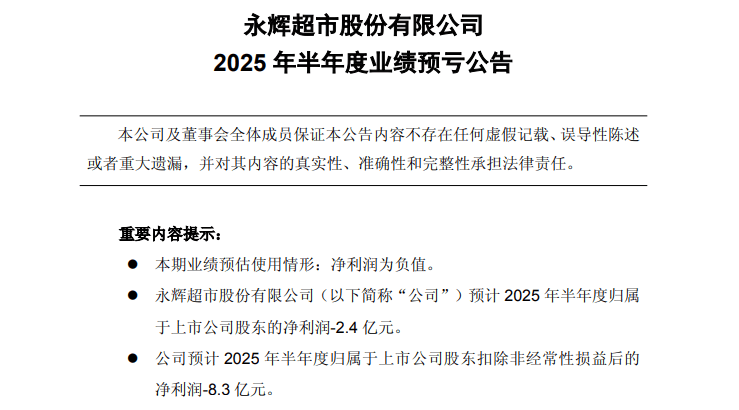
Core Viewpoint - Yonghui Supermarket is undergoing aggressive reforms, leading to significant losses in the first half of 2025, with a net profit loss of 240 million yuan and a non-recurring net profit loss of 830 million yuan, exceeding market expectations [1][4]. Group 1: Financial Performance - In the first half of 2025, Yonghui's revenue was approximately 17.48 billion yuan, a decrease of 19.32% compared to the same period in 2024 [6]. - The net profit attributable to shareholders was 147.56 million yuan, down 79.96% year-on-year, while the non-recurring net profit was 137.33 million yuan, a decline of 77.07% [6]. - Operating cash flow decreased by 71.15%, amounting to 572.44 million yuan [6]. Group 2: Store Closures and Reforms - Yonghui closed 232 stores in 2024 and an additional 227 stores in the first half of 2025, potentially reducing the total number of stores to below 450 [4][5]. - The company is implementing a "fast-track" reform strategy, with significant investments of 5 to 8 million yuan per store for renovations and upgrades [5][19]. Group 3: Supply Chain Transformation - Yonghui is focusing on a supply chain overhaul, emphasizing a "naked price" strategy to eliminate middlemen and directly control procurement prices [7][19]. - The company aims to enhance its product offerings by developing its own brand products and optimizing cost structures through direct sourcing [8][19]. Group 4: Competitive Landscape - Yonghui faces intense competition from discount retailers and new entrants, which are eroding its market share [10][12]. - The rise of hard discount models and new brands targeting younger consumers poses additional challenges to Yonghui's traditional retail model [12][13]. Group 5: Future Outlook and Risks - The success of Yonghui's transformation hinges on achieving profitability by the end of 2025, with a focus on establishing at least 100 high-efficiency stores [19][20]. - The company has limited time to demonstrate its turnaround strategy, with a potential cash flow crisis looming if improvements are not realized soon [18][20].


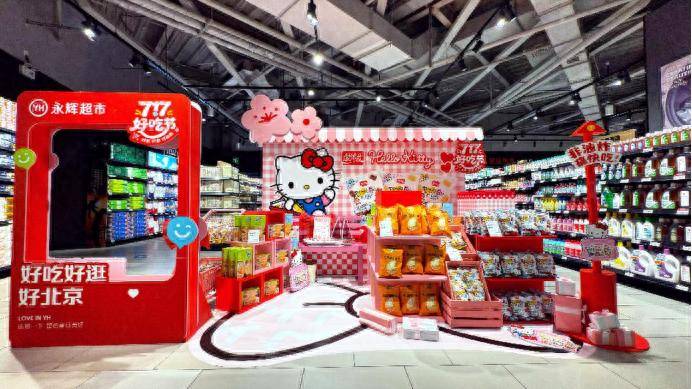
深圳第六家“胖永辉”落子光明科学城,打造一刻钟便民生活圈
Nan Fang Du Shi Bao· 2025-07-18 06:55
Core Insights - Guangming District is emerging as a significant growth area for regional consumption upgrades, supported by its dual positioning as a science city and an industrial new town [1] - Yonghui Supermarket has opened its sixth modified store in Shenzhen, marking a strategic expansion in the Guangdong-Hong Kong-Macao Greater Bay Area [1][10] Product Structure Reconstruction - The store underwent a two-month transformation, resulting in a total of 9,772 products, including 57 private label bestsellers from the "Fat Donglai" brand and 15.1% imported premium products [3] - The fresh produce section has been enhanced with high-end items such as salmon sashimi and imported Wagyu beef gift boxes, achieving over 80% alignment with the product structure of "Fat Donglai" [3] Fresh Produce and Vegetables - The vegetable section now features organic vegetables, highland-grown varieties, and a series of purple vegetables, adhering to "zero fertilizer, zero chemical pesticide, zero hormone" standards [5] - The seafood section has been upgraded to focus on quality and service, introducing the "Green Starry Fish" series, which meets national green food standards [5] Store Environment and Customer Experience - The store layout has been redesigned to enhance customer comfort, with wider aisles and lower shelving for better visibility [7] - Additional customer service features include magnifying glasses for reading labels, health measurement stations, and a pet area, creating a "15-minute convenient living circle" [8] Marketing and Strategic Goals - The opening coincided with Yonghui's annual brand festival, "717 Good Food Festival," which features over 100 renovated stores and new product offerings [10] - The establishment of the Guangming Daqianli store strengthens Yonghui's regional presence, with plans to accelerate the renovation of stores nationwide, targeting 200 modified stores by September 30 [10]
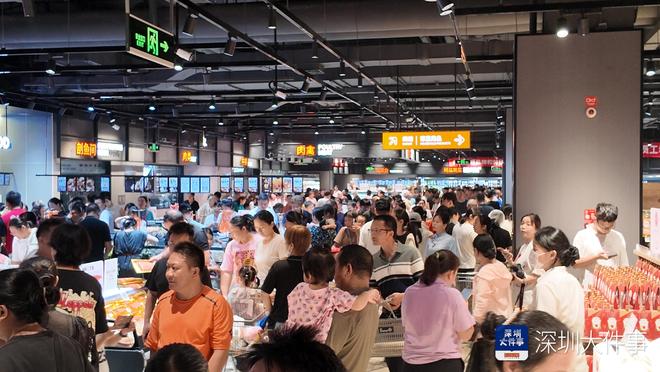
永辉超市转型阵痛加剧上半年预亏2.4亿,名创优品63亿入主后CEO仍悬而未决
Sou Hu Cai Jing· 2025-07-16 12:48
Core Viewpoint - Yonghui Supermarket is undergoing a significant transformation, facing increasing operational challenges and financial losses as it adapts to new market conditions and strategies [1][3][6]. Financial Performance - In the first half of 2025, Yonghui Supermarket expects a net loss of 240 million yuan and a non-recurring net loss of 830 million yuan, marking a shift from profit to loss compared to the previous year [3]. - The company reported a revenue of 17.48 billion yuan in Q1 2025, with net profits of 148 million yuan and 137 million yuan for recurring profits, indicating a substantial decline in Q2 with losses of approximately 387 million yuan and 967 million yuan respectively [3]. Store Operations - During the transformation, Yonghui opened 93 stores while closing 227 underperforming locations, incurring costs related to lease compensation, personnel severance, and asset write-offs [4]. - The company is implementing a significant supply chain reform, upgrading suppliers and products to enhance operational efficiency [5]. Strategic Changes - Yonghui Supermarket is adopting a new operational model inspired by the successful "Fat Donglai" retail concept, which has gained popularity in lower-tier cities [7][10]. - The first "Fat Donglai" style store opened in Zhengzhou, achieving sales of 1.88 million yuan on its first day, significantly higher than previous daily averages [11]. Shareholder Dynamics - In September 2022, Miniso's subsidiary invested 6.3 billion yuan to become Yonghui's largest shareholder, holding 29.4% of the shares [15]. - The board of directors underwent a significant reshuffle, with Miniso's founder leading the reform efforts, while the previous CEO was not re-elected [16]. Leadership and Governance - The search for a new CEO is ongoing, with the company taking a cautious approach to leadership appointments during this transformative phase [18].
中证500可选消费指数报3880.00点,前十大权重包含双环传动等
Jin Rong Jie· 2025-07-16 08:41
Group 1 - The core index of the CSI 500 Consumer Discretionary Index is reported at 3880.00 points, with a recent increase of 2.84% over the past month and a slight decrease of 0.47% year-to-date [1][2] - The CSI 500 Consumer Discretionary Index is composed of various sectors categorized into 11 primary industries, 35 secondary industries, and over 90 tertiary industries, providing a comprehensive analysis tool for investors [2] - The top ten weighted stocks in the CSI 500 Consumer Discretionary Index include Sichuan Changhong (6.97%), Ninebot (6.54%), Chuanfeng Power (4.85%), and others, indicating a diverse representation of companies [2] Group 2 - The market share of the CSI 500 Consumer Discretionary Index is primarily from the Shanghai Stock Exchange at 62.05%, while the Shenzhen Stock Exchange accounts for 37.95% [2] - The index's holdings are significantly concentrated in the passenger vehicles and parts sector (35.37%) and durable consumer goods (34.76%), highlighting the focus on these industries [2] - The index samples are adjusted biannually, with changes implemented on the next trading day following the second Friday of June and December, ensuring the index remains reflective of market conditions [3]


永辉“胖改”1年,迎来半年度历史第二大亏损
阿尔法工场研究院· 2025-07-15 11:57
Core Viewpoint - Yonghui Supermarket is still experiencing significant losses after a year of transformation under the "Fat Reform" initiative, with projected losses of approximately 240 million yuan for the first half of 2025, marking a deep transitional period for the company [1][4]. Financial Performance - Yonghui Supermarket has reported continuous losses for four consecutive years from 2021 to 2024, accumulating losses of about 9.5 billion yuan, while the net profit from 2016 to 2020 was only 7.897 billion yuan [4]. - The company's revenue has declined from 91.06 billion yuan in 2021 to 67.57 billion yuan in 2024, indicating a significant downturn in financial performance [4]. Store Adjustments - In the first half of 2025, Yonghui Supermarket adjusted and opened 93 stores, bringing the total number of adjusted stores to 124 [1]. - The company closed 227 long-term loss-making stores during the same period, incurring costs related to lease compensation, personnel compensation, and asset write-offs [2][14]. Strategic Partnerships - Yonghui Supermarket sought assistance from the retail giant "Fat Donglai" to reform its operations, with the first store transformation completed in June 2024, resulting in a significant increase in sales [5][13]. - In September 2024, Miniso acquired a 29.4% stake in Yonghui Supermarket for 6.27 billion yuan, becoming the largest indirect shareholder, indicating confidence in the company's transformation efforts [6]. Management Changes - The company appointed former Alibaba executive She Xianping as Vice President and Chief Product Officer to enhance operational efficiency and supply chain management [7][9]. - The restructuring of procurement centers into five regional hubs aims to improve supplier management and product quality [9]. Future Plans - Yonghui Supermarket aims to complete the transformation of 300 stores by the Lunar New Year in 2026, with plans to increase the number of adjusted stores to over 40% of its total by September 2025 [13][15]. - The company has seen promising results from the initial store adjustments, with some locations achieving sales up to 13.9 times their previous averages [13].
"学徒"难出师:永辉超市、中百集团学习胖东来一年多,今年上半年仍预亏超2亿元
Mei Ri Jing Ji Xin Wen· 2025-07-15 10:56
Core Insights - The retail industry is experiencing challenges as companies like Zhongbai Group and Yonghui Supermarket report significant losses despite attempts to learn from the successful model of Pang Donglai [1][2][4] - Pang Donglai has shown strong sales performance, achieving 11.707 billion yuan in sales in the first half of the year, which is nearly 70% of its total sales for the previous year [3] - The transformation efforts of traditional supermarkets are ongoing, but the results vary significantly among companies, with some seeing growth while others continue to struggle [2][4] Company Performance - Zhongbai Group expects a loss of 213 million to 290 million yuan in the first half of the year, worsening from a loss of 142 million yuan in the same period last year [1][2] - Yonghui Supermarket anticipates a net profit loss of 240 million yuan for the first half of 2025, marking a shift from profit to loss [1][2] - In contrast, Bubu Gao expects a significant profit increase of over 300% due to recognizing substantial restructuring gains [2] Transformation Efforts - Both Zhongbai Group and Yonghui Supermarket acknowledge that their store transformations have led to sales growth, but they still face financial losses [2][4] - Yonghui Supermarket has undergone a transformation phase, adjusting 93 stores in the first half of 2025, with a total of 124 stores modified by June 30, 2025 [4] - The transformation process involves significant challenges, including store closures, renovations, and supply chain upgrades, which require time to yield results [4] Market Dynamics - The retail sector is undergoing a period of adjustment, with experts noting that learning from Pang Donglai is not a panacea for all traditional supermarket issues [2][4] - The industry is facing intense competition, leading to the closure of many underperforming stores, with Yonghui Supermarket closing 227 loss-making locations in the first half of the year [4] - The retail market in China is large and diverse, suggesting that innovation and various successful business models will continue to emerge [4]

上半年预亏2.4亿,永辉超市CEO仍悬而未决
Sou Hu Cai Jing· 2025-07-15 09:43
Core Viewpoint - Yonghui Supermarket is facing significant losses in the first half of 2025, with a projected net profit attributable to shareholders of -240 million yuan, compared to a profit of 280 million yuan in the same period of 2024 [1] Group 1: Store Renovation and Performance - As of mid-July 2025, Yonghui Supermarket has completed renovations on 132 stores, accounting for approximately 25% of its total stores, with plans to exceed 178 renovated stores by the end of August 2025 [4] - The company has closed 227 underperforming stores in the first half of 2025, leading to costs associated with lease compensation, personnel compensation, and asset write-offs [2][4] - The renovation of stores based on the "Pang Donglai model" has shown positive short-term effects, with significant increases in customer traffic and sales in newly renovated stores [5][7] Group 2: Financial Performance and Losses - In the second half of 2024, the company reported a loss of approximately 1.74 billion yuan, continuing into the first half of 2025 [5] - The company is undergoing a major transformation, with a goal to complete renovations on over half of its stores by the Lunar New Year in 2026 [4][5] Group 3: Management Changes - In March 2025, a new board of directors was formed, with significant representation from Miniso, which became the largest shareholder by acquiring 29.4% of Yonghui Supermarket [7][8] - The CEO position remains vacant following the resignation of Li Songfeng in March 2025, with the reform leadership group currently acting in this capacity [8]
A股盘前市场要闻速递(2025-07-15)
Jin Shi Shu Ju· 2025-07-15 02:14
Monetary Policy and Economic Indicators - The People's Bank of China will conduct a buyout reverse repurchase operation of 1.4 trillion yuan on July 15, 2025 [1] - As of the end of June, M2 (broad money) increased by 8.3% year-on-year, reaching 330.29 trillion yuan, while M1 (narrow money) grew by 4.6% to 113.95 trillion yuan [2] - The cash in circulation (M0) reached 13.18 trillion yuan, with a year-on-year growth of 12% [2] Green Finance Initiatives - The People's Bank of China, along with financial regulatory authorities, issued the "Green Finance Support Project Directory (2025 Edition)" to enhance liquidity in the green finance market and improve asset management efficiency [2] Corporate Earnings Forecasts - Vanke A expects a net loss of 10 billion to 12 billion yuan for the first half of 2025, with a basic loss per share of 0.8433 to 1.01 yuan [4] - Yonghui Supermarket anticipates a net loss of 240 million yuan for the first half of 2025, impacted by the closure of 227 underperforming stores [5] - Longi Green Energy forecasts a net loss of 2.4 billion to 2.8 billion yuan, although it expects to reduce losses compared to the previous year [6] - Hengsheng Electronics projects a net profit of approximately 251 million yuan, a 741% increase year-on-year [7] - Wintime Technology expects a net profit of 390 million to 585 million yuan, representing a growth of 178% to 317% [8] - ST Huatuo anticipates a net profit of 2.4 billion to 3 billion yuan, a year-on-year increase of 107.2% to 159% [9] - Tianqi Lithium expects a net profit of 0 to 1.55 billion yuan, recovering from a loss of 5.206 billion yuan in the previous year [10] - Ganfeng Lithium forecasts a net loss of 300 million to 550 million yuan, compared to a loss of 760 million yuan in the same period last year [11] - Liyi Intelligent Manufacturing expects a net profit of 900 million to 1.14 billion yuan, a growth of 31.57% to 66.66% [12] - CICC anticipates a net profit of 3.453 billion to 3.966 billion yuan, a year-on-year increase of 55% to 78% [13] - Shenwan Hongyuan projects a net profit of 4.1 billion to 4.5 billion yuan, a growth of 92.66% to 111.46% [14] - Shandong Gold expects a net profit of 2.55 billion to 3.05 billion yuan, an increase of 84.3% to 120.5% year-on-year [15] - Huahong Technology anticipates a net profit of 70 million to 85 million yuan, a significant increase from 2.224 million yuan in the previous year [16] Corporate Actions and Legal Matters - Suzhou Planning intends to acquire 100% of Beijing Dongjin Aviation Technology Co., Ltd., with stock resuming trading on July 15, 2025 [17] - BOE Technology Group plans to appeal the preliminary ruling from the US International Trade Commission regarding trade secrets and has initiated a patent lawsuit against Samsung Display [18]




上半年经济数据今天公布;王兴兴等将亮相中外记者见面会|南财早新闻
2 1 Shi Ji Jing Ji Bao Dao· 2025-07-14 23:46
Group 1 - The Central Committee of the Communist Party of China has issued opinions to strengthen financial trial work, emphasizing the need to punish financial crimes such as market manipulation and insider trading, and to improve rules for handling disputes in emerging financial fields like digital currency and internet finance [1] - The People's Bank of China reported that the cumulative increase in social financing scale reached 22.83 trillion yuan in the first half of 2025, with a year-on-year increase of 4.74 trillion yuan [4] - The General Administration of Customs announced that China's goods trade import and export totaled 21.79 trillion yuan in the first half of the year, a year-on-year increase of 2.9% [4] Group 2 - The National Medical Insurance Administration stated that by the end of 2024, approximately 1.327 billion people will be covered by basic medical insurance, maintaining a coverage rate of over 95% [4] - The China Coal Transportation and Marketing Association emphasized the need to maintain safety and stability in the coal industry while improving supply quality and addressing competition issues [4] - The report from Goldman Sachs indicated that central banks and institutions globally purchased an average of 77 tons of gold per month from January to May, predicting that gold prices could reach $3,700 per ounce by the end of 2025 [4] Group 3 - The electric vehicle ownership in China reached 36.89 million by the end of June, accounting for 10.27% of the total number of vehicles, with a significant increase in new registrations [4] - The expected net profit for Yonghui Supermarket in the first half of 2025 is a loss of 240 million yuan, compared to a profit of 280 million yuan in the same period last year, due to store closures [6] - China Rare Earth's expected net profit for the first half of 2025 is between 136 million and 176 million yuan, indicating a turnaround from losses, driven by improved market conditions [7]


盘前必读丨特朗普称将对俄罗斯征收100%关税;央行将开展买断式逆回购操作
Di Yi Cai Jing· 2025-07-14 23:33
Group 1 - The market is experiencing index differentiation due to sector rotation, with ongoing upward momentum in the market [1][13] - The U.S. stock market closed higher, with the Dow Jones up 0.20%, Nasdaq up 0.27%, and S&P 500 up 0.14% [4] - The communication sector led gains, while the energy sector saw the largest decline [4] Group 2 - Autodesk shares rose by 5.1% after reports that the company will no longer seek to acquire PTC, which saw its stock drop by 1.8% [4] - Bitcoin surpassed $120,000 for the first time, boosting the cryptocurrency sector, with Coinbase up 1.8% and MicroStrategy up 3.8% [4] - The Nasdaq Golden Dragon China Index increased by 0.7%, with Bilibili up 4.2% and Alibaba and NetEase rising over 1% [4] Group 3 - China’s central bank announced a 14 billion yuan reverse repurchase operation to maintain liquidity in the banking system [5] - The People's Bank of China is focusing on structural monetary policy tools to support technology innovation and consumption [5] - The Green Finance Support Project Directory (2025 version) was issued to enhance liquidity in the green finance market [6] Group 4 - China Salt Chemical reported a 26.51% decrease in total operating revenue for the first half of 2025, with a net profit of 441 million yuan, down 42.24% year-on-year [8] - CICC expects a net profit increase of 55% to 78% for the first half of 2025, projecting a profit of 34.53 billion to 39.66 billion yuan [9] - Sanyuan Group anticipates a significant net profit increase of 810.41% to 1265.61% for the first half of 2025 [10] Group 5 - Vanke A expects a net loss of 10 billion to 12 billion yuan for the first half of 2025, primarily due to declining project settlement scale and low gross margins [11] - Yonghui Supermarket forecasts a net loss of 240 million yuan for the first half of 2025, impacted by store closures and supply chain reforms [12] - Jinpu Titanium Industry plans to acquire 100% of Nanjing Lide Oriental Rubber and Plastic Technology Co., with stock resuming trading after a suspension [13]


