
BANK OF CHINA(601988)

Search documents
2025中国企业ESG“金责奖”优秀奖评选结果揭晓


Xin Lang Cai Jing· 2026-01-15 03:45
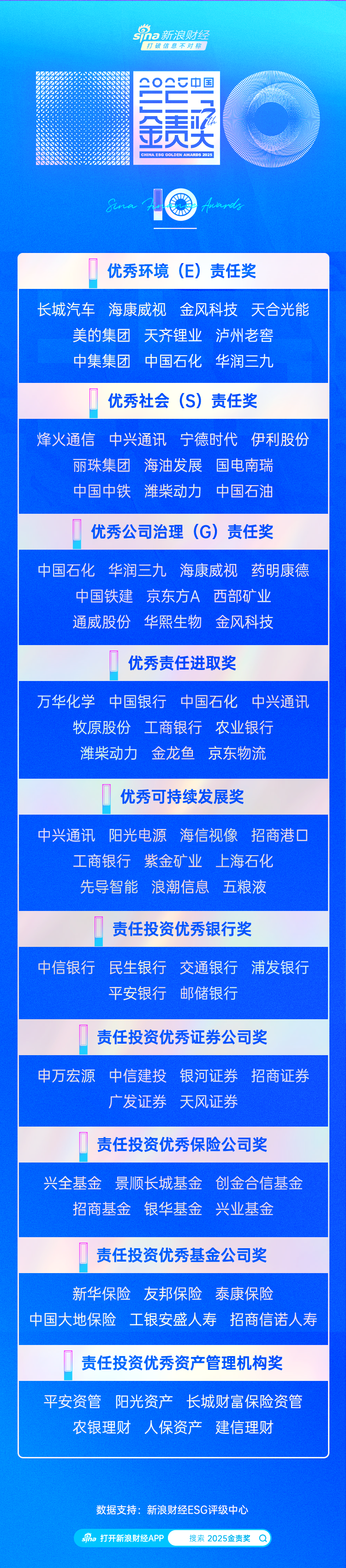
Core Viewpoint - The 2025 China Enterprise ESG "Golden Responsibility Award" aims to recognize companies and institutions that have made significant contributions to ESG initiatives in China, reflecting a shift from voluntary practices to compliance requirements in ESG performance [1][12]. Group 1: ESG Development and Awards Overview - By 2025, China's ESG development has transitioned from "setting standards" to "strengthening regulations," with a comprehensive disclosure standard system being established [1][12]. - The award selection attracted over 5,000 companies, with results based on ESG performance, online voting, and professional evaluations [2][12]. Group 2: Award Categories and Winners - The award categories include Excellent Environmental Responsibility Award, Excellent Social Responsibility Award, Excellent Corporate Governance Responsibility Award, Excellent Responsibility Initiative Award, Excellent Sustainable Development Award, and various responsibility investment awards [1][12]. - Notable winners of the Excellent Environmental Responsibility Award include Great Wall Motors, Hikvision, and China Petroleum [7][24]. - The Excellent Social Responsibility Award was awarded to companies such as YF Communication, ZTE, and Ningde Times [7][24]. - Winners of the Excellent Corporate Governance Responsibility Award include China Petroleum, Hikvision, and WuXi AppTec [7][24]. - The Excellent Responsibility Initiative Award was given to companies like ZTE, Sunlight Power, and Industrial and Commercial Bank of China [7][24]. - The Excellent Sustainable Development Award included companies such as WanHua Chemical, China Bank, and China Petroleum [7][24]. Group 3: Responsibility Investment Awards - The Responsibility Investment Excellent Bank Award was given to institutions like CITIC Bank and Minsheng Bank [5][21]. - The Responsibility Investment Excellent Securities Company Award included firms such as Shenwan Hongyuan and CITIC Securities [5][22]. - The Responsibility Investment Excellent Insurance Company Award recognized companies like New China Life and AIA [5][26]. - The Responsibility Investment Excellent Fund Company Award included firms such as Xinhua Fund and Harvest Fund [5][27]. - The Responsibility Investment Excellent Asset Management Institution Award recognized institutions like Ping An Asset Management and Sunshine Asset Management [5][28]. Group 4: Call to Action and Future Directions - The award committee encourages more Chinese enterprises to integrate ESG principles into their operations and strategic planning, emphasizing the importance of balancing commercial and social values [10][29].

今日水贝金价及各大银行金条报价【2026.1.15】
Xin Lang Cai Jing· 2026-01-15 03:17
Group 1 - The price of gold bars from various banks and institutions has shown an increase, with specific examples including the Construction Bank and Industrial and Commercial Bank both reporting a rise of 3.40 yuan per gram [1][2] - The Shanghai Gold Exchange reported a gold bar price of 1035 yuan per gram, reflecting an increase of 3.00 yuan per gram [2] - The silver prices have also seen increases, with the average price for silver bars from different sources showing rises, such as the Baoquan Coin's silver bar increasing by 1.86 yuan per gram [2][3] Group 2 - The current market for gold and silver bars is dynamic, with prices subject to real-time changes, indicating a volatile investment environment [3]


Visa支持中国消费者Apple Pay绑卡
Xin Lang Cai Jing· 2026-01-15 02:55
1月15日金融一线消息,Visa今日宣布支持中国持卡人 ApplePay绑卡。Visa将与Apple一起,支持中国持 卡人将Visa卡绑定至ApplePay,并在境外的线下商户、移动app或线上网站等多种场景进行支付。目 前,全球79%的线下交易来自"一拍即付"。 Visa中国区总裁尹小龙表示:"全球数字支付飞速发展的同时,消费者对基于手机的、互联互通的移动 支付方式的需求也与日俱增。一直以来,Visa致力于为中国持卡人提供多元的支付选择,让他们无论身 处何地,都能安心自在地畅享支付之旅。此次,Visa秉持着对中国市场和持卡人长期不变的承诺,在数 据安全与支付安全领域加大投入,推出支付标记化服务并率先实现其在跨境场景的应用。我们很高兴与 Apple及金融机构携手,率先为中国持卡人带来更安全、更便捷的移动支付新体验。" 首批支持的发卡银行包括:中国工商银行、中国银行、中国农业银行、交通银行、招商银行、中信银 行、平安银行及兴业银行。Visa和Apple正在与包括上海浦东发展银行、中国建设银行、中国民生银 行、中国光大银行在内的更多银行伙伴紧密合作,相关功能将于未来陆续上线。 责任编辑:王馨茹 Visa中国区总裁 ...





2025中国企业ESG“金责奖”评选结果揭晓 共筑可持续发展新生态
Xin Lang Cai Jing· 2026-01-15 02:38
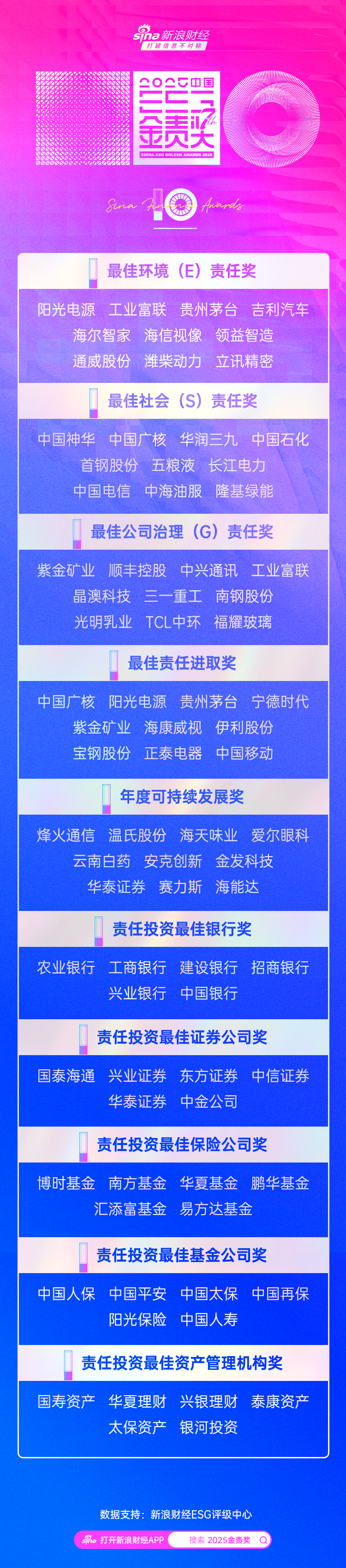
Core Viewpoint - The 2025 China Enterprise ESG "Golden Responsibility Award" aims to recognize companies and institutions that have made significant contributions to ESG initiatives in China, reflecting a shift from voluntary practices to compliance requirements in ESG performance [1][18]. Group 1: Award Categories and Winners - The award includes ten categories: Best Environmental Responsibility Award, Best Social Responsibility Award, Best Corporate Governance Responsibility Award, Best Responsibility Initiative Award, Annual Sustainable Development Award, Best Responsible Investment Bank Award, Best Responsible Investment Securities Company Award, Best Responsible Investment Insurance Company Award, Best Responsible Investment Fund Company Award, and Best Responsible Investment Asset Management Institution Award [1][18]. - The Best Environmental Responsibility Award winners include: Sungrow Power Supply, Industrial Fulian, Kweichow Moutai, Geely Automobile, Haier Smart Home, Hisense Visual Technology, Linyang Electronics, Tongwei Co., Weichai Power, and Luxshare Precision [10][28]. - The Best Social Responsibility Award winners include: China Shenhua, China General Nuclear Power, China Resources Sanjiu, Sinopec, Shougang, Wuliangye, Yangtze Power, China Telecom, China Oilfield Services, and LONGi Green Energy [10][28]. - The Best Corporate Governance Responsibility Award winners include: Zijin Mining, SF Holding, ZTE Corporation, Industrial Fulian, JA Solar, Sany Heavy Industry, Nanjing Steel, Bright Dairy, TCL Zhonghuan, and Fuyao Glass [10][28]. - The Best Responsibility Initiative Award winners include: FiberHome Technologies, Wens Foodstuff Group, Haitian Flavoring and Food, Aier Eye Hospital, Yunnan Baiyao, Anker Innovations, Kingfa Sci. & Tech., Huatai Securities, Silex, and Hainengda [11][28]. - The Annual Sustainable Development Award winners include: China General Nuclear Power, Sungrow Power Supply, Kweichow Moutai, Contemporary Amperex Technology, Zijin Mining, Hikvision, Yili, Baosteel, Chint Electric, and China Mobile [11][28]. Group 2: Responsible Investment Awards - The Best Responsible Investment Bank Award winners include: Agricultural Bank of China, Industrial and Commercial Bank of China, China Construction Bank, China Merchants Bank, Industrial Bank, and Bank of China [11][28]. - The Best Responsible Investment Securities Company Award winners include: Guotai Junan, Everbright Securities, CITIC Securities, Huatai Securities, and CICC [12][28]. - The Best Responsible Investment Insurance Company Award winners include: China Life Insurance, China Ping An, China Pacific Insurance, China Re, Sunshine Insurance, and China Life [13][28]. - The Best Responsible Investment Fund Company Award winners include: Bosera Funds, Southern Fund, China Asset Management, Penghua Fund, Huitianfu Fund, and E Fund [14][28]. - The Best Responsible Investment Asset Management Institution Award winners include: China Life Asset Management, Huaxia Wealth Management, Xingyin Wealth Management, Taikang Asset, Taikang Asset, and Galaxy Investment [15][28]. Group 3: ESG Development Context - By 2025, China's ESG development has transitioned from "setting standards" to "strengthening regulations," with a comprehensive disclosure standard system being established [1][18]. - The ESG performance of enterprises is now a compliance requirement, linking commercial value with social value [1][18]. - The ESG rating center aims to promote sustainable development and responsible investment, enhancing the ESG performance of listed companies [17][34].


易通讯集团股东将股票由中国银行(香港)转入德林证券香港 转仓市值6826.1港元

Zhi Tong Cai Jing· 2026-01-15 00:54
智通财经APP获悉,香港联交所最新资料显示,1月14日,易通讯集团(08031)股东将股票由中国银行(香 港)转入德林证券香港,转仓市值6826.1港元,占比71.05%。 易通讯集团发布公告,公司股份自2026年1月13日上午9时正起于香港联合交易所有限公司暂停买卖,以 待根据香港公司收购及合并守则刊发构成公司内幕消息的公告。 ...
易通讯集团(08031)股东将股票由中国银行(香港)转入德林证券香港 转仓市值6826.1港元
智通财经网· 2026-01-15 00:44
易通讯集团发布公告,公司股份自2026年1月13日上午9时正起于香港联合交易所有限公司暂停买卖,以 待根据香港公司收购及合并守则刊发构成公司内幕消息的公告。 智通财经APP获悉,香港联交所最新资料显示,1月14日,易通讯集团(08031)股东将股票由中国银行(香 港)转入德林证券香港,转仓市值6826.1港元,占比71.05%。 ...
存款江湖变天遇上开门红:大行拼“资产提升”,小行逆势提利率
Di Yi Cai Jing· 2026-01-14 16:57
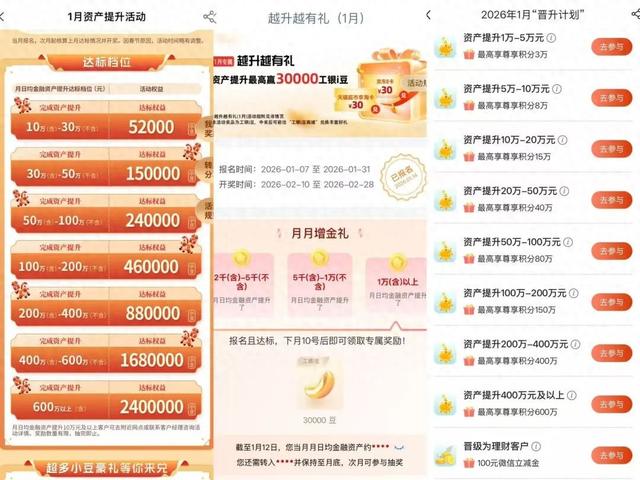
Core Insights - Major banks are launching "opening red" activities to attract depositors, focusing on enhancing various financial asset scales amid declining interest rates and expiring fixed deposits [1][9] - State-owned banks are shifting their strategy from merely attracting deposits to enhancing assets under management (AUM) and strengthening wealth management, with a clear urgency for retail strategy transformation by 2026 [1][10] Group 1: Asset Enhancement Activities - Agricultural Bank of China has initiated a "Unified Asset Enhancement Activity" from January to March 2026, offering rewards based on the increase in monthly average financial assets, with seven tiers of rewards ranging from 52,000 to 2,400,000 small beans [3][4] - Industrial and Commercial Bank of China (ICBC) has a similar program targeting customers with average financial assets below 10,000, offering rewards based on asset increases, with rewards ranging from 5,000 to 30,000 ICBC beans [5] - Other banks like China Construction Bank and Bank of China are also launching asset enhancement activities with various reward structures, indicating a competitive landscape among banks [5] Group 2: Interest Rate Adjustments - Some small and medium-sized banks are raising deposit interest rates to attract customers, with increases of up to 20 basis points, reflecting a strategy to counteract deposit outflows [1][9] - For instance, Hubei Macheng Rural Commercial Bank has raised rates on several deposit products, with the highest rate reaching 1.6% for certain terms [10][11] - Jiangsu Bank has also introduced high-interest fixed deposit products, indicating a trend among smaller banks to offer competitive rates to retain customers [11] Group 3: Customer Engagement Strategies - Social media platforms are buzzing with strategies shared by users on how to maximize benefits from various banks' asset enhancement activities, indicating a growing consumer awareness and engagement [7][8] - Banks are increasingly using these promotional activities not just for attracting deposits but also as tools for maintaining customer relationships, reflecting a shift in traditional banking strategies [10]

多家银行短期大额存单利率进入“0字头”
Zheng Quan Ri Bao· 2026-01-14 15:42
Core Viewpoint - The deposit market is undergoing a significant adjustment in 2026, with a notable decline in interest rates for large time deposits, leading to a shift in asset allocation strategies among depositors [1][3]. Group 1: Market Trends - Medium and small banks are adjusting their large time deposit products, with short-term and low-interest rates becoming the market norm [2]. - New large time deposits are generally issued with interest rates below 2%, narrowing the gap with regular fixed-term deposits, and some rural commercial banks have rates entering the "0" range [2]. - Major state-owned banks have already reduced short-term large time deposit rates to 0.9% for terms of three months or less [2]. Group 2: Changes in Asset Allocation - The continuous decline in interest rates is prompting ordinary depositors to fundamentally change their investment strategies, moving from reliance on high-interest deposits to diversified asset allocation [4][5]. - Financial products and dividend insurance have become popular choices among depositors, with recommendations for structured deposits linked to gold for short-term needs and dividend insurance for long-term stability [4]. - Depositors are advised to manage funds based on their intended use and risk tolerance, including maintaining emergency funds in liquid assets and considering government bonds or low-risk bank products for medium-term investments [4]. Group 3: Future Outlook - There is an expectation of further room for interest rate cuts and reserve requirement ratio reductions in 2026, indicating that large time deposit rates may continue to decline [5]. - The competition among banks is likely to shift from interest rate comparisons to service optimization and product innovation, necessitating a faster transition away from reliance on interest rate spreads [5].

存款江湖变天
第一财经· 2026-01-14 15:06
Core Viewpoint - The article discusses the shift in focus of major banks in China from merely attracting deposits to enhancing asset management and wealth management services, particularly through promotional activities aimed at increasing the scale of various financial assets held by customers [5][6]. Group 1: Asset Enhancement Activities - Major state-owned banks have launched attractive "asset enhancement" activities, shifting their focus from deposit acquisition to increasing assets under management (AUM) and strengthening wealth management [5][6]. - For example, Agricultural Bank of China has set up a structured "Unified Asset Enhancement Activity" from January to March 2026, with rewards based on the increase in average financial assets compared to December 2025, offering rewards ranging from 52,000 to 2,400,000 "small beans" based on different tiers of AUM [6][8]. - The rewards can be exchanged for various products and services, with the highest tier potentially offering over 12,000 yuan in value [8]. Group 2: Competitive Strategies Among Banks - Different banks are implementing various strategies to attract and retain customers, such as Industrial and Commercial Bank of China's "Increasing Rewards" program, which targets customers with lower average financial assets and offers rewards based on asset increases [9]. - Other banks like China Construction Bank and Bank of China are also running similar promotional activities, with varying reward structures and incentives for asset retention [9][10]. - Some smaller banks have raised deposit rates to attract customers, with increases of up to 20 basis points, indicating a competitive environment for customer deposits [11][14]. Group 3: Market Context and Challenges - The banking sector is facing challenges due to declining deposit rates, with significant amounts of term deposits maturing in 2026, leading to increased competition for retaining these funds [12][13]. - The total amount of term deposits maturing this year is estimated at 67 trillion yuan, with a notable portion maturing in the first quarter, creating pressure on banks to retain customers [12][13]. - Banks are increasingly focusing on enhancing their middle-income strategies and wealth management capabilities to counteract the challenges posed by smaller banks and changing customer preferences [13].

形成四五十万亿股权基金!黄奇帆重磅提议
Sou Hu Cai Jing· 2026-01-14 13:39
Core Viewpoint - Huang Qifan emphasizes the need to increase direct financing through a dual approach, developing both the stock market and equity investment funds, suggesting the establishment of a guiding fund involving various financial sources [1][2]. Group 1: Funding Sources for Equity Investment - Huang Qifan estimates that if 3% of China's bank capital is allocated to equity investment, it could generate approximately 1 trillion yuan as a source for equity investment funds [1]. - The social security fund could potentially contribute around 2 trillion yuan if 30% of its assets are directed towards equity investment [1]. - Insurance funds, if allocated 30% for equity investment, could yield between 3 trillion to 4 trillion yuan for equity investment funds [1]. Group 2: Potential Scale of Equity Investment Funds - The aggregation of funds from banks, social security, insurance, and foreign exchange could create a guiding fund of over ten trillion yuan, potentially leading to a scale of 40 to 50 trillion yuan in equity investment funds to support corporate equity [2]. Group 3: Current Developments in Financial Asset Investment Companies (AIC) - As of 2024, the pilot program for financial asset investment companies has expanded to 18 cities, with signed agreements exceeding 350 billion yuan [3][4]. - The number of bank-affiliated AICs has grown to nine, with total signed amounts surpassing 3.8 billion yuan [5]. Group 4: Recent Initiatives and Fund Launches - The establishment of the Jianyuan Zhengxing Fund, with a scale of 7 billion yuan, marks the first instance of AICs participating in Shenzhen's strategic industry investments [6]. - China Bank has successfully launched a science and technology mother fund, expanding its scale to over 50 billion yuan, with a focus on long-term capital investment [6][7]. Group 5: Role of Social Security and Insurance Funds - Multiple social security science and technology funds have been launched in 2025, totaling 2.1 billion yuan, which will help attract more social capital to strategic industries [8]. - Since the policy shift in late 2020, insurance capital has increasingly invested in private equity, becoming a significant source of long-term capital for the VC/PE sector [9][10]. Group 6: Regulatory Changes and Future Expectations - The recent notification from the National Financial Supervision Administration allows insurance companies to invest up to 30% in single venture capital funds, enhancing support for the equity investment industry [9]. - The alignment of insurance capital with long-term investment characteristics is expected to facilitate a more stable investment environment in the equity investment sector [10][11].