
CICC(601995)

Search documents
中金公司首席港股与海外策略分析师刘刚:2026年投资需均衡配置 宜跟随信用扩张的方向
Mei Ri Jing Ji Xin Wen· 2025-12-28 19:24
Core Insights - The investment landscape for 2026 is characterized by a shift from "single-sided bets" to "balanced allocation," focusing on AI hardware and high-dividend assets as a hedge against market volatility [1][5] Group 1: Investment Strategy - The investment strategy for 2026 should embrace AI hardware as a certain growth direction while retaining high-dividend assets for risk mitigation [1][5] - The market environment in 2026 will be defined by excess liquidity chasing scarce return assets, with the ability of these assets to expand being a critical variable [2] Group 2: Scarce Return Assets - AI hardware, particularly supported by government policies, remains a primary focus for investment, despite high short-term expectations leading to elevated valuations [2][3] - High-dividend assets are crucial in an environment of contracting private credit, providing stability and acting as a "cash is king" buffer during credit downturns [3] Group 3: Market Dynamics - The Hong Kong stock market benefits from a unique structure where its fundamentals are driven by mainland companies while liquidity is influenced by both domestic and overseas capital [4] - The inflow of southbound funds is expected to show differentiation, with long-term investors like insurance funds continuing to increase holdings in high-dividend assets, while retail and private funds may fluctuate based on A-share market activity [4] Group 4: Investment Recommendations - A balanced allocation strategy is recommended, with 10% to 20% of funds directed towards high-dividend assets, adaptable based on individual risk preferences [5] - The Hong Kong market's structural advantages, particularly in high-dividend offerings, are highlighted as key attractions for institutional investors [5] - Strong cyclical sectors, particularly those benefiting from U.S. demand, are also recommended for consideration, while the consumer sector lacks fundamental support [5]

“隐秘的角落”:低利率时代,高端理财渠道的收益“创新”
Sou Hu Cai Jing· 2025-12-28 18:31
作者 |崔峻阳 编辑 | 袁畅 在低利率逐渐成为常态之后,一个有些"奇怪"的行业现象开始出现。 一方面,面向大众的现金类工具,回报越来越接近,功能也越来越趋同。 另一方面,一些只在大型券商高端理财货架上出现、主要面向私募客户的产品,却在"放现金"这件事上,走出了完全不同 的路径。 原本最应该简单透明的"现金",开始被放进更复杂的安排之中。 这种变化并不张扬,也很少被单独拿出来讨论,却正在悄然发生。 对于一部分资金来说,"放在哪里"不再只是收益高低的选择,而是进入了另一套运行体系。 01 闲钱产品中的"例外" 当前低利率环境下,那些暂时不用、但随时能取的钱,放在哪种产品里,回报已经差不多。 资事堂注意到,中金公司旗下的财富平台上,一款名为"现金宝"的产品在同类现金类产品中显得较为突出。 该产品全称为"外贸信托-中金现金宝XX号集合资金信托计划",下文简称为"中金现金宝"。公开资料显示,该产品面向私募 类高净值客户开放, 七日年化收益率可达1.9%(截至2025年12月25日)。 这一收益表现的"突出",来自与当前主流现金管理工具的直接对照。 截至目前,国有大行一年期定存利率已降至1%以下,五年期定存利率约为1. ...

中金公司首席港股与海外策略分析师刘刚:2026年投资需均衡配置,宜跟随信用扩张的方向
Mei Ri Jing Ji Xin Wen· 2025-12-28 17:32
Core Insights - Investors are facing a complex situation as the global economic cycle approaches a critical turning point by the end of 2025, with strong long-term growth potential from AI but high valuations and expectations [1] Investment Strategy - The investment strategy for 2026 should shift from "single-sided bets" to "balanced allocation," embracing AI hardware as a certain growth direction while retaining high-dividend assets for hedging [2] Scarcity of Return Assets - The core characteristic of the 2026 market environment will be excess liquidity chasing scarce return assets, with the ability of these assets to expand being a key variable [3] - AI hardware, particularly supported by government policies, remains a clear direction for scarce return assets, despite high short-term expectations and valuations [3] High Dividend Assets - High dividend-paying assets are crucial hedging tools in an environment of contracting private credit, providing stable returns amidst overall credit contraction [4] - Strong cyclical sectors may benefit from U.S. fiscal expansion and monetary easing, potentially boosting demand for commodities like copper and aluminum [4] Opportunities in Hong Kong Market - The influx of southbound funds has provided significant liquidity to the Hong Kong market, with an average monthly inflow exceeding 120 billion from January to November 2025 [5] - The unique structure of the Hong Kong market, driven by mainland companies and influenced by both domestic and overseas liquidity, creates complex rotation patterns [5] Fund Flow Dynamics - The flow of southbound funds may become differentiated, with long-term allocation funds like insurance continuing to invest in high-dividend assets, while trading funds may shift back to A-shares if the market becomes more active [6] - A balanced allocation strategy is recommended for individual investors, with 10% to 20% of funds allocated to high-dividend assets [6] Sector Focus - The Hong Kong market's structural advantages remain prominent, with high dividends being a core attraction for institutional investors [6] - AI hardware, supported by policy, offers high certainty, while strong cyclical sectors benefiting from U.S. demand are also worth attention [6] - Individual investors are advised to use thematic ETFs to participate in the Hong Kong market rather than directly betting on individual stocks [7]
发动消费引擎 释放内需潜力
Zheng Quan Ri Bao· 2025-12-28 16:24
Group 1 - The core viewpoint emphasizes that consumption is the main engine of economic growth and a barometer of people's well-being, with significant policies implemented to boost consumption in 2025, resulting in a 4% year-on-year increase in retail sales of consumer goods in the first 11 months, surpassing both the previous year's growth and the annual growth rate [1] - The "Two New" policy, which includes large-scale equipment updates and the replacement of old consumer goods, has been a key focus of macroeconomic policy this year, with substantial increases in funding for these initiatives, including 300 billion yuan for consumer goods replacement and 200 billion yuan for equipment updates [2] - The government is actively working to eliminate restrictive measures in the consumption sector, with multiple high-level meetings emphasizing the need to stimulate consumption potential and remove unreasonable restrictions on consumption, particularly in the automotive and housing sectors [3] Group 2 - Looking ahead to 2026, experts suggest that the focus of consumption policies should shift from demand-side stimulation to a coordinated reform of both supply and demand, as outlined in the 15th Five-Year Plan [4] - The research department of China International Capital Corporation (CICC) highlights the importance of increasing the supply of quality consumer goods and services, with specific targets set for 2027, including three trillion-yuan-level consumption areas and ten hundred-billion-yuan-level consumption hotspots [5] - The chief economist at招商基金 predicts a moderate recovery in consumption in 2026, with continued support for the "Two New" policy and an emphasis on service consumption, particularly in sectors like healthcare and elderly care, which are expected to be the main focus of policy support [6]
2026为何重视券商投行拐点及科创板跟投?
Changjiang Securities· 2025-12-28 11:45
丨证券研究报告丨 %% %% %% %% research.95579.com 1 行业研究丨专题报告丨多元金融 [Table_Title] 2026 为何重视券商投行拐点及科创板跟投? 报告要点 [Table_Summary] 券商投行业务经历了 2022-2024 三年收缩后,2025 年迎来了向上拐点,业务量及收入均显著 提升。同时受科创板行情回暖影响,2025 年券商科创板跟投收益大幅改善。展望 2026 年,随 着市场交投及权益自营基数走高,传统经纪及自营收入弹性减弱背景下,投行承销收入及跟投 收益有望成为券商业绩的重要边际增量。看好龙头券商有望以资源、规模优势持续巩固竞争优 势,推荐国泰海通、中信证券、中金公司。 分析师及联系人 [Table_Author] 吴一凡 戴永飞 SAC:S0490519080007 SAC:S0490524070001 SFC:BUV596 请阅读最后评级说明和重要声明 [Table_Title2] 2026 为何重视券商投行拐点及科创板跟投? [Table_Summary2] 券商投行业务经历三年收紧周期后,迎来向上修复拐点 券商投行业务经历了 2022-2024 ...


中金公司(03908) - 海外监管公告 - 2023年面向专业投资者公开发行公司债券(第一期)(品...
2025-12-28 11:01
香港交易及結算所有限公司及香港聯合交易所有限公司對本公告的內容概不負責,對其 準確性或完整性亦不發表任何聲明,並明確表示,概不對因本公告全部或任何部份內容 而產生或因倚賴該等內容而引致的任何損失承擔任何責任。 China International Capital Corporation Limited 中 國 國 際 金 融 股 份 有 限 公 司 (於中華人民共和國註冊成立的股份有限公司) (股份代號:03908) 海外監管公告 本公告乃根據香港聯合交易所有限公司證券上市規則第13.10B條而作出。 茲載列中國國際金融股份有限公司(「本公司」)在上海證券交易所網站刊登的本公司2023 年面向專業投資者公開發行公司債券(第一期)(品種二)2026年票面利率調整及債券回售 實施的第三次提示性公告,僅供參閱。 承董事會命 中國國際金融股份有限公司 董事會秘書 孫男 中國,北京 2025年12月26日 於本公告日期,本公司執行董事為陳亮先生及王曙光先生;非執行董事為張薇女士、 孔令岩先生及田汀女士;以及獨立非執行董事為吳港平先生、陸正飛先生、彼得 • 諾蘭先 生及周禹先生。 债券代码:138842 债券简称:23 ...
【中金外汇 · 周报】市场料在年末维持平稳
Sou Hu Cai Jing· 2025-12-28 08:27
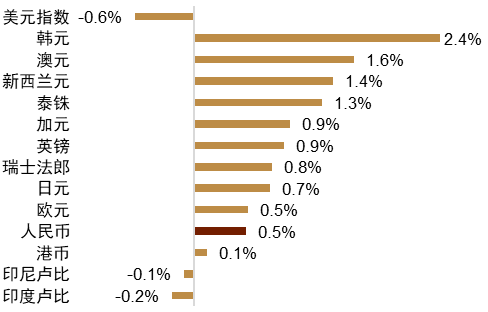
Group 1 - The core viewpoint of the article indicates that the US dollar index has returned to around 98, with market liquidity significantly weakened during the Christmas week, despite the US Q3 GDP data exceeding expectations. Concerns about the US labor market persist, supporting high expectations for Federal Reserve rate cuts [1][18] - Non-US currencies experienced overall appreciation last week, with significant gains in commodity currencies such as the Australian dollar (up 1.57%), New Zealand dollar (up 1.37%), Norwegian krone (up 1.34%), and Canadian dollar (up 0.95%). The British pound rose by 0.88%, while the euro saw a modest increase of about 0.5% [1] - The Japanese yen reversed previous losses after the Bank of Japan's dovish rate hike in December, ultimately appreciating by 0.75% last week. The Chinese yuan also accelerated its appreciation, with the offshore rate briefly surpassing 7.0 due to a weak dollar and increased year-end settlement demand [1][10] Group 2 - Looking ahead, the market is expected to remain relatively stable during the last three trading days of 2025, with liquidity likely to remain weak due to many traders being on holiday. Attention will be focused on the Chinese yuan exchange rate, which may face upward pressure as year-end settlement pressures are released [2] - The prediction range for USD/CNY is set between 7.00 and 7.03. Last week, the yuan maintained a moderate appreciation trend, although the pace of appreciation was limited by the steady exchange rate policy [3][10] - The yuan's appreciation is supported by seasonal factors, but the central bank's steady exchange rate policy has constrained the rate of appreciation. The central bank's recent signals emphasize the need to prevent excessive fluctuations in the exchange rate [11][16] Group 3 - The euro experienced a rise early last week but faced resistance around 1.18, ultimately closing with a weekly gain of about 0.5%. The market's focus on the Federal Reserve's dovish expectations may continue to influence the euro's performance [17] - Concerns about the US labor market persist, with Q3 GDP growth recorded at 4.3%, surpassing expectations. However, weekly unemployment claims data indicates a weakening employment growth momentum, maintaining high expectations for Federal Reserve rate cuts [18] - The European Central Bank (ECB) is perceived to have ended its current rate cut cycle, as indicated by the OIS market, which reflects a relatively calm European market during the Christmas holiday [21]
诚邀体验 | 中金点睛数字化投研平台
中金点睛· 2025-12-28 01:03
Core Viewpoint - The article emphasizes the establishment of a digital research platform by CICC, aimed at providing efficient, professional, and accurate research services through the integration of insights from over 30 specialized teams and extensive market coverage [1]. Group 1: Research Services - CICC's digital research platform, "CICC Insight," integrates the wisdom of research analysts and offers a one-stop service for research reports, conference activities, and fundamental databases [1]. - The platform covers over 1,800 individual stocks, showcasing a deep accumulation of research [1]. - It utilizes advanced model technology to enhance the research service experience for clients [1]. Group 2: Research Content - The platform provides daily updates on research focuses and selects timely articles for users [4]. - It features live broadcasts where senior analysts interpret market hotspots, enhancing real-time engagement [4]. - The platform includes over 3,000 complete research reports covering macroeconomics, industry research, and commodities [9]. Group 3: Data and Frameworks - CICC Insight offers more than 160 industry research frameworks and over 40 premium databases, providing comprehensive data resources [10]. - The platform includes a sophisticated data dashboard and AI search capabilities for efficient information retrieval [10].

一REITs,发售火爆!
中国基金报· 2025-12-26 14:10
Core Viewpoint - Over 80% of public REITs products experienced an increase this week, with the China Securities REITs Total Return Index rising by 1.56% from December 22 to 26, 2023 [2][5] Market Performance - The China Securities REITs Total Return Index saw a slight decline of 0.18% on December 26, closing at 1014.80 points. During the week, 67 out of 79 listed public REITs recorded a rise, with the highest increase being 7.86% for the Zhongjin Chongqing Liangjiang REIT [5][6] - The top-performing REITs included Zhongjin Chongqing Liangjiang REIT (7.86%), Huaxia Fund Huayun REIT (5.99%), and Bosera Jinkai Industrial Park REIT (5.94%). Conversely, 10 products experienced declines, with one falling over 5% [5][6] New Developments - The highly anticipated Xinjiang first hydropower REIT, Huaxia Zhongke Clean Energy REIT, successfully concluded its issuance, attracting over 1616 billion yuan in subscription funds, with a public investor subscription multiple of approximately 392 times [3][8][9] - The underlying asset of Huaxia Zhongke Clean Energy REIT is the Bopona Hydropower Station, the largest in the Hotan region, which has maintained stable revenue and power generation for over 14 years [9] Market Insights - Analysts suggest that the recent price fluctuations in the public REITs market are largely unrelated to the underlying fundamentals, but rather influenced by discussions surrounding the accounting treatment of OCI principal and interest [5][7] - The market is still in a policy dividend period, and it is recommended to gradually focus on low-priced opportunities in relatively stable projects [7]

关于同意中国国际金融股份有限公司为华宝中证港股通汽车产业主题交易型开放式指数证券投资基金提供主做市服务的公告
Xin Lang Cai Jing· 2025-12-26 09:51
Group 1 - The Shanghai Stock Exchange has approved China International Capital Corporation to provide primary market-making services for the Huabao CSI Hong Kong Stock Connect Automotive Industry Thematic ETF starting from December 29, 2025 [1] - The approval aims to enhance market liquidity and ensure stable operation of the Hong Kong Stock Connect Automotive Industry ETF [1] Group 2 - The announcement is documented under the Shanghai Stock Exchange notice number 2682 for the year 2025 [1] - The date of the announcement is December 26, 2025 [3]