Sugon(603019)

Search documents
——金融工程市场跟踪周报20251215:交易信心有所提振,后市仍将震荡上行-20251215
EBSCN· 2025-12-15 02:53
2025 年 12 月 15 日 总量研究 交易信心有所提振,后市仍将震荡上行 ——金融工程市场跟踪周报 20251215 要点 本周市场核心观点与市场复盘: 本周(2025.12.08-2025.12.12,下同)A 股震荡上行,市场量能有所提振。截 至周五(2025.12.12,下同),主要宽基指数量能择时指标均转为看多信号。沪 深 300、中证 500 指数时序波动率、横截面波动率均有提升,Alpha 环境好转。 资金面方面,融资增加额环比提升,资金交易情绪积极。 12 月中央经济工作会议进一步提振市场信心,资金面叠加情绪指标改善下,市 场或进一步震荡上行。风格方面,本周市场大市值风格显著、基本面因子表现相 对占优,市场或逐步实现资金面驱动向基本面驱动的过渡。中长线持续看好"红 利+科技"配置主线。 本周上证综指下跌 0.34%,上证 50 下跌 0.25%,沪深 300 下跌 0.08%,中证 500 上涨 1.01%,中证 1000 上涨 0.39%,创业板指上涨 2.74%,北证 50 指数 上涨 2.79%。 截至 2025 年 12 月 12 日,宽基指数来看,上证指数和上证 50 指数处于估 ...




跨越科技奇点,布局AI新机
Ping An Securities· 2025-12-15 02:09
Group 1: Industry Overview - The computer industry has shown steady revenue growth and improved profit margins, with total revenue reaching 939.34 billion yuan in the first three quarters of 2025, a year-on-year increase of 9.4% [11] - The software development sub-industry has seen significant profit improvements, while the computer equipment sub-industry remains relatively high in terms of market sentiment [11] - The industry has experienced a volatile upward trend since the beginning of 2025, with the computer industry index rising by 18.54% as of November 28, 2025, outperforming the CSI 300 index by 3.5 percentage points [18] Group 2: Algorithm and Applications - The global landscape of large models is rapidly evolving, with significant competition among closed-source models from companies like Google, Anthropic, and OpenAI, while domestic open-source models like Kimi K2 and MiniMax-M2 maintain a leading position [27][30] - The focus of large model applications is shifting towards programming, enterprise services, and office productivity tools, indicating a convergence in the market [42] - The integration of multi-modal capabilities and AI agents is becoming a competitive focal point in the large model market, expanding the boundaries of model tasks [32][34] Group 3: Computing Power - The AI computing power market is experiencing high demand, with the global AI server market projected to grow at a CAGR of 15.5% from 2024 to 2028, while China's market is expected to grow at a CAGR of 30.6% during the same period [10] - The domestic AI computing power chip industry is poised for growth due to strong policy support and increasing downstream demand, with a clear trend towards self-sufficiency [10][22] Group 4: Intelligent Driving - The penetration rate of Navigate on Autopilot (NOA) features is increasing, indicating a rapid commercialization of the intelligent driving industry in China, with the market size expected to exceed 300 billion yuan by 2030 [4] - Major players like Tesla and Xpeng are advancing their intelligent driving technologies, with significant updates and new model releases enhancing their market positions [4][5] Group 5: Investment Recommendations - The report maintains a "stronger than market" rating for the computer industry, highlighting investment opportunities in AI computing power, algorithms, and intelligent driving sectors [5] - Specific stock recommendations include companies like Zhongke Chuangda, Haiguang Information, and Industrial Fulian in the AI computing power segment, and companies like Daotong Technology and Kingsoft Office in the AI algorithm and application space [5][6]




研判2025!中国刀片式服务器行业分类、市场规模及重点企业分析:规模扩张与国产化共塑关键窗口期,高端竞争蓄势待发[图]
Chan Ye Xin Xi Wang· 2025-12-15 01:42
Core Viewpoint - The Chinese blade server industry is experiencing a critical development phase driven by technological upgrades, deepening market applications, and supply chain localization, characterized by simultaneous expansion of market size and acceleration of domestic production processes [1] Industry Overview - Blade servers are a high-density server platform designed for specific application industries and high-density computing environments, allowing multiple "blade" modules to be inserted into a unified chassis, providing optimal space efficiency and energy efficiency for large data centers [4][6] - The evolution of the blade server industry in China has transitioned from early architectural exploration to market maturity, showcasing a trajectory from single functionality to multi-fusion [6] Market Size - The market size of the Chinese blade server industry is projected to reach approximately 15.07 billion yuan in 2024, reflecting a year-on-year growth of 2.8%, driven by strong demand from cloud computing and artificial intelligence [1][8] Key Enterprises - Unisplendour Corporation, through its subsidiary H3C, leads the blade server market, leveraging its unique position as the exclusive provider of HPE servers in China and its "plastic architecture" for resource pooling [10] - Inspur Information maintains a strong market share through continuous innovation in liquid cooling technology, while Huawei excels in AI computing scenarios with its self-developed Kunpeng chips [10] - Sugon focuses on high-performance computing and liquid cooling technology, establishing a competitive edge in the research and supercomputing sectors [10] Industry Development Trends 1. **Liquid Cooling Technology and AI Integration** - The industry is accelerating towards green and intelligent infrastructure, with liquid cooling technology expected to penetrate over 30% of the market by 2025, significantly improving energy efficiency [13] 2. **Market Concentration and Localization** - The competition is becoming increasingly oligopolistic, with domestic CPUs gaining traction in government and military sectors, while the supply chain is reducing reliance on imports [14] 3. **Edge Computing Expansion** - The blade server architecture is evolving towards a dual-mode of "centralized large clusters + distributed micro-clusters," adapting to the demands of edge computing driven by 5G and IoT applications [16]





A股重要调整 明起实施
2 1 Shi Ji Jing Ji Bao Dao· 2025-12-14 14:41
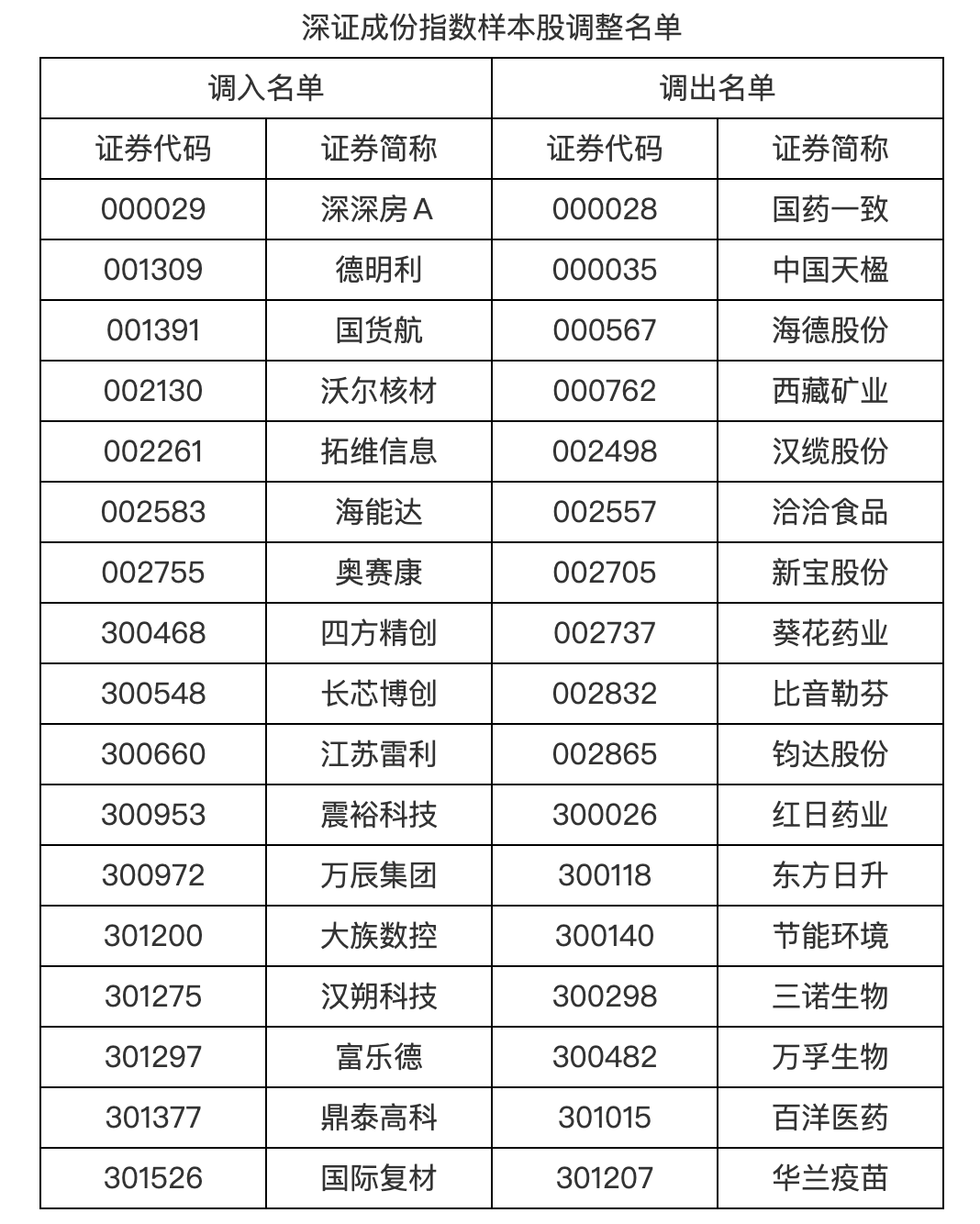
Core Viewpoint - The periodic sample adjustment of various indices, including the Shanghai Stock Exchange 50 and ChiNext indices, is set to take effect, reflecting a shift towards including more emerging industry leaders and enhancing the technology attributes of these indices [1][9]. Index Adjustments - The Shanghai Stock Exchange 50 Index will replace 4 samples, while the Shanghai 180 Index will replace 7 samples, and the Shanghai 380 Index will replace 38 samples [1]. - The ChiNext Index will see 8 samples replaced, with notable additions including companies like Aosheng Technology and Shenghong Technology [1][3]. - The CSI 500 Index will replace 50 samples, and the CSI 1000 Index will replace 100 samples, indicating a significant overhaul [1]. Emerging Industry Focus - The adjustments will increase the representation of strategic emerging industries, with the ChiNext Index's strategic emerging industry weight reaching 93% [9]. - The new sample companies have shown a 13% year-on-year increase in R&D expenses, with 30 companies having an R&D intensity exceeding 10% [9]. - The weight of strategic emerging industries in the ChiNext 50 Index is now at 98%, with new generation information technology industries, such as artificial intelligence and chips, accounting for 45% [9]. ETF Rebalancing - Following the index adjustments, ETFs tracking these indices will also undergo rebalancing to align with the new sample compositions [8].




A股半导体并购接连刹车
Xin Lang Cai Jing· 2025-12-14 09:48
Core Viewpoint - A significant wave of merger and acquisition (M&A) terminations is occurring in the A-share market as the end of 2025 approaches, with at least 20 listed companies announcing the cessation of major asset restructuring plans within a month [1] Group 1: Industry Trends - The terminated M&A activities involve prominent sectors such as semiconductors, pharmaceuticals, chemicals, and information technology [1] - Notably, several semiconductor companies have recently halted their acquisition plans, indicating a trend within the industry [1] Group 2: Company-Specific Actions - Chipmaker Xinyuan Co. (688521.SH) announced on December 12 the termination of its acquisition of a 97.0070% stake in Xinlai Zhihong, citing discrepancies between the core demands of the target company's management and market conditions, policy requirements, and the interests of the company and its shareholders [1] - Haiguang Information (688041.SH) and Zhongke Shuguang (603019.SH) both announced on December 10 the termination of their absorption merger plan, stating that they could not reach an agreement on related transaction matters within the expected timeframe [1] - Other semiconductor firms, including SIRUI (688536.SH) and Diaomicro (688381.SH), have also recently declared the termination of their M&A restructuring efforts [1]


A股半导体并购接连“刹车”
Di Yi Cai Jing· 2025-12-14 09:17
Core Viewpoint - A wave of merger and acquisition (M&A) terminations has emerged in the A-share market, particularly in the semiconductor sector, reflecting challenges in the current M&A environment due to macroeconomic changes and valuation discrepancies [2][3][5] Group 1: M&A Termination Overview - From November 13 to December 13, at least 20 listed companies announced the termination or suspension of significant asset restructuring plans, including notable firms in the semiconductor, pharmaceutical, chemical, and information technology sectors [2][3] - The semiconductor industry has been particularly affected, with companies like Chipone Technology (688521.SH) and Haiguang Information (688041.SH) announcing terminations of major acquisition plans, citing misalignment of core demands and market conditions [2][3][4] Group 2: Specific Cases and Impacts - Haiguang Information and Zhongke Shuguang (603019.SH) announced the termination of a merger plan valued at approximately 100 billion, leading to a significant drop in Zhongke Shuguang's stock price [3][6] - Chipone Technology terminated its acquisition of 97.0070% equity in Chipwise Technology due to discrepancies between the management's core demands and market conditions [3][4] - Other semiconductor firms, such as Sierpo (688536.SH) and Diaowei (688381.SH), have also recently announced the termination of their M&A plans [2][4] Group 3: Reasons for Termination - The primary reasons for M&A terminations include failure to reach consensus on core terms, immature transaction conditions, and changes in the market environment [5][6] - Valuation discrepancies are a common issue, with buyers seeking conservative valuations while sellers prefer premium offers, leading to difficulties in negotiations [5][6] - The volatility in the A-share market has resulted in a "short-term pulse, long-term differentiation" effect on stock prices following M&A announcements, heavily influenced by the quality of the transactions and the realization of synergies [5][6]

A股半导体并购接连“刹车”
第一财经· 2025-12-14 09:14
Core Viewpoint - The A-share market is experiencing a significant wave of merger and acquisition (M&A) terminations, particularly in the semiconductor sector, reflecting challenges in the current M&A environment due to macroeconomic changes and valuation disagreements [4][6]. Group 1: M&A Termination Overview - From November 13 to December 13, 2025, at least 20 listed companies announced the termination or suspension of major asset restructuring plans, with notable companies in the semiconductor, pharmaceutical, chemical, and information technology sectors [3][6]. - Semiconductor companies have been particularly affected, with significant terminations including the halted acquisition of 97.0070% of Chip Origin's shares by Chip Origin Co., which cited misalignment of core demands with market conditions [6][7]. Group 2: Reasons for Termination - The primary reasons for M&A terminations include failure to reach consensus on core terms, immature transaction conditions, and changes in the market environment [9][10]. - Valuation discrepancies are a common issue, with buyers seeking conservative valuations while sellers demand premiums, leading to difficulties in negotiations [10][11]. Group 3: Market Impact and Reactions - The termination of major deals has led to significant stock price movements, with companies like Huaguang Information and Zhongke Shuguang experiencing stock price drops following their termination announcements [6][10]. - The market has shown volatility, with stock prices of companies involved in M&A often fluctuating significantly before and after announcements, indicating a complex interplay between market conditions and M&A activities [11].

A股半导体并购接连“刹车”,市场波动加剧致使“议价僵局”
Di Yi Cai Jing· 2025-12-14 08:41
Core Viewpoint - The recent wave of mergers and acquisitions (M&A) in the A-share market is facing significant challenges, leading to a notable increase in the number of terminated deals, particularly in the semiconductor sector [1][2]. Group 1: M&A Terminations - From November 13 to December 13, at least 20 listed companies announced the termination or suspension of major asset restructuring plans, with notable companies in the semiconductor, pharmaceutical, chemical, and information technology sectors involved [1]. - The semiconductor sector has emerged as a critical area for M&A terminations, with companies like Haiguang Information and Zhongke Shuguang announcing the termination of a merger plan valued at approximately 100 billion [2]. - Chip manufacturers such as Chipone and Diaomicro have also recently announced the termination of their acquisition plans due to disagreements on key terms and market conditions [3][4]. Group 2: Reasons for Termination - The primary reasons for the termination of M&A deals include the inability of parties to reach consensus on core terms, the immaturity of transaction conditions, and changes in the market environment [4][5]. - A significant issue in these negotiations is the valuation disagreement, where buyers seek conservative valuations while sellers demand premiums, leading to a fundamental mismatch in expectations [5][6]. - Market volatility has exacerbated these challenges, with fluctuations in stock prices affecting the perceived value of deals, particularly in high-growth sectors like technology [6].
近一个月这些上市公司被“踏破门槛”!算力芯片“双龙头”获机构组团调研,机构来访接待量居前的个股名单一览
Xin Lang Cai Jing· 2025-12-14 01:37
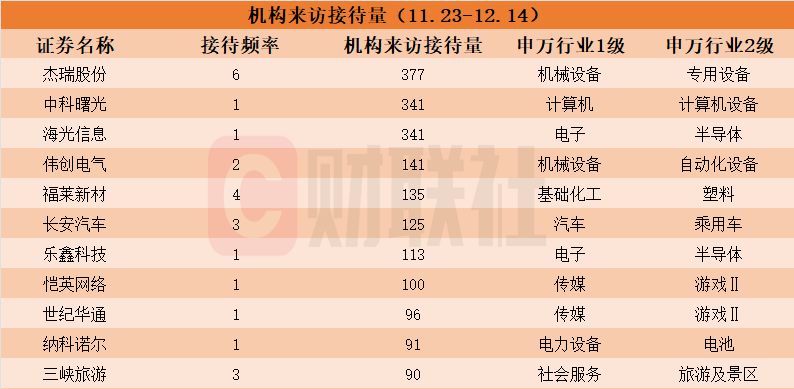
Group 1 - The article highlights that 11 listed companies, including Jie Rui Co., Zhongke Shuguang, and Haiguang Information, have received over 90 institutional visits in the past month, indicating strong investor interest [1] - Haiguang Information and Zhongke Shuguang both had 341 institutional visits, drawing attention due to the termination of their merger plan, yet they plan to maintain independent operations while collaborating on core areas [1][2] - Zhongke Shuguang focuses on CPU and DCU chips, establishing a leading position in domestic core chips, while Haiguang Information emphasizes integrated computing infrastructure and high-end chip design [2] Group 2 - Weichuang Electric, Fule New Materials, and Changan Automobile have also attracted significant institutional interest, with visit counts of 141, 135, and 125 respectively, all linked to their developments in robotics [1][2] - Weichuang Electric is advancing in the robotics field with a comprehensive layout, recently launching various new products including micro motors and intelligent components for mobile robots [3] - Fule New Materials has redefined TPU architecture for robotics, focusing on integrating computing capabilities into electronic skin, enhancing interaction and safety [4] Group 3 - Changan Automobile is strategically developing its robotics business with a "1+N+X" approach, focusing on humanoid robots and various applications across different scenarios [4] - The company aims to integrate the robotics industry supply chain, covering components, software services, and infrastructure, to enhance its smart mobility and automotive robotics offerings [4]
近一周逾260家公司获机构调研 中科曙光和海光信息获调研数最多
Zheng Quan Shi Bao Wang· 2025-12-13 23:49
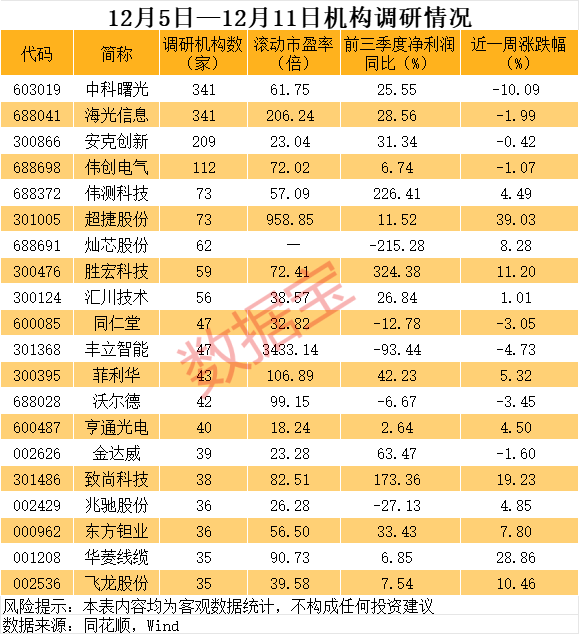
Core Insights - In the past week, over 260 stocks received institutional research, with Zhongke Shuguang and Haiguang Information being the most researched companies, each attracting 341 institutions [1][2] - Zhongke Shuguang stated that despite the termination of their restructuring, they will deepen collaboration with Haiguang while maintaining the independence of the listed company [1] - Haiguang Information focuses on CPU and DCU chips and has established a leading position in the domestic core chip market, while Zhongke Shuguang excels in areas such as networking, scheduling, software, computing power services, and storage [1] - The average stock price of companies under institutional research increased by nearly 1% in the past month, with several stocks like Chaojie Co., Hualevo, and others rising over 20% [1] Company Summaries - Zhongke Shuguang: - Number of institutions researching: 341 - Rolling P/E ratio: 61.75 - Q3 profit change: -10.09% [2] - Haiguang Information: - Number of institutions researching: 341 - Rolling P/E ratio: 206.24 - Q3 profit change: -1.99% [2] - Anker Innovation: - Number of institutions researching: 209 - Rolling P/E ratio: 23.04 - Q3 profit change: -0.42% [2] - Weichuang Electric: - Number of institutions researching: 112 - Rolling P/E ratio: 72.02 - Q3 profit change: -1.07% [2] - Chaojie Co.: - Number of institutions researching: 73 - Rolling P/E ratio: 958.85 - Q3 profit change: 39.03% [2]