
Sugon(603019)

Search documents
国产首次万卡超集群真机或即将亮相
Xin Lang Cai Jing· 2025-12-04 13:04
Core Viewpoint - The domestic large-scale intelligent computing supercluster system is set to debut at the HAIC 2025 conference from December 17 to 19, showcasing significant advancements in technology [1] Group 1: Product Launch - The large-scale intelligent computing supercluster system will be based on the Shuguang scaleX640 super-node technology [1] - This system's scale can be enhanced to a level of ten thousand cards, marking a potential first for the domestic intelligent computing supercluster systems [1]

抢抓AI存储上行机遇 上市公司募资扩产忙
Zheng Quan Ri Bao Zhi Sheng· 2025-12-03 13:40
Core Viewpoint - The AI storage market is experiencing significant growth, prompting companies to accelerate their investment and development efforts in high-end storage solutions to meet increasing demand driven by AI technologies [1][2]. Group 1: Company Developments - Jiangbolong plans to raise up to 3.7 billion yuan for R&D and industrialization of high-end storage solutions targeting the AI sector, semiconductor storage control chips, and high-end packaging and testing [1]. - Demingli aims to raise up to 3.2 billion yuan for expanding SSD and DRAM production, as well as establishing a smart storage management and R&D headquarters [2]. - Zhaoyi Innovation reported rapid market share gains for its DDR4 8Gb products and plans to mass-produce self-developed LPDDR4 series products next year [3]. Group 2: Market Trends - The demand for storage is being driven by the exponential growth of generative AI and large model technologies, leading to a significant increase in data processing needs [1]. - DRAM spot prices surged, with DDR5 chips increasing by 30% in one week due to tight supply and limited shipments from major module manufacturers [2]. - The storage industry is expected to enter a prolonged "super cycle" due to AI-driven supply shortages, with market demand continuing to rise [1][2]. Group 3: Industry Standards and Collaboration - The establishment of the Future Storage working group aims to develop AI storage standards and promote a technical framework for storage architecture and performance evaluation [3][4]. - The working group will focus on key technologies such as KV Cache optimization and storage acceleration for AI inference [3].
2026计算机年度策略:算力聚沙成塔,应用乘风而起
Shenwan Hongyuan Securities· 2025-12-03 11:05
Core Insights - The report emphasizes that computational power is accumulating, leading to significant advancements in applications, particularly in AI, with a projected 10% impact point approaching in 2026 [3] - Institutional holdings in the computer sector are at a historical low of 2.4%, indicating potential for growth in valuations [3][21] - The report identifies three key focus areas for 2026: large models, computational power, and applications, all showing significant changes and accelerated iterations [3] Group 1: Market Overview - The computer index has shown a year-to-date increase of 18%, ranking 12th among all sectors, with AI computing, embodied intelligence, and AI applications as the main themes [9][10] - The report notes a basic performance turning point, with net profit rebounding and a stable overall performance expected for 2025 [10][13] Group 2: Valuation and Holdings - The report indicates that the computer sector's valuation is at a historical mid-to-high level, with PE (TTM) at 85.4, PS (TTM) at 3.6, and PCF (TTM) at 46.6 [18] - The report highlights that the computer sector's fund allocation is at a historical low, with a 2.4% allocation in Q3 2025 [21] Group 3: AI Model Developments - The report discusses the rapid narrowing of the performance gap between Chinese and American large models, with significant advancements in commercial applications expected [3][26] - It highlights the emergence of various large models in 2025, focusing on monetization, AI programming, and multi-modal capabilities [26][29] Group 4: Key Companies and Trends - The report identifies key companies in the computer sector, such as Zhongke Shuguang and Inspur Information, which have seen significant increases in their market values due to rising domestic computational capacity [23] - The report notes that the demand for AI applications is driving growth in various sectors, with companies like Alibaba and ByteDance leading in AI-related job creation [40]




Web3.0概念下跌3.15%,7股主力资金净流出超亿元
Zheng Quan Shi Bao Wang· 2025-12-03 09:08
Group 1 - The Web3.0 concept has seen a decline of 3.15%, ranking among the top declines in concept sectors, with notable declines in companies such as Fushi Holdings, Rongji Software, and Xuan Ya International [1][2] - Among the Web3.0 sector, five stocks experienced price increases, with Jia Chuang Video, Guanxiang Technology, and Xiamen Xinda leading the gains at 6.23%, 4.71%, and 2.34% respectively [1][2] Group 2 - The Web3.0 sector experienced a net outflow of 3.468 billion yuan, with 55 stocks seeing net outflows, and seven stocks exceeding 100 million yuan in outflows, led by BlueFocus with a net outflow of 707 million yuan [2][3] - Other companies with significant net outflows include Rongji Software, Zhongke Shuguang, and Kunlun Wanwei, with net outflows of 454 million yuan, 293 million yuan, and 237 million yuan respectively [2][3] - Conversely, the stocks with the highest net inflows include Xiamen Xinda, Jia Chuang Video, and Quzhou Development, with net inflows of 72.86 million yuan, 57.14 million yuan, and 55.57 million yuan respectively [2][4]




中科曙光:曙光AI超集群系统等产品深度适配DeepSeek-V3.2
Zheng Quan Shi Bao Wang· 2025-12-02 10:28
Core Viewpoint - DeepSeek has officially released versions V3.2 and V3.2-Speciale, significantly enhancing its Agent capabilities and integrating reasoning and thinking [1] Group 1: Product Development - The new versions of DeepSeek are based on China's first AI computing open architecture, achieving "cross-layer collaboration" across hardware, software, and model layers [1] - The products, including the Shuguang AI supercluster system and scaleX640 super nodes, have completed deep adaptation and tuning for the new DeepSeek versions [1] Group 2: Market Application - The enhancements in DeepSeek support full-scale deployment for clients across various industries [1]
11月份银河创新成长混合基金跌6.7% 规模138.75亿元
Zhong Guo Jing Ji Wang· 2025-12-02 07:48
Group 1 - The core point of the news is the performance of the Galaxy Innovation Growth Mixed Fund A and C, which experienced declines in November 2025, with A falling by 6.71% and C by 6.75% [1][2] - As of the end of the third quarter of 2025, Galaxy Innovation Growth Mixed Fund A had a scale of 13.875 billion yuan [1] - The fund primarily invests in the semiconductor industry chain, with its top ten holdings including companies like SMIC, Zhaoyi Innovation, and Cambrian [1] Group 2 - Galaxy Innovation Mixed Fund C was established on November 22, 2021, and has a cumulative return of -0.23% as of December 1, 2025, due to its launch during a market peak [1] - The current fund manager, Zheng Weishan, has a background in investment and research, having worked at various financial institutions before joining Galaxy Fund Management in October 2018 [1]




世界物联网大会聚焦万物智联,数字经济规模迎来高增长,数字经济ETF(560800)盘中蓄势
Xin Lang Cai Jing· 2025-12-02 02:40
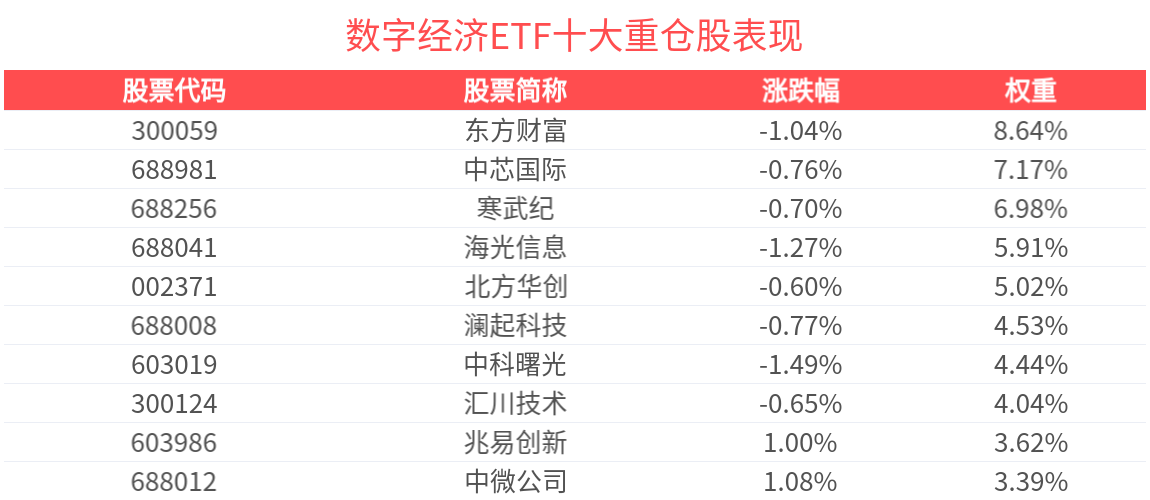
Core Insights - The digital economy theme index has seen a decline of 0.64% as of December 2, 2025, with specific stocks like Tuojing Technology leading gains while Nasta led losses [1] - The first Global Internet of Things Conference highlighted the rapid growth of the digital economy, projected to exceed $40 trillion this year, with a global IoT connection forecast to surpass 30 billion [2] - The digital economy ETF closely tracks the digital economy theme index, focusing on companies with high digitalization levels [3] Market Performance - The digital economy ETF (560800) experienced a turnover of 0.88% with a transaction volume of 5.6556 million yuan, and its scale increased by 9.5608 million yuan over the past week [1] - In the last 21 trading days, there were 11 days of net inflow totaling 14.7958 million yuan, indicating strong investor interest [1] Industry Trends - The digital economy is growing at an annual rate of 8%, with China's digital economy expected to exceed 80 trillion yuan, supported by over 1.2 million companies meeting advanced digital economy conditions [2] - The AI industry is showing robust growth, with a leading global AI company exceeding revenue expectations for Q3 and providing optimistic guidance for Q4, reflecting strong demand for AI computing power [2] Key Stocks - The top ten weighted stocks in the digital economy theme index account for 54.6% of the index, with companies like Dongfang Wealth, Cambricon, and SMIC among the leaders [3][4]




12月1日财经新闻综述:政策精准发力 市场暖意渐浓
Sou Hu Cai Jing· 2025-12-02 02:17
Macro Policy - The People's Bank of China, along with financial regulatory authorities, has introduced a new customer due diligence regulation that will take effect on January 1, 2026, which simplifies the audit process for ordinary customers while enhancing due diligence for large, unusual transactions [4] - The central bank has included stablecoins in the regulatory framework for virtual currencies, emphasizing the need to combat illegal financial activities and maintain market order [4] Capital Market - On December 1, the A-share market showed a broad upward trend, with the Shanghai Composite Index rising by 0.65% to 3914.01 points, and the Shenzhen Component Index increasing by 1.25% to 13146.72 points [5] - The market saw significant trading activity, with a total turnover of 1.87 trillion yuan, an increase of 288.1 billion yuan from the previous trading day, and nearly 3400 stocks recorded gains [5] - The telecommunications, electronics, and non-ferrous metals sectors attracted substantial capital inflows, with the telecommunications sector leading with a net inflow of 5.559 billion yuan [5][6] Industry Dynamics - The establishment of a dedicated Commercial Space Administration marks a significant regulatory and supportive phase for China's commercial space industry, leading to stock surges in related companies [7] - The Ministry of Industry and Information Technology is set to introduce targeted policies to address irrational competition in the power and energy storage battery sectors, promoting high-quality industry development [7] - The global shortage of storage chips is expected to lead to a 50% price increase by the second quarter of 2026, presenting opportunities for domestic industry players [7] International Linkage - Speculation regarding a change in leadership at the Federal Reserve has led to fluctuations in global asset prices, with rising expectations for interest rate cuts boosting gold and silver prices [8] - The easing of geopolitical risks following recent negotiations between the U.S. and Ukraine has provided a respite for global capital markets [8] - Analysts maintain an optimistic outlook for the A-share market in December, anticipating upward trends supported by improved fundamentals and liquidity [8]




海内外利好密集来袭,AI算力链迎四大增量,云计算ETF(159890)涨1.85%
Sou Hu Cai Jing· 2025-12-02 01:13
Core Insights - The article highlights the strong performance of sectors such as consumer electronics, components, and communication devices, with a focus on AI infrastructure and applications driving growth in cloud computing ETFs [1] Group 1: AI Computing Developments - Google's TPU has introduced a new direction for AI computing with its OCS next-generation optical interconnect solution, designed specifically for accelerating AI and machine learning tasks, marking it as a significant support following GPUs [6] - Alibaba has raised its AI investment guidance, confirming a potential increase in capital expenditures to 380 billion yuan over the next three years, with cloud business growth reported at 34% [7] - Beijing has launched a "space computing" plan to build large-scale data centers in low Earth orbit, aiming to transfer substantial AI computing power to space [8][9] Group 2: Market Growth Projections - According to the China Academy of Information and Communications Technology, the global computing power scale is projected to grow to over 16 ZFLOPS by 2030, with a compound annual growth rate exceeding 50% [3] - The global cloud computing market is expected to reach $692.9 billion in 2024, reflecting a year-on-year growth of 20.3%, while China's cloud computing market is anticipated to grow to 828.8 billion yuan, a 34.4% increase [3] - The cloud computing ETF (159890) tracks the CSI Cloud Computing and Big Data Theme Index, which includes leading companies in optical modules, electronic terminals, and software development [3][13] Group 3: Investment Opportunities - The investment landscape for computing power is evolving, with new stock offerings from companies like Moore Threads and Muxi indicating a potential shift in the investment paradigm [2] - The demand for AI computing infrastructure is expected to remain robust, with significant opportunities in the supply chain for optical modules and related technologies [18][19]



12月指数定期调样的影响估算




HTSC· 2025-12-01 12:34
Quantitative Models and Construction Methods 1. Model Name: Liquidity Impact Coefficient Model - **Model Construction Idea**: This model measures the liquidity impact of index adjustments on individual stocks by calculating the ratio of net fund flows to the stock's recent average daily trading volume[12][13] - **Model Construction Process**: The liquidity impact coefficient for a stock is calculated as follows: $$ impact_{i} = \sum_{k=1}^{N} \frac{\Delta weight_{k,i} \times AUM_{k}}{amt\_avg_{i,20}} $$ - \( \Delta weight_{k,i} \): Estimated weight change of stock \( i \) in index \( k \) - \( AUM_{k} \): Total assets under management of passive products tracking index \( k \) as of the end of November - \( amt\_avg_{i,20} \): Average daily trading volume of stock \( i \) over the past 20 trading days as of the end of November[12][13] - **Model Evaluation**: The model provides a quantitative framework to estimate short-term liquidity shocks caused by index adjustments, but it is subject to data discrepancies and assumptions, which may lead to deviations from actual results[13] --- Model Backtesting Results Liquidity Impact Coefficient Model - **Top 5 Stocks with Highest Positive Impact Coefficients**: - Zhangjiagang Bank (002839 CH): 11.55[15] - Jiangzhong Pharmaceutical (600750 CH): 11.44[15] - Tower Group (002233 CH): 11.04[15] - Jichuan Pharmaceutical (600566 CH): 10.14[15] - Zhengbang Technology (002157 CH): 9.99[15] - **Top 5 Stocks with Highest Negative Impact Coefficients**: - Shenzhen Expressway (600548 CH): -24.95[16] - Vanward Electric (002543 CH): -20.90[16] - Aviation Materials (688563 CH): -14.06[16] - Huaxi Biology (688363 CH): -10.81[16] - Ninghu Expressway (600377 CH): -10.54[16] --- Quantitative Factors and Construction Methods 1. Factor Name: Net Fund Flow Factor - **Factor Construction Idea**: This factor estimates the net fund inflow or outflow for stocks due to index adjustments, based on changes in index weights and the total AUM of passive products tracking the index[9][10] - **Factor Construction Process**: - Outflow Amount: Total AUM of linked products multiplied by the stock's actual weight in the index as of the end of November - Inflow Amount: Total AUM of linked products multiplied by the estimated weight of the stock in the index post-adjustment - Weight estimation is based on free-float market capitalization and index-specific weighting rules, such as dividend yield weighting or market capitalization weighting[9][10] - **Factor Evaluation**: The factor provides a transparent and systematic approach to estimate fund flows, but it is sensitive to assumptions about future index weights and AUM changes[9][10] --- Factor Backtesting Results Net Fund Flow Factor - **Top 5 Stocks with Highest Net Fund Inflows**: - Victory Precision (300476 CH): 112.61 billion CNY[10] - Dongshan Precision (002384 CH): 99.32 billion CNY[10] - Guangqi Technology (002625 CH): 77.81 billion CNY[10] - Sugon Information (603019 CH): 65.44 billion CNY[10] - Top Group (601689 CH): 53.07 billion CNY[10] - **Top 5 Stocks with Highest Net Fund Outflows**: - China Mobile (600941 CH): -40.02 billion CNY[11] - CRRC Corporation (601766 CH): -36.40 billion CNY[11] - Aluminum Corporation of China (601600 CH): -34.29 billion CNY[11] - TCL Zhonghuan (002129 CH): -30.07 billion CNY[11] - Huagong Tech (000988 CH): -27.44 billion CNY[11]