
Nanhua Futures(603093)

Search documents
南华期货生猪企业风险管理日报-20250815
Nan Hua Qi Huo· 2025-08-15 04:59
1. Report Industry Investment Rating - No relevant content provided 2. Core Viewpoints of the Report - Policy disturbances may affect the future supply of live pigs. Although the fundamentals are still in a situation of oversupply, the policy expectations provide an opportunity for arbitrage to hedge risks [3] - There are both positive and negative factors in the live pig market. Positive factors include improved macro - sentiment, a high standard - fat price difference, and medium - to - long - term policy - driven capacity reduction expectations. Negative factors include a high inventory of sow stocks, high inventory of large - scale enterprises, high slaughter volume with losses in slaughter profits, and weak downstream consumption [4][5] 3. Summary by Relevant Catalogs 3.1 Pig Price Forecast and Risk Management - The strong support level for the main contract price is 13,400, with a current volatility (20 - day rolling) of 10.94% and a current volatility historical percentile (3 - year) of 0.75% [2] - For inventory management when product inventory is high, strategies include shorting live pig futures (LH2511, sell 20%), selling call options (20%), and buying out - of - the - money put options [2] - For procurement management when there are future procurement plans, strategies include buying live pig forward contracts according to the procurement plan, selling put options according to the procurement plan, and buying out - of - the - money call options [2] 3.2 Pig Spot and Futures Prices - Spot prices vary by region. The national average is 13.72 yuan/kg, with a daily increase of 0.02 yuan and a growth rate of 0.15%. Prices in different regions show different changes [8] - Futures prices of different contracts (pig 01, 03, 05, 07, 09, 11) remain unchanged on the day [9] 3.3 Pig Price Spreads and Basis - Different contract spreads and basis show various changes, such as LH01 - 03 with a spread of 835 yuan, a decrease of 65 yuan, and a decline rate of 7.22% [17] - Seasonal charts of basis and spreads for different contracts are provided, including pig 01, 03, 05, 07, 09, 11 contracts [10][16][19] 3.4 Dalian Commodity Exchange Pig Warehouse Receipt Inventory - Seasonal data of Dalian Commodity Exchange pig warehouse receipt inventory is presented [27]

南华期货锡风险管理日报-20250815
Nan Hua Qi Huo· 2025-08-15 04:54
Report Summary 1. Investment Rating No investment rating for the industry is provided in the report. 2. Core View - Tin prices declined slightly on Thursday, fluctuating with the non - ferrous metals sector. Recently, the macro - environment has limited impact on tin prices. The repeated delay of the full resumption of tin mines in Myanmar has significantly supported tin prices and may have a continuous impact. According to Alphamin's financial report, the production cut at the Bisie tin mine has exceeded expectations, pushing up short - term tin prices. There has been no significant change in demand [3]. 3. Summary by Relevant Content 3.1 Price and Volatility - The latest closing price of tin is 267,420 yuan/ton, with a monthly price range forecast of 245,000 - 263,000 yuan/ton. The current volatility is 14.36%, and the historical percentile of the current volatility is 26.1% [2]. - In the tin futures market, the latest prices of沪锡主力,沪锡连一 are 267,420 yuan/ton,沪锡连三 is 267,820 yuan/ton,伦锡3M is 33,435 dollars/ton (down 0.79% daily), and the沪伦比 is 8.02 (up 0.12% daily) [6]. 3.2 Risk Management Recommendations - **Inventory Management**: For high finished - product inventory and fear of price drops, it is recommended to sell 75% of the main Shanghai tin futures contracts at around 275,000 yuan/ton and sell 25% of the SN2510C275000 call options when volatility is appropriate [2]. - **Raw Material Management**: For low raw - material inventory and fear of price increases, it is recommended to buy 50% of the main Shanghai tin futures contracts at around 230,000 yuan/ton and sell 25% of the SN2510P245000 put options when volatility is appropriate [2]. 3.3 Factors Affecting Prices - **Likely Positive Factors**: Sino - US tariff policy easing, the semiconductor sector remaining in the expansion cycle, and the resumption of production in Myanmar falling short of expectations [7]. - **Likely Negative Factors**: Repeated tariff policies, the inflow of Burmese tin ore into China, and the slowdown of the semiconductor sector's expansion and its transition from an expansion cycle to a contraction cycle [5]. 3.4 Spot and Inventory Data - **Spot Data**: The latest price of Shanghai Non - Ferrous tin ingots is 269,500 yuan/ton (up 0.86% weekly), 1 tin premium is 300 yuan/ton (down 25% weekly), 40% tin concentrate is 257,500 yuan/ton (up 0.9% weekly), 60% tin concentrate is 261,500 yuan/ton (up 0.89% weekly), etc. [12]. - **Inventory Data**: The total warehouse receipts of tin in the Shanghai Futures Exchange are 7,422 tons (down 0.11% daily), in Guangdong are 4,881 tons (down 0.49% daily), in Shanghai are 1,670 tons (up 0.97% daily), and the total LME tin inventory is 1,780 tons (up 0.85% daily) [20].
南华煤焦产业风险管理日报-20250814
Nan Hua Qi Huo· 2025-08-14 11:08
Group 1: Report Industry Investment Rating - No relevant content found Group 2: Core Viewpoints of the Report - The mid - to long - term trend of coking coal and coke is not pessimistic, but there is a certain callback pressure on the black futures market in the short term. Attention should be paid to macro - risk events at home and abroad such as parade production restrictions, Fed rate - cut games, and the Fourth Plenary Session [4] Group 3: Summary by Related Catalogs 3.1 Double - Coking Price Range Forecast - The predicted monthly price range for coking coal is 1100 - 1500, with a current 20 - day rolling volatility of 32.68% and a historical percentile of 63.87%. For coke, the predicted monthly price range is 1600 - 1950, with a current 20 - day rolling volatility of 25.37% and a historical percentile of 49.13% [3] 3.2 Double - Coking Risk Management Strategy Suggestions - For raw material procurement, when coking enterprises have a coking coal replenishment plan but haven't determined the purchase price and are worried about price increases affecting profits, it is recommended to go long on the coking coal 2601 contract JM2601 at an entry range of (1150, 1200) [3] 3.3 Black Warehouse Receipt Daily Report - On August 14, 2025, compared with August 13, 2025, the warehouse receipts of rebar increased by 2382 tons, hot - rolled coil remained unchanged at 78386 tons, iron ore decreased by 200 lots, coking coal remained unchanged at 800 lots, coke increased by 20 lots, ferrosilicon increased by 373 sheets, and silicomanganese decreased by 87 sheets [3] 3.4 Core Contradictions - Supply - side disturbances such as over - production inspections in Shanxi coal mines and the "276 - working - day" policy have emerged. The resumption of production in coal mines has slowed down, and "anti - involution" in the coal industry will be the trading focus in the third quarter. There are also disturbances in Mongolian coal imports, strengthening the expectation of reduced coking coal supply. In the off - season, macro factors have a greater impact on the futures market. The trading focus of far - month contracts lies in unfalsifiable policy expectations, and "anti - involution" may be hyped repeatedly. Steel mill profits are still resilient, but attention should be paid to the impact of Dalian Commodity Exchange's position limits on the over - heated sentiment in the coking coal and coke market [4] 3.5 Bullish Interpretations - There is room for policy expectation games before the Fourth Plenary Session in October [4] 3.6 Bearish Interpretations - The expectation of "anti - involution" in coal mines remains, and the production increase space for mines in the second half of the year may be limited. The downstream steel mills have good profits, and the procurement demand for coking coal and coke is rigid. However, the import profit of overseas coal has recovered, and there will be pressure on future arrivals. The apparent demand for rebar is lower than expected, and there is pressure on the actual end of finished products. The Dalian Commodity Exchange has imposed position limits on the main coking coal contract, which is expected to reduce the speculation degree of coking coal [6] 3.7 Coking Coal and Coke Futures Prices - On August 14, 2025, compared with August 13, 2025, the basis of coking coal and coke contracts, the spread between different contracts, and indicators such as coking profit, ore - coke ratio, screw - coke ratio, and carbon - coal ratio have all changed to varying degrees [7] 3.8 Coking Coal and Coke Spot Prices - On August 14, 2025, compared with August 13, 2025, the spot prices of coking coal and coke in different regions and varieties remained mostly unchanged, with only slight changes in some prices. The import and export profits of coking coal and coke also changed, and the ratio of coking coal to thermal coal decreased [8][9]
集装箱运输市场日报:期价相对维稳-20250814
Nan Hua Qi Huo· 2025-08-14 10:18
1. Report Industry Investment Rating No relevant content provided. 2. Core View of the Report - Today, the prices of all monthly contracts of the Container Shipping Index (European Line) futures continued to fluctuate. Except for a slight decline in the EC2510 contract, the prices of the remaining monthly contracts slightly rebounded. After consecutive declines, most contracts have reached short - term lows, some short - sellers took profits and left the market, and the market trading sentiment was relatively calm, so the futures prices rebounded today. For the future, the current futures prices are gradually approaching the spot cabin quotation level, and it is expected that the EC will likely continue to fluctuate. In the medium term, without sudden event factors, based on fundamental considerations, the overall futures price trend may still decline slightly [1]. 3. Summary by Relevant Catalogs 3.1 EC Risk Management Strategy Recommendations - **Position Management**: For those who have already obtained positions but have full capacity or poor booking volume and are worried about the decline in freight rates, they can short the container shipping index futures according to the company's positions to lock in profits. The recommended hedging tool is EC2510, with a selling direction and an entry range of 1450 - 1550 [1]. - **Cost Management**: When the shipping company's blank - sailing intensity increases or the market peak season is approaching, and one hopes to book cabins according to the order situation, they can buy the container shipping index futures at present to prevent the increase in transportation costs due to the rise in freight rates and determine the cabin - booking cost in advance. The recommended hedging tool is EC2510, with a buying direction and an entry range of 1200 - 1300 [1]. 3.2 Market News and Influencing Factors - **Positive Factors**: Israeli Prime Minister Benjamin Netanyahu's statement about expanding Israel's boundaries has caused controversy and anger in Arab countries, which may potentially affect the shipping market [2]. - **Negative Factors**: Evergreen continues to lower the spot cabin quotation for the European Line, and the SCFIS European Line continues to decline with an enlarged decline [3]. 3.3 EC Data - **EC Basis Daily Changes**: On August 14, 2025, the basis of EC2508 was 151.58 points, with a daily decline of 0.90 points and a weekly decline of 73.58 points; the basis of EC2510 was 875.98 points, with a daily decline of 26.40 points and a weekly decline of 1.48 points; etc. [4]. - **EC Prices and Spreads**: On August 14, 2025, the closing price of EC2508 was 2083.9 points, with a daily increase of 0.04% and a weekly increase of 0.54%; the closing price of EC2510 was 1359.5 points, with a daily increase of 1.98% and a weekly decline of 4.29%; etc. [4]. 3.4 Spot Cabin Quotations - On August 28, for Maersk's Shanghai - Rotterdam shipping schedule, the total quote for 20GP was $1390, an increase of $5 compared to the previous period, and the total quote for 40GP was $2340, an increase of $10 compared to the previous period. At the end of August, for Evergreen's Shanghai - Rotterdam shipping schedule, the opening quote for 20GP was $1955, a decrease of $100 compared to the previous period, and the total quote for 40GP was $2960, a decrease of $200 compared to the previous period [6]. 3.5 Global Freight Rate Indexes - On August 14, 2025, the latest value of SCFIS for the European Line was 2235.48 points, a decrease of 62.38 points or 2.71% compared to the previous value; the latest value of SCFIS for the US West Line was 1082.14 points, a decrease of 47.98 points or 4.25% compared to the previous value; etc. [7]. 3.6 Global Major Port Waiting Times - On August 13, 2025, the waiting time at Hong Kong Port was 0.486 days, an increase of 0.146 days compared to the previous day; the waiting time at Shanghai Port was 1.386 days, a decrease of 0.137 days compared to the previous day; etc. [14]. 3.7 Ship Speed and Number of Container Ships Waiting at Suez Canal Port Anchorage - On August 13, 2025, the speed of 8000 + container ships was 15.952 knots, a decrease of 0.016 knots compared to the previous day; the speed of 3000 + container ships was 15.031 knots, an increase of 0.209 knots compared to the previous day; the number of ships waiting at the Suez Canal port anchorage was 8, a decrease of 1 compared to the previous day [23].
南华商品指数:贵金属板块上涨,黑色板块领跌
Nan Hua Qi Huo· 2025-08-14 10:18
Report Information - Report Name: Nanhua Commodity Index Daily Report [2] - Date: August 14, 2025 [2] - Author: Nanhua Index Group, including Cao Yanghui, Zhao Bo, and Wang Yilin [2] Investment Rating - No investment rating information is provided in the report. Core View - According to the closing prices of adjacent trading days, the Nanhua Composite Index declined by -0.81% today. Among the sector indices, only the Nanhua Precious Metals Index rose by 0.02%, while the rest of the sectors declined. The sector with the largest decline was the Nanhua Black Index, down -1.56%, and the sector with the smallest decline was the Nanhua Non-Ferrous Metals Index, down -0.63%. All theme indices declined, with the Black Raw Materials Index having the largest decline of -1.99% and the Economic Crops Index having the smallest decline of -0.04%. Among the single-variety indices of commodity futures, the caustic soda index had the largest increase of 1.26%, and the rapeseed meal index had the largest decline of -3.05% [1][3][4]. Index Performance Summary Composite and Sector Indices - Nanhua Composite Index (NHCI): Closed at 2534.95, down -0.81% from the previous close of 2555.72, with an annualized return of 0.35% and an annualized volatility of 13.73% [3]. - Nanhua Precious Metals Index (NHPMI): Closed at 1261.11, up 0.02% from 1260.91, with an annualized return of 29.51% and an annualized volatility of 16.60% [3]. - Nanhua Industrial Products Index (NHII): Closed at 3650.38, down -0.89% from 3683.10, with an annualized return of -6.10% and an annualized volatility of 16.15% [3]. - Nanhua Metal Index (NHMI): Closed at 6464.57, down -1.02% from 6531.47, with an annualized return of 1.60% and an annualized volatility of 14.94% [3]. - Nanhua Energy and Chemical Index (NHECI): Closed at 1681.16, down -0.70% from 1693.04, with an annualized return of -12.75% and an annualized volatility of 18.40% [3]. - Nanhua Non-Ferrous Metals Index (NHNF): Closed at 1713.87, down -0.63% from 1724.76, with an annualized return of 5.63% and an annualized volatility of 13.41% [3]. - Nanhua Black Index (NHFI): Closed at 2582.71, down -1.56% from 2623.70, with an annualized return of -8.58% and an annualized volatility of 21.92% [3]. - Nanhua Agricultural Products Index (NHAI): Closed at 1113.19, down -0.86% from 1122.89, with an annualized return of 5.55% and an annualized volatility of 9.53% [3]. - Nanhua Mini Composite Index (NHCIMi): Closed at 1191.43, down -0.91% from 1202.38, with an annualized return of 3.23% and an annualized volatility of 14.63% [3]. - Nanhua Energy Index (NHEI): Closed at 1058.07, down -1.05% from 1069.32, with an annualized return of 2.54% and an annualized volatility of 29.87% [3]. - Nanhua Petrochemical Index (NHPCI): Closed at 945.19, down -0.85% from 953.29, with an annualized return of 0.75% and an annualized volatility of 15.28% [3]. - Nanhua Coal Chemical Index (NHCCI): Closed at 1036.33, down -1.00% from 1046.83, with an annualized return of 1.17% and an annualized volatility of 17.17% [3]. - Nanhua Black Raw Materials Index (NHFM): Closed at 1067.01, down -1.99% from 1088.67, with an annualized return of 7.32% and an annualized volatility of 23.31% [3]. - Nanhua Building Materials Index (NHBMI): Closed at 763.35, down -0.72% from 768.87, with an annualized return of 3.25% and an annualized volatility of 23.12% [3]. - Nanhua Oilseeds and Oils Index (NHOOI): Closed at 1287.05, down -1.18% from 1302.40, with an annualized return of 3.74% and an annualized volatility of 10.27% [3]. - Nanhua Economic Crops Index (NHAECI): Closed at 910.15, down -0.04% from 910.49, with an annualized return of 1.89% and an annualized volatility of 5.65% [3]. Theme Indices - All theme indices declined, with the Black Raw Materials Index having the largest decline of -1.99% and the Economic Crops Index having the smallest decline of -0.04% [4] Single-Variety Indices - The caustic soda index had the largest increase of 1.26%, and the rapeseed meal index had the largest decline of -3.05% [1][4] Contribution to Index Movements - For the Nanhua Composite Index, positive contributors included soda ash (4.15%), while negative contributors included zinc (-1.52%), aluminum (-1.80%), and PVC (-1.98%) [8] - For the Nanhua Mini Composite Index, positive contributors included soda ash (7.44%), while negative contributors included zinc (-32.55%), aluminum (-1.80%), and PVC (-1.98%) [8] - For the Nanhua Industrial Products Index, positive contributors included soda ash (4.69%), while negative contributors included iron ore (-1.68%), crude oil (-1.61%), and zinc (-1.67%) [8] - For the Nanhua Metal Index, positive contributors included caustic soda (2.54%), while negative contributors included tin (-6.52%), aluminum (-3.51%), and zinc (-3.51%) [8] - For the Nanhua Energy and Chemical Index, positive contributors included soda ash (7.47%), while negative contributors included crude oil (-16.62%), iron ore (-19.37%), and PVC (-9.11%) [8] - For the Nanhua Agricultural Products Index, positive contributors included cotton (1.45%), while negative contributors included rapeseed meal (-17.58%), palm oil (-22.79%), and soybean meal (-14.26%) [8] Other Information - The calculation of price changes is (today's closing price - yesterday's closing price) / yesterday's closing price, and the contribution is the product of price change and weight [11] - The Nanhua Commodity Index excludes the price difference when changing commodity contracts, reflecting the real return of investing in commodity futures [11] - The contribution calculation method used is: a variety's daily price change / ∑|all varieties' daily price changes|, with yellow data bars indicating a daily increase and blue data bars indicating a daily decrease [11]
南华原木产业风险管理日报-20250814
Nan Hua Qi Huo· 2025-08-14 10:17
南华原木产业风险管理日报 2025年8月14日 宋霁鹏(投资咨询证号:Z0016598 ) 投资咨询业务资格:证监许可【2011】1290号 原木价格区间预测 | | 价格区间预测(月度) | 当前波动率(20日滚动) | 当前波动率历史百分位(3年) | | --- | --- | --- | --- | | 原木 | 820-860 | 16.28% | 67.4% | source: 南华研究 原木套保策略表 | 行为导 | 情景分析 | 现货敞 | 策略推荐 | 套保工 | 买卖方 | 套保比例 | 建议入场 | | --- | --- | --- | --- | --- | --- | --- | --- | | 向 | | 口 | | 具 | 向 | (%) | 区间 | | 库存管 理 | 原木进口量偏高库存高位,担心价格 下跌 | 多 | 为了防止存货叠加损失,可以根据企业的库存情况,做空原木期货来锁定利润, 弥补企业的生产成本 | lg2509 卖出 | | 25% | 850-875 | | 采购管 | 采购常备库存偏低,希望根据订单情 | | 为了防止原木价格上涨而抬升采购成本,可以在目 ...
多元金融板块8月14日涨0.38%,南华期货领涨,主力资金净流入4912.39万元
Zheng Xing Xing Ye Ri Bao· 2025-08-14 08:32
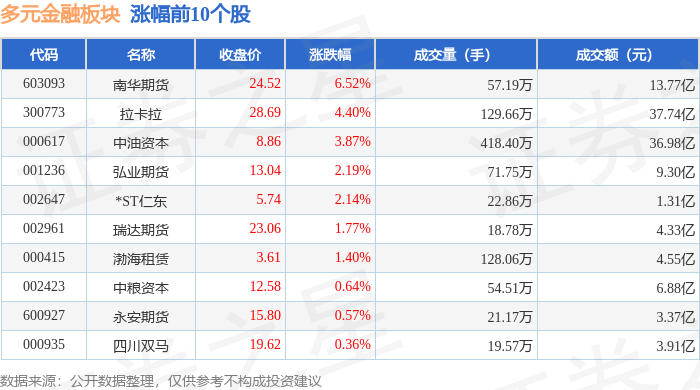
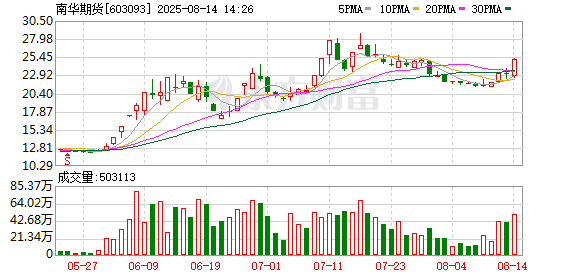
Group 1 - The diversified financial sector increased by 0.38% on August 14, with Nanhua Futures leading the gains [1] - The Shanghai Composite Index closed at 3666.44, down 0.46%, while the Shenzhen Component Index closed at 11451.43, down 0.87% [1] - Key stocks in the diversified financial sector showed varied performance, with Nanhua Futures rising by 6.52% to a closing price of 24.52 [1] Group 2 - Major stocks that declined included Jiuding Investment, which fell by 9.98% to a closing price of 19.48 [2] - The overall net capital flow in the diversified financial sector showed a net inflow of 49.12 million yuan from main funds, while retail investors contributed a net inflow of 15.2 million yuan [2] - The trading volume and turnover for various stocks in the sector varied significantly, with Lakala achieving a turnover of 3.774 billion yuan [1][2]





多元金融异动拉升 南华期货盘中一度涨停
Bei Ke Cai Jing· 2025-08-14 07:24
新京报贝壳财经讯 8月14日,多元金融异动拉升,南华期货盘中一度涨停,拉卡拉、中油资本、瑞达期 货、弘业期货、永安期货跟涨。 ...
多元金融异动拉升,南华期货涨停
Mei Ri Jing Ji Xin Wen· 2025-08-14 06:26
(文章来源:每日经济新闻) 每经AI快讯,8月14日,多元金融异动拉升,南华期货涨停,拉卡拉、中油资本、瑞达期货、弘业期 货、永安期货跟涨。 ...
机构行为精讲系列之三:低利率下基金资金运作及配债行为变化
Huachuang Securities· 2025-08-14 03:44
Report Industry Investment Rating No relevant content provided. Core Viewpoints of the Report - The research on the regulatory framework, fund operation, bond - allocation behavior, and the latest characteristics of the fund industry is crucial for analyzing the bond market trends. In a low - interest - rate environment, the impact of fund trading behavior on bond market assets is increasing. [8][10] - By examining the pricing power, seasonality, product innovation, and new trends of funds, investment opportunities and risks in the bond market can be identified. [9][10] Summary According to the Directory 1. Overview of Public Fund Bond Allocation - As of the end of 2024, the bond - allocation scale of public funds was 18.87 trillion, ranking second in the market, accounting for 10.7% of the 177 - trillion custody balance of the Chinese bond market. Since Q4 2023, the bond - allocation scale of bond funds has grown rapidly, with the growth rate reaching over 20%. In H1 2025, the growth rate returned below 10%. Bond - type funds prefer policy - financial bonds and general credit bonds. [2][16][18] 2. Overview of the Public Fund Market: Variety Classification and Institutional Framework Defined by Supervision (1) Public Fund Variety Classification: Divided by Investment Assets and Ratios - Public funds can be divided into stock funds, bond funds, money - market funds, fund - of - funds (FOF), and hybrid funds according to the investment assets and ratios. As of the end of 2024, fixed - income funds such as money - market funds and bond - type funds dominated, accounting for 75% of the total. [23][25] (2) Public Fund Regulatory Framework: Institutional System, Operational Norms, and Tax Regulations - **Public Funds**: Subject to multiple regulatory requirements from the new asset - management regulations, fund systems, and institutional reforms. The regulatory framework has been continuously updated since 1998, covering aspects such as investment scope, credit rating, leverage, duration, valuation methods, liquidity requirements, and investment concentration. [32][38] - **Money - Market Funds**: Have stricter regulatory requirements than general public funds in terms of leverage, duration, and liquidity. There are also special regulations for controlling scale, investment scope, and other aspects. There are also special types such as floating money - market funds and important money - market funds. [42][50] - **Tax Policy**: Public funds have advantages in value - added tax and enterprise income tax compared with institutional investors such as bank self - operations, which is an important reason for bank self - operations to invest indirectly. [56] 3. Public Fund Operation: How Products Operate from the Fund End to the Asset End (1) Fund Sources - Since 2017, public funds have entered a stage of rapid expansion. As of the end of 2024, fixed - income funds represented by bond funds and money funds dominated, accounting for nearly 75%. Bond funds are mainly for institutional investors, while money funds are for individual investors. [5] (2) Bond - Type Funds - In asset allocation, bond investment is the main focus, with policy - financial bonds and credit bonds having a relatively high proportion. The duration is mostly between 2 - 4 years, and the leverage ratio is between 110% - 130%. The risk - return characteristics of different types of bond funds vary. [5] (3) Money - Market Funds - In asset allocation, liquidity is the primary consideration, with inter - bank certificates of deposit, bank deposits, and repurchase transactions accounting for over 90%. The average remaining term is 70 - 85 days, and the leverage ratio is 105% - 110%. The deviation is controlled within 0.1%, and the yield is highly correlated with the fund interest rate. [5] 4. Impact of Fund Institutional Behavior on the Bond Market: Focus on Pricing Power, Seasonality, Product Innovation, and New Trends - **Pricing Power**: Funds have pricing power over most maturities of policy - financial bonds, long - term new Treasury bonds, and 1 - 3 - year credit bonds. [5][10] - **Seasonality**: Although public funds do not have obvious seasonal characteristics in bond - allocation behavior, there have been significant peaks in bond allocation in Q2 and year - end front - running in the past two years. [6][10] - **Product Innovation**: New products in the fund industry can reshape market capital flows and investment structures, bringing structural market conditions. [9][10] - **New Trends**: In a low - interest - rate environment, funds tend to increase duration and focus on trading. With the trend of public fund fee reduction, low - fee index products may see accelerated development. [10]