
SWHY(000166)

Search documents
券商开年密集发债,重资本业务扩张需求激增
Zhong Guo Ji Jin Bao· 2026-01-18 12:35
Group 1 - The core viewpoint of the article highlights a significant surge in bond issuance by securities firms at the beginning of 2026, driven by a strong A-share market and an increase in capital demand, with a total issuance of 119.52 billion yuan, representing a year-on-year growth of 71.87% [1][2] - The bond issuance is characterized by diversification, with both traditional leading firms like China Galaxy and internet brokers like East Money participating, and various types of products being issued, including conventional corporate bonds and perpetual subordinated bonds [2][3] - The bond issuance trend is a continuation from 2025, where the total issuance exceeded 1.89 trillion yuan, with both the number and scale of bonds issued showing over 44% year-on-year growth [3] Group 2 - The increase in bond issuance is attributed to a combination of business transformation, policy guidance, and a low-cost environment, with firms transitioning from traditional channel businesses to capital-intensive models [4][5] - The active A-share market has led to a growing demand for capital-intensive business expansion, prompting firms to leverage debt financing to seize profit opportunities [4][6] - The current low interest rate environment has made bond issuance an attractive option for firms to refinance high-interest debt and optimize financial structures, thereby enhancing profit margins for future business expansion [4][6] Group 3 - The regulatory environment has positively influenced the expansion of financing channels, with securities firms being included in the issuance of technology innovation bonds, aligning fundraising with national strategic goals [5][6] - The bond issuance trend is expected to continue in the short to medium term, as long as market activity remains robust, sustaining the demand for capital [6][7] - The competitive landscape is shifting towards a "stronger gets stronger" dynamic, where leading firms are better positioned to capitalize on low-cost debt financing, potentially widening the gap between them and smaller firms [7][8]





申万宏源:真正将“行稳致远”纳入思考框架
Xin Lang Cai Jing· 2026-01-18 09:25
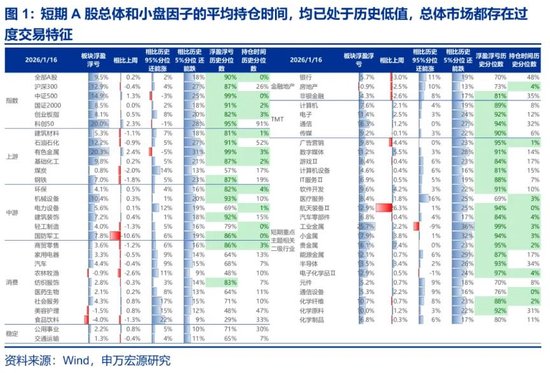
Group 1 - The 2026 market opening shows a clear characteristic of increased risk appetite driven by inflow of incremental funds, with commercial aerospace and AI application industries trending upwards [1][16] - The current market is experiencing strong momentum and excessive trading, which may lead to a short-term consolidation phase [1][16] - The average holding period for defense and military stocks is significantly lower than historical lows, indicating a decrease in stability for short-term momentum trades [1][19] Group 2 - The opening market is viewed as an extension of the strong structural technology market from 2025, which is now entering a high valuation adjustment phase [2][17] - Since September 2025, several high-momentum industries have entered a high-level consolidation phase, with notable examples including Nvidia's computing chain and Google's computing chain [2][17] - The market is expected to shift towards a consolidation phase after rapid valuation increases in new technology directions [2][17] Group 3 - The policy direction emphasizes a stable and long-term approach to avoid past investment pitfalls, such as the "deposit migration" of 2007 and the excessive trading of 2015 [10][26] - The A-share market has a mid-term upward basis, suggesting that a stable approach can balance short-term volatility with long-term goals [10][26] - The current market dynamics indicate a potential reduction in overall profit effects, with a need to wait for further economic and policy catalysts [10][28] Group 4 - The mid-term outlook for the A-share market suggests two phases of upward movement, with the first phase being driven by strong structural technology trends and the second phase potentially benefiting from cyclical improvements and increased asset allocation towards equities [12][28] - The characteristics of the two upward phases are interconnected, with the first phase led by cyclical alpha and AI computing, while the second phase may see a transition towards application-level AI trends [12][28]

资本补充与业务扩张双线发力 券商开年发债规模同比增长超七成
Shang Hai Zheng Quan Bao· 2026-01-16 18:34
Group 1 - The core viewpoint of the articles highlights a significant increase in bond issuance by securities firms at the beginning of 2026, with a total issuance exceeding 119.8 billion yuan, representing a year-on-year growth of over 73% [1][2][4] - A total of 27 securities firms have issued 44 bonds as of January 16, 2026, with leading firms like Huatai Securities, Guotai Junan, and China Galaxy Securities showing notable issuance volumes of 17.5 billion yuan, 14.8 billion yuan, and 14 billion yuan respectively [2][3] - The bond issuance is driven by a combination of business expansion, rising funding needs, and a low-interest-rate environment, allowing firms to actively position for future growth and structural adjustments [1][4][5] Group 2 - The current bond issuance structure indicates a clear strategic direction, with 12 short-term financing bonds, 27 corporate bonds, and 3 subordinated bonds issued, primarily aimed at supplementing working capital and repaying maturing debts [2][3] - Some firms are also utilizing international financing channels to increase capital for overseas subsidiaries, as seen with GF Securities planning to raise over 6 billion HKD through H-share placements and convertible bonds [3] - The favorable market conditions, including a strong performance in the capital market and low interest rates, have created an attractive environment for bond issuance, allowing firms to optimize their debt structure through refinancing [4][5]



2025年12月份证券类App月活达1.75亿 创当年单月新高
Zheng Quan Ri Bao· 2026-01-16 16:49
Core Insights - The brokerage apps have become an important window for observing the comprehensive strength and service innovation trends of various brokerages, with active users reaching 175 million in December 2025, marking a 1.75% month-on-month increase and a 2.26% year-on-year increase, setting a new monthly record for 2025 [1] Group 1: User Engagement and Competition - Two brokerage apps, Huatai Securities' "Zhangle Wealth" and Guotai Junan's "Guotai Junan Junhong," lead the monthly active user rankings with 12.12 million and 10.40 million users respectively, showing month-on-month growth of 2.59% and 2.12% [2] - Other major brokerage apps also demonstrated high user engagement, with Ping An Securities' app reaching 8.88 million active users (up 2.06%), and several others exceeding 7 million [2] - The brokerage app with the highest month-on-month growth was "Zhangshan Securities," which saw a 2.99% increase, reaching 7.30 million active users [2] Group 2: Year-on-Year Growth - The brokerage app with the most significant year-on-year growth was "Xingye Securities Youlibao," which achieved a 20.66% increase, reaching 1.87 million active users in December [3] - Other apps like "Changjiang e-Number" and "Zhangle Wealth" also experienced steady growth, with year-on-year increases exceeding 5% [3] Group 3: Wealth Management Transformation - In December 2025, the Shanghai Composite Index rose by 2.06%, prompting brokerages to enhance their apps by refining advisory services and adding smart trading tools and insurance sections to meet diverse investment needs [4] - Optimizing advisory services has become a key focus for brokerage app upgrades, with companies like Guosen Securities launching new advisory service sections and products tailored to different customer segments [4] - The introduction of insurance sections in brokerage apps has emerged as a highlight, with Ping An Securities and other firms offering various insurance products and educational content to users [4] Group 4: Industry Trends and Future Directions - Analysts indicate that in the context of declining commission rates, the transformation towards wealth management is essential for brokerages to overcome development bottlenecks, evolving from mere securities brokerage to comprehensive wealth management institutions [5] - The inclusion of insurance products can enhance the stability and risk resistance of customer asset portfolios, allowing brokerages to provide more precise and comprehensive services throughout the customer lifecycle [6]



沪深两市单日成交额近4万亿 机构看好中资券商配置机会(附概念股)
Zhi Tong Cai Jing· 2026-01-16 12:46
Group 1 - The core viewpoint of the news is the adjustment of the minimum margin requirement for margin trading in the Shanghai and Shenzhen stock exchanges, increasing it from 80% to 100% for new margin contracts, which reflects a regulatory approach to stabilize the market and manage leverage [2][3] - The adjustment is expected to lead to a slowdown in the growth of margin financing in the short term, but it will create a more stable overall business environment for the securities industry [3] - The securities sector is anticipated to benefit from the migration of household deposits and the reconstruction of the stock market mechanism, which will support the growth of wealth management, investment banking, and institutional business [2][3] Group 2 - The adjustment of the margin requirement is seen as a measure to guide the market towards a healthier and more sustainable medium to long-term trend, similar to adjustments made in 2015 [2] - Companies in the securities industry, particularly those with strong capital and risk management capabilities, are recommended for investment opportunities [3] - The news highlights several Chinese securities firms listed in Hong Kong, including Huatai Securities, GF Securities, and China Galaxy, among others, indicating a broad interest in the sector [4]


申万宏源傅静涛:业绩改善确定性增强,中游制造或率先走出通缩
Xin Lang Cai Jing· 2026-01-16 08:31
Core Viewpoint - The current market shows skepticism regarding the macroeconomic improvement and the next phase of China's economic growth drivers, with a cautious attitude prevailing among most analysts [3][9]. Group 1: Market Trends - Two significant trends are identified: first, the improvement in listed companies' performance is more certain than the overall economic improvement; second, the core logic driving advanced manufacturing development is that the supply clearance in the midstream manufacturing sector has reached historical highs [3][9]. - By 2026, the midstream manufacturing sector is expected to emerge from the deflationary cycle, with marginal improvements in this area being more certain than in upstream cyclical industries [3][9]. Group 2: Investment Opportunities - Investment strategies focusing on midstream manufacturing are projected to have higher certainty compared to traditional cyclical products like steel and coal [3][9]. - A forecast suggests that the A-share market may experience two significant milestones in 2026: an effective upward marginal improvement in overall profitability and the potential for double-digit positive growth in the market [3][9][10]. - The past five years have not seen double-digit growth, but the improvement in the fundamental cycle is expected to significantly expand the range of investment opportunities, the number of targets, and the investment success rate for investors in 2026 [4][10].
申万宏源傅静涛:科技风格主导延续,2026年新科技产业趋势可期
Xin Lang Cai Jing· 2026-01-16 08:13
Group 1 - The core argument presented by Fu Jingtao is the distinction between structural bull markets and comprehensive bull markets, emphasizing that structural bulls are characterized by the dominance of AI and related industries, while comprehensive bulls are driven by the overall rise of the market due to alpha investments in the AI industry chain [3][7] - Fu compares the current stage of AI development to the internet boom from 1995 to 1998 and the mobile internet phase from 2010 to 2012, suggesting that if the U.S. succeeds in AI application models, it will lead to substantial performance support for leading internet companies in A-shares and Hong Kong stocks [3][7] - The interaction between primary and secondary markets is highlighted, with Fu noting that the secondary market is currently in a bullish phase, which is influencing the primary market, similar to historical patterns observed in 2013, 2019, and the current year of 2025 [3][7] Group 2 - Fu predicts that 2026 will be a year of improvement for the primary market, while the secondary market will continue to uncover new trends and directions in emerging industries [3][7] - The overarching theme of both structural and comprehensive bulls is the continuity of industrial trends, with technology remaining a dominant focus, particularly in areas beyond just computing power, such as semiconductors [3][7]

申万宏源傅静涛:市场正在为“全面牛”积蓄力量,关键窗口或在2026年下半年
Xin Lang Cai Jing· 2026-01-16 08:02
Core Viewpoint - The forum highlighted the "Two-Stage Bull Market" theory proposed by Fu Jingtao, indicating that the current market is experiencing a structural bull market primarily driven by technology and AI sectors, with a potential comprehensive bull market expected in the second half of 2026 after a phase of adjustment [3][8]. Group 1: Market Analysis - Fu Jingtao noted that the main divergence in the current market is regarding the rhythm and depth of the upcoming bull market [3][8]. - The market has been in a high-level oscillation phase since September 3, 2022, with the current spring rally seen as an extension of the high-level structural bull market [3][8]. - Historical patterns of the A-share market demonstrate a "two-stage" performance, with notable examples from 2013 to 2015 and 2016 to 2021, both of which included significant adjustment periods [3][8]. Group 2: Structural vs. Comprehensive Bull Market - Fu Jingtao explained the relationship between structural and comprehensive bull markets and industry trends, stating that structural bulls occur when industry trends are not yet mature, leading to low-value areas and subsequent adjustments [4][9]. - A comprehensive bull market is characterized by mature industry trends supported by various funding forces and optimistic market expectations, which can lead to inflated valuations and potential bubbles [4][9]. - Two key judgments were made: the major bull market trend has not yet ended, and after the spring rally, the market may enter a phase of quarterly adjustments to build momentum for the comprehensive bull market anticipated in the second half of 2026 [4][9].
沪深300放量拉升!申万宏源:A股“全面牛”或在2026年下半年启动
Mei Ri Jing Ji Xin Wen· 2026-01-16 06:48
Group 1 - The Shanghai Composite Index experienced fluctuations around the 4100-point mark after achieving a record of 17 consecutive gains, indicating a market correction phase [1] - Regulatory authorities tightened margin trading policies, primarily targeting high-frequency speculative trading, aiming to "cool down" the market rather than halt it [1] - Analyst Fu Jingtao from Shenwan Hongyuan Securities suggested that the current spring market resembles an extension of the technology sector bull market, with a comprehensive bull market expected to resume after a period of consolidation, potentially in the second half of 2026 [1] Group 2 - The latest equity risk premium for the CSI 300 index stands at 5.50, slightly above the average of 5.15 since 2014, indicating that while not significantly undervalued, there is still considerable room for risk compensation given the declining domestic risk-free interest rates and low levels of corporate earnings [2] - Among various ETFs tracking the CSI 300 index, the Huaxia CSI 300 ETF (510330) has the lowest management fee at 0.15% per year, managed by Huaxia Fund, which has extensive experience in index operations [2]
169股连续5日或5日以上获融资净买入
Zheng Quan Shi Bao Wang· 2026-01-16 03:47
Core Insights - As of January 15, a total of 169 stocks in the Shanghai and Shenzhen markets have experienced net financing inflows for five consecutive days or more [1] - The stock with the longest consecutive net inflow is Shenwan Hongyuan, which has seen net buying for 13 trading days [1] - Other notable stocks with significant consecutive net inflows include Shijia Guangzi, Lens Technology, Shangwei New Materials, Zhaochi Co., Deep Keda, Zhongchen Technology, Wukuang Capital, and Qianeng Hengxin [1]


