
Midea Group(000333)

Search documents
大消费+AI重塑双11,品牌正走出新的大促稳增公式
Sou Hu Cai Jing· 2025-10-24 14:15
Core Insights - The 17th Tmall Double 11 event has started earlier, with pre-sales beginning on October 15 and actual sales starting on October 20, showcasing significant growth in brand performance compared to previous years [1] - The integration of AI and instant retail has transformed Tmall into a comprehensive consumption platform, redefining brand competition boundaries and enhancing operational efficiency [2][3] Group 1: All-Scenario Operations - The all-scenario operation strategy has emerged following Tmall's activation of the "big consumption" strategy, allowing brands to connect with consumers across diverse contexts [4] - Lin's Home, a notable example, achieved over 30% growth in online business and over 20% growth in sales during the Double 11 period, driven by a comprehensive consumer journey network [4][5] - The operational strategy includes three main steps: attracting consumers through targeted content, re-engaging high-intent users, and leveraging offline stores to enhance online sales [5][6] Group 2: AI-Driven Strategies - AI has become a strategic foundation for brands, with the upgraded "Wanshangtai AI Wujie" serving as a crucial partner for merchants, optimizing advertising and matching products with consumer needs [9][10] - Data indicates that on the first day of sales, various AI-driven strategies significantly boosted conversion rates and sales for merchants, highlighting a shift from quantity to precision in advertising [10][11] - Midea's approach exemplifies effective AI utilization, employing a three-step strategy to connect emotionally with users, enhance exposure, and achieve high conversion rates through targeted advertising [11][12] Group 3: Long-Term Brand Strategy - The focus on long-term brand strength has shifted from mere exposure to fostering brand search competitiveness, which is now seen as a key indicator of brand health [15][18] - The "Brand New Power WIN" model introduced by Alibaba measures brand health through widespread reach, interaction, and search competitiveness, emphasizing the importance of user-initiated brand searches [16][17] - The strategies implemented during the pre-sale phase of Double 11 demonstrated a significant increase in brand exposure and user engagement, indicating a successful transition to a mindset focused on long-term brand building [20][21] Conclusion - The 2025 Double 11 event represents a collective upgrade in operational systems, with all-scenario operations, AI-driven insights, and a focus on long-term brand strategies reshaping the e-commerce landscape [24]



美的集团(00300.HK)10月24日耗资1亿元回购133.8万股A股
Ge Long Hui· 2025-10-24 09:17
Group 1 - The company, Midea Group, announced a share buyback of 1 billion RMB to repurchase 1.338 million A-shares on October 24 [1]
美的集团(00300)10月24日斥资9999.58万元回购133.8万股A股
智通财经网· 2025-10-24 09:05
智通财经APP讯,美的集团(00300)发布公告,于2025年10月24日,该公司斥资9999.58万元回购133.8万 股A股。 ...
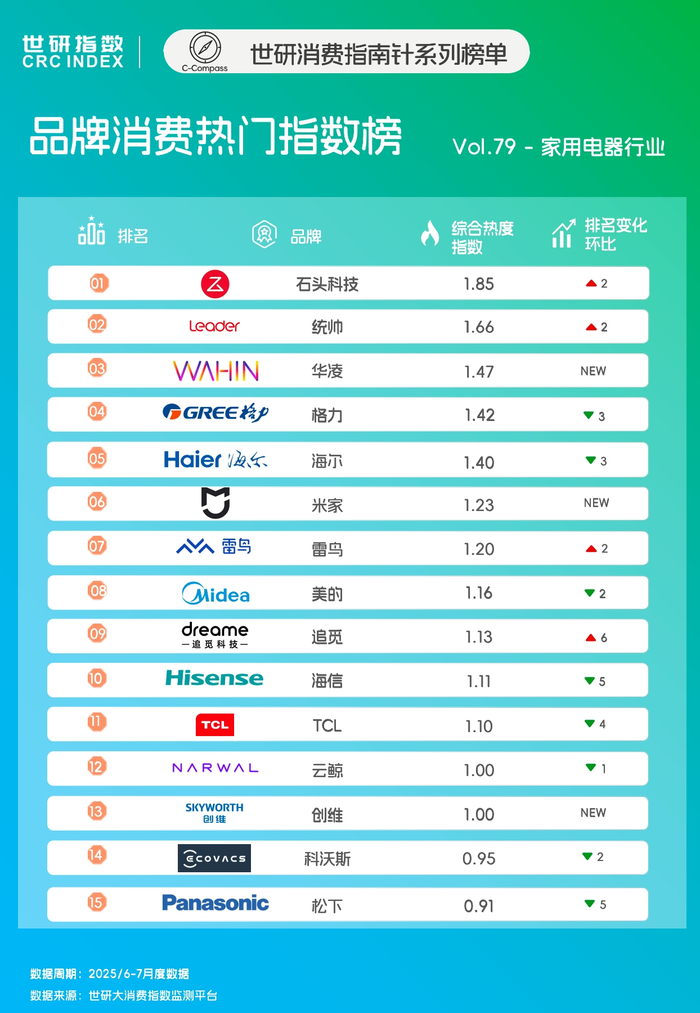
Z世代家电消费升级,品质健康引领技术|世研消费指数品牌榜Vol.79
3 6 Ke· 2025-10-24 04:23
Group 1 - The core viewpoint of the article highlights the strong performance of brands like Stone Technology, Leader, and Hualing in the home appliance market, driven by targeted strategies that cater to the younger generation's consumption needs [1][3][4] - The top three brands in the heat index are Stone Technology with a score of 1.85, Leader at 1.66, and Hualing at 1.47, indicating a competitive landscape in the home appliance sector [2][3] - The article emphasizes the importance of differentiated positioning and understanding specific consumer demands to capture market share, particularly among younger consumers [3][4] Group 2 - The article discusses how Leader and Hualing, as sub-brands under the same group, successfully implement strategies that focus on "deep youthfulness" and "extreme cost performance," respectively, to meet the needs of young consumers [3][4] - Haier and Midea are highlighted as technology-driven brands that leverage comprehensive product matrices and continuous R&D investments to address consumer demands for quality and health [4][5] - The competitive essence of the home appliance industry is underscored as being rooted in ongoing research and development, with a focus on precise consumer insights to create differentiated advantages [4][5]





沪深300ETF中金(510320)涨0.57%,半日成交额901.13万元
Xin Lang Cai Jing· 2025-10-24 03:45
Core Viewpoint - The performance of the CSI 300 ETF managed by CICC shows a slight increase, with notable movements in its constituent stocks, indicating mixed market sentiment and potential investment opportunities [1] Group 1: ETF Performance - As of the midday close on October 24, the CSI 300 ETF (510320) rose by 0.57%, priced at 1.245 yuan, with a trading volume of 9.0113 million yuan [1] - The performance benchmark for the CSI 300 ETF is the return rate of the CSI 300 Index, with a return of 23.62% since its inception on April 16, 2025, and a return of 1.97% over the past month [1] Group 2: Constituent Stocks Performance - Major stocks within the CSI 300 ETF showed varied performance: Kweichow Moutai decreased by 0.90%, CATL increased by 0.94%, Ping An Insurance rose by 0.36%, and China Merchants Bank fell by 0.54% [1] - Other notable movements include Industrial Bank down by 0.63%, Yangtze Power down by 0.18%, Midea Group down by 0.31%, Zijin Mining up by 0.81%, BYD up by 0.15%, and East Money Information up by 0.20% [1]






沪深300ESGETF(561900)涨0.82%,半日成交额111.27万元
Xin Lang Cai Jing· 2025-10-24 03:39
Core Viewpoint - The article discusses the performance of the Hu-Shen 300 ESG ETF (561900) as of October 24, highlighting its current price, trading volume, and the performance of its major holdings [1] Group 1: ETF Performance - As of the midday close, the Hu-Shen 300 ESG ETF (561900) increased by 0.82%, reaching a price of 0.978 yuan, with a trading volume of 1.1127 million yuan [1] - Since its inception on July 6, 2021, the fund has recorded a return of -2.88%, while its return over the past month is 1.82% [1] Group 2: Major Holdings Performance - Major holdings in the ETF include: - Kweichow Moutai: down 0.90% - China Merchants Bank: down 0.54% - Contemporary Amperex Technology: up 0.94% - Yangtze Power: down 0.18% - Industrial Bank: down 0.63% - Midea Group: down 0.31% - BYD: up 0.15% - Industrial and Commercial Bank of China: unchanged - Wuliangye: down 0.89% - Ping An Insurance: up 0.36% [1]
行业龙头三年投500亿布局AI等赛道
Nan Fang Du Shi Bao· 2025-10-23 23:11
Core Insights - Midea Group plans to invest at least 50 billion yuan in R&D over the next three years, focusing on cutting-edge fields such as AI large models and embodied intelligence [10] - The Shunde district aims to establish itself as a world-class intelligent manufacturing hub, emphasizing the importance of private enterprises in driving economic growth [11][12] - Cloud-based water ecosystems and AI+IoT integration are key strategies for companies like Yunmi, which has seen a 70% growth rate in the first half of the year [11][13] Company Strategies - Midea's ToB business revenue is projected to reach 104.5 billion yuan in 2024, marking a significant growth avenue beyond its smart home appliances [12] - Yunmi has invested over 1 billion yuan in creating a smart water ecosystem, positioning itself for long-term success in the next decade [13] - Guangdong Tiantai Robot Co. has established national standards for robotic components, showcasing its commitment to innovation in the robotics sector [13] Market Expansion - Keda Manufacturing emphasizes the potential for overseas market expansion, particularly in Africa, South America, and North America, as domestic markets face challenges [14][15] - Yunmi is actively pursuing global markets, particularly in Southeast Asia and North America, under the banner of "Chinese Intelligent Manufacturing" [15] - Yizhiming plans to establish a global R&D center and manufacturing facilities to enhance its competitive position in the industry [15] Industry Trends - The shift from OEM to proprietary branding and eventual public listing is a notable trend among traditional industries, as exemplified by Hanhigh Group's recent IPO [16] - Shunde district has a robust pipeline for future listings, with 44 companies already listed and 13 more in the process, indicating a strong entrepreneurial ecosystem [16] - The focus is shifting from family-oriented business models to shareholder-driven approaches, encouraging companies to adapt to market demands [16] Economic Collaboration - The conference highlighted the importance of collaboration between government and enterprises to drive economic growth, with a diverse representation of businesses from various sectors [17][18] - The district's ambition to create world-class manufacturing and tourism destinations reflects a strategic vision for sustainable economic development [18]

2025年中国品牌在东南亚市场的崛起报告-增长机遇及对区域竞争者的影响
Sou Hu Cai Jing· 2025-10-23 13:47
Core Insights - The report highlights the rise of Chinese brands in the Southeast Asian market, driven by a young population, digital economy growth, and strategic investments [1][9][12] - By 2024, China's exports to Southeast Asia are projected to reach $587 billion, marking a 12% year-on-year increase, with ASEAN6 countries contributing significantly to this growth [1][9][31] Trade Evolution - The historical trade relationship between China and Southeast Asia has been strengthened by the Belt and Road Initiative, enhancing infrastructure connectivity and economic ties [19][24] - The ASEAN6 countries, which include Indonesia, Malaysia, the Philippines, Singapore, Thailand, and Vietnam, account for 95% of the region's GDP, making them attractive markets for Chinese brands [1][25] Market Opportunities - Southeast Asia's demographic advantage, with over 6.5 billion people and a median age of 31, presents significant growth potential for Chinese brands [14][52] - The region's digital economy is rapidly expanding, with a notable shift towards e-commerce and fintech, driven by a young, tech-savvy consumer base [12][52] Industry Focus - Chinese brands have established leadership in sectors such as electronics and electric vehicles, with companies like BYD and Xiaomi holding over 25% market share [2][15] - The home appliance sector has seen brands like Haier and Midea increase their market share from 9% in 2015 to 25% in 2024 through localization and premium positioning [2][15] Competitive Landscape - The competitive landscape in Southeast Asia is being reshaped as Chinese brands leverage innovation, efficiency, and localization strategies to challenge traditional competitors [3][10] - Existing companies must adapt quickly to the digital capabilities and pricing strategies of Chinese competitors to maintain market share [10][14] E-commerce and Cross-border Trade - The rise of cross-border e-commerce, facilitated by platforms like Lazada and Shopee, has transformed consumer behavior in Southeast Asia, allowing Chinese brands to penetrate the market effectively [46][47] - Despite progress, e-commerce penetration remains low in key markets like Malaysia, Thailand, and Vietnam, indicating untapped opportunities for growth [47][52]




美的集团(00300.HK)10月23日耗资人民币1亿元回购134.3万股A股
Ge Long Hui· 2025-10-23 12:51
Core Viewpoint - Midea Group announced a share buyback of 1 billion RMB, repurchasing 1.343 million A-shares on October 23 [1] Group 1 - The company spent 1 billion RMB for the buyback [1] - A total of 1.343 million A-shares were repurchased [1]
美的集团10月23日斥资9999.98万元回购134.34万股A股
Zhi Tong Cai Jing· 2025-10-23 12:48
Group 1 - The company Midea Group (000333) announced a share repurchase plan, intending to buy back 1.3434 million A-shares at a total cost of approximately RMB 99.9998 million [1] - The repurchase price is set between RMB 73.75 and RMB 74.94 per share [1]