
CHANGAN AUTOMOBILE-B(000625)

Search documents
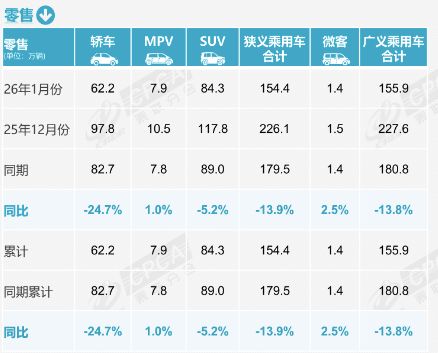
1月我国乘用车零售销量约154.4万辆 乘联分会:预期内的短期波动,不代表长期走势
Mei Ri Jing Ji Xin Wen· 2026-02-12 12:05
Core Viewpoint - The retail sales of passenger cars in China experienced a significant decline in January 2026, with a total of approximately 1.544 million units sold, representing a year-on-year decrease of 13.9% [1][2]. Retail Performance - In January 2026, retail sales for different vehicle categories were as follows: sedans at 622,000 units (down 24.7%), MPVs at 79,000 units (up 1.0%), SUVs at 843,000 units (down 5.2%), and microvans at 14,000 units (up 2.5%) [2]. - The total retail sales for narrow passenger vehicles were 1.544 million units, down 13.9% compared to the same month last year [2]. Market Analysis - The decline in the passenger car market is viewed as a short-term fluctuation rather than a long-term trend, attributed to the expiration of the new energy vehicle purchase tax exemption policy at the end of 2025 [3]. - The market is expected to face a low point in February 2026 due to the post-holiday consumption slowdown, which may help alleviate retail inventory pressure [3]. Brand Performance - In January 2026, retail sales for domestic brands were 890,000 units (down 18%), while mainstream joint venture brands sold 470,000 units (down 4%), and luxury vehicles sold 180,000 units (down 15%) [4]. - Major domestic brands like Geely, BYD, Changan, and Chery saw significant declines in retail sales, with Geely down 12.6%, BYD down 53%, Changan down 33.5%, and Chery down 41% [4][6]. Joint Venture Brands - Joint venture brands showed relatively stable performance, with FAW-Volkswagen down 3.5%, SAIC Volkswagen down 9.3%, and BMW Brilliance down 3.9% [6]. - Some joint venture brands, such as FAW Toyota and GAC Toyota, experienced year-on-year growth of 8.3% and 0.3%, respectively [6]. New Energy Vehicle Market - In January 2026, retail sales of new energy vehicles (NEVs) were 596,000 units, down 20% year-on-year, while wholesale sales were 864,000 units, down 3.3% [9]. - The A00-class pure electric vehicle segment saw a drastic decline, with wholesale sales dropping 62%, significantly impacting the overall performance of the new energy vehicle market [11]. Export Performance - New energy vehicles have become a major force in China's passenger car exports, with 139,000 units exported in January 2026, marking a year-on-year increase of 29.4% [13]. - The export of pure electric vehicles accounted for 66% of new energy vehicle exports, with A0 and A00-class vehicles making up 38% of the total new energy vehicle export volume [13]. Future Outlook - The market is expected to enter a recovery phase in February 2026, driven by the gradual implementation of vehicle replacement policies [16]. - However, rising costs due to increased prices of raw materials like lithium and copper may pressure automakers, potentially leading to cautious consumer behavior and affecting demand [16].




研报掘金丨长江证券:维持长安汽车“买入”评级,回购计划开启凸显公司发展前景
Ge Long Hui A P P· 2026-02-12 07:53
Group 1 - The core viewpoint of the article highlights that Changan Automobile's share repurchase plan underscores the company's growth prospects and strengthens investor confidence [1] - The repurchase plan includes a minimum of 700 million yuan and a maximum of 1.4 billion yuan for A-shares, and a minimum of 300 million yuan and a maximum of 600 million yuan for B-shares [1] - The repurchase is based on the company's strong confidence in its strategic development and intrinsic value, aiming to enhance shareholder rights and increase earnings per share [1] Group 2 - Changan Automobile is actively developing intelligent driving technologies and is strategically positioning itself in robotics and flying car businesses to build future competitiveness [1] - The company has strong capabilities in product development and is undergoing a transformation towards electric and intelligent vehicles, with rapid overseas expansion [1] - The acceleration of the electric and intelligent transformation is expected to drive sales growth, with projected net profits of 5.16 billion yuan and 7.59 billion yuan for 2025 and 2026, respectively, corresponding to PE ratios of 21.5 and 14.7 [1]
【月度分析】2026年1月份全国乘用车市场分析
乘联分会· 2026-02-12 06:06
Overall Market - In January 2026, the retail sales of passenger cars reached 1.544 million units, a year-on-year decrease of 13.9% [14] - The decline in retail sales is attributed to complex market factors and a historical pattern of fluctuating sales in January [14] - The end of the new energy vehicle purchase tax exemption in December 2025 has led to a recovery period for the new energy vehicle market, with some consumers having made purchases in December to take advantage of the policy [14] - January 2026 saw a significant increase in exports, with passenger car exports reaching 576,000 units, a year-on-year increase of 52.0% [16] - The production of passenger cars in January 2026 was 2.003 million units, a year-on-year decrease of 4.4% [16] - The wholesale volume for January 2026 was 1.973 million units, a year-on-year decrease of 6.2% [17] New Energy Market - In January 2026, retail sales of new energy vehicles (NEVs) totaled 596,000 units, down 20.0% year-on-year [18] - The penetration rate of NEVs in the domestic market was 38.6%, while the export penetration rate was 49.6% [15] - The production of NEVs reached 938,000 units, a slight decrease of 0.6% year-on-year [18] - The wholesale volume of NEVs was 864,000 units, down 3.3% year-on-year [18] - The export of NEVs reached 286,000 units, a significant increase of 103.6% year-on-year, accounting for 49.6% of total passenger car exports [22] Company Performance - BYD, Geely, and Chery are leading in the new energy vehicle market, with BYD's sales reaching 205,518 units in January 2026 [24] - The market share of domestic brands in the new energy sector is increasing, with a notable rise in the export of new energy vehicles to Europe and Southeast Asia [15][22] - The new energy vehicle market is characterized by a shift towards higher quality products, with an increase in the proportion of high-end NEVs [15] Market Outlook - February 2026 is expected to see lower sales due to the shorter working days caused by the extended Spring Festival holiday [27] - The market is anticipated to stabilize post-holiday, with potential recovery in the entry-level electric vehicle segment [28] - The overall sentiment in the consumer market remains cautious, influenced by high costs and economic factors [28]

宁德时代上涨,据报计划联合长安汽车于年内快速落地多款纳电车型
Zhi Tong Cai Jing· 2026-02-12 05:44
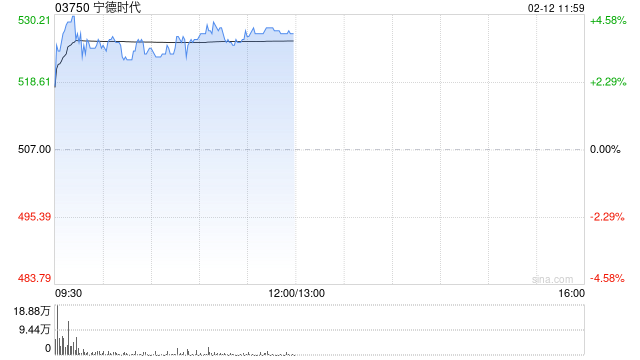
Core Viewpoint - CATL (03750) shares rose over 4%, reaching HKD 527.5 with a trading volume of HKD 8.82 billion, following the announcement of sodium-ion battery collaboration with Changan Automobile [1][1]. Group 1: Company Developments - CATL's CTO Gao Huan revealed that the sodium-ion battery cells have an energy density of up to 175 Wh/kg, enabling electric vehicles to achieve a range exceeding 400 kilometers, with future upgrades potentially reaching 500-600 kilometers [1][1]. - The company plans to establish 3,000 battery swap stations across over 140 cities this year, in collaboration with Changan Automobile, aiming to launch multiple sodium-ion models by 2026 [1][1]. Group 2: Industry Insights - As of February 12, lithium carbonate futures surged to 150,000 CNY/ton, indicating a shift in lithium demand dynamics, with energy storage becoming a core growth driver for lithium battery demand [1][1]. - UBS suggests that the industry is approaching a critical point regarding cost, range, and charging time, where declining costs could stimulate end-user consumption, creating a positive cycle of "technological cost reduction—demand expansion—resource value reassessment" [1][1].
宁德时代午前涨逾4% 据报计划联合长安汽车于年内快速落地多款纳电车型
Xin Lang Cai Jing· 2026-02-12 04:01
Group 1 - The core point of the article is that CATL (宁德时代) has seen a stock price increase of 3.95% to 527 HKD, driven by the introduction of sodium-ion batteries in collaboration with Changan Automobile, which will launch sodium battery passenger vehicles across multiple brands [1][4]. - CATL's sodium-ion battery cells have a maximum energy density of 175 Wh/kg, allowing pure electric models to achieve a range exceeding 400 kilometers, with future upgrades potentially reaching 500-600 kilometers, and hybrid models exceeding 300-400 kilometers [1][4]. - CATL plans to establish 3,000 battery swap stations in over 140 cities this year and aims to rapidly launch multiple sodium battery models with Changan Automobile by 2026 [1][4]. Group 2 - As of February 12, lithium carbonate futures reached a peak of 150,000 CNY per ton, indicating a significant demand for lithium resources [1][4]. - Analysts suggest that energy storage is becoming the core incremental demand for lithium batteries, with solid-state batteries expected to enhance lithium consumption per battery due to their energy density and safety advantages [1][4]. - UBS believes the industry is approaching a critical point regarding cost, range, and charging time, where declining costs will stimulate end-user consumption, creating a virtuous cycle of "technological cost reduction—demand expansion—resource value reassessment" [1][4].
港股异动 | 宁德时代(03750)午前涨超4% 据报计划联合长安汽车于年内快速落地多款纳电车型
智通财经网· 2026-02-12 03:48
Core Viewpoint - CATL (Ningde Times) has seen a stock increase of over 4%, currently trading at 527.5 HKD, with a transaction volume of 8.82 billion HKD, following the announcement of a partnership with Changan Automobile to introduce sodium-ion batteries in passenger vehicles [1] Group 1: Company Developments - CATL's CTO Gao Huan revealed that the energy density of their sodium-ion battery cells can reach up to 175 Wh/kg, enabling pure electric vehicles to achieve a range exceeding 400 kilometers, with future upgrades potentially reaching 500-600 kilometers [1] - The company plans to establish 3,000 battery swap stations across over 140 cities this year, in collaboration with Changan Automobile, aiming to launch multiple sodium-ion models by 2026 [1] Group 2: Market Context - As of February 12, lithium carbonate futures surged to 150,000 CNY/ton, indicating a strong demand for lithium driven by energy storage solutions replacing electric vehicles as the core growth driver [1] - UBS suggests that the industry is approaching a critical point regarding cost, range, and charging time, where declining costs will stimulate end-user consumption, creating a positive cycle of "technological cost reduction—demand expansion—resource value reassessment" [1]
宁德时代午前涨超4% 据报计划联合长安汽车于年内快速落地多款纳电车型
Zhi Tong Cai Jing· 2026-02-12 03:47
Core Viewpoint - Contemporary Amperex Technology Co., Limited (CATL) has seen a stock increase of over 4%, currently trading at 527.5 HKD, with a transaction volume of 8.82 billion HKD, following the announcement of a partnership with Changan Automobile to introduce sodium-ion batteries in passenger vehicles [1] Group 1: Company Developments - CATL's Chief Technology Officer, Gao Huan, announced that the energy density of their sodium-ion battery cells can reach up to 175 Wh/kg, enabling electric vehicles to achieve a range exceeding 400 kilometers, with future upgrades potentially reaching 500-600 kilometers [1] - The company plans to establish 3,000 battery swap stations across over 140 cities this year, in collaboration with Changan Automobile, aiming to launch multiple sodium-ion models by 2026 [1] Group 2: Industry Insights - As of February 12, lithium carbonate futures surged to 150,000 CNY per ton, indicating a strong demand for lithium driven by energy storage solutions replacing electric vehicles as the core growth driver [1] - UBS analysts suggest that the industry is approaching a critical point regarding cost, range, and charging time, where declining costs could stimulate end-user demand, creating a positive cycle of "technological cost reduction—demand expansion—resource value reassessment" [1]
中国车企在澳大利亚市场逆势大涨77%!究竟是如何做到的?
Zhong Guo Qi Che Bao Wang· 2026-02-12 02:57
Core Insights - Chinese automotive brands are significantly increasing their presence in the Australian market, with a notable growth in sales and market share, indicating a shift in the local automotive landscape [1][2][4] Group 1: Market Performance - In January, the Australian automotive market saw sales of 87,753 vehicles, a slight increase of 0.1% year-on-year, with Chinese vehicles becoming the second-largest source of cars in Australia, showing a year-on-year sales increase of 68.6% [1][2] - Chinese automotive companies achieved a market share of 22.4% in Australia, surpassing Korean brands and marking a significant change in the market structure [2][4] Group 2: Product Quality and Consumer Perception - The quality of Chinese automotive products has improved significantly, with advancements in durability, configuration, and cost-effectiveness, altering consumer perceptions in Australia [2][4] - Chinese brands are now recognized for their high safety ratings, with multiple models receiving ANCAP five-star certifications, indicating international standards in safety performance [4] Group 3: Competitive Strategies - Chinese automotive companies leverage a strategy of "high value at low cost," offering vehicles that are 10%-20% cheaper than competitors while maintaining comparable quality and technology [5] - The introduction of electric and hybrid models has positioned Chinese brands as key players in the Australian market, aligning with local consumer preferences for sustainable options [4][5] Group 4: Localization Efforts - Chinese automotive brands are focusing on localizing their operations in Australia, enhancing after-sales service networks to compete with established Japanese brands [6][7] - Collaborations with local dealers to build charging infrastructure and provide home charging solutions are part of the strategy to alleviate consumer concerns regarding electric vehicle charging [6][7] Group 5: Future Challenges and Strategies - To sustain growth, Chinese brands need to optimize their supply chains and establish regional parts centers to improve service efficiency [7] - Building consumer trust requires ongoing efforts in marketing and brand development, including local sponsorships and tailored marketing strategies to resonate with Australian consumers [7][8]

长安汽车:回购计划开启强化信心,智能、电动化加速推进-20260212
Changjiang Securities· 2026-02-12 00:45
Investment Rating - The investment rating for the company is "Buy" and is maintained [5]. Core Insights - The company announced a share repurchase plan on February 4, 2026, intending to repurchase between 1 billion and 2 billion yuan using its own funds [3][9]. - The company's sales of self-owned new energy vehicles have significantly increased both year-on-year and quarter-on-quarter, driven by product structure optimization [9]. - The company is accelerating its transformation towards electric and intelligent vehicles, with rapid overseas expansion and continuous improvement in efficiency [9]. Summary by Relevant Sections Share Repurchase Plan - The repurchase plan includes a minimum of 700 million yuan and a maximum of 1.4 billion yuan for A shares, and a minimum of 300 million yuan and a maximum of 600 million yuan for B shares [9]. - The repurchase price cap is set at 150% of the average trading price over the 30 trading days prior to the board's approval of the repurchase plan [9]. Electric and Intelligent Transformation - The company has received the first official license plate for L3 level autonomous driving in the country, marking the beginning of the L3 era [9]. - The company is collaborating with Huawei on intelligent driving technologies and is developing humanoid robots, with a prototype expected to be released in 2026 [9]. Financial Performance and Projections - The company expects to achieve a net profit attributable to shareholders of 5.16 billion yuan in 2025 and 7.59 billion yuan in 2026, with corresponding P/E ratios of 21.5 and 14.7 [9]. - Revenue projections for the upcoming years are as follows: 159.73 billion yuan in 2024, 188.81 billion yuan in 2025, 204.06 billion yuan in 2026, and 229.06 billion yuan in 2027 [12].
长安汽车(000625):公司研究|点评报告|长安汽车(000625.SZ):长安汽车:回购计划开启强化信心,智能、电动化加速推进
Changjiang Securities· 2026-02-11 14:45
Investment Rating - The investment rating for the company is "Buy" and is maintained [8] Core Insights - The company announced a share repurchase plan on February 4, 2026, intending to repurchase between 1 billion and 2 billion yuan using its own funds, which is expected to enhance investor confidence [2][4] - The company's sales of self-owned new energy vehicles have significantly increased both year-on-year and quarter-on-quarter, driven by product structure optimization [2] - The company is accelerating its electric and intelligent transformation, with a strong focus on overseas expansion and continuous improvement in efficiency [6] - The expected net profit attributable to the parent company for 2025 and 2026 is projected to be 5.16 billion and 7.59 billion yuan, respectively, corresponding to a PE ratio of 21.5 and 14.7 times [6] Summary by Sections Share Repurchase Plan - The repurchase plan includes a minimum of 700 million yuan and a maximum of 1.4 billion yuan for A shares, and a minimum of 300 million yuan and a maximum of 600 million yuan for B shares [12] - The repurchase price will not exceed 150% of the average trading price over the 30 trading days prior to the board's approval of the repurchase plan [12] Electric and Intelligent Transformation - The company is advancing its electric and intelligent transformation, with a focus on enhancing cooperation with Huawei in smart driving technology [6] - The company has received the first official license plate for L3 level autonomous driving in the country, marking a significant milestone in its smart driving initiatives [12] Global Expansion - The company has accelerated its globalization strategy, having entered 117 countries and launched 41 models as of January 2026 [12] - The company is actively developing new products under multiple brands, including Changan, Deep Blue, and Avita, to capture market opportunities in the new energy vehicle sector [12]