CHANGAN AUTOMOBILE-B(000625)

Search documents
乘用车板块9月29日涨0.67%,海马汽车领涨,主力资金净流出8.12亿元
Zheng Xing Xing Ye Ri Bao· 2025-09-29 08:39
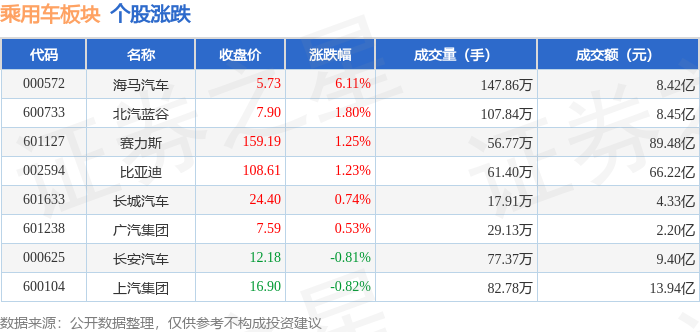
Core Insights - The passenger car sector experienced a 0.67% increase on September 29, with Haima Automobile leading the gains [1] - The Shanghai Composite Index closed at 3862.53, up 0.9%, while the Shenzhen Component Index closed at 13479.43, up 2.05% [1] Passenger Car Sector Performance - The following companies showed notable performance: - Haima Automobile (Code: 000572) closed at 5.73, up 6.11% with a trading volume of 1.4786 million shares and a transaction value of 8.42 billion [1] - BAIC Blue Valley (Code: 600733) closed at 7.90, up 1.80% with a trading volume of 1.0784 million shares and a transaction value of 8.45 billion [1] - BYD (Code: 002594) closed at 108.61, up 1.23% with a trading volume of 1.6140 million shares and a transaction value of 6.622 billion [1] - Great Wall Motors (Code: 601633) closed at 24.40, up 0.74% with a trading volume of 179,100 shares and a transaction value of 4.33 billion [1] Fund Flow Analysis - The passenger car sector saw a net outflow of 8.12 billion from main funds, while retail investors contributed a net inflow of 4.83 billion [1] - Specific fund flows for key companies include: - BYD had a main fund net inflow of 98.09 million, but a retail net outflow of 103 million [2] - Haima Automobile experienced a main fund net inflow of 2.22 million, with both retail and speculative funds showing net outflows [2] - Great Wall Motors had a main fund net inflow of 2.26 million, but a significant speculative fund outflow of 45.73 million [2]







别克至境L7上市,限时权益价16.99万元
Zhong Guo Zhi Liang Xin Wen Wang· 2025-09-29 04:42
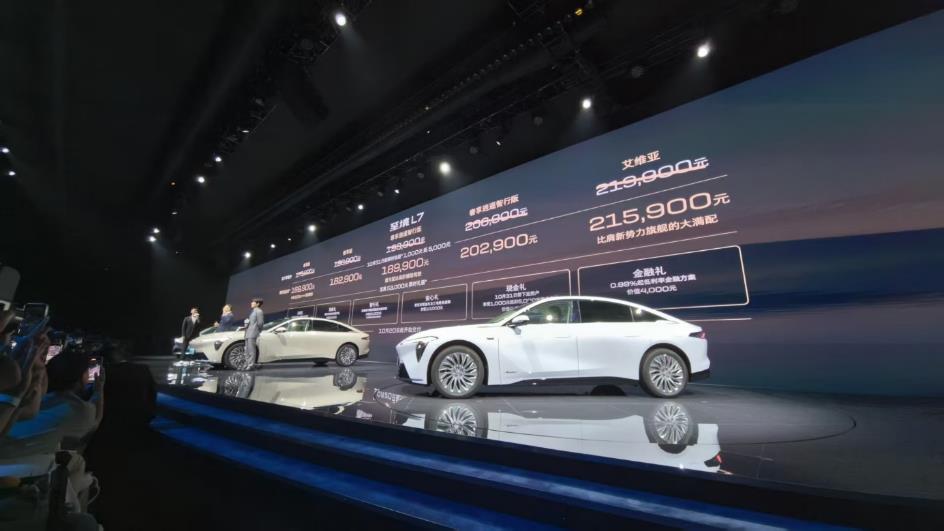
Core Viewpoint - SAIC-GM Buick brand has launched the Zhijing L7, offering five models at a limited-time price range of 169,900 to 215,900 yuan, targeting the needs of Chinese consumers with advanced range-extending technology [1][19]. Product Launch and Pricing - The Zhijing L7 is available for pre-order through various platforms, with a promotional price for customers who complete the order and payment by October 31 and vehicle delivery by December 31 [3][19]. Technology and Performance - The Zhijing L7 features the "Zhenlong" range-extending system, providing a smooth driving experience comparable to a 3.0T V6 engine, with a 0-100 km/h acceleration time of 5.9 seconds and minimal performance drop in low battery conditions [5][19]. - It offers a pure electric range of 302 km and a comprehensive range of 1,420 km, with fast charging capabilities that allow for 30% to 80% charge in just 18 minutes [7][19]. Safety and Driving Assistance - The vehicle is equipped with the "Xiaoyao Zhixing" advanced driver-assistance system, utilizing the Momenta R6 model for enhanced navigation and parking assistance in complex scenarios [9][19]. - Multiple safety redundancies and alerts are integrated into the driving assistance features, ensuring reliable safety for users [9][19]. Interior and Comfort Features - The Zhijing L7 boasts a luxurious interior with a 50-inch AR-HUD display, dual-screen design, and a high-end sound system with 27 speakers, providing an immersive experience [13][18]. - The seating arrangement includes advanced comfort features such as adjustable lumbar support and massage functions, enhancing passenger comfort [16][18]. Quality and Testing - The vehicle has undergone rigorous testing, exceeding national standards with over 60 crash tests and extensive durability trials, ensuring high-quality manufacturing and safety [19]. Market Positioning - The launch of the Zhijing L7 allows consumers to access luxury configurations typically found in C-class vehicles at B-class prices, while also offering advanced smart features and strong battery technology [19].

2025年1-7月中国基本型乘用车(轿车)产量为683.7万辆 累计增长10%
Chan Ye Xin Xi Wang· 2025-09-29 02:09
Core Insights - The article discusses the growth of China's basic passenger car production, highlighting a production volume of 966,000 units in July 2025, representing an 8.4% year-on-year increase [1] - Cumulative production from January to July 2025 reached 6.837 million units, showing a 10% increase compared to the same period in the previous year [1] Industry Overview - The report by Zhiyan Consulting provides a deep assessment of the Chinese automotive industry from 2025 to 2031, focusing on market opportunities and investment forecasts [1] - Key players in the industry include BYD, SAIC Motor, Great Wall Motors, Changan Automobile, GAC Group, FAW Jiefang, Dongfeng Motor, and BAIC Blue Valley [1] Statistical Data - The production statistics for basic passenger cars in China from January to July 2025 indicate a steady growth trend, with a notable increase in both monthly and cumulative production figures [1] - The data is sourced from the National Bureau of Statistics and compiled by Zhiyan Consulting, emphasizing the reliability of the information presented [1]


中国长安汽车朱华荣:全球汽车产业应借助中国电动智能化生态
Guan Cha Zhe Wang· 2025-09-29 01:55
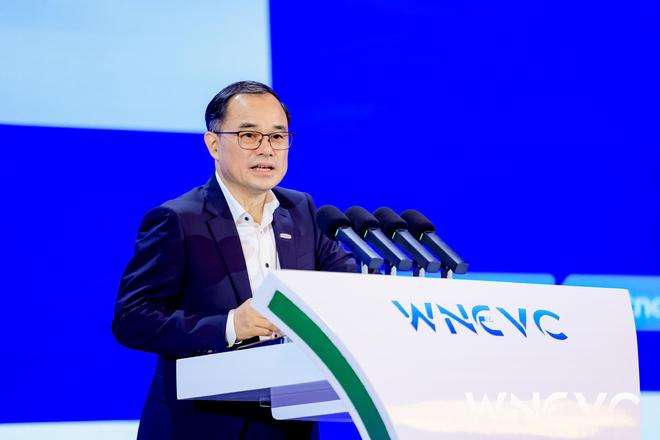
Core Viewpoint - The Chinese automotive industry is accelerating its globalization, presenting both opportunities and challenges, with a focus on leveraging China's advancements in new energy and intelligent vehicles for global market expansion [1][3]. Group 1: Market Trends and Projections - The expected sales of new energy vehicles (NEVs) in China for the year are projected to reach 16 million units, with a penetration rate of 50% [3]. - By 2030, the energy structure of Chinese automobiles is anticipated to reach a ratio of 4:4:2 for plug-in hybrids, pure electric, and fuel vehicles respectively [3]. - Global NEV penetration is expected to increase from 25% in 2025 to 40% by 2030 [3]. Group 2: Industry Development Strategies - The diversification of market demand is leading to a preference for multi-energy structures, multiple technological routes, and multi-brand development within the automotive industry [3]. - Major Chinese automotive groups are initiating multi-brand strategies during their electrification transitions to create varied value for different users [3]. - Utilizing common platform development and standardized designs can significantly enhance scale and reduce costs, aiding in competitive market positioning [3]. Group 3: Technological Advancements - Intelligent technology has become a critical competitive factor, with 92% of consumers considering it important when purchasing a vehicle [4]. - By 2030, the penetration rate of intelligent NEVs is expected to reach 70%, with L2 level driver assistance becoming standard in domestic passenger cars [4]. - The market for embodied intelligence is projected to exceed $20 billion by 2030, driven by multi-technology integration and cross-industry collaboration [4]. Group 4: Globalization Challenges - Current geopolitical issues, trade protectionism, and tariff barriers are creating instability and challenges for the globalization of the automotive industry [5]. - Despite these challenges, the company believes that globalization is an unstoppable trend in the long run [5].
长安汽车申请一种故障识别方法、装置、设备及存储介质专利,提高识别效率
Jin Rong Jie· 2025-09-29 00:49
Group 1 - The core point of the article is that Chongqing Changan Automobile Co., Ltd. has applied for a patent for a fault identification method, device, equipment, and storage medium, which aims to significantly improve identification efficiency and accuracy while reducing labor costs [1] - The patent application, published as CN 120707969 A, was filed on July 2025 and pertains to vehicle technology [1] - The method involves obtaining a first image of a tested vehicle, processing it through a neural network model to generate multiple corresponding second images, and then using a second neural network model to produce identification results related to various types of parts and their faults [1] Group 2 - Chongqing Changan Automobile Co., Ltd. was established in 1996 and is primarily engaged in the automotive manufacturing industry, with a registered capital of approximately 992.18 million RMB [1] - The company has invested in 119 enterprises and participated in 5,000 bidding projects, holding 3,129 trademark records and 5,000 patent records, along with 962 administrative licenses [1]
一部logo史,半部辛酸泪,国产车的门面支棱起来了吗?
汽车商业评论· 2025-09-28 23:07
Core Viewpoint - The article discusses the evolution and significance of automotive brand logos in China, highlighting how logos have become essential for brand identity, market positioning, and consumer engagement in the competitive automotive industry [4][11][70]. Brand Logo Evolution - Over the past decade, more than twenty passenger car companies in China have updated their brand logos, with some brands changing multiple times within ten years [5][6]. - The period from 2014 to 2025 has seen significant logo redesigns among various brands, reflecting a trend towards simplification and modern aesthetics [6][7]. Importance of Logos - Logos are no longer mere decorative elements; they serve as the first step in implementing brand strategies and are crucial for consumer recognition and emotional connection [11][12]. - A well-designed logo should be visually appealing, easily recognizable, and strongly associated with the brand's identity [11][12]. Design Principles - Effective logo design is a systematic process that aligns with brand strategy, emphasizing simplicity, logic, and aesthetic appeal [12]. - The article outlines three key criteria for a good logo: beauty, high recognition, and strong association [11]. Case Studies of Logo Redesigns - **Changan**: The evolution of Changan's logo reflects the broader understanding of logo significance in the Chinese automotive industry, transitioning from a complex design to a more streamlined and modern aesthetic [15][16]. - **Avita**: Avita's logo embodies minimalist modernism, using simple lines to convey a sense of technology and sophistication [17]. - **Deep Blue**: The logo of Deep Blue is highly abstract, focusing on a triangular shape that symbolizes energy, though it requires consumer interpretation to connect with the brand [20]. Consumer Perception - The article emphasizes the importance of consumer perception in logo design, noting that logos must resonate with target audiences to be effective [44]. - It highlights the need for logos to be memorable and evoke positive associations, which can significantly impact brand loyalty and recognition [11][12]. Conclusion - The article concludes that the best logos are simple and versatile, capable of adapting to various contexts while maintaining their core identity [70]. - It encourages readers to engage in discussions about what constitutes a good logo and to participate in voting for the best logos among Chinese automotive brands [70].



B级车市场杀出新玩家,别克也开始“掀桌子”了
Di Yi Cai Jing· 2025-09-28 22:48
Core Insights - The launch of the Buick Zhijing L7 marks a significant shift in the B-segment car market, with a pricing strategy that directly challenges existing competitors [2][3] - The B-segment is crucial for automakers due to its large market capacity and high profitability, traditionally dominated by joint venture brands [2][4] - Buick aims to combine the strengths of traditional joint venture brands with the innovations of new energy and smart technology, positioning the Zhijing L7 as a potential blockbuster [3][4] Pricing Strategy - The Buick Zhijing L7 is priced between 169,900 to 215,900 yuan, significantly lower than the previous market positioning of 200,000 to 300,000 yuan [2] - This pricing strategy is seen as a direct challenge to both domestic and new energy brands, indicating a shift in competitive dynamics within the market [2] Market Dynamics - The B-segment market has seen a shift where joint venture brands are now adopting defensive strategies, including price reductions, to maintain market share [2] - Despite the rise of new energy vehicles, traditional fuel-powered models like the Passat, Magotan, and Camry still hold significant retail sales positions [2] Technological Advancements - The Zhijing L7 incorporates advanced features such as laser radar, the Momenta R6 flying model, and Qualcomm's latest 8775 chip, with over 300 kilometers of pure electric range [2] - The vehicle's development was led by a local Chinese team, emphasizing a shift towards localized innovation and collaboration with domestic tech firms like Momenta [3] Strategic Shift in Joint Ventures - Joint venture brands are transitioning from a "market for technology" model to a "co-creation" model, focusing on local technology development [4] - Buick's strategy with the Zhijing L7 reflects this shift, aiming to penetrate the B-segment market traditionally dominated by joint venture brands [4]
消息称阿维塔拟下月冲刺港股IPO 长安汽车剧透其“全球化野心”
Zheng Quan Shi Bao Wang· 2025-09-28 13:53
Group 1 - Avita plans to submit an IPO application to the Hong Kong Stock Exchange in Q4 2025, with a target listing in Q2 2026, supported by China International Capital Corporation and CITIC Securities as joint sponsors [1] - Avita aims for global sales of 400,000 units by 2027, 800,000 units by 2030, and 1.5 million units by 2035, with a projected annual revenue of 100 billion yuan by 2027 [1][2] - The company has completed four rounds of financing from 2021 to 2024, raising approximately 19 billion yuan [3] Group 2 - Avita's sales increased from 12,000 units in 2022 to 35,000 units in 2023, with a cumulative sales of 79,711 units from January to August 2025, representing a year-on-year growth of 119.18% [4] - The projected maximum fundraising amount for the IPO is up to 1 billion USD (approximately 7.8 billion HKD) [4] - Avita's revenue for 2022, 2023, and 2024 is reported as 28.34 million yuan, 5.645 billion yuan, and 15.35 billion yuan respectively, with net losses of 2.015 billion yuan, 3.693 billion yuan, and 4.018 billion yuan [4]
汽车周报:正视挑战,国补额度压力下的新矛盾-20250928
Shenwan Hongyuan Securities· 2025-09-28 12:44
Investment Rating - The report maintains a "Positive" outlook on the automotive industry, highlighting potential investment opportunities in high-quality component manufacturers and strong vehicle manufacturers [4]. Core Insights - The report emphasizes that technological advancements are igniting market sentiment, and there is a strong interest in high-quality component manufacturers as well as new vehicle models that are expected to capture orders during the upcoming holiday season [4]. - The report notes that the automotive industry is facing challenges due to insufficient national subsidies, which may pressure future sales [4]. - The report provides an update on the automotive market, indicating that retail sales of passenger cars reached 508,000 units in the 38th week of 2025, with a month-on-month increase of 12.89% and a year-on-year increase of 10.29% [2]. Market Situation Update - The total transaction value of the automotive industry for the week was 851.59 billion yuan, reflecting a week-on-week decrease of 7.71% [4]. - The automotive industry index closed at 8106.63 points, with no change over the week, underperforming compared to the Shanghai Composite Index, which rose by 1.07% [4][19]. - The report highlights that 122 stocks in the automotive sector rose while 168 fell, with the largest gainers being Xincidian, Kebo Da, and Tiangong Co., which increased by 25.0%, 22.6%, and 21.0% respectively [23]. Key Events - The report discusses significant events such as the launch of the new electric SUV i6 by Li Auto, which is priced starting at 249,800 yuan and features advanced driving assistance systems [7][52]. - The report mentions the delivery commencement of the new AITO M7, which has a monthly production capacity of over 30,000 units and has received strong market demand with over 230,000 pre-orders [11][12]. - The report also highlights the launch of the Shangjie H5, which targets the mainstream market with a price range of 159,800 to 199,800 yuan and features advanced driving assistance technology [14][41]. Investment Recommendations - The report recommends focusing on domestic leading manufacturers such as NIO, Xiaomi, Xpeng, and Li Auto, as well as component manufacturers with strong performance and overseas expansion capabilities [4]. - It suggests monitoring companies involved in the integration of state-owned enterprises, such as SAIC Motor and Dongfeng Motor [4]. - The report identifies potential investment opportunities in component manufacturers like Fuyao Glass, New Spring, and others that have strong growth prospects and are involved in robotics [4].

最年长又最年轻 ,中国长安汽车如何“老树发新芽”
Guan Cha Zhe Wang· 2025-09-28 09:01
Core Viewpoint - China Changan Automobile Group has been established as a state-owned enterprise under the direct management of the State-owned Assets Supervision and Administration Commission, marking a significant strategic deployment for national development and state-owned enterprise reform [1][3]. Group 1: Historical Context and Strategic Goals - Changan Automobile has a rich history of 163 years, evolving from a military factory during wartime to a modern automotive leader, aligning closely with national strategies [1][3]. - The company aims to become a world-class automotive group with global competitiveness and independent core technologies, as emphasized by its leadership [3][6]. Group 2: Challenges and Adaptation - Changan faces three main challenges: adapting a long-standing enterprise to modern demands, navigating fierce market competition, and maintaining long-term growth while ensuring efficiency and market share [3][6]. - The company emphasizes the importance of technological innovation, quality, user responsibility, and passionate leadership to overcome these challenges [3][4]. Group 3: Sales and Production Goals - For 2024, Changan targets total vehicle sales of 3 million units, including 1 million new energy vehicles (NEVs), with a cumulative sales goal of 30 million units since its establishment [7][8]. - The company plans to achieve a production and sales scale of 5 million vehicles by 2030, with NEVs accounting for over 60% of sales and overseas sales exceeding 30% [7][8]. Group 4: Strategic Initiatives - Changan is advancing three major plans: the "Shangri-La" plan for new energy, the "Beidou Tianzhu" plan for intelligence, and the "Haina Baichuan" plan for globalization, aiming to fulfill its vision of becoming a world-class automotive group [8][10]. - The company will invest 200 billion yuan over the next decade to enhance electric and intelligent transformation, focusing on core technologies and establishing a comprehensive innovation system [10][11]. Group 5: Global Expansion and Brand Strategy - Changan is implementing a global "152" strategy, establishing a presence in five major overseas markets and planning 20 overseas factories, with 9 already operational [11][12]. - The company is focusing on brand differentiation and positioning to avoid internal competition and resource wastage, ensuring clarity in brand strategy across its three new energy brands: Avita, Deep Blue, and Changan Qiyuan [13][15].