
GREE(000651)

Search documents
客厅里的智能战争
3 6 Ke· 2025-11-17 03:17
Core Insights - The home appliance industry in China is entering an era of full-home intelligence, with traditional appliance companies and tech firms like Huawei and Xiaomi intensifying competition through AI technology and smart ecosystems [1][2][7] Group 1: Market Dynamics - Traditional appliance companies such as Midea, Gree, Haier, and Hisense are seeking new growth points by developing AI technology, expanding product lines, and exploring international markets [1] - Tech companies like Huawei and Xiaomi leverage their established smart ecosystem advantages to enhance competition in the appliance market [1][2] - The trend towards smart appliances is evident, with many brands offering independent smart systems, often named with a prefix like "Xiao" [2] Group 2: Consumer Behavior - Consumers are increasingly drawn to smart appliances, with features like AI voice functionality appealing to families with children and elderly members [3] - A shift in consumer preferences is noted, with many opting for domestic brands over foreign ones, indicating a growing expectation for smart features in appliances [3][4] - The interest in full-home smart systems is rising, but many consumers face challenges due to incompatibility between different brands' systems [4] Group 3: Technological Advancements - Midea's full-home smart system integrates various home environments and appliances, evolving from passive responses to proactive services [5][6] - The interaction between vehicles and home systems is emerging, with Midea collaborating with companies like BYD and Tesla to enhance connectivity [5][6] - A report indicates that the smart home market in China is expected to grow at double-digit rates from 2023 to 2025, with smart security, lighting, and audio-visual products being the fastest-growing categories [6][7] Group 4: Competitive Landscape - Major players in the appliance sector include Gree, Midea, Haier, Hisense, and TCL, with the boundaries of the industry becoming increasingly blurred as companies embrace a broader home ecosystem [7][8] - The competition is intensifying, with a notable price war among domestic brands, as they strive to offer smart services that add higher value beyond traditional hardware manufacturing [8]



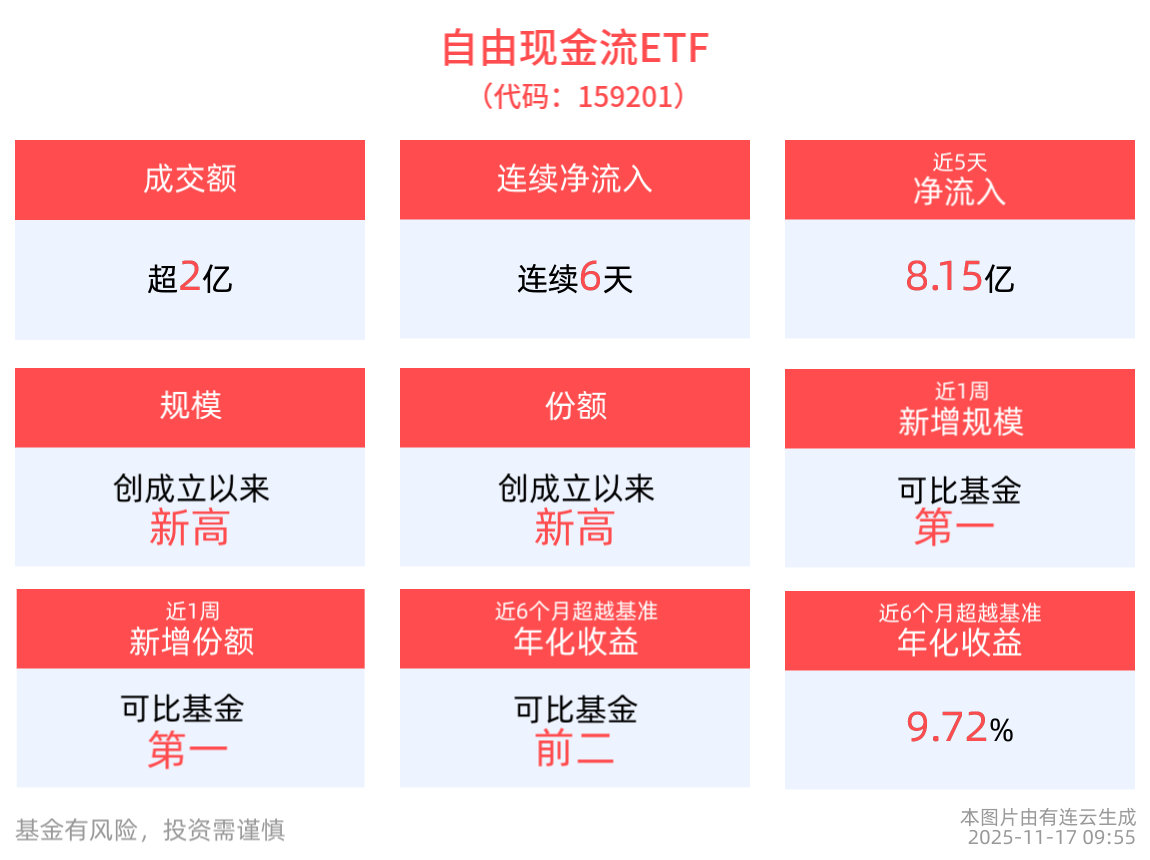
成交额超2亿元,自由现金流ETF(159201)连续6天净流入,合计“吸金”8.88亿元
Sou Hu Cai Jing· 2025-11-17 02:18
Core Insights - The Guozheng Free Cash Flow Index has decreased by 0.86% as of November 17, 2025, with mixed performance among constituent stocks [1] - The Free Cash Flow ETF (159201) has dropped by 1.07%, currently priced at 1.21 yuan, with a trading volume of 2.02 billion yuan [1] - Over the past six days, the Free Cash Flow ETF has seen continuous net inflows, totaling 8.88 billion yuan, with a daily average net inflow of 1.48 billion yuan [1][4] Performance Metrics - The Free Cash Flow ETF has achieved a net value increase of 22.85% over the past six months [4] - Historical performance shows a maximum monthly return of 7%, with the longest consecutive monthly gain of 6 months and a total gain of 22.69% [4] - The ETF has a monthly profit percentage of 87.5% and a historical 100% profit probability for holding over six months [4] Fund Details - The management fee for the Free Cash Flow ETF is 0.15%, and the custody fee is 0.05% [5] - As of October 31, 2025, the top ten weighted stocks in the Guozheng Free Cash Flow Index account for 54.79% of the index, including China National Offshore Oil Corporation and SAIC Motor [5] Stock Performance - The top ten stocks in the index have shown varied performance, with notable declines in stocks like Gree Electric Appliances (-1.08%) and China Aluminum (-2.57%) [7]







格力电器近10年分红1201亿 手握1162亿现金财务费持续为负
Chang Jiang Shang Bao· 2025-11-16 23:37
Core Viewpoint - Gree Electric Appliances continues its mid-term dividend plan, proposing a dividend of 5.585 billion yuan for the mid-2025 period, maintaining the same level as the previous year [2][3]. Dividend and Shareholder Returns - Since its listing in 1996, Gree has distributed a total of approximately 147.639 billion yuan in cash dividends, ranking 16th in the A-share market [4][5]. - Over the past decade, Gree has distributed around 120.1 billion yuan in cash dividends, placing it 14th in the A-share market [6]. - The company has conducted 32 cash dividend distributions since its IPO, with an average dividend payout ratio of 48.35% [4]. - Gree's dividend payout ratio for 2024 was 52.06%, with total cash dividends amounting to 16.755 billion yuan [3]. Share Buybacks - Since 2020, Gree has repurchased approximately 617 million shares, spending around 30 billion yuan, and has canceled about 415 million shares, which is 6.89% of the total shares before cancellation [10]. Financial Health - As of September 30, 2025, Gree's debt-to-asset ratio stood at 62.80%, with cash and cash equivalents totaling approximately 116.235 billion yuan [11]. - The company has a negative financial expense of -3.297 billion yuan for the first three quarters of 2025, indicating strong cash flow [13][14]. - Gree's cumulative profit since its listing is approximately 305.341 billion yuan, with a net profit of 32.185 billion yuan in 2024, marking a significant milestone [15]. Research and Development - Gree has invested approximately 33.3 billion yuan in R&D from 2020 to 2024, with R&D spending of 5.622 billion yuan in the first three quarters of 2025, reflecting a year-on-year increase [16].
如何看2025年10月消费数据
2025-11-16 15:36
Summary of Conference Call Records Industry Overview - The furniture industry is currently in a bottoming phase due to declining real estate sales and the reduction of subsidies, with a focus on quality companies like Gujia and Xilinmen, as well as operational turning points for companies like Oppein and Sophia [1][2] - During the Double Eleven shopping festival, cultural office supplies, daily necessities, and tobacco and alcohol sales grew by 13.5%, 7.4%, and 4.1% respectively, with pet supplies performing exceptionally well [1][3] - The retail sales of consumer goods in October increased by 2.9% year-on-year, with commodity retail growing by 2.8% and the catering industry by 3.8% [1][6] Key Insights and Arguments - The furniture retail sector saw a year-on-year growth of 9.6% in October, but this was a slowdown compared to September. The decline in building materials and home appliances sales was significant, with drops of 8.3% and 14.6% respectively [2] - The hotel sector benefited from the release of business travel demand and strong cultural tourism demand, with October's RevPAR remaining flat year-on-year but exceeding expectations in the weeks following the holiday [1][9] - The overall retail sales of consumer goods in October reached 4.6 trillion yuan, with supermarkets growing by 4.7% and department stores by only 1% [6] Investment Opportunities - For 2026, there is a focus on opportunities in overseas manufacturing and brand expansion, with domestic demand expected to recover in a lower interest rate environment. Recommended stocks include Xiangxin, YK Medical, Meiyingsen, Zhongxing Co., and Jiayi Co. [1][5] - The retail sector is expected to see improvements in companies like Yonghui and Bubugao in the fourth quarter and next year [7] - The hotel sector is projected to have a favorable supply-demand relationship in 2026, with recommendations for stocks like Shoulv Jinjiang, Atour, and Huazhu [10] Other Important Insights - The duty-free sector has shown strong performance, with significant growth in sales and average transaction value following new policy implementations [1][11][12] - The automotive sector experienced a decline in retail sales in October, with a total of 425.5 billion yuan, down 6.6% year-on-year, while wholesale sales of passenger vehicles increased by 7.5% [13][14] - The white goods sector is currently facing challenges due to reduced subsidies, but there are still investment opportunities in leading companies like Midea, Haier, and Gree, which are expected to have strong performance in the medium to long term [23][24][26][27] Conclusion - The overall consumer data for the coming year is expected to show a positive trend, with structural growth in certain sectors like the three-wheeled vehicle business of Aima Technology contributing positively to overall consumption [28]

董明珠一语点破当前我国大企业的困境!她公开表示:“格力一年被挖走600人,培养人才的速度比不上挖人的速度。#今日热聊#
Sou Hu Cai Jing· 2025-11-15 18:29
她公开表示:"格力一年被挖走600人,培养人才的速度比不上挖人的速度。 董明珠一语点破当前我国大企业的困境! ...

客厅里的智能战争
经济观察报· 2025-11-14 15:08
Core Viewpoint - The competition in the home appliance market is intensifying as traditional companies like Midea, Gree, Haier, and Hisense seek new growth through AI technology, product line expansion, and internationalization, while tech companies like Huawei and Xiaomi leverage their established smart ecosystem advantages to increase competition [2][3]. Group 1: Market Dynamics - Traditional home appliance companies are exploring new growth points through AI technology and expanding product lines [2][3]. - Tech companies are intensifying competition in the home appliance market by leveraging their smart ecosystem advantages [2][3]. - The shift towards a fully smart home environment is becoming evident, with consumers increasingly interested in integrated smart solutions [12]. Group 2: Consumer Behavior - Consumers are showing a preference for smart appliances, with features like AI voice control being particularly appealing to families with children and elderly members [6]. - There is a noticeable shift in consumer purchasing habits, with many moving from foreign brands to domestic brands due to the increasing expectations for smart features [6][7]. - Consumers are facing challenges with compatibility between different brands' smart systems, which complicates the integration of smart home devices [7]. Group 3: Technological Advancements - Home appliances are evolving from "single product intelligence" to "whole home intelligence," with systems like Midea's "Xiao Mei AI" integrating various smart functions [9][10]. - The interaction between vehicles and home systems is being developed, allowing for seamless integration and control of home environments from vehicles [11]. - The trend towards smart home integration is expected to continue, with significant growth projected in the smart home market over the next few years [12]. Group 4: Industry Trends - Major players in the home appliance sector, including Gree, Midea, Haier, and Hisense, are adapting to the blurred lines between home appliances and broader home ecosystems [14]. - The retail landscape is shifting, with smart home products being prominently displayed alongside traditional appliances to attract consumer interest [14]. - The release of technological potential in the home appliance sector is expected to reshape global competition, allowing Chinese companies to gain a more advantageous position in the market [15].

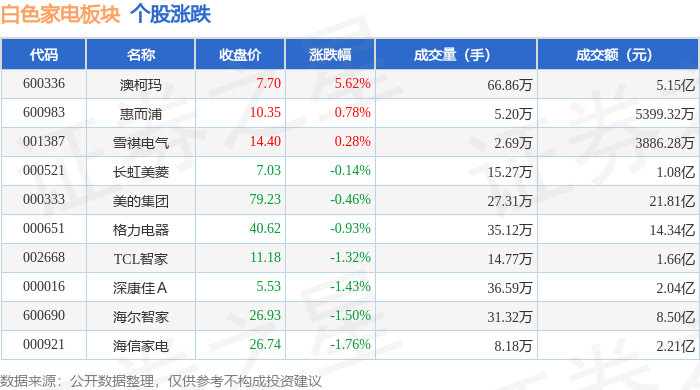
白色家电板块11月14日跌0.74%,海信家电领跌,主力资金净流出1.64亿元
Zheng Xing Xing Ye Ri Bao· 2025-11-14 08:49
Market Overview - The white goods sector experienced a decline of 0.74% on November 14, with Hisense Appliances leading the drop [1] - The Shanghai Composite Index closed at 3990.49, down 0.97%, while the Shenzhen Component Index closed at 13216.03, down 1.93% [1] Stock Performance - Aokema (600336) saw a significant increase in its closing price to 7.70, up by 5.62% with a trading volume of 668,600 shares [1] - Whirlpool (600983) closed at 10.35, up 0.78%, with a trading volume of 52,000 shares [1] - Midea Group (000333) closed at 79.23, down 0.46%, with a trading volume of 273,100 shares [1] - Gree Electric (000651) closed at 40.62, down 0.93%, with a trading volume of 351,200 shares [1] - Hisense Appliances (000921) closed at 26.74, down 1.76%, with a trading volume of 81,800 shares [1] Capital Flow - The white goods sector experienced a net outflow of 164 million yuan from institutional investors, while retail investors saw a net inflow of 129 million yuan [1] - Aokema had a net inflow of 52.74 million yuan from institutional investors, while retail investors had a net outflow of 27.33 million yuan [2] - Midea Group had a net inflow of 10.00 million yuan from institutional investors, but retail investors experienced a net outflow of 20.38 million yuan [2] - Hisense Appliances faced a net outflow of 31.43 million yuan from institutional investors, while retail investors had a net inflow of 23.60 million yuan [2]


家电行业2025年三季报综述:收入韧性,盈利优化
Changjiang Securities· 2025-11-14 05:12
Investment Rating - The report maintains a "Positive" investment rating for the home appliance industry [11] Core Insights - The home appliance sector shows strong profitability resilience despite challenges from domestic subsidy reductions and external tariff impacts. The overall valuation remains at a reasonable low level, suggesting opportunities for growth in high-performing leaders and stable value recovery in established companies [2][10] Overall Industry Summary - The home appliance industry achieved a revenue growth of 7.52% year-on-year in the first three quarters of 2025, with quarterly growth rates of +13.97%, +5.46%, and +3.59% respectively. The growth trend is expected to slow down due to subsidy reductions and diminishing marginal effects [4][21] - The gross profit margin for the industry in Q3 2025 was 24.75%, reflecting a slight year-on-year decrease of 0.54 percentage points, while the gross sales difference improved by 0.64 percentage points to 16.35% [31][39] - The net profit attributable to shareholders for the first three quarters of 2025 reached 1,048.77 billion, marking a year-on-year increase of 9.76%, with Q3 net profit growing by 4.22% [38][44] White Goods - The white goods sector reported a revenue growth of 9.06% year-on-year in the first three quarters of 2025, with Q3 growth at 5.29%. The sector benefits from a reduction in domestic price competition, leading to a recovery in gross profit margins [5][27] - The net profit for the white goods sector increased by 11.32% year-on-year in the first three quarters, with Q3 showing a growth of 3.50% [43][44] Black Goods - The black goods sector experienced a revenue growth of 3.09% year-on-year in the first three quarters, but Q3 saw a decline of 2.64%. The sector's performance is influenced by a low base effect and increased non-recurring gains [6][24] - The net profit for the black goods sector surged by 37.26% in Q3, reflecting a strong recovery [42][43] Kitchen Appliances and Post-Cycle - The kitchen appliance sector faced a revenue decline of 4.09% in Q3 2025, attributed to a downturn in the real estate market and cautious consumer spending [7][25] - The net profit for the kitchen appliance sector decreased by 12.73% year-on-year in Q3 [42][43] Small Appliances - The small appliances sector achieved a revenue growth of 5.92% in Q3 2025, with the cleaning segment showing a remarkable growth of 30.70% [8][24] - The net profit for the small appliances sector increased by 16.52% year-on-year in Q3 [42][43] Upstream Components - The upstream components sector reported a revenue growth of 8.13% year-on-year in the first three quarters, with Q3 growth at 3.31%. The sector's profitability significantly improved due to order and business structure optimization [9][26] - The net profit for the upstream components sector grew by 30.29% in Q3 [42][43] Investment Recommendations - The report suggests focusing on high-growth leaders with strong organizational, technological, and brand capabilities, such as Anker Innovations, Roborock, and Ninebot. Additionally, it recommends paying attention to stable leaders like Midea Group, Haier Smart Home, and Gree Electric for value recovery opportunities [10]



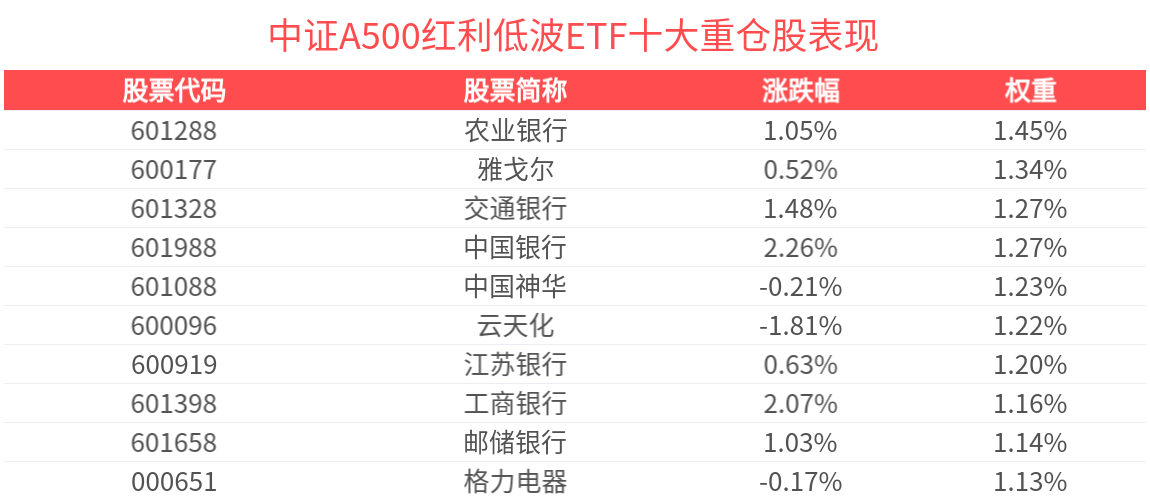
银行股集体上涨,中证A500红利低波ETF(561680)红盘向上
Xin Lang Cai Jing· 2025-11-14 03:07
Core Insights - The China A500 Dividend Low Volatility Index (932422) has shown a slight increase of 0.14% as of November 14, 2025, with notable gains in major banks such as Bank of China (601988) up by 2.26% and Industrial and Commercial Bank of China (601398) up by 2.07% [1] Investment Environment - The National Bureau of Statistics emphasizes the need to focus on high-quality development, optimize investment structure, and enhance the investment environment to stimulate private investment and promote healthy investment growth [1] - According to Zhongtai Securities, the investment logic for bank stocks is shifting from "pro-cyclical" to "weak-cyclical," making high-dividend bank stocks more attractive during economic stagnation [1] - With the M1 growth rate declining, major financial data has entered a downward cycle, attributed to weaker fiscal expansion and the fading of low base effects [1] ETF Performance - The China A500 Dividend Low Volatility ETF (561680) has a turnover rate of 1.8% and a transaction volume of 3.36 million yuan as of November 14, 2025 [2] - Since its inception, the ETF has recorded a maximum monthly return of 3.37% and an average monthly return rate of 3.37%, with a monthly profit probability of 78.57% [2] - The maximum drawdown since inception is 3.42%, with a recovery period of 30 days [2] Index Composition - As of October 31, 2025, the top ten weighted stocks in the China A500 Dividend Low Volatility Index account for 31.82% of the index, including Agricultural Bank of China (601288) and China Shenhua Energy (601088) [3] - The top ten stocks include major banks and companies, indicating a strong representation of the financial sector within the index [3][5]





11月13日深证龙头(399653)指数涨1.73%,成份股瑞达期货(002961)领涨
Sou Hu Cai Jing· 2025-11-13 10:06
Core Insights - The Shenzhen Leading Index (399653) closed at 3104.35 points, up 1.73%, with a trading volume of 105.65 billion yuan and a turnover rate of 0.96% [1] - Among the index constituents, 36 stocks rose while 12 fell, with Ruida Futures leading the gainers at an increase of 8.07%, and Binjiang Group leading the decliners with a drop of 3.33% [1] Index Constituents Summary - The top ten constituents of the Shenzhen Leading Index include: - Ningde Times (20.44% weight) at 415.60 yuan, up 7.56%, with a market cap of 1896.42 billion yuan [1] - Zhongji Xuchuang (8.35% weight) at 481.00 yuan, down 2.19%, with a market cap of 534.45 billion yuan [1] - Midea Group (7.67% weight) at 79.60 yuan, up 0.14%, with a market cap of 611.73 billion yuan [1] - Luxshare Precision (6.06% weight) at 57.38 yuan, down 0.68%, with a market cap of 417.85 billion yuan [1] - Sungrow Power (5.67% weight) at 190.51 yuan, up 1.53%, with a market cap of 394.97 billion yuan [1] - BYD (5.25% weight) at 99.83 yuan, up 2.11%, with a market cap of 910.17 billion yuan [1] - Wugong Liquor (4.41% weight) at 121.20 yuan, up 0.68%, with a market cap of 470.45 billion yuan [1] - Gree Electric (3.53% weight) at 41.00 yuan, down 0.36%, with a market cap of 229.66 billion yuan [1] - ZTE Corporation (2.83% weight) at 40.35 yuan, up 1.56%, with a market cap of 193.02 billion yuan [1] - Yuanlefang A (2.75% weight) at 4.04 yuan, unchanged, with a market cap of 151.15 billion yuan [1] Capital Flow Analysis - The net inflow of main funds into the Shenzhen Leading Index constituents totaled 3.862 billion yuan, while retail investors experienced a net outflow of 684 million yuan [1] - Notable capital flows include: - Ningde Times saw a net inflow of 2.655 billion yuan from main funds, while retail investors had a net outflow of 448 million yuan [2] - BYD had a net inflow of 607 million yuan from main funds, with retail investors experiencing a net outflow of 208 million yuan [2] - Zhongji Xuchuang had a net inflow of 409 million yuan from main funds, while retail investors had a negligible outflow [2]





