
ZGXT(000831)

Search documents
贵金属蓄势待发,有色ETF基金(159880)红盘震荡,机构:重点关注战略小金属投资机会
Sou Hu Cai Jing· 2025-06-10 06:00
Group 1 - The core viewpoint of the articles highlights the strong performance of the non-ferrous metal sector, particularly in light of increasing gold reserves and heightened market risk aversion due to global conflicts and inflation data [1][2] - As of May 30, 2025, the top ten weighted stocks in the non-ferrous metal industry index accounted for 51.92% of the total index, indicating a concentration of investment in key players such as Zijin Mining and Northern Rare Earth [2] - The China Central Bank has increased its gold reserves to 7.383 million ounces as of the end of May, marking the seventh consecutive month of gold accumulation, which reflects a strategic move amidst global economic uncertainties [1] Group 2 - The non-ferrous ETF fund closely tracks the non-ferrous metal industry index, which includes 50 securities that are prominent in terms of scale and liquidity, providing a benchmark for the overall performance of listed companies in the sector [1] - The article suggests focusing on investment opportunities in strategic minor metals such as gallium, germanium, tungsten, and antimony, as their price trends are showing divergence [1]



稀土:从资源龙头到永磁先锋,政策与需求双重驱动下的产业链价值解析
Sou Hu Cai Jing· 2025-06-09 14:32
Core Viewpoint - The article discusses the evolving landscape of the rare earth industry, highlighting the impact of policy changes, supply-demand dynamics, and emerging market opportunities driven by technological advancements and strategic resource management [1][2][3]. Group 1: Policy and Supply Dynamics - China's rare earth mining quota is expected to remain at 270,000 to 280,000 tons REO by 2025, with a year-on-year growth rate of 5%-10%, significantly lower than the previous years' growth of over 20% [1]. - The policy shift emphasizes "quality control" over "scale expansion," with all sources of rare earths now included in quota management, enhancing state control over supply [1]. - The supply of heavy rare earths is tightening, with a 17.3% year-on-year decline in imports from Myanmar due to ongoing conflicts and resource tax disputes, leading to a supply gap of 5.8% for heavy rare earths [4]. Group 2: Demand Drivers - The demand for rare earth permanent magnet materials (NdFeB) is surging, particularly in sectors such as electric vehicles, wind power, industrial motors, and humanoid robots [2]. - By 2025, global sales of electric vehicles are projected to reach 18 million units, driving the demand for praseodymium-neodymium oxide to over 70,000 tons [4]. - The penetration rate of permanent magnet direct-drive wind turbines is expected to exceed 65%, with a projected demand of 15,000 tons by 2025 [4]. Group 3: Market Space and Price Trends - The global rare earth market is anticipated to reach a scale of $14-16 billion by 2025, with China accounting for over 60% of this market [4]. - The price of praseodymium-neodymium oxide is expected to rise to a central price range of 450,000 to 500,000 yuan per ton by 2025, driven by tightening domestic quotas and recovering demand [4]. - The price of dysprosium oxide is projected to exceed 2,000 yuan per kilogram, while terbium oxide is expected to surpass 7,000 yuan per kilogram due to supply disruptions and export control policies [4]. Group 4: Company Insights - Northern Rare Earth is the largest light rare earth supplier globally, controlling 83% of the Baiyun Obo mine's reserves, with a projected 69.8% share of the national mining quota by 2025 [7]. - China Rare Earth Group, as a core platform, has seen a turnaround with a 141.32% year-on-year revenue increase in Q1 2025, primarily due to rising rare earth prices [8]. - Xiamen Tungsten is the only company in China capable of recycling all rare earth elements, with a complete supply chain from mining to magnetic materials [8]. Group 5: Technological Advancements and Future Outlook - The development of high-temperature resistant NdFeB materials and low rare earth content magnets has strengthened competitiveness in high-end markets [10]. - The establishment of a joint venture with China Rare Earth Group in Fujian aims to enhance resource development in southern heavy rare earths [10]. - The recycling of rare earths is projected to reach 32,000 tons by 2025, with the market scale exceeding 100 billion yuan by 2030 [9].


19.46亿主力资金净流入,稀土永磁概念涨3.45%
Zheng Quan Shi Bao Wang· 2025-06-09 08:51
资金面上看,今日稀土永磁概念板块获主力资金净流入19.46亿元,其中,39股获主力资金净流入,7股 主力资金净流入超亿元,净流入资金居首的是英洛华,今日主力资金净流入5.34亿元,净流入资金居前 的还有中国稀土、北方稀土、中科磁业等,主力资金分别净流入3.09亿元、1.36亿元、1.20亿元。 资金流入比率方面,英洛华、北矿科技、华阳新材等流入比率居前,主力资金净流入率分别为 32.63%、27.12%、19.81%。(数据宝) 稀土永磁概念资金流入榜 | 601600 | 中国铝 | 1.34 | 1.18 | 7879.02 | 7.52 | | --- | --- | --- | --- | --- | --- | | | 业 | | | | | | 300224 | 正海磁 | 5.04 | 6.76 | 7829.95 | 10.36 | | | 材 | | | | | | 603072 | 天和磁 | 6.39 | 26.31 | 7828.83 | 8.64 | | | 材 | | | | | | 600980 | 北矿科 | 10.01 | 8.29 | 7271.47 | 27.12 | | ...

港股收评:技术性牛市!科技金融齐涨,中国稀土狂飙60%
Ge Long Hui· 2025-06-09 08:51
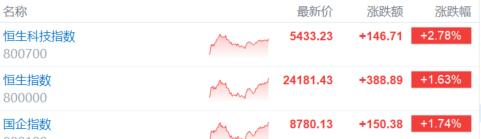
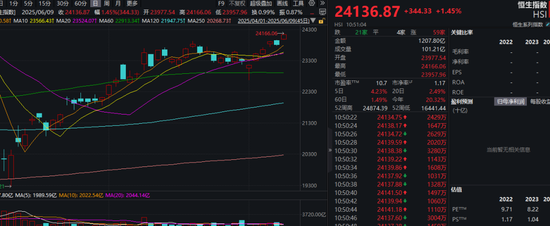
6月9日,中美经贸磋商会议在伦敦举行,市场风险情绪升温。 港股三大指数全天表现强势,恒生科技指数一度大涨3.2%,收涨2.78%;恒指涨1.63%站上24100点上方,从4月低点上涨21%进入技术性牛市,近乎收复此 前调整跌幅。 | 名称 | | 最新价 | 涨跌额 涨跌幅 | | --- | --- | --- | --- | | 恒生科技指数 | Fryst | 5433.23 | +146.71 +2.78% | | 800700 | | | | | 恒生指数 | Mar | 24181.43 | +388.89 +1.63% | | 800000 | | | | | 国企指数 | | 8780.13 | +150.38 +1.74% | | | M.N | | | 盘面上,大型科技股、大金融股、中字头股等权重集体表现活跃助力大市走强;医药板块大涨,创新药概念股涨幅居前;新消费概念股再度活跃,泡泡玛特 再创历史新高,半导体股、苹果概念股、军工股、稳定币概念股、石油股、教育股等热门板块齐涨。另一方面,市场避险情绪降温致金价下滑,黄金股逆势 下跌,铝、铜等有色金属股集体跟跌,啤酒股、汽车股、煤炭股普遍弱势。 ...

港股收盘(06.09) | 恒指收涨1.63%站上两万四 创新药概念全天强势 中国稀土(00769)飙升60%
智通财经网· 2025-06-09 08:48
Market Overview - The Hong Kong stock market showed a positive trend with the Hang Seng Index rising 1.63% to close at 24,181.43 points, while the Hang Seng China Enterprises Index and the Hang Seng Tech Index also saw significant gains of 1.74% and 2.78% respectively, marking a technical bull market as they rose over 20% from April lows [1] - The trading volume for the day reached 245.83 billion HKD, indicating strong market activity [1] Blue Chip Performance - Kuaishou-W (01024) led the blue-chip stocks with a 5.58% increase, closing at 62.4 HKD, contributing 16.34 points to the Hang Seng Index [2] - Other notable performers included WuXi Biologics (02269) up 5.48%, SMIC (00981) up 5.1%, while Budweiser APAC (01876) and Zijin Mining (02899) experienced declines of 2.06% and 1.64% respectively [2] Sector Highlights - Major technology stocks collectively rose, with Kuaishou increasing over 5% and Meituan and JD.com both rising over 4% [3] - The innovative drug sector showed strong performance, with stocks like Eucure Biopharma-B (01477) up 19.45% and King’s Ray Biotech (01548) up 16.14% [3][4] - The Chinese securities sector saw a broad increase, with firms like Everbright Securities (06178) rising 5.27% and GF Securities (01776) up 4.66% [4] Regulatory Developments - The China Securities Regulatory Commission approved the transfer of control for eight companies to Central Huijin, which may lead to a new wave of mergers and acquisitions in the securities industry [5] Consumer and Technology Trends - The upcoming Apple Worldwide Developers Conference (WWDC 2025) is expected to drive interest in consumer electronics and related stocks, with companies like AAC Technologies (01415) and Sunny Optical (02382) showing gains [6] - New consumption stocks also performed well, with companies like Bruker (00325) rising 22.34% [6][7] Commodity Movements - Gold stocks faced declines, with Shandong Gold (01787) down 3.99%, influenced by stable U.S. employment data which suggests the Federal Reserve may maintain its current interest rate stance [7] Notable Stock Movements - China Rare Earth (00769) surged 60% following news of eased export controls on rare earths, reflecting strong market interest [8] - Huicai Holdings (01180) experienced a dramatic drop of 47.54% before being suspended, indicating volatility in the entertainment equipment sector [9]

中国稀土(00769.HK)6月9日收盘上涨60.0%,成交2.73亿港元
Jin Rong Jie· 2025-06-09 08:40
Group 1: Company Overview - China Rare Earth Holdings Limited is one of the largest producers of rare earth and refractory materials in China, listed on the Hong Kong Stock Exchange since October 15, 1999 [3] - The company began operations in 1987 in Yixing, Jiangsu Province, evolving from a rare earth separation plant to an internationally recognized manufacturer [3] - The production capacity of the company includes 6,500 tons of rare earth oxides (REO) and 100,000 tons of refractory materials [3] Group 2: Financial Performance - As of December 31, 2024, the company achieved total operating revenue of 701 million yuan, representing a year-on-year growth of 10.29% [2] - The net profit attributable to shareholders was -97.16 million yuan, with a year-on-year increase of 47.68% [2] - The gross profit margin was -7%, and the debt-to-asset ratio stood at 5.35% [2] Group 3: Market Position and Valuation - The company's price-to-earnings (P/E) ratio is -9.68, ranking 44th in the industry, while the average P/E ratio for the general metals and ores industry is -2.2 [3] - The company has not received any investment rating recommendations from institutions [3] Group 4: Production Facilities and Products - The company operates a rare earth separation plant and a refractory materials production facility, equipped with advanced production and control technologies [4] - The rare earth products are essential raw materials for various industrial products, including electronics, motors, LCD screens, and energy-saving products [4] - Refractory materials are widely used in high-temperature processing equipment across industries such as petrochemicals, metallurgy, and construction [4] Group 5: Research and Development - The company has a dedicated research and development center focused on improving existing products and developing new ones [4] - There is an emphasis on developing environmentally friendly and high-value-added deep-processing products to meet market needs [4]
中美经贸磋商在即,中国稀土狂飙50%!全球“稀土焦虑”彻底引爆?
Sou Hu Cai Jing· 2025-06-09 07:51
近期在一系列消息影响下,稀土概念再度"火力全开"。 今日,港A稀土概念高开高走。其中,A股科恒股份、北矿科技、英洛华涨停,中科磁业涨超16%,银河磁体、华伍股份等跟涨。 | 代码 | 名称 | 最新价 | 涨跌额 | ※跌幅 > | 总市值 | | --- | --- | --- | --- | --- | --- | | 301141 | 中科磁业 | 47.12 | +6.72 | 16.63% | 58.44亿 | | 300340 | 科恒股份 | 15.72 | +2.62 | 20.00% | 43.37亿 | | 600980 | 北矿科技 | 18.80 | +1.71 | 10.01% | 35.58亿 | | 000795 | 英洛华 | 11.12 | +1.01 | 9.99% | 126.07亿 | | 300127 | 银河磁体 | 26.63 | +1.76 | 7.08% | 86.05亿 | | 300095 | 华伍股份 | 9.51 | +0.47 | 5.20% | 39.95亿 | | 688077 | 大地龍 | 28.14 | +1.74 | 6.59% | 32 ...

港股中国稀土(00769.HK)午后涨幅持续扩大,一度涨超52%,现涨近46%,成交额近1.6亿港元。

news flash· 2025-06-09 05:35
港股中国稀土(00769.HK)午后涨幅持续扩大,一度涨超52%,现涨近46%,成交额近1.6亿港元。 ...
A股、港股,大涨!中国稀土狂飙!
Zheng Quan Shi Bao· 2025-06-09 03:48
Market Overview - A-shares and Hong Kong stocks showed significant strength, with the Shanghai Composite Index briefly surpassing the 3400-point mark and the Hang Seng Index returning above 24000 points for the first time in over two months [1][2] - The Hang Seng Technology Index experienced a surge, with gains exceeding 3% during the trading session [4] Sector Performance - The biopharmaceutical sector led the A-share market, with a rise of over 2.7%, and several stocks, including Hainan Haiqi Pharmaceutical and Ruizhi Pharmaceutical, hitting the "20cm" limit up [1] - Non-bank financial stocks also saw substantial increases, with companies like Xinda Securities and Yong'an Futures reaching their daily limit up [1] - In contrast, the home appliance and non-ferrous metals sectors experienced declines [2] Economic Indicators - The National Bureau of Statistics reported a 0.1% year-on-year decline in the Consumer Price Index (CPI) for May 2025, with food prices down 0.4% and non-food prices remaining stable [2] - The Producer Price Index (PPI) for May 2025 showed a year-on-year decrease of 3.3% [2] Notable Stock Movements - In the Hong Kong market, Kingdee International saw a price increase of over 9%, while Tencent Music and Kuaishou both rose by over 6% [4] - Conversely, gold stocks in Hong Kong faced declines, with companies like Zhaojin Mining and Zijin Mining dropping significantly [4] - Chinese rare earth stocks experienced a dramatic rise, with one stock increasing by over 50% during the session [4] Regulatory Developments - The Ministry of Commerce confirmed the implementation of export controls on rare earth materials, emphasizing the dual-use nature of these items and the need to maintain national security [4]
6月9日电,港股中国稀土涨幅扩大至20%,成交额超2000万港元。
news flash· 2025-06-09 01:54
智通财经6月9日电,港股中国稀土涨幅扩大至20%,成交额超2000万港元。 ...