
ZGXT(000831)

Search documents
中国稀土:公司一直高度重视投资者关系
Zheng Quan Ri Bao Wang· 2025-12-19 15:13
证券日报网讯12月19日,中国稀土(000831)在互动平台回答投资者提问时表示,公司一直高度重视投 资者关系。近年来,公司在年度报告披露后均及时召开业绩说明会,已实现业绩说明会常态化;同时, 根据实际情况,召开半年度和季度业绩说明会。后续,公司如有召开业绩说明会,将及时履行信息披露 义务。 ...

中国稀土:截至2025年12月10日收盘公司股东总户数为237903户
Zheng Quan Ri Bao Wang· 2025-12-19 15:13
Core Viewpoint - As of December 10, 2025, the total number of shareholders for China Rare Earth (000831) is reported to be 237,903 [1] Company Summary - China Rare Earth has provided an update on its shareholder count, indicating a significant engagement with investors [1]
中国稀土:稀土产品价格受市场环境、政策变化、行业供需周期等因素影响
Zheng Quan Ri Bao Wang· 2025-12-19 15:12
证券日报网讯12月19日,中国稀土(000831)在互动平台回答投资者提问时表示,稀土产品价格受市场 环境、政策变化、行业供需周期等因素影响,一直处于波动状态。 ...
美国手握190万吨稀土,却哭着求中国发货!中国稀土卡脖子的真相
Sou Hu Cai Jing· 2025-12-19 14:36
Core Insights - The article discusses the strategic importance of China's dominance in the rare earth industry, highlighting that the U.S. relies on Chinese imports despite having its own rare earth resources due to a lack of processing capabilities [1][3][11] Group 1: U.S. Dependence on Chinese Rare Earths - The U.S. has 1.9 million tons of rare earth reserves, accounting for 2% of global reserves, theoretically sufficient for self-sufficiency [3] - The actual dependence stems from the inability to efficiently convert rare earth resources into usable products, necessitating imports from China [4][9] Group 2: China's Competitive Advantages - China holds 80% of the world's known rare earth reserves and has a significant strategic advantage akin to that of Middle Eastern oil [3] - The country leads in extraction and refining technology, being the only nation capable of stable mass production of 6N-grade heavy rare earths, while others struggle with 4N-grade [6][8] - The cost of extracting one ton of rare earth in China is $8,000, compared to $28,000 in the U.S., making China's position more favorable [6][8] Group 3: Challenges for Other Countries - Other nations, including the U.S. and Japan, face significant hurdles in establishing independent rare earth production lines, often requiring imports of equipment and expertise from China [9][11] - Japan's attempts to develop deep-sea rare earth mining have stalled, illustrating the difficulties faced even by technologically advanced countries [9][11] Group 4: Strategic Implications - China's comprehensive control over the rare earth supply chain, including over 90% of processing tasks, creates a barrier for other countries to replace its role in the market [8][11] - The reliance on Chinese rare earths extends beyond the U.S. and Japan, affecting multiple countries globally and solidifying China's irreplaceable position in the strategic resource landscape [11]

中国稀土涨2.99%,成交额13.84亿元,今日主力净流入1.30亿
Xin Lang Cai Jing· 2025-12-19 07:59
Core Viewpoint - China's rare earth sector experienced a price increase of 2.99%, with a trading volume of 1.384 billion yuan and a turnover rate of 2.90%, leading to a total market capitalization of 47.914 billion yuan [1] Company Overview - The company primarily engages in the production and operation of rare earth oxides and provides rare earth technology research and consulting services [2][8] - The main products include high-purity single rare earth oxides and rare earth co-precipitation products, with over 80% of products having a purity greater than 99.99%, and some rare earth oxides reaching purities of 99.9999% [2] - The company is controlled by the State-owned Assets Supervision and Administration Commission of the State Council, categorizing it as a state-owned enterprise [3][4] Financial Performance - For the period from January to September 2025, the company achieved a revenue of 2.494 billion yuan, representing a year-on-year growth of 27.73%, and a net profit attributable to shareholders of 192 million yuan, marking a significant increase of 194.67% [8] - The company has distributed a total of 346 million yuan in dividends since its A-share listing, with 124 million yuan distributed over the past three years [9] Shareholder Structure - As of September 30, 2025, the top ten circulating shareholders include Hong Kong Central Clearing Limited as the fourth largest shareholder with 29.0694 million shares, an increase of 9.4669 million shares from the previous period [10] - New shareholders include the Jiashi Zhongzheng Rare Earth Industry ETF and the Southern Zhongzheng Shenwan Nonferrous Metals ETF, indicating growing institutional interest [10] Market Dynamics - The stock is categorized under the non-ferrous metals sector, specifically within the small metals and rare earths sub-sector, and is associated with concepts such as state-owned enterprise reform and rare earth permanent magnets [8]
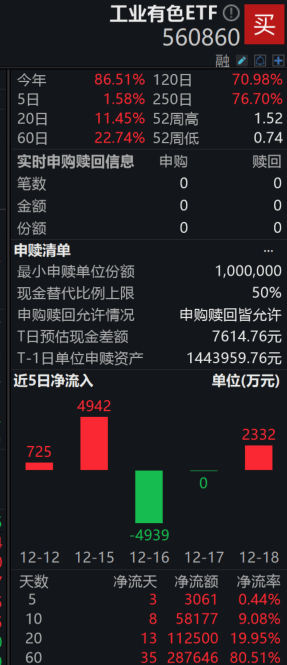
11月CPI或增美联储鸽派声音,国际铜、铝期价上涨,工业有色ETF(560860)放量涨超2%,场内溢价频现,近10日“吸金”超5.8亿
Sou Hu Cai Jing· 2025-12-19 06:44
Group 1 - The market experienced a slight increase on December 19, with the non-ferrous metals sector leading the gains, including copper, aluminum, and rare earths, with Yun Aluminum rising over 60% [1] - The Industrial Non-Ferrous ETF (560860) saw a trading volume exceeding 3.1 billion, surpassing the total from the previous day, indicating active trading with frequent premiums in the market [1] - The Industrial Non-Ferrous ETF has attracted significant capital, with over 5.8 billion raised in the last 10 days, over 11 billion in the last 20 days, and over 28 billion in the last 60 days, bringing its latest scale to 69.88 billion [1] Group 2 - Internationally, U.S. inflation showed unexpected easing, with the November core CPI rising by 2.6%, the lowest since 2021, providing the Federal Reserve with substantial room to consider interest rate cuts [3] - LME metal futures generally rose, with LME copper increasing by 41 USD to 11,778 USD/ton and LME aluminum rising by 10 USD to 2,916 USD/ton [3] - In the rare earth sector, Chinese authorities have communicated policies to exporters, with some exporters meeting the basic requirements for applying for general licenses, indicating a potential increase in exports [3] Group 3 - According to Guotai Junan Securities, copper is expected to see dual positive catalysts from its financial and commodity attributes, with increased demand and inventory pressures due to insufficient supply [3] - Aluminum is anticipated to break out of its three-year price range due to strong demand and low inventory, entering a phase of significant upward movement driven by demand catalysts [4] - The Industrial Non-Ferrous ETF closely tracks the CSI Industrial Non-Ferrous Metals Theme Index, covering leading strategic resources such as copper, aluminum, and rare earths, providing opportunities for investors to capitalize on cyclical and policy-driven benefits [4]



2025年10月中国稀土及其制品出口数量和出口金额分别为1.05万吨和3.41亿美元
Chan Ye Xin Xi Wang· 2025-12-19 03:04
Core Viewpoint - China's rare earth and its products export volume reached 10,500 tons in October 2025, marking a year-on-year increase of 1.6%, while the export value amounted to 341 million USD, reflecting a year-on-year growth of 22.6% [1]. Group 1 - The export volume of China's rare earth and its products in October 2025 was 10,500 tons [1]. - The year-on-year growth rate for the export volume was 1.6% [1]. - The export value for the same period was 341 million USD [1]. Group 2 - The year-on-year increase in export value was 22.6% [1].

中国稀土:2025年12月24日召开2025年第四次临时股东会
Zheng Quan Ri Bao· 2025-12-18 07:19
证券日报网讯 12月17日晚间,中国稀土发布公告称,公司将于2025年12月24日14:50召开2025年第四 次临时股东会。 (文章来源:证券日报) ...
小金属及新材料行业2026年度投资策略(有色板块成长篇):小金属供给收紧筑底,AI金属需求高增空间广
Western Securities· 2025-12-18 07:16
Core Conclusions - The small metal sector is expected to benefit from the rising demand in the AI industry, presenting new investment opportunities [6] - The report maintains an "overweight" rating for the small metal sector, indicating a positive outlook for the industry [7] Industry Overview - The small metal sector significantly outperformed the market in 2025, with an annual cumulative return of 83.54%, surpassing the cumulative return of the Shenwan Nonferrous Metals Index (82.05%) and the CSI 300 Index (20%) [10][13] - The rare earth sector is projected to maintain an upward trend in 2026 due to strong demand recovery and supply-side policy constraints, indicating that the industry cycle is not yet over [10] - The tungsten market is entering a new price cycle driven by supply constraints and emerging demand, suggesting a strategic value for investors [10] - The antimony market is experiencing a new phase characterized by supply rigidities and policy relaxations, with potential price increases anticipated in 2026 [10] - The tin market is also entering a new phase with supply constraints and demand upgrades, indicating a resilient supply-demand balance [10] - The demand for new metal materials is expected to grow alongside the rapid development of the AI industry, particularly for permanent magnetic materials and high-end copper alloys [10] Investment Recommendations - Recommended stocks in the rare earth sector include Northern Rare Earth, Zhenghai Magnetic Materials, and Jinli Permanent Magnet, with a focus on China Rare Earth and Shenghe Resources [6] - For tungsten, attention is drawn to Zhongtung High-tech and Xiamen Tungsten [6] - In the antimony sector, recommended stocks include Huayu Mining, Huaxi Nonferrous, and Hunan Gold [6] - For tin, focus on Tin Industry Co. and Huaxi Nonferrous [6] - In the new materials sector, recommended stocks include Bowei Alloy and Srey New Materials [6] Supply and Demand Dynamics - The rare earth industry is experiencing a strong price increase driven by supply-side constraints and a recovery in export demand, with the price of praseodymium-neodymium oxide increasing by 45.49% in 2025 [31] - The global rare earth production is expected to grow moderately, with China's production leading the market, indicating a dominant position in both production and reserves [41] - Domestic supply indicators for light rare earths are showing a significant slowdown in growth, with the supply structure increasingly dominated by major players [48]




中国稀土(000831) - 关于召开2025年第四次临时股东会的提示性公告
2025-12-17 08:00
证券代码:000831 证券简称:中国稀土 公告编号:2025-064 中国稀土集团资源科技股份有限公司 关于召开 2025 年第四次临时股东会的提示性公告 本公司及董事会全体成员保证信息披露的内容真实、准确、完整,没有虚 假记载、误导性陈述或重大遗漏。 中国稀土集团资源科技股份有限公司(以下简称"公司")于 2025 年 12 月 9 日在 《证券时报》《中国证券报》和巨潮资讯网(http://www.cninfo.com.cn)发布了《关于 召开 2025 年第四次临时股东会的通知》。为保护投资者合法权益,方便股东行使股东会 表决权,现发布关于召开公司 2025 年第四次临时股东会的提示性公告: 一、召开会议的基本情况 1、股东会届次:2025 年第四次临时股东会 2、股东会的召集人:董事会 3、本次会议的召集、召开符合《中华人民共和国公司法》《深圳证券交易所股票上 市规则》《深圳证券交易所上市公司自律监管指引第 1 号——主板上市公司规范运作》等 法律、行政法规、部门规章、规范性文件及《公司章程》的有关规定。 4、会议时间: (1)现场会议时间:2025 年 12 月 24 日 14:50 (2)网络投 ...