
Sinoma Science & Technology (002080)

Search documents
建材稳增长方案出台,继续推荐反内卷+出海+高端电子布投资机会
Tianfeng Securities· 2025-09-28 12:44
Investment Rating - Industry Rating: Outperforming the market (maintained rating) [4] Core Viewpoints - The construction materials sector (CITIC) declined by 1.73% this week, underperforming the CSI 300 index, which rose by 1.07%, resulting in a 2.8 percentage point lag [2][10] - On September 24, the Ministry of Industry and Information Technology and five other departments jointly released the "Construction Materials Industry Stabilization Growth Work Plan (2025-2026)", addressing weak market demand and structural issues in the industry. The plan emphasizes strict capacity control for cement and glass, promotes technological innovation, and encourages digital transformation and green low-carbon upgrades [2][17] - The new plan focuses more on resolving structural issues rather than emphasizing growth targets, with clear measures for capacity control in overcapacity sectors like cement and glass. It also highlights the need for continuous improvement in transformation and upgrading, particularly in high-end materials [2][17] Summary by Sections Market Review - The CSI 300 index increased by 1.07% while the construction materials sector (CITIC) fell by 1.73%, with glass fiber and glass sub-sectors experiencing smaller declines. Notable stock performances included Xidamen (+9.8%), Shangfeng Cement (+8.1%), and China Jushi (+7.5%) [1][10] Key Recommendations - Recommended stocks include: 1. Cement: Huaxin Cement, Conch Cement, Shangfeng Cement 2. Glass: Qibin Group, Fuyao Glass, Yamaton 3. Consumer Building Materials: Dongfang Yuhong, Sankeshu, Beixin Building Materials 4. Glass Fiber: China Jushi, Shandong Fiberglass, Changhai Co. [2][19] Focused Investment Opportunities - The report suggests focusing on high-demand sectors such as high-end electronic fabrics and overseas markets, recommending companies like China National Materials, Honghe Technology, and West Cement [2][19]



长江大宗2025年10月金股推荐
Changjiang Securities· 2025-09-28 10:12
Group 1: Metal Sector - Zijin Mining's net profit forecast for 2025 is 475 million CNY, with a PE ratio of 15.46[12] - Luoyang Molybdenum's net profit forecast for 2025 is 168.65 million CNY, with a PE ratio of 17.35[12] - The copper production of Zijin Mining is expected to increase by 7% to 115,000 tons in 2025[20] Group 2: Chemical Sector - Wanhua Chemical's net profit forecast for 2025 is 141.75 million CNY, with a PE ratio of 0.00[12] - Longbai Group's net profit forecast for 2025 is 23.01 million CNY, with a PE ratio of 19.75[12] - The MDI market is expected to improve as supply and demand conditions stabilize[48] Group 3: Transportation Sector - China Merchants Highway's net profit forecast for 2025 is 55.01 million CNY, with a PE ratio of 12.10[12] - Haitong Development's net profit forecast for 2025 is 4.43 million CNY, with a PE ratio of 18.87[12] Group 4: Construction Sector - Sichuan Road and Bridge's net profit forecast for 2025 is 82.86 million CNY, with a PE ratio of 8.79[12] - Honglu Steel Structure's net profit forecast for 2025 is 7.96 million CNY, with a PE ratio of 15.35[12]




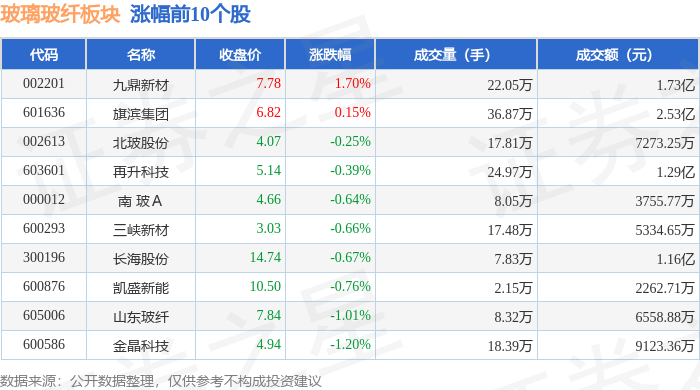
玻璃玻纤板块9月26日跌2.43%,宏和科技领跌,主力资金净流出4.48亿元
Zheng Xing Xing Ye Ri Bao· 2025-09-26 08:48
Market Overview - The glass and fiberglass sector experienced a decline of 2.43% on September 26, with Honghe Technology leading the drop [1] - The Shanghai Composite Index closed at 3828.11, down 0.65%, while the Shenzhen Component Index closed at 13209.0, down 1.76% [1] Stock Performance - Notable stock performances in the glass and fiberglass sector included: - Jiuding New Materials (002201) closed at 7.78, up 1.70% with a trading volume of 220,500 shares and a turnover of 173 million yuan [1] - Qibin Group (601636) closed at 6.82, up 0.15% with a trading volume of 368,700 shares and a turnover of 253 million yuan [1] - Honghe Technology (603256) closed at 35.00, down 4.50% with a trading volume of 141,500 shares and a turnover of 502 million yuan [2] Capital Flow - The glass and fiberglass sector saw a net outflow of 448 million yuan from institutional investors, while retail investors had a net inflow of 453 million yuan [2] - The capital flow for specific stocks showed: - Jiuding New Materials had a net inflow of 26.42 million yuan from institutional investors [3] - Yao Pi Glass (600819) had a net inflow of 21.22 million yuan from institutional investors [3] - Jinjing Technology (600586) experienced a significant net outflow of 17.34 million yuan from institutional investors [3]


大摩闭门会-金融、 风电、汽车、交运行业更新
2025-09-26 02:29
Summary of Key Points from Conference Call Industry Overview - The conference call primarily discusses the **wind power industry** and its dynamics, along with insights into the **automobile** and **luxury car dealership** sectors. [1][2] Core Insights and Arguments Wind Power Industry - The wind power industry is expected to benefit from a surge in demand and industry consolidation, with installation volumes projected to exceed **100 GW** by **2025**. [1] - The trend towards larger wind turbines is causing component supply constraints, leading to a rebound in industry gross margins starting from the first half of **2025**. [1] - Wind power has a power density advantage over solar power, with mechanism electricity prices in Shandong province reaching **0.32 CNY/kWh**, compared to **0.2 CNY/kWh** for solar. [1][4] - The anticipated new installation volume for wind power in the coming years is expected to remain between **100-120 GW**, with offshore wind accounting for **15-20 GW**. [5] - The competition landscape in the component sector is more favorable than in complete machine manufacturing, indicating promising profit prospects. [5][6] Key Companies - **Zhongtian Technology** is highlighted as a low-valuation player with a projected **P/E ratio of 13.5** by **2026**. The company is expected to benefit from increased revenue in its optical communication segment, with revenues projected to rise from **1-2 billion CNY** in **2024** to over **10 billion CNY** in **2026**. [7] - **China National Materials Technology** is the largest blade supplier in China, holding about **40%** market share. Its gross margin is expected to recover to **17-18%** in the first half of **2025**. [8] - **Goldwind Technology** maintains a hold rating due to valuation considerations, with its current market-to-book ratio at **1.1** and facing competitive pressures in both onshore and offshore wind markets. [9] Market Dynamics - The wind power sector is experiencing a significant turnaround after a downturn from **2022 to 2024**, with installation volumes increasing from **38 GW** in **2021-2022** to an expected **100 GW** in **2025**. [2] - The **136 Document** has not significantly impacted the wind power sector, as demand remains strong despite new market pricing policies. [16] - The pricing of onshore wind turbines has remained stable, while offshore wind prices are influenced by regional demand and bidding volumes. [16][17] Luxury Car Dealership Industry - The luxury car dealership sector is nearing a bottom and is expected to rebound in **2026** after a period of store closures and declining margins. [10][11] - The overall profitability of new car sales is under pressure, but strong new car release cycles and stable accident repair services are expected to support core profitability. [11] Other Important Insights - The wind power industry is expected to see a continued increase in installation volumes and profitability due to improved utilization rates and product structure enhancements. [5] - The consolidation in the wind power sector has led to a more favorable competitive environment for component suppliers compared to complete machine manufacturers. [6] - The luxury car market is facing challenges, including declining margins and store closures, but new vehicle launches are anticipated to improve profitability. [11] This summary encapsulates the key points discussed in the conference call, focusing on the wind power industry and its competitive landscape, as well as insights into the luxury car dealership sector.


中国风电行业-反内卷努力后细分领域回暖-China – Wind-Segment Turnaround after Anti-involution Effort
2025-09-26 02:29
Summary of the Conference Call on China's Wind Power Industry Industry Overview - The conference call focuses on the **wind power industry in China**, highlighting a significant turnaround after a down-cycle from 2022 to 2024, attributed to self-regulation and robust demand [3][12][39]. Key Points Demand and Installation Forecasts - **Domestic demand** is expected to remain resilient during the 15th Five-Year Plan (FYP), with forecasts of annual installations of **106GW for 2025**, **103GW for 2026**, and **105GW for 2027**, potentially reaching **~120GW per annum from 2028 to 2030**, including **15-20GW offshore annually** [4][12][45]. - Public tendering for wind projects was robust, with **21.5GW tendered** from June to August 2025, marking a **21% year-on-year increase** [13][45]. Industry Dynamics - The industry has achieved a **price and profitability turnaround** without significant government intervention, driven by: 1. **Increased demand** for wind installations, with a **79% year-on-year rise** in new installations in the first seven months of 2025 [40]. 2. **Recovery in bidding prices** for Wind Turbine Generators (WTG), with onshore prices rising **8%** and offshore prices **12%** in 2025 [52]. 3. **Supply chain consolidation** and improved quality focus among manufacturers due to past losses and accidents [15][41]. Investment Preferences - Preference for **key WTG component suppliers** and **submarine cable manufacturers** over WTG Original Equipment Manufacturers (OEMs) due to better margin recovery prospects [5][14]. - **ZTT** is highlighted as a preferred investment due to its strong valuation and expected growth in submarine cable deliveries [20]. Company-Specific Insights - **Sinoma S&T** upgraded to Overweight (OW) with a price target of **Rmb48.2**, reflecting a **98.9% increase in net profit estimates for 2025** and **117.1% for 2026** due to recovery in gross profit margins across its business segments [19][21]. - **Ningbo Orient** remains OW despite a **39.4% reduction in net profit estimates for 2025**, with a price target of **Rmb69.63** [22][23]. - **Riyue** and **Goldwind** are maintained at Equal Weight (EW) with adjusted price targets reflecting lower profit forecasts due to rising costs and reduced sales expectations [24][25][29]. Risks and Challenges - Potential risks include **delays in offshore project approvals**, **competition affecting offshore WTG prices**, and **increased costs for outsourced machining** [16][24][29][37]. - The industry faces challenges from **overseas shipment growth slowing down** and **delayed revenue recognition** for key offshore projects [30][32]. Conclusion - The wind power industry in China is positioned for a strong recovery, driven by robust demand and improved pricing dynamics. Key players in the supply chain are expected to benefit from ongoing margin recovery and favorable market conditions, making them attractive investment opportunities in the near term [42][43].


中材科技20250925
2025-09-26 02:28
Summary of Zhongcai Technology Conference Call Company Overview - Zhongcai Technology is a leading player in the special optical fiber and glass fiber industry, with significant market share and production capacity [2][5]. Key Points and Arguments Special Optical Fiber Business - The special optical fiber business has shown remarkable performance, with a monthly shipment volume expected to increase from 600,000-700,000 meters in Q4 2024 to over 2 million meters by Q3 2025 [2][5]. - The company covers various product categories including first-generation cloth, second-generation cloth, CT, and Q cloth, making it one of the strongest suppliers in terms of comprehensive supply capability [5]. Profit Projections - For 2025, the special glass fiber business is projected to achieve a profit of 350 million yuan, with quarterly profits expected to grow from 30 million yuan in Q1 to 100-150 million yuan in Q4 [2][6]. - In 2026, the combined profit from first-generation, second-generation, and CT products is expected to reach 900-1,000 million yuan, while Q cloth may contribute an additional 500-1,000 million yuan, leading to an overall profit expectation of 1.5-2 billion yuan [6]. Q Cloth Demand and Pricing - Q cloth is highlighted for its highest price and profit elasticity, with prices at 100 yuan per meter compared to 30 yuan for first-generation cloth and 40 yuan for second-generation cloth [2][7]. - The demand for Q cloth is anticipated to increase with applications in Rabin 144 architecture, including CPX and Mid Panel, and further growth expected by 2026 or 2027 with Roving Ultra or orthogonal backplane applications [7][8]. Production Process and Material Differences - First-generation and second-generation cloth primarily use glass fiber, while Q cloth utilizes quartz material, with a shift in production process from traditional methods to rod drawing [9]. - The DF values for first-generation, second-generation, and Q cloth are 0.29%, 0.20%, and approximately 0.5‰ to 0.7‰, respectively, indicating a significant difference in quality and production strategy [10]. Market Position and Competitiveness - Zhongcai Technology is recognized as a key supplier in the construction materials industry, particularly in the PCB upstream CCL materials sector, benefiting from the growth of AI technology [3]. - The company, along with its competitor Feilihua, holds a strong position in the special glass fiber market, with a stable supply chain and clear market share [12]. Wind Power and Other Business Segments - The wind power segment is expected to account for approximately 30% of the industry’s total installed capacity, with an optimistic outlook for Q4 2025 despite overall industry adjustments [13]. - The diaphragm business is not expected to have a significant short-term impact, with projected earnings of 1.5-2 billion yuan next year, contributing to an overall performance of 3.2-3.3 billion yuan [14]. Investment Recommendations - Zhongcai Technology is considered a strong investment choice due to its robust governance and performance stability, particularly during market corrections in the electronics sector [15]. Additional Important Insights - The company is well-positioned to maintain strong growth momentum in the coming years, supported by its comprehensive product offerings and increasing production capacity [8].
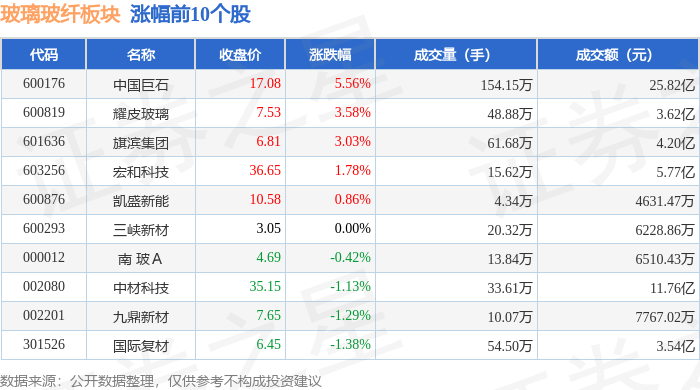
玻璃玻纤板块9月25日涨1.46%,中国巨石领涨,主力资金净流出2.02亿元
Zheng Xing Xing Ye Ri Bao· 2025-09-25 08:45
Market Overview - On September 25, the glass fiber sector rose by 1.46% compared to the previous trading day, with China Jushi leading the gains [1] - The Shanghai Composite Index closed at 3853.3, down 0.01%, while the Shenzhen Component Index closed at 13445.9, up 0.67% [1] Stock Performance - China Jushi (600176) closed at 17.08, up 5.56% with a trading volume of 1.5415 million shares [1] - Yao Pi Glass (618009) closed at 7.53, up 3.58% with a trading volume of 488,800 shares [1] - Qibin Group (601636) closed at 6.81, up 3.03% with a trading volume of 616,800 shares [1] - Honghe Technology (603256) closed at 36.65, up 1.78% with a trading volume of 156,200 shares [1] - Other notable performances include Kaisheng New Energy (600876) at 10.58, up 0.86%, and Sanxia New Materials (600293) at 3.05, unchanged [1] Capital Flow - The glass fiber sector experienced a net outflow of 202 million yuan from institutional investors, while retail investors saw a net inflow of 33.26 million yuan [2] - The sector's overall capital flow indicates a mixed sentiment among different investor types [2] Individual Stock Capital Flow - Yao Pi Glass saw a net outflow of 39.93 million yuan from institutional investors, while retail investors had a net inflow of 6.71 million yuan [3] - Honghe Technology had a net inflow of 5.24 million yuan from institutional investors, with a slight net outflow from retail investors [3] - Other stocks like North Glass (002613) and South Glass A (000012) also showed varied capital flows, indicating differing investor sentiments across the sector [3]



特种电子布跟踪系列:供需测算
2025-09-24 09:35
Summary of Special Electronic Fabric Industry Conference Call Industry Overview - The special electronic fabric market is expected to exceed 10 billion yuan by 2026 and 20 billion yuan by 2027, with significant growth in LCTE and Q fabric products [1][2] - Leading companies such as Zhongtai Technology, Honghe Technology, and Feirongda are identified as having long-term development opportunities [1][2] Key Trends and Developments - Recent expansion plans by leading companies like Zhonglai Technology and Nitobor have significantly impacted market supply and demand dynamics, particularly after August [3] - Domestic companies have rapidly developed, with monthly production capacity exceeding 6 million meters, capturing over 60% market share as of August 2025 [4][13] - The demand for special electronic fabrics in the AI industry is growing rapidly, with low-end electronic fabric market expected to exceed 10 billion yuan by 2026 [10] Technical Barriers - The industry faces several technical barriers, including raw material formulation and control of kiln temperatures during the manufacturing process [6][12] - Continuous R&D and iteration capabilities are crucial for maintaining competitive advantages [6] Domestic Equipment and Cost Reduction - The domestic equipment localization process has accelerated, with about 40% of the complete process equipment now domestically sourced, significantly reducing costs [9] - This shift is expected to promote the development of the fiberglass and carbon fiber industries [9] Supply and Demand Dynamics - The supply side is expected to face significant barriers, particularly for LDK2 and LOST products, which are in high demand but have limited production capabilities [14] - The market for CT products is projected to exceed 4 billion yuan in 2026, driven by supply constraints and significant demand growth [29] Company Highlights - Zhongcai Technology is highlighted for its leading position in domestic replacement, with plans to increase production capacity significantly [38][39] - Zhengtai Technology has made rapid progress in Q fabric products, with monthly shipments nearing 100,000 meters [40] - Jushi Group is expanding its production capacity and is confident in entering the special electronic fabric market [41] - Guangyuan New Materials and Honghe Technology are focusing on high-end electronic fabrics, with significant progress in production capacity [42] Market Competition - The market is currently dominated by overseas companies like Nitto Denko, which holds about 30% market share, while domestic companies are gradually increasing their presence [37] - The competition is expected to intensify as domestic companies improve their technology and production capabilities [37] Future Outlook - The demand for Q fabric is expected to grow significantly, with companies like Feili Hua and Zhongcai being key suppliers [53] - The overall supply-demand balance in the special electronic fabric industry is projected to remain tight, with price fluctuations anticipated for various products [54] This summary encapsulates the key points discussed in the conference call regarding the special electronic fabric industry, highlighting market trends, technical challenges, and company developments.
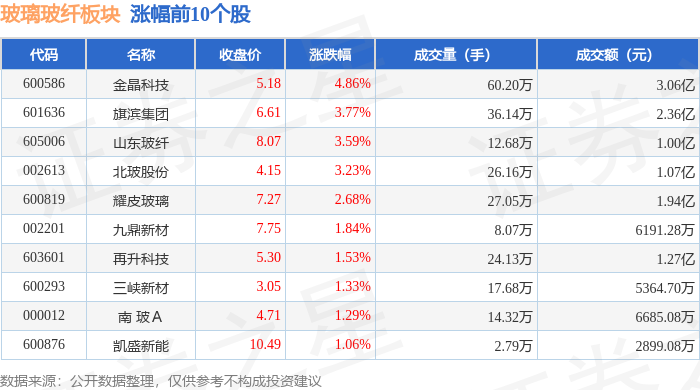
玻璃玻纤板块9月24日跌1.93%,宏和科技领跌,主力资金净流出1.38亿元
Zheng Xing Xing Ye Ri Bao· 2025-09-24 08:46
Market Overview - On September 24, the glass and fiberglass sector declined by 1.93%, with Honghe Technology leading the drop [1] - The Shanghai Composite Index closed at 3853.64, up 0.83%, while the Shenzhen Component Index closed at 13356.14, up 1.8% [1] Stock Performance - Key stocks in the glass and fiberglass sector showed varied performance, with Jin Jing Technology rising by 4.86% to a closing price of 5.18, and Honghe Technology falling by 6.47% to 36.01 [1][2] - The trading volume and turnover for major stocks included: - Jin Jing Technology: 602,000 shares, turnover of 306 million yuan - Qi Bin Group: 361,400 shares, turnover of 236 million yuan - Shandong Pofiber: 126,800 shares, turnover of 100 million yuan [1][2] Capital Flow - The glass and fiberglass sector experienced a net outflow of 138 million yuan from institutional investors and 174 million yuan from retail investors, while individual investors saw a net inflow of 312 million yuan [2] - Detailed capital flow for selected stocks included: - Jin Jing Technology: 77.61 million yuan net inflow from institutional investors - Qi Bin Group: 48.32 million yuan net inflow from institutional investors [3] Summary of Individual Stock Flows - Jin Jing Technology had a significant institutional net inflow of 77.61 million yuan, while retail investors showed a net outflow of 60.91 million yuan [3] - Qi Bin Group also saw a net inflow from institutional investors of 48.32 million yuan, with retail investors experiencing a net outflow of 28.91 million yuan [3]


建材行业 2025 年中报综述:周期建材有贝塔,消费建材看阿尔法
Shenwan Hongyuan Securities· 2025-09-24 08:14
Investment Rating - The report suggests focusing on investment opportunities in the fiberglass and cement industries due to improving profitability, while selecting stocks with alpha characteristics in the consumer building materials and early-cycle sectors [2][5]. Core Insights - The building materials industry has seen a narrowing revenue decline and notable profit improvements, particularly in the cement and fiberglass sectors, with overall revenue for sample companies decreasing by 4.1% year-on-year to 277.57 billion yuan, while net profit increased by 38.9% to 14.82 billion yuan [11][12]. - The cement industry has shown significant recovery, with a revenue of 118.8 billion yuan, a decline of 7.5%, and a net profit of 5.4 billion yuan, reflecting a year-on-year increase of 1110.5% [24][29]. - The fiberglass sector reported a revenue of 31.1 billion yuan, up 20.9%, and a net profit of 3.29 billion yuan, up 127.0%, indicating a strong recovery driven by price improvements and growth in special fabric business [6][38]. Summary by Sections 1. Industry Revenue Decline Narrowing, Cement and Fiberglass Perform Well - Sample companies in the building materials sector achieved a total revenue of 277.57 billion yuan in the first half of 2025, with a year-on-year decline of 4.1%, a significant improvement compared to a 10.7 percentage point decline in 2024 [11][12]. - The overall net profit for the industry turned positive, reaching 14.82 billion yuan, compared to a 50.8% decline in 2024 [11][12]. 2. By Sector: Cement and Fiberglass Recovery, Consumer Building Materials Seek Alpha 2.1 Cement: Bottom Recovery Becoming Certain - The cement industry has shown a significant improvement, with a revenue of 118.8 billion yuan and a net profit of 5.4 billion yuan, reflecting a year-on-year increase of 1110.5% [24][29]. - The demand for cement remains in a declining trend, but the rate of decline has slowed [24]. 2.2 Fiberglass: Profitability Out of Undervaluation, Steady Recovery Expected - The fiberglass sector reported a revenue of 31.1 billion yuan, up 20.9%, and a net profit of 3.29 billion yuan, up 127.0%, with most companies in the sector achieving double-digit revenue growth [6][38]. 2.3 Consumer Building Materials: Revenue Decline Narrowing, Some Companies Show Strong Alpha - The consumer building materials sector saw a revenue of 68.76 billion yuan, down 2.7%, and a net profit of 4.35 billion yuan, down 13.2%, with some companies like Keda Manufacturing and Three Trees showing strong performance [6][12]. 2.4 Glass: Photovoltaic Glass Experiences Phase Recovery, Building Glass Still Under Pressure - The glass industry faced challenges, with a revenue of 24.6 billion yuan, down 17.0%, and a net profit of 1 billion yuan, down 60.3%, indicating ongoing pressure from weak real estate completions [6][12]. 2.5 Early Cycle: Overall Pressure, Leading Companies Recover First - The early-cycle sector remains under pressure, but leading companies like Subote have achieved revenue and profit growth, focusing on major projects in the western regions [7][12].
