
Sinoma Science & Technology (002080)

Search documents
建材行业2025年中报综述:周期建材有贝塔,消费建材看阿尔法
Shenwan Hongyuan Securities· 2025-09-24 06:43
Investment Rating - The report maintains a "Positive" outlook on the building materials industry for 2025, highlighting investment opportunities in the fiberglass and cement sectors, while suggesting stock selection in consumer building materials and early-cycle segments [2][3]. Core Insights - The building materials industry has shown signs of recovery, with a narrowing revenue decline and improved profitability in the cement and fiberglass sectors. The overall revenue for sample companies in the first half of 2025 was 277.57 billion yuan, a year-on-year decline of 4.1%, which is a 10.7 percentage point improvement compared to the entire year of 2024. Net profit attributable to shareholders reached 14.82 billion yuan, a year-on-year increase of 38.9% [5][15]. - The cement industry is experiencing a gradual recovery, with significant profit improvements. In the first half of 2025, the cement sector achieved a revenue of 118.8 billion yuan, down 7.5% year-on-year, but net profit surged by 1110.5% to 5.4 billion yuan. This recovery is partly due to a low base effect from 2024 and favorable pricing conditions [6][28]. - The fiberglass sector reported robust growth, with sample companies generating a total revenue of 31.1 billion yuan, a 20.9% increase year-on-year, and net profit rising by 127.0% to 3.29 billion yuan. The recovery in pricing and the growth in specialty fabric business are contributing factors [7][19]. - Consumer building materials showed a smaller revenue decline of 2.7%, with total revenue of 68.76 billion yuan and net profit down 13.2% to 4.35 billion yuan. Companies like Keda Manufacturing and Sankeshu are demonstrating strong alpha characteristics due to their unique market positions [6][7]. - The glass sector remains under pressure, with a revenue decline of 17.0% to 24.6 billion yuan and a net profit drop of 60.3% to 1 billion yuan, primarily due to high base effects and weak demand in the construction sector [5][19]. - Early-cycle industries are still facing challenges, but leading companies like Subote have reported revenue and profit growth by expanding into major engineering projects [8][19]. Summary by Sections 1. Industry Revenue Decline Narrowing, Cement and Fiberglass Perform Well - The building materials industry is categorized into six segments: cement, glass, fiberglass, early-cycle, consumer building materials, and new materials. The overall revenue decline has narrowed, and profitability has improved, particularly in the cement and fiberglass sectors [15][19]. 2. By Industry: Cement and Fiberglass Recovery, Consumer Building Materials Seek Alpha 2.1 Cement: Recovery Certainty Gradually Realized - The cement industry is showing signs of recovery with improved profitability. The first half of 2025 saw a revenue of 118.8 billion yuan, down 7.5% year-on-year, and a net profit of 5.4 billion yuan, up 1110.5% [28][34]. 2.2 Fiberglass: Profitability Out of Undervaluation, Steady Recovery Expected - The fiberglass sector has shown significant growth, with a total revenue of 31.1 billion yuan, a 20.9% increase year-on-year, and net profit rising by 127.0% [7][19]. 2.3 Consumer Building Materials: Revenue Stabilizing, Some Companies Show Profit Alpha - The consumer building materials segment experienced a revenue decline of 2.7%, totaling 68.76 billion yuan, with net profit down 13.2% to 4.35 billion yuan. Certain companies are demonstrating strong alpha characteristics [6][7]. 2.4 Glass: Photovoltaic Glass Phase Improvement, Building Glass Still Under Pressure - The glass industry is under pressure, with a revenue decline of 17.0% to 24.6 billion yuan and a net profit drop of 60.3% to 1 billion yuan [5][19]. 2.5 Early Cycle: Overall Pressure, Leading Companies Recover First - Early-cycle industries are still facing challenges, but leading companies like Subote have reported revenue and profit growth by expanding into major engineering projects [8][19].



建材周专题:开工竣工仍在触底,继续推荐非洲链和特种布
Changjiang Securities· 2025-09-23 14:52
Investment Rating - The industry investment rating is "Positive" and maintained [11] Core Insights - In August, new construction and completion in the real estate sector continued to hit bottom, with ongoing pressure on sales volume and prices. The new construction area from January to August decreased by 19.5% year-on-year, with a 20.3% decline in August alone. Cement production also saw a year-on-year decline of 4.8% from January to August, with a 6.2% drop in August [5][6] - The report recommends focusing on special fabrics and the African supply chain, with leading companies in the existing market being the main investment theme for the year [2][9] Summary by Sections Real Estate Market - The real estate market continues to face downward pressure on sales volume and prices, with national commodity housing sales amount and area decreasing by 7.3% and 4.7% year-on-year respectively from January to August. The decline in sales accelerated in August, with sales amount and area down by 14.0% and 10.6% respectively [6][7] Cement Market - Cement shipments showed a slight recovery in September, with an average shipment rate of approximately 48%, up by 1.6 percentage points month-on-month but down by 0.6 percentage points year-on-year. The average price of cement increased by 0.5% month-on-month as companies pushed for price increases to enhance profitability [7][24] Glass Market - The domestic float glass market experienced mixed price movements, with slight improvements in shipments but overall cautious price adjustments. The inventory levels remain high, and the market sentiment is generally cautious, with production capacity pressures persisting [8][40] Recommended Companies - The report recommends focusing on leading companies in special fabrics such as China National Materials Technology and in the African supply chain like Huaxin Cement and Keda Manufacturing. These companies are expected to benefit from domestic demand recovery and overseas expansion [9][10]


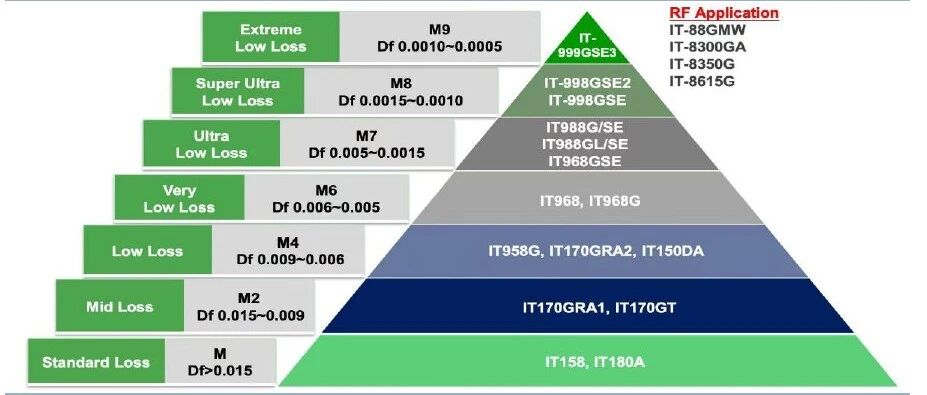
缺货!从LowDK到Q布:揭秘特种电子布三大升级路径,谁将卡位下一代PCB材料?
材料汇· 2025-09-23 14:18
Core Viewpoints - The industry is experiencing a significant upgrade in special electronic fabrics, transitioning from LowDK-1 to LowDK-2, with urgent demand for LowCTE fabrics to address chip packaging warping issues, and quartz fiber fabrics (Q fabrics) emerging as the ultimate solution for next-generation applications [2][3][11]. Demand Side: Dual Acceleration Driving Product Iteration - The market for low dielectric electronic fabrics is projected to reach 168 million meters by 2026, driven by the demand from Nvidia's Rubin architecture and 1.6T switches, with Q fabric demand expected to reach 16.85 million meters, corresponding to a market size of approximately 4 billion yuan [3][11]. - The increasing performance requirements of high-end smartphones will drive the demand for LowCTE glass fiber fabrics, with a potential increase in demand exceeding 13.5 million meters if the usage in a single Apple phone rises from 0 to 0.05 meters [11][12]. Supply Side: Clear Trend of Domestic Substitution, Short-Term Supply Still Tight - High-end electronic fabric production faces significant barriers in raw material formulation, drawing processes, and weaving machines, with a forecasted supply gap for LowDK-2 and LowCTE products continuing until 2026, supporting price stability [3][12][14]. - Domestic manufacturers such as China National Materials, Honghe Technology, and others are rapidly expanding their production capacity, with domestic production capacity expected to exceed 6 million meters per month by August 2025 [7][13]. Competitive Landscape: High-End Overseas Leadership, Domestic Manufacturers Accelerating Technology and Capacity Enhancement - The global market for special electronic fabrics is currently dominated by a few manufacturers in Japan and Taiwan, but domestic companies are making significant technological breakthroughs and capacity expansions [7][13]. - Companies like Feilihua, a leader in the quartz fiber industry, are positioned to benefit from the growing demand for quartz fiber and Q fabrics, with a comprehensive supply chain advantage [7][13]. Unique Insights Compared to Market Views - The report indicates that all types of special electronic fabrics will remain in a state of supply tightness in 2025, with LowDK-2 and LowCTE experiencing continued shortages until 2026 due to rapid demand growth and supply-side barriers [8][14]. - Q fabrics are expected to enter mass production in 2026, but the demand and ramp-up pace will depend on the determination of technological routes and the market launch of end products [8][14].


华泰证券今日早参-20250923
HTSC· 2025-09-23 01:56
Group 1: Market Overview - The A-share market is currently experiencing a period of volatility, with liquidity and market sentiment being key factors influencing its performance [2][4] - Recent data indicates that financing activity is approaching historical highs, with private equity fund registrations returning to mid-July levels and new public fund issuance maintaining around 20 billion [2][4] - The market's ability to break through its current plateau will depend on the continued inflow of public and foreign investment funds [2][4] Group 2: Fixed Income Insights - Since 2024, the structure of credit floating rate bonds has adjusted, with a notable increase in corporate issuances and a contraction in asset-backed securities (ABS) [3] - Floating rate bonds are characterized by their interest rates that follow benchmark rates, providing a defensive advantage, especially during periods of rising rates [3] - The performance of floating rate bonds has lagged behind fixed rate bonds in recent years, suggesting that better investment opportunities may arise when the funding environment tightens [3] Group 3: Real Estate and Construction - In the third week of September, both new and second-hand housing markets showed signs of recovery, particularly in first-tier cities following policy relaxations [4][16] - The construction sector is witnessing an increase in industrial activity, with freight volumes remaining high and coal consumption showing a downward trend [4] - The demand for cement remains stable, while supply is at low levels, indicating a potential for price recovery in the construction materials market [4] Group 4: Energy and New Energy Equipment - In August 2025, China's inverter exports reached 6.29 billion, with a notable demand driven by energy transitions in India and subsidy plans in Australia [7] - The long-term demand for inverters is expected to be supported by rising electricity prices and increased installations of renewable energy sources [7] - The report recommends leading companies in the sector, such as Sungrow Power Supply and DeYe Shares, as having strong performance support [7] Group 5: Transportation and Logistics - Despite August being a traditional off-peak season for e-commerce and express delivery, the industry is experiencing a rebound in demand due to competitive pressures [8] - The report highlights a marginal slowdown in package volumes, but anticipates a price increase as the peak season approaches, which could enhance profitability [8] - Recommended companies in the logistics sector include Shentong Express and YTO Express, with a focus on those benefiting from price increases and strong overseas growth [8] Group 6: Consumer Goods and Retail - The snack retail sector is evolving from rapid expansion to consolidation, with new retail formats emerging in response to changing consumer preferences [13] - The report discusses the competitive landscape of various retail formats, including discount stores and community shops, and their impact on traditional retail channels [13] - Companies like Youyou Foods are highlighted for their strategic positioning in the market, aiming for significant revenue growth through innovative product offerings [13] Group 7: Construction Materials - The report discusses the outlook for specialty electronic fabrics, driven by trends in AI and high-end PCB materials [14] - The demand for low thermal expansion and high-performance materials is expected to grow, with recommendations for companies like China Jushi and China National Materials [14] - The report emphasizes the importance of product upgrades in meeting the evolving needs of the electronics industry [14] Group 8: Company Ratings and Recommendations - New Hongji Real Estate has been rated "Buy" with a target price of 111.51 HKD, supported by its significant land reserves and upcoming project deliveries [17] - Youyou Foods has also received a "Buy" rating with a target price of 15.60 CNY, reflecting its strong market position in the snack sector [19] - The report indicates a positive outlook for companies with robust growth strategies and market adaptability [19]


研判2025!中国风电叶片芯材行业产业链、发展现状、企业分析及未来趋势分析:风电叶片大型化、轻量化趋势下,风电叶片芯材行业市场规模有望持续增长[图]
Chan Ye Xin Xi Wang· 2025-09-23 01:19
Core Viewpoint - The rapid development of China's wind power industry is driving significant growth in the demand for wind turbine blades and their core materials, particularly in the wind blade core material sector, which is expected to see its market size increase from 7.35 billion yuan in 2021 to 14.05 billion yuan in 2025, reflecting an 18.1% year-on-year growth [1][6]. Wind Blade Core Material Industry Overview - Wind blades are the core components of wind turbines, responsible for converting wind energy into mechanical energy, which is then transformed into electrical energy [2]. - The manufacturing materials for wind blades include various components such as reinforcement materials, core materials, matrix materials, surface coatings, and structural adhesives [2]. Key Materials in Wind Blade Structure - Core materials, which are crucial for enhancing the structural integrity of wind blades, are typically used in the skin and web of the blades to improve stiffness and reduce weight [3][4]. - Common core materials include balsa wood, PVC foam, and PET foam, with balsa wood being the primary material due to its favorable compressive and shear strength [3][4]. Industry Chain of Wind Blade Core Materials - The upstream of the wind blade core material industry consists of raw materials like balsa wood, PVC, and PET, with a high dependency on imports for balsa wood [4]. - The midstream involves the production and manufacturing of core materials, while the downstream pertains to the application in wind blade manufacturing [4]. Market Size and Growth - The market size for the wind blade industry in China is projected to grow from 29.4 billion yuan in 2021 to 56.2 billion yuan in 2025, driven by increasing installed capacity [5][6]. - The wind blade core material market is expected to expand from 7.35 billion yuan in 2021 to 11.9 billion yuan in 2024, with a forecasted growth to 14.05 billion yuan in 2025 [1][6]. Competitive Landscape - Key players in the wind blade core material industry include both wind blade manufacturers and specialized core material producers, such as Tian Sheng New Materials and Jiangsu Changyou Environmental Technology [8][9]. - Companies are focusing on vertical integration to reduce costs and enhance competitiveness in the market [8]. Development Trends in the Industry - The trend towards larger and lighter wind blades is driving demand for improved core materials, which must meet higher performance and cost-efficiency standards [12]. - PET foam is anticipated to become the mainstream material in the future due to its mechanical strength, lower cost, and recyclability compared to balsa wood and PVC foam [13]. - The demand for wind blade core materials is expected to rise in line with the increasing global demand for clean energy and the growth of wind power installations in China [14].


建筑材料行业跟踪周报:期待内需政策的进一步落地-20250922
Soochow Securities· 2025-09-22 12:32
Investment Rating - The report maintains an "Accumulate" rating for the building materials industry [1] Core Viewpoints - The building materials sector has shown resilience with a slight increase in prices and demand, particularly in cement, glass, and fiberglass, indicating potential for recovery [4][11][12] - The report emphasizes the importance of domestic demand policies and anticipates further implementation of these policies to support the industry [4][6] Summary by Sections 1. Industry Trends - The building materials sector (SW) experienced a weekly increase of 0.43%, outperforming the Shanghai Composite Index and the Wind All A Index, which decreased by -0.44% and -0.18% respectively [4] - Cement prices have shown a slight increase, with the national average price at 345.7 RMB/ton, up by 1.7 RMB/ton from the previous week, but down by 35.8 RMB/ton compared to the same period last year [4][18] 2. Bulk Building Materials Fundamentals and High-Frequency Data 2.1 Cement - The average cement shipment rate is approximately 48.3%, with a slight increase of 1.7 percentage points from the previous week [24] - The report anticipates a rebound in cement prices due to seasonal demand and industry self-discipline [11][17] 2.2 Glass - The average price of float glass is reported at 1208.0 RMB/ton, reflecting a weekly increase of 10.9 RMB/ton, but a year-on-year decrease of 31.3% [4] - The report suggests that the glass industry is facing a supply-demand stalemate, with potential for price recovery as supply constraints tighten [13] 2.3 Fiberglass - The report indicates that the fiberglass sector is expected to see a recovery in profitability, with mid-term improvements anticipated as supply pressures ease [12] - The demand for electronic fiberglass products is expected to rise, driven by advancements in technology and new applications [12] 3. Industry Dynamics Tracking - The report highlights the ongoing government efforts to stimulate domestic demand, which are expected to positively impact the building materials sector [14] - The anticipated policies for 2024 and 2025 are expected to further enhance consumer confidence and demand for home improvement materials [6][14] 4. Investment Recommendations - The report recommends focusing on leading companies in the cement sector such as Huaxin Cement, Conch Cement, and Shanshui Cement, as well as fiberglass companies like China Jushi [11][12][13] - It also suggests monitoring companies in the home improvement sector that are well-positioned to benefit from government policies and market recovery, such as Oppein Home Group and Arrow Home [14][15]

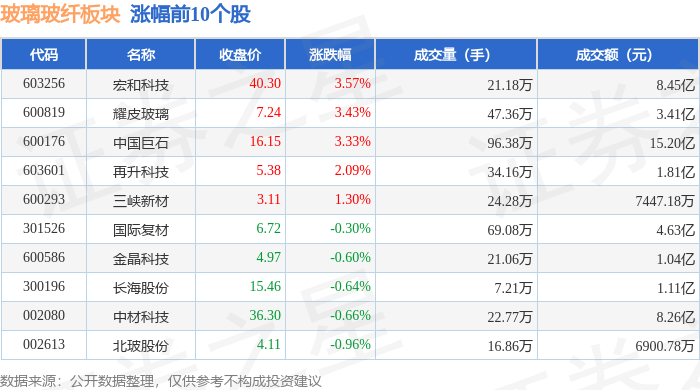
玻璃玻纤板块9月22日涨1.01%,宏和科技领涨,主力资金净流入2219.84万元
Zheng Xing Xing Ye Ri Bao· 2025-09-22 08:47
Market Overview - On September 22, the glass and fiberglass sector rose by 1.01% compared to the previous trading day, with Honghe Technology leading the gains [1] - The Shanghai Composite Index closed at 3828.58, up 0.22%, while the Shenzhen Component Index closed at 13157.97, up 0.67% [1] Stock Performance - Key stocks in the glass and fiberglass sector showed varied performance: - Honghe Technology (603256) closed at 40.30, up 3.57% with a trading volume of 211,800 shares and a turnover of 845 million yuan [1] - Yao Pi Glass (618009) closed at 7.24, up 3.43% with a trading volume of 473,600 shares and a turnover of 341 million yuan [1] - China Jushi (600176) closed at 16.15, up 3.33% with a trading volume of 963,800 shares and a turnover of 1.52 billion yuan [1] - Other notable performances include: - Zai Sheng Technology (603601) at 5.38, up 2.09% [1] - Sanxia New Materials (600293) at 3.11, up 1.30% [1] - International Composite Materials (301526) at 6.72, down 0.30% [1] Capital Flow - The glass and fiberglass sector experienced a net inflow of 22.19 million yuan from institutional investors, while retail investors saw a net inflow of 30.26 million yuan [2] - However, there was a net outflow of 52.45 million yuan from speculative funds [2] Individual Stock Capital Flow - Honghe Technology saw a net outflow of 43.72 million yuan from institutional investors, while retail investors had a net outflow of 49.84 million yuan [3] - Yao Pi Glass had a net inflow of 31.51 million yuan from institutional investors, but a net outflow of 43.57 million yuan from retail investors [3] - China Jushi experienced a net inflow of 22.30 million yuan from institutional investors, with a significant net outflow of 52.21 million yuan from speculative funds [3]


降息或利好建材低估值品种,关注新疆板块催化
Tianfeng Securities· 2025-09-22 07:42
Investment Rating - Industry Rating: Outperform the market (maintained rating) [4] Core Views - The recent 25 basis point interest rate cut by the Federal Reserve is expected to improve liquidity, leading to a potential valuation recovery in the undervalued building materials sector. The focus is on the Xinjiang region due to its strong economic growth and upcoming infrastructure projects, which are anticipated to boost demand for cement [2][14] - Fixed asset investment in Xinjiang increased by 9.1% year-on-year from January to August 2025, significantly higher than the national average. Cement usage in the region also saw a 1.3% year-on-year increase during the same period [2][14] - Key infrastructure projects, such as the new Tibet Railway and the China-Kyrgyzstan-Uzbekistan Railway, are expected to further drive cement demand, with estimates suggesting an increase of 4.62 to 6.94 million tons for the Xinjiang segment alone [2][14] Summary by Sections Market Review - During the week of September 15-19, 2025, the CSI 300 index fell by 0.44%, while the building materials sector (CITIC) rose by 0.49%. Notable individual stock performances included Gongyuan Co. (+23.5%), Mona Lisa (+21.2%), and Youbang Ceiling (+14.9%) [1][10] Recommended Stocks - The report recommends a focus on the following stocks: China National Materials, Honghe Technology, China Glass, Qingsong Construction, Huaxin Cement, and Sankeshu [3][16] Cement Sector Insights - The national cement market price increased by 0.5% week-on-week, with price hikes observed in regions such as Jiangxi, Guangxi, and Sichuan. The average shipment rate for cement companies in key areas was approximately 48%, showing a slight increase [15] - The report anticipates that cement prices will continue to trend upwards due to seasonal demand, despite current market conditions being less than ideal [15] Glass Sector Insights - The photovoltaic glass market showed stable transactions, with prices for mainstream products remaining unchanged. The overall production capacity in the glass sector is stable, with a slight year-on-year decrease in output [15][16] Fiberglass Sector Insights - The fiberglass market is experiencing stable pricing, with some improvement in demand. However, the overall market remains under pressure due to high inventory levels [16] Long-term Outlook - The building materials industry is expected to be near the bottom of its cycle, with potential for recovery driven by infrastructure and real estate demand improvements. The report highlights the importance of traditional building materials and new materials in the growth trajectory [16]

国泰海通建材鲍雁辛一周观点:消费建材基本面与预期兼具,玻纤全系列涨价周期-20250922
Haitong Securities· 2025-09-22 06:50
Investment Rating - The report maintains a positive outlook on the construction materials industry, indicating a recovery in the consumption segment and a price increase cycle for fiberglass products [1][5][7]. Core Insights - The construction materials sector is showing signs of recovery, with the fundamentals entering a positive phase, particularly in real estate sales and construction starts [1][20][21]. - A price increase cycle for fiberglass products is anticipated, driven by supply-demand dynamics and market conditions [2][6][7]. - The cement industry is entering a peak season with price increases observed in various regions, supported by policy measures aimed at limiting overproduction [4][27][28]. Summary by Sections Construction Materials - The consumption construction materials sector is stabilizing, with expectations of improved revenue performance starting in Q3 2025 due to lower revenue baselines and reduced price competition [1][20][21]. - Companies like Hanhigh Group and Sankeshu are already showing growth, with expectations for Dongfang Yuhong to follow suit [1][15]. Fiberglass - The fiberglass market is experiencing a price increase cycle, with major companies discussing price hikes for various products, including low dielectric fabrics [2][6]. - The supply-demand balance is shifting positively, with larger manufacturers maintaining good inventory control while smaller producers are adjusting prices upward [6][7]. Cement - The cement market is witnessing a slight price increase, with specific regions like Jiangsu and Anhui implementing price hikes [4][27]. - The report highlights the potential for growth in the cement sector due to policy support and overseas expansion opportunities [27][28]. Investment Recommendations - Companies such as China Jushi, Zhongcai Technology, and Feilihua are highlighted for their strong market positions and growth potential in the fiberglass and construction materials sectors [10][12][18]. - Huaxin Cement is noted for its overseas expansion and profitability, particularly from its Nigerian operations, which are expected to contribute significantly to future earnings [31][33].


行业周报:政策驱动力度持续,积极布局建材机会-20250921
KAIYUAN SECURITIES· 2025-09-21 12:41
Investment Rating - The investment rating for the building materials industry is "Positive" (maintained) [1] Core Viewpoints - The building materials sector is driven by dual forces of policy and demand, with a focus on high-performance new materials supporting green construction and renovation [3] - The new materials industry in China is expected to grow from a value of 6.8 trillion yuan in 2022 to 10 trillion yuan by 2025, with 30 sub-industries transitioning to high value-added products [3] - The report highlights specific companies to invest in, including Sankeshu (channel expansion), Dongfang Yuhong (waterproofing leader), Weixing New Materials (high-quality operations), and Jianlang Hardware [3] - The cement sector is expected to benefit from energy-saving and carbon reduction initiatives, with a target to control cement clinker capacity at around 1.8 billion tons by the end of 2025 [3] Market Performance - The building materials index increased by 0.43% in the week from September 15 to September 19, outperforming the CSI 300 index by 0.88 percentage points [4][13] - Over the past three months, the building materials index has risen by 19.82%, while the CSI 300 index has increased by 14.18%, indicating a 5.64 percentage point outperformance [4][13] - In the past year, the building materials index has grown by 43.00%, compared to a 34.31% increase in the CSI 300 index, resulting in an 8.69 percentage point outperformance [4][13] Cement Sector Insights - As of September 19, the average price of P.O42.5 bulk cement in China was 279.00 yuan/ton, reflecting a 1.44% increase from the previous period [6][24] - The clinker inventory ratio reached 65.11%, up by 2.52 percentage points [6][24] - Regional price variations were noted, with increases in East China (+2.04%) and South China (+1.72%), while North China saw a decrease of 1.01% [24] Glass Sector Insights - The average price of float glass as of September 19 was 1208.98 yuan/ton, with a slight increase of 0.55% [6][76] - The inventory of float glass decreased by 29,000 weight boxes, a decline of 0.53% [6][78] - The price of photovoltaic glass remained stable at 125.00 yuan/weight box [6][80] Fiberglass Sector Insights - The price of non-alkali 2400tex direct yarn ranged from 3400 to 4000 yuan/ton, with variations based on specific product types [6][5] - The market for fiberglass is showing stability, with flexible pricing strategies being employed by some manufacturers [6][5] Consumer Building Materials Insights - As of September 19, the price of asphalt was stable at 4570 yuan/ton, while the price of titanium dioxide decreased by 0.38% to 13000 yuan/ton [6][5] - The report indicates that raw material prices for consumer building materials are experiencing slight fluctuations [6][5]


