IFLYTEK(002230)

Search documents
中航证券:政策护航+应用提速 AI有望加速释放新质生产力
智通财经网· 2025-09-01 01:59
Core Insights - The artificial intelligence industry is experiencing a convergence of policy, technology, and application, leading to accelerated development and industrialization of large model capabilities [1][3] - The Chinese government has issued a strategic framework for AI development, emphasizing six areas of deep integration and setting clear mid- to long-term goals for 2027, 2030, and 2035 [1][3] Policy and Strategic Framework - The State Council has released the "Implementation of the 'Artificial Intelligence+' Action Plan," which outlines strategic directions for the industry [1] - The National Development and Reform Commission highlights the next one to two years as a critical window for AI application acceleration, advocating for a structured approach to development [1][3] - A standardized evaluation system for AI has been established, covering over 60 companies and facilitating more than 100 assessments, promoting a systematic approach to industry evaluation [1] Technological Advancements - Significant upgrades in large model technologies are being observed, with improvements in capabilities for complex task handling and visual reasoning tasks [2] - New AI models such as Claude Opus4.1 and GLM-4.5V have demonstrated enhanced performance in various applications, including coding and visual understanding [2] Investment Recommendations - Companies to focus on include Kunlun Wanwei and iFlytek, which are key players in large model development and AI agent capabilities [3] - Other recommended companies for investment in AI application scenarios include Focus Technology, Aofei Entertainment, and several others involved in diverse sectors such as education and entertainment [3]



财联社9月1日早间新闻精选
Xin Lang Cai Jing· 2025-09-01 00:51
Group 1 - The Ministry of Commerce of China held discussions with U.S. officials regarding the implementation of agreements from the recent talks between the two countries' leaders [1] - The U.S. Department of Commerce removed several Chinese semiconductor companies from the "validated end-user" list, prompting a response from the Chinese Ministry of Commerce to protect the rights of its enterprises [2] - The China Securities Regulatory Commission (CSRC) plans to deepen reforms in the capital market to enhance its attractiveness and promote long-term investment strategies [3] Group 2 - In August, the manufacturing Purchasing Managers' Index (PMI) was reported at 49.4%, a slight increase of 0.1 percentage points from the previous month, while the non-manufacturing business activity index was at 50.3%, indicating continued expansion [4] - As of June, the "national team" of central financial institutions held stock ETFs valued at 1.28 trillion yuan, an increase of nearly 23% from the end of the previous year [5] - The Ministry of Industry and Information Technology issued a plan for the steel industry, targeting an average annual growth rate of 4% from 2025 to 2026 [7] Group 3 - Semiconductor companies such as SMIC and Huahong Group are planning significant equity purchases and capital raises, indicating ongoing consolidation in the sector [9][10] - Several companies reported substantial increases in net profits for the first half of the year, including BYD with a net profit of 15.51 billion yuan, up 13.79%, and TCL Technology with a net profit of 1.883 billion yuan, up 89.26% [13] - Conversely, companies like Magpowr and China Shenhua reported declines in net profits, with Magpowr down 44.82% [14] Group 4 - Alibaba reported a revenue of 247.65 billion yuan for the first quarter of fiscal year 2026, a 2% year-on-year increase, and plans to invest heavily in AI and daily service consumption sectors [23]



科大讯飞AI商业化路径更加清晰
2025-08-31 16:21
Summary of the Conference Call for Keda Xunfei Company Overview - Keda Xunfei is a leading AI product and solution provider in China, established in 1999, supported by resources from China Mobile and the University of Science and Technology of China [10][21]. Key Financials - For 1H25, Keda Xunfei reported a revenue increase of 17% year-on-year to RMB 10.911 billion, with a net loss of RMB 239 million (net profit margin of -2.2%) [1]. - In 2Q25, revenue grew by 10% year-on-year, with a net loss of RMB 46 million (net profit margin of -0.7%) [1]. - The company’s 2C business segment saw a revenue increase of 38% year-on-year, significantly outpacing the 2B/2G segment [2]. AI Commercialization Strategy - Management outlined three main directions for AI commercialization: 1. Implementation of AI in vertical industries such as education, healthcare, energy, and transportation. 2. Integration of AI in hardware and software innovations, including AI learning machines and translation devices. 3. Expansion into international markets, focusing on regions like Japan, ASEAN, the Middle East, and Latin America, leveraging its "self-controllable" and multilingual advantages [1]. International Revenue Growth - Keda Xunfei's overseas revenue in 1H25 surged by 212% year-on-year to approximately RMB 180 million, accounting for about 2% of total revenue, with expectations for further growth [1]. Medical Sector Development - The company is expanding its medical segment from primary care AI-assisted diagnostics to specialized applications in higher-tier hospitals, with a positive outlook for revenue growth in this area over the next 3-5 years [2]. Capital Raising and Strategic Confidence - Keda Xunfei announced a plan to raise up to RMB 4 billion through a targeted issuance of shares, with RMB 800 million allocated for the development of its Spark Education model and related product upgrades [3]. - The remaining RMB 3.2 billion will be used to supplement working capital, reflecting management's confidence in the long-term AI strategy [3]. Valuation and Investment Rating - The target price for Keda Xunfei is maintained at RMB 60.00, with a "Buy" rating based on a DCF model (WACC: 7.8%), corresponding to a 2025E P/S of 4.5x and PSG of 0.24x [4]. Market Performance - As of August 22, 2025, Keda Xunfei's stock price was RMB 52.22, with a market capitalization of RMB 121 billion (approximately USD 16.8 billion) [5][21]. - The stock has a 52-week price range of RMB 57.45 to RMB 33.32 [5]. Risks and Challenges - Key risks include potential tightening of government budgets, macroeconomic deterioration affecting IT spending, competitive pressures leading to slower sales growth, and the financial burden of ongoing investments in large language models [11]. Analyst Insights - Analysts rated the industry structure and regulatory environment as stable, with no immediate catalysts expected in the next three months [13]. This summary encapsulates the essential points from the conference call, highlighting Keda Xunfei's financial performance, strategic direction, and market outlook.
科大讯飞湾区总部落户深圳
Zheng Quan Shi Bao Wang· 2025-08-31 12:36
人民财讯8月31日电,据深圳发布,近日,科大讯飞(002230)湾区总部及深圳产业加速中心在深圳龙 华正式启动,迈出在粤港澳大湾区深化布局的关键一步。产业加速中心依托科大讯飞核心技术能力和国 家新一代人工智能开放创新平台集聚的开发者资源,打造"线上+线下"相融合的创新创业服务加速平 台,为开发者、创业企业和区域产业数字化转型提供线下赋能,通过创业孵化、产业聚集、行业赋能、 科技强基、国际合作五大业务板块和技术、市场、投资、品牌、管理、政策六大特色赋能服务,全方位 助力创新型中小微企业高质量发展和区域主导产业转型升级。 ...
8月31日周末公告汇总 | 贵州茅台控股股东拟超30亿元增持股票;中芯国际因收购中芯北方股权停牌
Xuan Gu Bao· 2025-08-31 12:21
Suspension and Resumption of Trading - SMIC is planning to issue A-shares to acquire minority stakes in its subsidiary, SMIC North, leading to a suspension of its stock trading [1] - Huahong Semiconductor intends to issue shares and pay cash to acquire 97.5% of Huali Micro's equity and will resume trading [2] - Tailin Micro plans to acquire 100% of Panqi Micro, both companies operate in the low-power wireless IoT chip design sector, and will resume trading [2] Mergers and Acquisitions - Xingchen Technology plans to acquire 53.3087% of Furui Kun for 214 million yuan, aiming to enhance its capabilities in connectivity, audio, and low power, thereby strengthening its SoC self-developed IP platform [3] - Huijin Co. intends to cash purchase 20% of Cooper New Energy's equity, which is expected to constitute a major asset restructuring [3] Share Buybacks - Kweichow Moutai's controlling shareholder plans to increase its stake by purchasing 3 to 3.3 billion yuan worth of company shares [4] - Kaiying Network intends to repurchase shares worth 100 to 200 million yuan [4] Investment Cooperation and Operational Status - Jiayuan Technology plans to invest 500 million yuan to acquire a portion of Endatong's equity, which is related to the optical module industry [5] - Zhiyang Innovation plans to establish a wholly-owned subsidiary with an investment of 20 million yuan to promote embodied intelligence technology innovation [6] - Yunzhu Technology plans to raise no more than 876 million yuan through a private placement for the upgrade and expansion of chip insertion integrated (CMI) component projects [6] Performance Changes - Sails reported a net profit of 2.941 billion yuan for the first half of 2025, an increase of 81.03% year-on-year [8] - BYD's net profit for the first half reached 15.51 billion yuan, up 13.79% year-on-year [8] - Lanke Technology reported a net profit of 1.159 billion yuan for the first half, a significant increase of 95.41% year-on-year [8] - Yilake Co. reported a net profit of 2.515 billion yuan for the first half, up 13.69% year-on-year, with a lithium salt project expected to start trial operations by the end of September [8] - Haowei Group reported a net profit of 2.028 billion yuan for the first half, an increase of 48.34% year-on-year, and has entered NVIDIA's supply chain [9] - Tianqi Lithium reported a net profit of 84.41 million yuan for the first half, marking a return to profitability [10] - China Rare Earth reported a net profit of 162 million yuan for the first half, also returning to profitability [10] - BeiGene reported a net profit of 450 million yuan for the first half, returning to profitability [10] - Guoxuan High-Tech reported a net profit of 367 million yuan for the first half, an increase of 35.22% year-on-year, and plans to invest up to 4 billion yuan in a new lithium-ion battery manufacturing base [10] - Lingyi Technology reported a net profit of 930 million yuan for the first half, an increase of 35.94% year-on-year [10] - Shenwan Hongyuan reported a net profit of 4.284 billion yuan for the first half, an increase of 101% year-on-year [10] - Zhongtai Securities reported a net profit of 711 million yuan for the first half, an increase of 77.26% year-on-year [10] - Guotai Junan reported a net profit of 15.737 billion yuan for the first half, an increase of 213.74% year-on-year [10] - China Shipbuilding reported a net profit of 2.946 billion yuan for the first half, an increase of 108.59% year-on-year [10] - Yangtze Power reported a net profit of 13.056 billion yuan for the first half, an increase of 14.86% year-on-year [10] - TCL Technology reported a net profit of 1.883 billion yuan for the first half, an increase of 89.26% year-on-year [10] - ST Huatuo reported a net profit of 2.656 billion yuan for the first half, an increase of 129% year-on-year [10] - Wentai Technology reported a net profit of 474 million yuan for the first half, an increase of 237.36% year-on-year [10]



科大讯飞湾区总部落户龙华
Shen Zhen Shang Bao· 2025-08-30 23:26
Group 1 - The establishment of iFLYTEK's Bay Area headquarters and Shenzhen Industrial Acceleration Center marks a significant step in deepening its layout in the Guangdong-Hong Kong-Macao Greater Bay Area [1] - The Industrial Acceleration Center will leverage iFLYTEK's core technological capabilities and resources from the national new generation artificial intelligence open innovation platform to create an integrated online and offline innovation and entrepreneurship service acceleration platform [1] - The center aims to support the high-quality development of innovative small and micro enterprises and the transformation and upgrading of regional leading industries through five major business segments and six specialized empowerment services [1] Group 2 - The Shenzhen Acceleration Center is located in Longhua District and is a collaborative project between iFLYTEK and the Longhua District government, focusing on artificial intelligence industry incubation [1] - The center will utilize iFLYTEK's strong AI technology and rich upstream and downstream industrial chain resources to create a hub for the AI and digital economy industries [1] - The center has already attracted 15 ecological enterprises, including Interactive Electronics and Yuron Technology, to settle in [3]
路线图出炉!未来十年,AI改变中国
Hua Xia Shi Bao· 2025-08-30 09:44
Group 1 - The State Council released an opinion on August 26 to implement the "Artificial Intelligence +" initiative, aiming to deeply integrate AI with various sectors and reshape production and living paradigms [1][2] - The opinion outlines a clear roadmap for AI development in China over the next decade, with goals for 2027, 2030, and 2035, including achieving over 70% penetration of new intelligent terminals and agents by 2027 [2][3] - Key actions and foundational support capabilities are detailed in the opinion, focusing on technology, industry development, consumer quality, public welfare, governance, and global cooperation [4][6] Group 2 - Companies like MiniMax and Jieyue Xingchen expressed strong support for the opinion, indicating their commitment to leveraging AI in various industries, with MiniMax planning to provide enterprise-level services [3][5] - The opinion emphasizes the importance of AI in enhancing public welfare, particularly in healthcare, with a focus on improving grassroots medical services through AI applications [5][6] - The document highlights the need for a robust action framework to support the ambitious goals set forth, including the development of a secure and controllable AI ecosystem [6][7]
AI引领增长 “反内卷”重塑格局
Shang Hai Zheng Quan Bao· 2025-08-29 19:52
Group 1: Economic Transition - The Chinese economy is shifting from a resource-driven growth model to an innovation-driven one, reflecting a structural change in the economy [1] - The integration of new and traditional economies is forming a more robust growth structure [1] Group 2: AI Industry Performance - The AI sector has become a strong market driver, with significant performance growth rooted in actual earnings rather than mere expectations [2] - The computer, electronics, and communication industries reported substantial net profit increases, with respective growth rates of 40.54%, 27.57%, and 7.81% [2] - AI chip leader Cambricon Technologies saw a revenue surge of 4347.82% year-on-year, reaching 2.881 billion yuan, and turned a profit of 1.038 billion yuan after a loss in the previous year [2] Group 3: Traditional Industry Recovery - The "anti-involution" policy has revitalized traditional industries, leading to profit recovery across various sectors [4] - The steel and agriculture sectors reported net profits of 13.137 billion yuan and 27.411 billion yuan, with year-on-year growth rates of 157.17% and 166.72% respectively [4] - Shandong Steel achieved a revenue of 36.806 billion yuan, a year-on-year increase of 118.60%, and turned a profit of 12.5258 million yuan [4] Group 4: Market Signals and Future Outlook - Companies are providing positive signals for future performance, with medical device company Mindray Medical projecting revenue growth in Q3 2025 [7] - Mindray anticipates overall revenue growth and improved performance in both domestic and international markets [7] - Lixun Precision is expected to report a net profit of 10.89 billion to 11.344 billion yuan for the first three quarters of 2025, reflecting a year-on-year increase of 20% to 25% [8]


A 股教育股冰火三重天:转型的赢家、困局与边缘
3 6 Ke· 2025-08-29 00:53
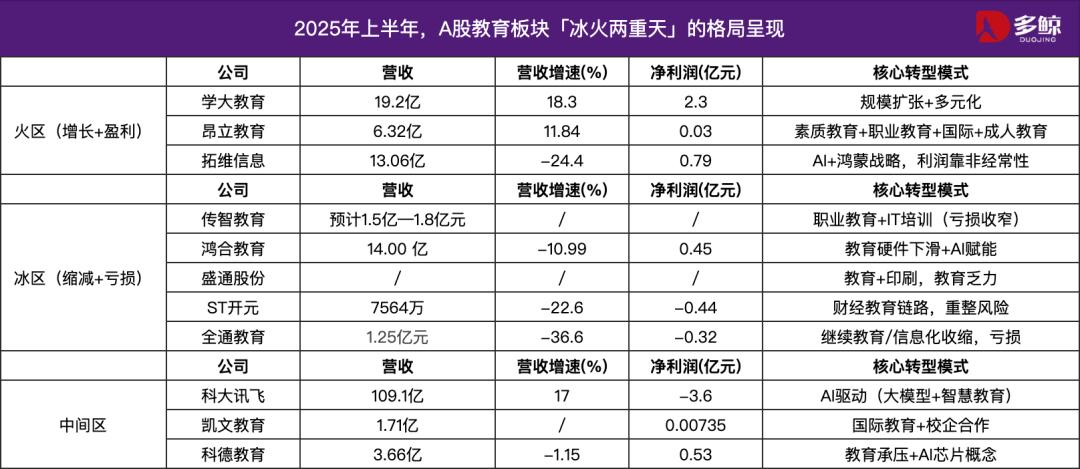
Core Viewpoint - The A-share education sector in the first half of 2025 continues to exhibit a "polarized" pattern, with some companies thriving while others struggle, reflecting the complex and changing market environment [1][20]. Group 1: "Fire Zone" Companies - Companies in the "fire zone" such as Xueda Education, Angli Education, and Tuo Wei Information show significant growth and profitability, driven by different strategies: scale expansion, comprehensive transformation, and technology-driven approaches [3][20]. - Xueda Education achieved revenue of 1.92 billion with a growth rate of 18.3% and a net profit of 230 million, focusing on personalized education and national expansion [4][20]. - Angli Education reported revenue of 632 million, up 11.84%, and turned a profit of 2.88 million, diversifying into multiple educational sectors including quality education and vocational training [6][20]. - Tuo Wei Information's revenue was 1.306 billion, down 24.42%, but net profit surged to 78.81 million due to non-recurring gains, highlighting a reliance on financial adjustments rather than core business growth [8][20]. Group 2: "Ice Zone" Companies - Companies in the "ice zone" like Quantu Education, Honghe Education, and ST Kaiyuan face severe challenges, including significant revenue declines and ongoing losses, reflecting the harsh realities of the education industry [10][20]. - Quantu Education's revenue fell to 125 million, down 36.58%, with a net loss of 32.3 million, struggling with policy tightening and reduced client payment capabilities [11][20]. - Honghe Education reported revenue of 1.4 billion, down 10.99%, with a net profit of only 45 million, as its core interactive whiteboard business continues to decline [12][20]. - ST Kaiyuan's revenue dropped to 75.64 million, down 22.6%, with a net loss of 44.36 million, facing severe financial distress and potential delisting risks [16][20]. Group 3: "Middle Zone" Companies - Companies like Keda Xunfei, Kewen Education, and Kede Education are positioned in the middle zone, showing both growth potential and structural challenges [20][24]. - Keda Xunfei achieved revenue of 10.91 billion, up 17%, but reported a net loss of 360 million, indicating a struggle to convert growth into profitability [21][20]. - Kewen Education's revenue was 171 million, with a net profit of 735,000, reflecting a strong brand in international education despite its small scale [23][20]. - Kede Education's revenue declined to 366 million, down 1.15%, while its net profit fell by 15.16%, showcasing a dual narrative of declining core business and capital market interest due to its AI chip investments [22][20].





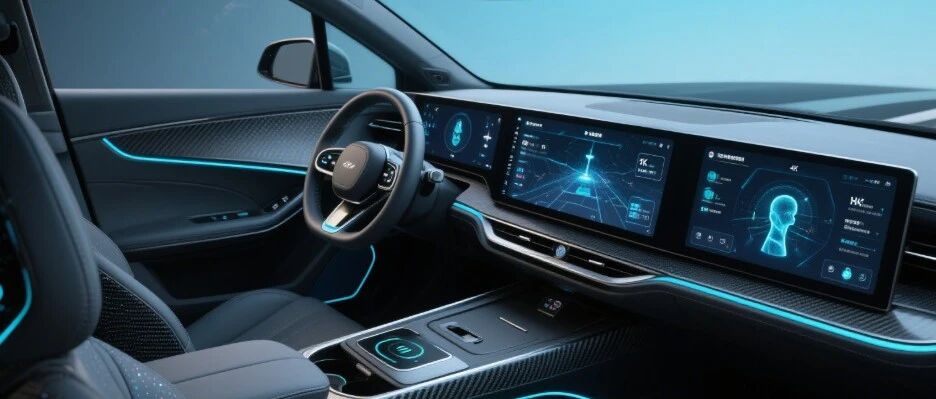
AI大模型正加速“上车”
AI研究所· 2025-08-28 13:00
Core Viewpoint - Tesla's integration of local AI models into its vehicles signifies a response to the growing demand for enhanced smart cockpit experiences in China, addressing previous shortcomings in user interaction and technology [1][2][25] Group 1: Market Trends and Predictions - The market for smart cockpit solutions in China's passenger vehicle sector is projected to reach 156.4 billion yuan by 2025, driven by the transformation of human-vehicle interaction through AI models [3] - The competition in the smart cockpit space is intensifying, with companies either developing their own AI models or partnering with leading tech firms to enhance user experience [3][25] Group 2: New Energy Vehicle Companies' Strategies - New energy vehicle companies like Xiaomi and NIO are focusing on self-developing AI models to create a closed-loop data and industry chain for their smart cockpits [4][10] - Xiaomi's "Human-Vehicle-Home Ecosystem" strategy exemplifies a successful model, integrating various devices for a seamless user experience [4][5][10] Group 3: Traditional Automakers' Collaborations - Traditional automakers are opting to collaborate with top tech companies to quickly address their AI deficiencies, as seen in Chery's partnership with iFlytek [11][12] - Chery's sales reached 2.6 million units in 2024, marking a 38.4% year-on-year increase, showcasing the effectiveness of its strategic focus on AI [12][14] Group 4: AI Model Development and Implementation - iFlytek is a leading player in the automotive AI model space, providing a comprehensive platform that supports various intelligent applications for vehicles [17][22] - The integration of iFlytek's AI model allows for voice command control of 90% of vehicle functions, enhancing user convenience and safety [16][25] Group 5: Competitive Landscape Among Tech Giants - Major tech companies like Huawei and Baidu are also entering the automotive AI space, with Huawei's HarmonySpace and Baidu's intelligent cockpit solutions [23][24] - The evolution of human-vehicle interaction is shifting towards emotional engagement and integrated decision-making, indicating a broader trend in automotive AI development [25]