GoerTek(002241)

Search documents
大行报告|美银:全球智能眼镜竞赛已加速,中国牢牢占领制造中心地位
智通财经网· 2025-09-23 13:32
Core Viewpoint - The smart glasses industry is approaching a "breakout critical point" with major tech companies like Meta launching new smart glasses, and AI glasses expected to dominate growth from 2025 to 2027, followed by AR glasses from 2028 onwards. China is positioned as a key player in the global supply chain with over 80% supplier representation [1]. Industry Trends - The smart glasses market is entering a phase of accelerated demand release, characterized by a "two-stage differentiation" growth logic: - **First Stage (2025-2027)**: AI glasses will lead growth with an expected annual shipment growth rate of 25%, focusing on lightweight applications such as voice interaction and health monitoring [2]. - **Second Stage (2028 onwards)**: AR glasses will take over with an anticipated annual shipment growth rate of 101%, driven by advancements in display technology and computational power [2]. - The overall global smart glasses shipment compound annual growth rate (CAGR) from 2025 to 2030 is projected to reach 40%, with a doubling point expected around 2027 due to consumer electronics replacement cycles and enterprise applications [2]. Supply Chain Dynamics - The global smart glasses supply chain is characterized by "China dominance and regional division of labor": - **Supply Side**: Chinese companies control over 80% of core components, including cameras, optical waveguides, MEMS, and batteries, with significant market shares in camera modules, optical coatings, and assembly [3]. Manufacturing Landscape - China remains the core manufacturing base for smart glasses, with major production hubs in Shandong and Guangdong. However, electronic manufacturing services (EMS) are gradually shifting some non-core assembly operations to Southeast Asia to mitigate supply chain risks, while retaining core component production in China [4]. Technological Barriers - The industry's core competitive focus is on two main technological directions: - Drug delivery efficiency (e.g., optical transmittance for AR glasses, voice recognition accuracy for AI glasses) - User adaptability (e.g., lightweight design, battery life, and matching usage scenarios for different demographics) [5]. Key Company Analysis - **GoerTek**: Recognized as the global leader in smart glasses assembly, with over 70% of orders from major clients like Meta and Sony. The target price is set at 42 RMB based on a projected PE of 34 times for 2026, reflecting a 30% annual growth expectation in the smart glasses assembly business [6]. - **Crystal Optoelectronics**: A core supplier of optical waveguides for AR glasses, with a target price of 30 RMB based on a PE of 27 times for 2026. The company is expected to achieve a stable 22% CAGR in earnings from 2024 to 2027 [7]. - **Sunny Optical**: A leading supplier of camera modules for smart glasses, with a target price of 104 HKD based on a PE of 25 times for 2026. The company is positioned for growth due to improvements in the optical industry and the potential of smart glasses as a second growth curve [10].





美银:全球智能眼镜竞赛已加速,中国牢牢占领制造中心地位
Zhi Tong Cai Jing· 2025-09-23 13:18
Core Insights - The smart glasses industry is approaching a "breakout critical point" with major tech companies like Meta launching new smart glasses [1] - Bank of America predicts that AI glasses will dominate growth from 2025 to 2027, while AR glasses are expected to take over as the main growth driver starting in 2028 [1] - China is positioned to play a crucial role in the global smart glasses supply chain, controlling over 80% of suppliers [1] Industry Trends - The smart glasses market is entering a phase of accelerated demand release, characterized by a "two-stage differentiation" growth logic [2] - **First Stage (2025-2027)**: AI glasses will lead growth with an expected annual shipment growth rate of 25% due to their high technological maturity and cost control [2] - **Second Stage (2028 onwards)**: AR glasses are projected to replace AI glasses, with an anticipated annual shipment growth rate of 101% as display technology and optical solutions improve [2] - The overall market is expected to see a compound annual growth rate (CAGR) of 40% from 2025 to 2030, with a doubling point in shipments around 2027 driven by consumer electronics replacement cycles and enterprise applications [2] Supply Chain Dynamics - The global smart glasses supply chain is characterized by "China dominance and regional division of labor" [3] - **Supply Side**: Chinese companies control over 80% of core components, including cameras, optical waveguides, MEMS, and batteries, with significant market shares in key areas [3] - **Manufacturing Side**: China remains the core manufacturing base, while EMS companies are gradually shifting some non-core assembly operations to Southeast Asia to mitigate supply chain risks [3] - The industry focuses on two main technological directions: drug delivery efficiency and user adaptability, with companies holding core technology patents establishing differentiated barriers [3] Key Company Analysis - **GoerTek**: Upgraded to "Buy" due to its position as the world's largest smart glasses assembler, with over 70% of assembly orders from major clients like Meta and Sony. Target price set at 42 RMB based on a 34x PE ratio for 2026 [4] - **Crystal Optoelectronics**: Maintained "Buy" rating as a core supplier of AR optical waveguide plates, with a target price of 30 RMB based on a 27x PE ratio for 2026 [6] - **Sunny Optical**: Also rated "Buy," recognized for its dual capabilities in camera modules and optical waveguides, with a target price of 104 HKD based on a 25x PE ratio for 2026 [9]

OpenAI做硬件的伙伴,为何锚定“果链双雄”?
2 1 Shi Ji Jing Ji Bao Dao· 2025-09-23 09:15
Group 1 - OpenAI is collaborating with Luxshare Precision and GoerTek to enter the AI hardware market, with a focus on consumer-grade AI devices [2][3] - Luxshare Precision's stock price surged by 51.6% over the past month, reaching a record high of 65.12 yuan on September 23, influenced by OpenAI's hardware ambitions and strong iPhone 17 sales [2] - OpenAI plans to develop AI hardware such as smart glasses, digital voice recorders, and wearable badges, with initial products expected to launch by late 2026 or early 2027 [2][4] Group 2 - GoerTek is also in discussions with OpenAI, likely supplying components like MEMS microphones for the AI hardware [3][4] - Following the news of OpenAI's hardware initiatives, GoerTek's stock rose by 7.73% on September 22, but fell by 2.82% the next day [4] - Analysts suggest that OpenAI's move into hardware could benefit various Chinese hardware companies in Apple's supply chain, including Luxshare Precision and GoerTek [4] Group 3 - OpenAI's hardware strategy is seen as a response to the growing trend of "physical AI," with significant recruitment from Apple to bolster its hardware team [4][5] - The collaboration with Jony Ive's company, io Products, aims to produce a new form of AI hardware, potentially assembled in Vietnam and resembling the iPod Shuffle [5] - The AI hardware market is expected to grow, with predictions of over 200 million wearable devices shipped globally by 2025, indicating a shift towards service-oriented products [10][11] Group 4 - The competitive landscape for smart glasses includes various players, with each type of manufacturer having distinct advantages [11] - Chinese companies are rapidly gaining market share in AI hardware, leveraging their supply chain capabilities and cost control [11][12] - Luxshare Precision has recently partnered with a U.S. AI chip company to develop next-generation wearable products, focusing on low power consumption and compact design [12]

新“新三样”领跑,接力中国资产重估
21世纪经济报道· 2025-09-23 06:19
Core Viewpoint - The article emphasizes the emergence of a new paradigm in China's economy, termed the "new new three samples," which includes robotics, artificial intelligence (AI), and innovative pharmaceuticals, as key drivers for high-quality economic development and a shift from traditional growth models to technology-led advancements [1][4][29]. Robotics Sector - The robotics sector has seen significant market capitalization growth, with companies like Huichuan Technology exceeding 200 billion yuan and several stocks doubling in price within the year [2][13]. - The market for industrial robots in China is projected to reach 302,000 units in 2024, maintaining its position as the largest industrial robot market globally [30]. - Key challenges include reliance on imported high-end servo motors and precision components, which need to be addressed to enhance domestic capabilities [33]. Artificial Intelligence Sector - The AI sector is characterized by a large number of high-value companies, with six firms exceeding a market cap of 100 billion yuan, including Cambricon and Hikvision [19]. - The demand for AI capabilities has surged, particularly in large model applications, leading to significant revenue growth for companies like Industrial Fulian and Cambricon, with year-on-year increases of 35.58% and 4347.82%, respectively [20]. - The sector is supported by national policies aimed at integrating AI into various industries, with a comprehensive action plan released to enhance AI's role in economic development [22]. Innovative Pharmaceuticals Sector - The innovative pharmaceuticals sector is represented by major players like Heng Rui Medicine, which is nearing a market cap of 500 billion yuan, and BeiGene, which recently achieved profitability [24][28]. - Recent policy measures have been introduced to support the development of innovative drugs, including streamlined approval processes and enhanced reimbursement mechanisms [27]. - The sector is witnessing a shift from loss-making to profitability, with companies like BeiGene demonstrating the commercial viability of innovative drug models [28]. Strategic Importance - The "new new three samples" signify a transition from scale-driven manufacturing to technology-driven innovation, crucial for enhancing China's global competitiveness and economic resilience [7][9][31]. - The collaboration among robotics, AI, and innovative pharmaceuticals creates a synergistic effect that strengthens overall productivity and fosters new business models [8][31]. - Addressing the "bottleneck" issues in these sectors is essential for sustaining growth and achieving leadership in global technology competition [32][33]. Policy Recommendations - To enhance competitiveness, policies should focus on data openness, regulatory reforms, and infrastructure development to support AI and innovative pharmaceuticals [35][38]. - Establishing a robust talent pipeline and fostering interdisciplinary education will be critical for sustaining innovation in these sectors [37][38]. - Encouraging public-private partnerships and international collaboration will further strengthen China's position in the global market [39].




歌尔股份股价跌5.07%,鑫元基金旗下1只基金重仓,持有18.82万股浮亏损失33.5万元
Xin Lang Cai Jing· 2025-09-23 02:59
Group 1 - The stock of GoerTek Inc. fell by 5.07% on September 23, closing at 33.36 CNY per share, with a trading volume of 4.44 billion CNY and a turnover rate of 4.17%, resulting in a total market capitalization of 116.78 billion CNY [1] - GoerTek Inc. is located in Weifang High-tech Industrial Development Zone, Shandong Province, and was established on June 25, 2001, with its IPO on May 22, 2008. The company's main business includes precision components, smart acoustic systems, and smart hardware [1] - The revenue composition of GoerTek Inc. is as follows: smart hardware accounts for 54.17%, smart acoustic systems for 22.17%, precision components for 20.25%, and other supplementary services for 3.41% [1] Group 2 - From the perspective of major fund holdings, one fund under Xinyuan Fund has a significant position in GoerTek Inc. The Xinyuan Technology Innovation Mixed A Fund (018827) held 188,200 shares in the second quarter, representing 6.25% of the fund's net value, making it the fourth-largest holding [2] - The Xinyuan Technology Innovation Mixed A Fund (018827) was established on September 4, 2023, with a latest scale of 67.12 million CNY. Year-to-date returns are 31.71%, ranking 2799 out of 8172 in its category, while the one-year return is 53.7%, ranking 2904 out of 7995 [2] - The fund manager, Li Biao, has a tenure of 6 years and 107 days, managing assets totaling 2.137 billion CNY, with the best fund return during his tenure being 73.46% and the worst being -5.7% [2]
苹果正加紧提高iPhone17的产量,消费电子ETF(561600)涨超0.7%
Xin Lang Cai Jing· 2025-09-23 02:04
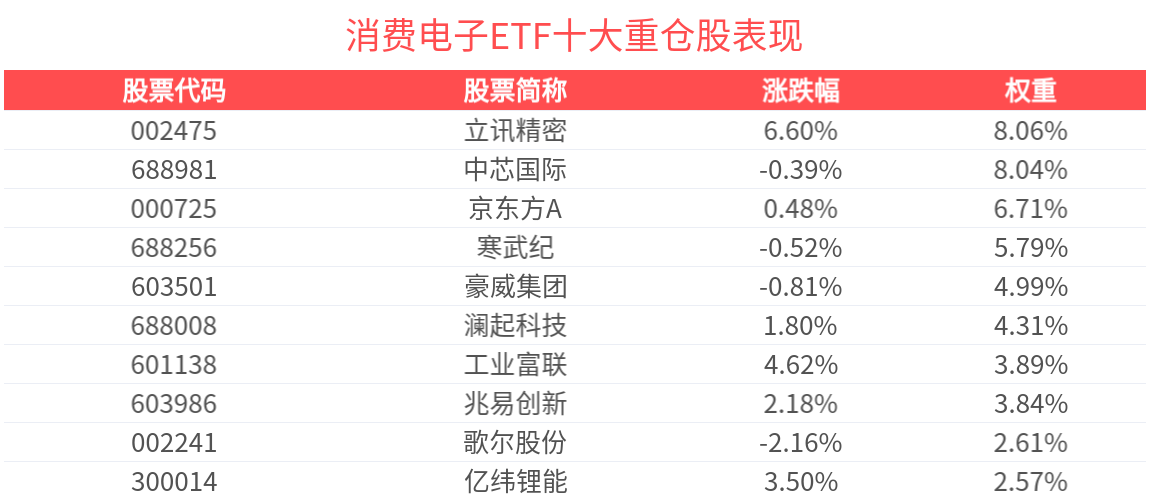
Group 1 - Apple is ramping up production of the standard iPhone 17, with long queues observed at Shenzhen stores on the first day of release, and delivery times for the entire iPhone 17 series are currently 3-4 weeks [1] - The consumer electronics sector is expected to benefit from the low price point of products, making it a potential early adopter of AI applications, with specific adoption targets set for 70% by 2027 and 90% by 2030 [1] - The domestic consumer electronics supply chain is well-established, making it a preferred partner for the development of various new consumer electronics products, with multiple AI glasses expected to be released within the year [1] Group 2 - As of September 23, 2025, the CSI Consumer Electronics Theme Index (931494) has risen by 1.26%, with notable increases in stocks such as Luxshare Precision (6.60%), Industrial Fulian (4.62%), and Xinwangda (4.19%) [1] - The CSI Consumer Electronics Theme Index includes 50 listed companies involved in component production and brand design, with the top ten stocks accounting for 54.8% of the index [2] - The top ten weighted stocks in the CSI Consumer Electronics Theme Index include Cambricon (688256), Luxshare Precision (002475), and SMIC (688981), among others, with Luxshare Precision having a weight of 8.06% [4]



LPR连续4个月按兵不动,上海一豪宅成交单价超32万 | 财经日日评
吴晓波频道· 2025-09-23 00:29
Group 1: Monetary Policy and Economic Indicators - The LPR in China has remained unchanged for four consecutive months, with the 1-year LPR at 3.00% and the 5-year LPR at 3.50% [2] - The stability in LPR pricing is attributed to unchanged policy rates, indicating a cautious approach by the People's Bank of China [2][3] - There is speculation that the central bank may implement a slight interest rate cut in Q4 to enhance liquidity in response to weakening export growth and slowing domestic demand recovery [3] Group 2: Real Estate Market Trends - A luxury property in Shanghai sold for over 32 million yuan per square meter, with total sales reaching 98.43 billion yuan in a single day [4] - Despite an overall downturn in the real estate market, the luxury segment remains robust, driven by high-net-worth individuals and a scarcity of prime properties [4][5] - The luxury market is showing independent trends compared to the general housing market, which is more affected by policy changes and income levels [5] Group 3: Corporate Developments and Market Reactions - OpenAI is collaborating with Luxshare Precision to develop a consumer-grade hardware product, indicating a strategic move to diversify revenue streams [8] - Nvidia has established its first AI technology center in the Middle East, partnering with the Abu Dhabi Technology Innovation Institute to advance AI models and robotics [10][11] - Anta Sports' stock price fell by 2.22% following controversy over an art event in the Himalayas, highlighting the impact of environmental concerns on brand reputation [12][13] Group 4: Investment Movements - Berkshire Hathaway has completely exited its investment in BYD, which had previously yielded a 3890% return, reflecting a shift in investment strategy [14][15] - The competitive landscape in China's new energy vehicle sector has intensified, prompting Berkshire to reassess its position in the market [15] Group 5: Stock Market Performance - The Chinese stock market experienced slight gains, with the Shanghai Composite Index rising by 0.22% amid strong performance in the semiconductor sector [16] - Market dynamics show a clear divergence between sectors, with technology stocks gaining while consumer sectors face challenges [17]




龙虎榜复盘 | AI叙事持续演化,消费电子迎来集体大涨
Xuan Gu Bao· 2025-09-22 11:08
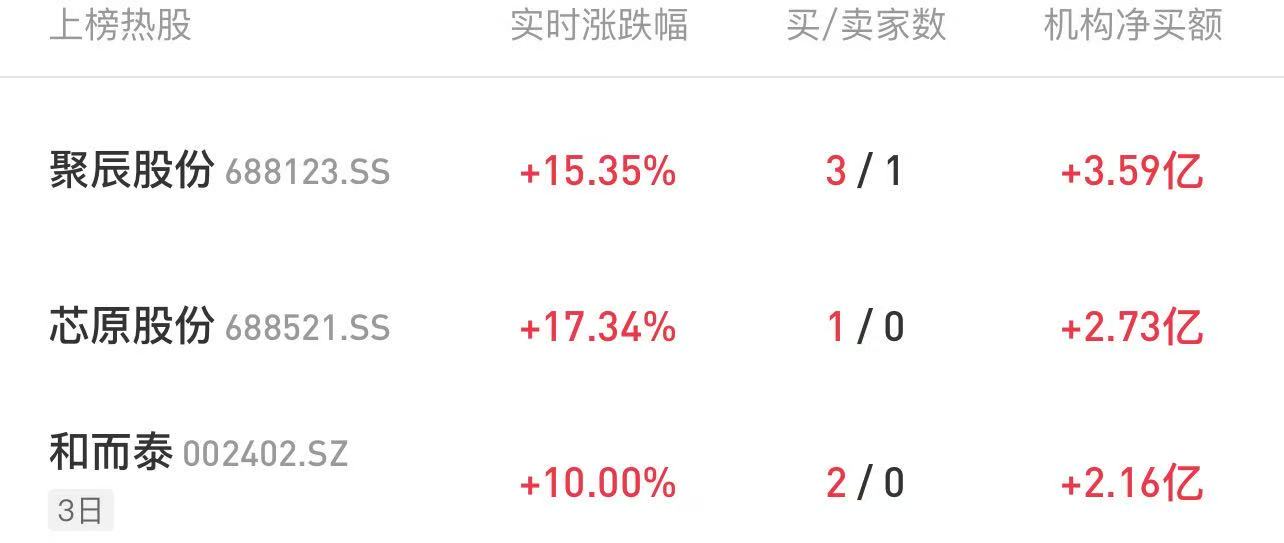
Group 1 - Institutional trading today saw 36 stocks listed, with 16 experiencing net buying and 20 facing net selling [1] - The top three stocks with the highest institutional buying were: Jucheng Co., Ltd. (3.59 billion), Xinyuan Co., Ltd. (2.73 billion), and Heertai (2.16 billion) [1] - Jucheng Co., Ltd. reported a net buying of 3.59 billion from four institutions, with its products widely used in various fields including storage modules, smartphones, automotive electronics, industrial control, IoT, wearable devices, white goods, communication equipment, and medical instruments [3] Group 2 - Jucheng Co., Ltd. saw a stock price increase of 15.35% with 3 buyers and 1 seller [2] - Xinyuan Co., Ltd. experienced a stock price increase of 17.34% with 1 buyer and no sellers [2] - Heertai's stock price rose by 10.00% with 2 buyers and no sellers [2] Group 3 - Apple device assembler Luxshare Precision has secured at least one assembly contract for an OpenAI device, and is in talks with GoerTek for future product components [4] - Apple has notified two suppliers to increase the daily production of the standard iPhone 17 model by at least 30% [5] - The Shanghai Stock Exchange will review the IPO of Moer Thread Technology on September 26, 2025, with a book value of 306 million [5]


端侧硬件场景丰富,产业链有望迎高增机遇
Orient Securities· 2025-09-22 11:03
Investment Rating - The industry investment rating is "Positive (Maintain)" [5] Core Viewpoints - The smart terminal market is expected to flourish, driven by the recovery in iPhone sales and the entry of large model manufacturers like Open AI, which will accelerate innovation in smart terminal categories and forms [3][8] - The iPhone 17 series has shown strong sales performance, with a fourfold increase in trade-in sales compared to the previous year, indicating a positive outlook for the supply chain [8] - Open AI's entry into AI hardware terminals is expected to enrich the product ecosystem, benefiting existing supply chain companies like Luxshare Precision and GoerTek [8] Summary by Sections Investment Suggestions and Targets - The report recommends buying shares of several companies in the AI supply chain, including Luxshare Precision (002475), Lens Technology (300433), and GoerTek (002241) among others [3] Industry Dynamics - The report highlights the potential for rapid growth in the AI hardware terminal market, with Open AI planning to launch its first device by late 2026 or early 2027, which will include various innovative products [8] - The report notes that the iPhone 17 series has prompted Apple to increase production capacity, reflecting strong market demand and potential for supply chain growth [8] - Meta's recent launch of multiple AI & AR glasses indicates a growing market for AR technology, suggesting a shift from accessory to independent smart terminal status for wearable devices [8]




15.50亿主力资金净流入,富士康概念涨2.83%
Zheng Quan Shi Bao Wang· 2025-09-22 10:17
Group 1 - Foxconn concept stocks rose by 2.83%, ranking fifth among concept sectors, with 70 stocks increasing in value [1][2] - Notable gainers included Hongfuhang and Weiteou, both reaching a 20% limit up, while other significant increases were seen in Guanjie Technology (14.62%), Pengding Holdings (14.33%), and Jintuo Co. (12.82%) [1][2] - The largest declines were recorded by Huicheng Vacuum (-5.47%), Kesen Technology (-3.83%), and An彩高科 (-2.99%) [1][2] Group 2 - The Foxconn concept sector attracted a net inflow of 1.55 billion yuan, with 44 stocks receiving net inflows, and 10 stocks exceeding 100 million yuan in net inflow [2][3] - Leading the net inflow was Lingyi Zhi Zao with 1.971 billion yuan, followed by Guanjie Technology (497 million yuan), GoerTek (462 million yuan), and Pengding Holdings (446 million yuan) [2][3] Group 3 - In terms of net inflow ratios, Guanjie Technology (32.79%), Lingyi Zhi Zao (18.98%), and Pengding Holdings (14.99%) led the sector [3] - Other notable stocks included Dazhu Laser (10.20%), ShenNan Electric (7.77%), and Huanli Tai (12.53%) [3][4]