DFD(002407)

Search documents
LiFSI(双氟磺酰亚胺锂)不仅仅是添加剂
猛兽派选股· 2025-12-24 03:15
Core Viewpoint - LiFSI (Lithium bis(fluorosulfonyl)imide) is transitioning from a performance-enhancing additive to a core material in high-end battery formulations, with its usage in leading battery manufacturers increasing from 5% to 15% as the industry moves towards high-nickel ternary, fast-charging, and solid-state batteries [1] Group 1: Advantages and Shortcomings of LiFSI - Core advantages include high efficiency and safety, with an ionic conductivity of 10.2 mS/cm at 25°C, which is 15% higher than traditional LiPF₆, and a capacity retention rate of 82.3% after 1000 cycles with high-nickel cathodes [3] - LiFSI remains conductive at -40°C, addressing range reduction issues for electric vehicles in cold climates, and shows excellent compatibility with silicon-carbon anodes and high-voltage cathodes above 4.4V, making it a standard material for 800V platforms [4] - As a primary salt, LiFSI can create high-concentration electrolytes, meeting the interface control needs of semi-solid batteries, with CATL's Kirin battery requiring at least 20% addition [5] - Current production costs are high, ranging from 120,000 to 200,000 yuan per ton, which is 2-3 times that of LiPF₆, despite a significant decrease from 800,000 yuan per ton in 2021 [6] - There is a risk of aluminum foil corrosion at high voltages, necessitating the use of additives like LiPO₂F₂ or blending with LiPF₆, complicating formulations [7] - The synthesis process is complex, requiring multiple reactions and a product purity of over 99.99%, with metal impurities needing to be controlled below 5 ppm [8] Group 2: Capacity Landscape - The domestic LiFSI market is highly concentrated, with over 85% market share held by five companies, including Tianqi Materials and Dongyue Group, as of Q3 2025, with effective capacity reaching 32,000 tons [9] - Tianqi Materials leads the industry with a capacity of 30,000 tons, expected to expand to 90,000 tons by 2026, benefiting from a cost advantage of 15% due to its integrated supply chain [10] - Dongyue Group operates at full capacity with 8,000 tons, achieving over 90% self-sufficiency in intermediates and maintaining top-tier impurity control [11] - New Zhongbang and Yongtai Technology focus on high-end markets with capacities of 5,000 tons and 6,000 tons, respectively, with the latter reducing energy consumption by 30% through continuous flow processes [12] - By 2026, planned domestic capacity is expected to exceed 50,000 tons, but only 30% will be high-end electronic-grade, leading to price competition in mid-to-low-end products [13] Group 3: Development Pathways - In the short term (2025-2027), LiFSI is expected to penetrate the market as an additive, increasing its proportion in power batteries from 8.5% to 20%, with high-end consumer electronics penetration exceeding 68% [15] - In the medium term (2028-2030), the demand for LiFSI as a primary salt will grow due to the mass production of semi-solid batteries, with usage in 4680 cylindrical batteries rising to over 5% per ton [16] - In the long term (post-2030), LiFSI is anticipated to adapt to new scenarios such as sodium-lithium hybrid batteries and hydrogen energy storage, with global demand potentially exceeding 200,000 tons [18] Group 4: Upstream and Downstream Dynamics - The upstream supply chain faces constraints, particularly with chlorosulfonic acid, which is essential for LiFSI production, leading to a 50% price surge to 2,050 yuan per ton due to increased demand [20] - The domestic effective capacity for chlorosulfonic acid is locked at 565,000 tons, with environmental approvals causing supply gaps, while Kaisheng New Materials monopolizes 40% of the market with 150,000 tons [20] - The downstream battery manufacturers are shifting from passive procurement to joint development, customizing LiFSI formulations to suit silicon-carbon anodes and solid electrolytes, with the average mixing ratio reaching 8.5% in 2024, up 6 percentage points from 2022 [22] - Three pathways for overcoming bottlenecks include upstream integration of raw materials, promoting process innovations, and establishing green approval channels for chlorosulfonic acid production [23][24][25] Conclusion - The evolution of LiFSI reflects the lithium battery industry's shift towards higher energy density and safety, with short-term raw material constraints supporting industry growth, while long-term leaders with integrated capabilities and technological barriers are expected to dominate [27]


锂电材料涨价落地节奏加速,新能车ETF(515700)冲击4连涨
Sou Hu Cai Jing· 2025-12-24 02:57
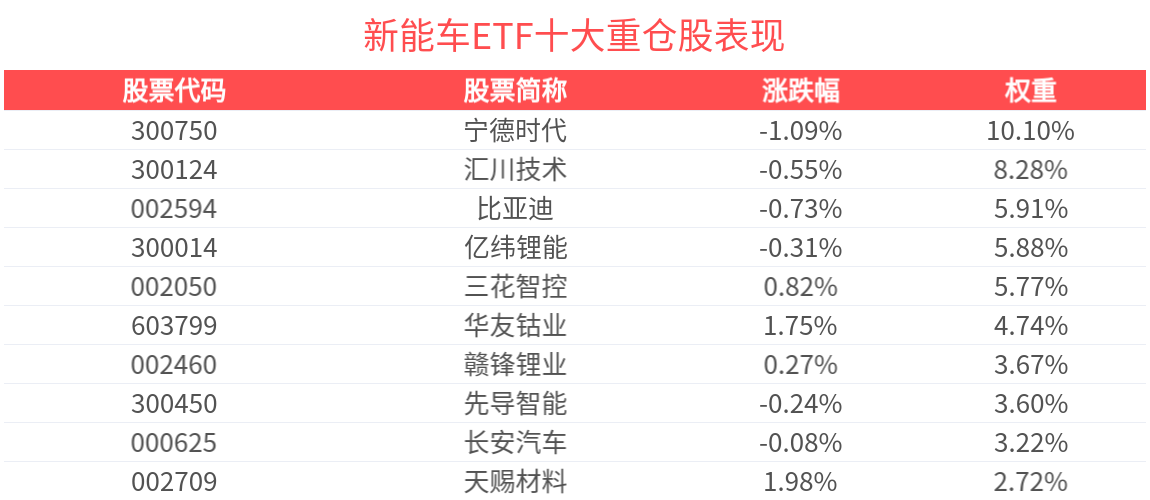
Group 1 - The core material for electrolytes, lithium hexafluorophosphate, has seen a price increase that exceeds market expectations, reaching an average price of 177,250 yuan per ton, which is over a 200% increase since early November [1] - The demand from energy storage and new energy vehicles has triggered a boom in the lithium battery industry chain, marking a turning point in industry prosperity since December 2025, with price increases expected to continue until the second quarter of 2026 due to supply-demand mismatches [1] - As of December 24, 2025, the CSI New Energy Vehicle Industry Index (930997) rose by 0.36%, with notable increases in component stocks such as Weichai Power (8.32%) and Zhongmin Resources (4.77%) [1] Group 2 - The CSI New Energy Vehicle Industry Index closely tracks the performance of 50 listed companies involved in the new energy vehicle sector, including manufacturers of electric vehicles, electric motors, battery equipment, and materials [2] - As of November 28, 2025, the top ten weighted stocks in the CSI New Energy Vehicle Industry Index accounted for 51.96% of the index, with leading companies including CATL, BYD, and Ganfeng Lithium [2]




动力电池和储能电池需求旺盛,锂电材料价格回升 | 投研报告
Zhong Guo Neng Yuan Wang· 2025-12-24 02:04
Core Viewpoint - The lithium battery industry is experiencing significant growth in production and demand, with notable increases in both battery and phosphoric iron lithium cathode material output in November 2025 compared to the same period in 2024 [1][2]. Production - In November 2025, domestic battery production reached 176.3 GWh, marking a year-on-year increase of 49.66% and a month-on-month increase of 3.34% [1][2]. - The production of phosphoric iron lithium cathode materials in November 2025 was 26.89 million tons, reflecting a year-on-year growth of 29.43% and a month-on-month growth of 0.75%, with a capacity utilization rate of 62.53% [1][2]. Pricing - The price of industrial-grade lithium carbonate rose to 101,000 yuan per ton as of December 19, 2025, with a weekly increase of 7.44% [3]. - The price of phosphoric iron lithium (power type) remained stable at 39,100 yuan per ton as of December 19, 2025 [3]. - The average price of square phosphoric iron lithium energy storage cells remained stable, with prices reported at 0.385, 0.310, and 0.310 yuan/Wh for different capacities [3]. Demand - In November 2025, the monthly shipment of phosphoric iron lithium batteries reached 75.3 GWh, a year-on-year increase of 43.62% and a month-on-month increase of 11.56%, setting a new high for the year [4]. - The monthly shipment of ternary power batteries was 18.2 GWh, showing a year-on-year increase of 33.82% and a month-on-month increase of 10.30% [4]. - The export volume of Chinese power batteries in November 2025 was 21.2 GWh, a year-on-year increase of 69.60% and a month-on-month increase of 9.28% [4]. Investment Recommendations - The company suggests focusing on core enterprises in the battery sector that are leading in both domestic and overseas markets, particularly those with a collaborative layout in power batteries and energy storage [5]. - Companies to watch include CATL (300750.SZ), Yiwei Lithium Energy (300014.SZ), and others involved in lithium battery materials [5].




锂电电解液指数盘中涨2%,天际股份触及涨停
Mei Ri Jing Ji Xin Wen· 2025-12-24 01:50
Group 1 - The lithium battery electrolyte index increased by 2% during intraday trading, indicating a positive market trend for the sector [1] - Notable performances among component stocks include Tianji Co., which hit the daily limit, and other companies such as Duofluoride, Haike Xinyuan, Huasheng Lithium Battery, and Shida Shenghua, which saw increases of 3.66%, 3.34%, 2.78%, and 2.37% respectively [1]


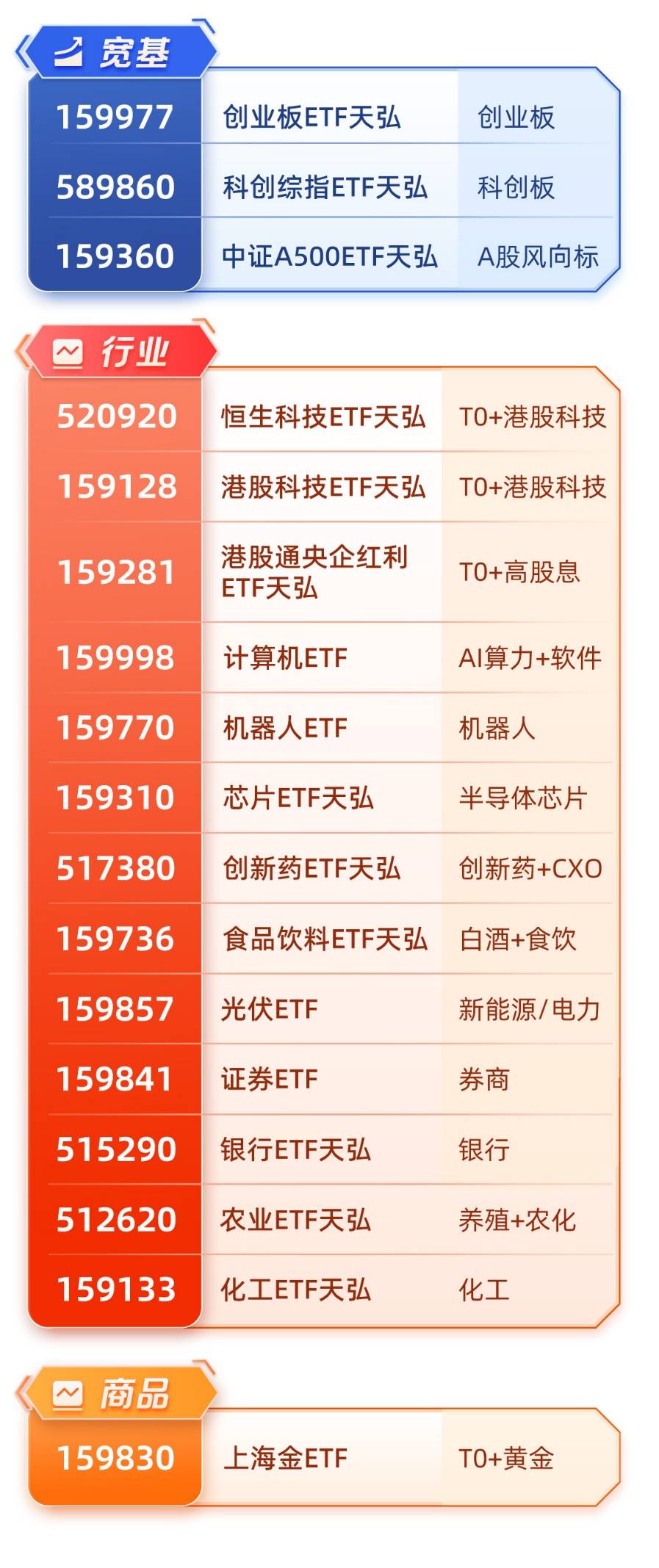
化工品涨价潮引爆板块行情!化工ETF天弘(159133)单日资金申购超2600万份,跟踪指数强势五连阳!
Sou Hu Cai Jing· 2025-12-24 01:43
Group 1 - The core viewpoint of the articles highlights the recent performance and growth of the chemical ETF Tianhong (159133), which has seen significant trading activity and inflows, indicating investor interest in the chemical sector [1] - As of December 23, 2025, the chemical ETF Tianhong (159133) recorded a turnover of 8.33% with a transaction volume of 45.52 million yuan, and the underlying index, the CSI Sub-Industry Chemical Theme Index (000813), rose by 0.65%, marking five consecutive days of gains [1] - The chemical ETF Tianhong (159133) experienced a notable increase in scale, growing by 50.67 million yuan over the past two weeks and 5.5 million shares in the past week, reflecting strong investor demand [1] Group 2 - Recent price increases in MDI and lithium carbonate have driven a positive outlook for the chemical sector, with global chemical giants raising MDI prices due to supply constraints [2] - The chemical sector has been in a profit bottoming phase for 11 consecutive quarters, with many sub-industries operating at or below breakeven, but expectations for supply-side reforms are rising [2] - Institutions like CICC and Founder Securities suggest focusing on low-valuation leaders and sectors with improving supply-demand dynamics, benefiting from domestic policies aimed at reducing excess capacity [2]


电池板块逆市上涨
Yang Zi Wan Bao Wang· 2025-12-23 23:14
Market Overview - Victory Energy (001331) has achieved an 8-day consecutive limit-up, while Luyuan Pharmaceutical (002788) has seen a 5-day consecutive limit-up. Other notable stocks include Jiamei Packaging (002969) with 6 limit-ups in 8 days and Shenjian Co. (002361) with 4 consecutive limit-ups [1] - The market experienced a pullback after a rise, with the ChiNext Index rising over 1% during the day. The total trading volume in the Shanghai and Shenzhen markets reached 1.9 trillion yuan, an increase of 37.9 billion yuan compared to the previous trading day [1] - Nearly 3,900 stocks in the market declined, while sectors such as photolithography machines, batteries, and the Hainan Free Trade Zone saw significant gains [1] Industry Highlights - The lithium battery sector was boosted by a renewed price surge in the supply chain, with companies like Tianji Shares (002759) and Duofluoride (002407) hitting the daily limit. Lithium mining stocks such as Dazhong Mining (001203) and Tianhua New Energy (300390) saw increases of over 10% [1] Company News - Ningbo Huaxiang (002048) announced that its subsidiary, Huaxiang Qiyuan, signed a contract to produce robot joints for a leading domestic manufacturer, which is expected to enhance its competitive advantage in the smart robot components market [2] - Victory Energy (001331) clarified that it does not engage in robot-related business and has no plans for asset restructuring in the next 12 months. The company has seen a cumulative stock increase of 114.44% over the past 8 trading days [2] - *ST Xinyan (300159) will resume trading on December 24, 2025, after completing a capital increase plan that will raise its total share capital from 1.496 billion shares to 3.29 billion shares through a 10-for-12 bonus share issuance [3]


【23日资金路线图】电力设备板块净流入近49亿元居首 龙虎榜机构抢筹多股
Zheng Quan Shi Bao· 2025-12-23 12:47
沪深300今日主力资金净流出76.96亿元,创业板净流出89.34亿元,科创板净流出15.25亿元。 | | 各板块最近五个交易日主力资金净流入数据(亿元) | | | | --- | --- | --- | --- | | 日期 | 沪深300 | 创业板 | 科创板 | | 2025-12-23 | -76.96 | -89. 34 | -15. 25 | | 2025-12-22 | 28. 91 | 20. 31 | -12. 07 | | 2025-12-19 | 9.88 | -38. 81 | 9.25 | | 2025-12-18 | -152. 56 | -101. 40 | -7.88 | | 2025-12-17 | 51. 45 | 40. 67 | -15. 20 | | | | 尾盘资金净流入数据(亿元) | | | 2025-12-23 | -14.66 | -19. 42 | -3.50 | | 2025-12-22 | 1. 21 | -2. 24 | 2. 46 | | 2025-12-19 | -3. 61 | -7.53 | 2. 93 | | 2025-12-18 | ...
锂电爆发引领行情,化工ETF(516020)盘中涨超1%!资金疯狂涌入化工板块!
Xin Lang Cai Jing· 2025-12-23 11:51
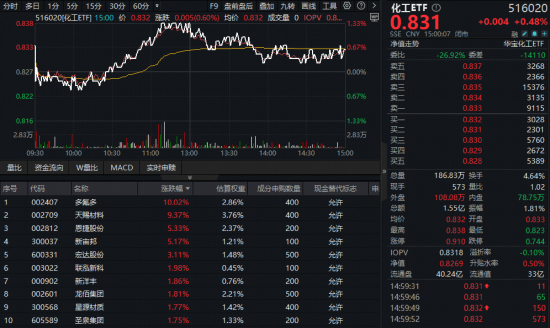
Group 1 - The chemical sector continues to rise, with the chemical ETF (516020) experiencing a maximum intraday increase of 1.33% before closing up 0.48% [1][10] - Key stocks in the sector include lithium battery-related companies, fluorochemicals, and phosphate chemicals, with notable performances from companies like Duofu Duo and Tianqi Materials, which surged by 9.37% and over 5% respectively [1][9] - The sub-index of the chemical ETF has shown a year-to-date increase of 34.27%, outperforming major A-share indices such as the Shanghai Composite Index (16.95%) and the CSI 300 Index (17.43%) [3][10] Group 2 - The basic chemical sector has seen significant capital inflow, with a net inflow of 14.218 billion yuan on a single day and a total of 37.722 billion yuan over the past five days, leading among 30 major industry sectors [2][11] - The lithium battery supply chain is experiencing a "warm winter" trend, driven by surging demand in energy storage and related sectors, leading to price increases across various components [4][12] - Analysts attribute the price increases in the lithium battery supply chain to unexpected growth in energy storage demand, with global energy storage installations expected to reach 150 GWh by 2025, a 50% year-on-year increase [5][13] Group 3 - The current valuation of the chemical sector is considered attractive, with the sub-index's price-to-book ratio at 2.48, which is at a relative low point historically [5][13] - Looking ahead, the chemical industry is expected to face a turning point in 2026, driven by supply-side contractions and strong policy support, potentially leading to a "Davis double play" scenario of valuation recovery and earnings growth [6][14] - The chemical ETF (516020) is recommended for investors looking to capitalize on the sector's rebound, as it tracks a comprehensive index covering various sub-sectors, with significant holdings in large-cap leading stocks [6][14]

主力资金丨2股尾盘获重点出击
Zheng Quan Shi Bao Wang· 2025-12-23 11:22
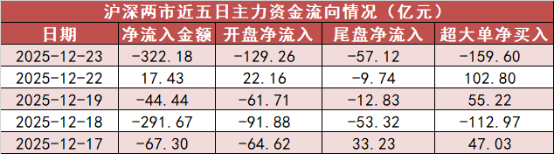
Group 1 - The A-share market saw all three major indices close in the green on December 23, with the energy metals, battery, fiberglass, electronic chemicals, and precious metals sectors leading the gains, while tourism, education, real estate services, aerospace, and software development sectors experienced declines [1] - The net outflow of main funds in the Shanghai and Shenzhen markets reached 32.218 billion yuan, with six industries receiving net inflows, led by the power equipment sector with a net inflow of 3.656 billion yuan [1] - Other sectors with net inflows included basic chemicals (1.278 billion yuan), building materials (358 million yuan), and banking (128 million yuan) [1] Group 2 - A total of 78 stocks saw net inflows exceeding 100 million yuan, with 8 stocks receiving net inflows over 500 million yuan [2] - Multi-Flor's main fund inflow reached 1.248 billion yuan, leading the market, while the lithium battery concept stocks showed strong performance with Multi-Flor hitting the daily limit [3] - The price of battery-grade lithium carbonate rose from 81,000 yuan/ton at the beginning of the month to 92,000 yuan/ton by the end, marking a 13.58% increase [3] Group 3 - In the tail end of trading, the power equipment sector saw net inflows exceeding 100 million yuan, with individual stocks like Aerospace Development and Baobian Electric receiving net inflows of 206 million yuan and 132 million yuan, respectively [4] - New stock Nanchuan's closing price surged by 408.17%, focusing on thermal management products for electric vehicles and fuel vehicles [4] - The tail end of trading also recorded net outflows exceeding 100 million yuan for stocks like Xinyi Sheng, Sanhua Intelligent Control, and Xue Ren Group [5]

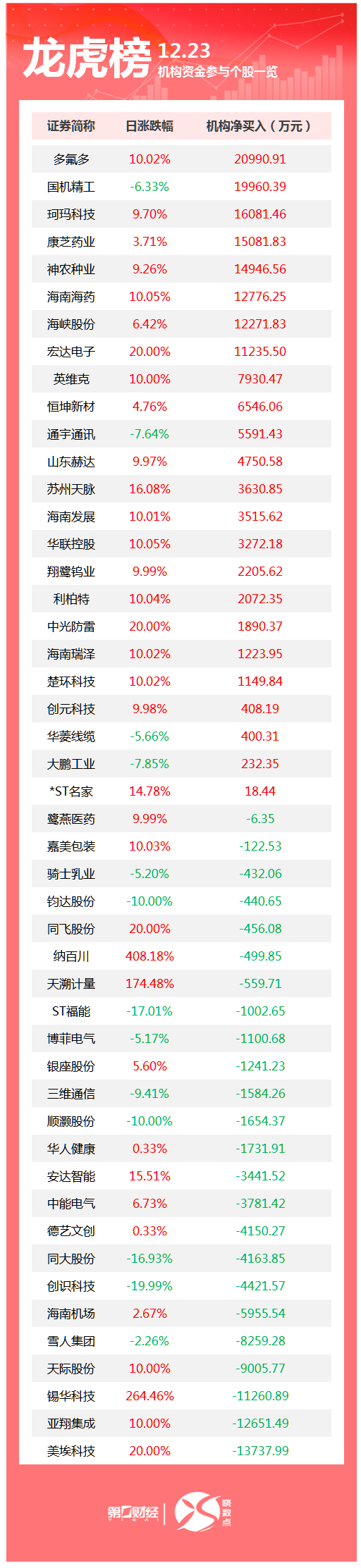
龙虎榜丨机构今日买入这24股,卖出美埃科技1.37亿元


Di Yi Cai Jing· 2025-12-23 11:08
Summary of Key Points Core Viewpoint - On December 23, a total of 48 stocks were involved with institutional investors, with 24 stocks showing net buying and 24 stocks showing net selling. Group 1: Institutional Net Buying - The top three stocks with the highest net buying by institutions were: - Duofuduo: Net buying amount of 210 million yuan, with a daily increase of 10.02% [1][2] - Guojijinggong: Net buying amount of 200 million yuan, with a daily decrease of 6.33% [1][2] - Kema Technology: Net buying amount of 161 million yuan, with a daily increase of 9.70% [1][2] Group 2: Institutional Net Selling - The top three stocks with the highest net selling by institutions were: - Meiai Technology: Net outflow amount of 137 million yuan, with a daily increase of 20.00% [1][4] - Yaxiang Integration: Net outflow amount of 126 million yuan, with a daily increase of 10.00% [1][4] - Xihua Technology: Net outflow amount of 112 million yuan, with a significant daily increase of 264.46% [1][4]