
BYD(002594)

Search documents
【环球财经】日本2月进口电动车销量增长43% 比亚迪销量翻倍
Zhong Guo Jin Rong Xin Xi Wang· 2026-03-05 09:54
Core Insights - The report from the Japan Automobile Importers Association indicates a decline in overall automobile imports in February, with non-Japanese brand vehicle sales dropping by 6% year-on-year [1] - Electric vehicle sales, particularly from Chinese brand BYD, have shown significant growth, marking a positive trend in a weakening market [1] Group 1: Overall Market Performance - In February, Japan imported 17,500 vehicles (excluding Japanese brands), reflecting a 6% decrease compared to the previous year [1] - The overall market is experiencing a downturn, which contrasts with the performance of electric vehicles [1] Group 2: Electric Vehicle Segment - Electric vehicle imports reached 2,675 units in February, representing a 43% increase year-on-year and accounting for 15% of total imports [1] - This marks the second consecutive month of growth for electric vehicle sales in Japan [1] Group 3: BYD's Performance - BYD's sales in Japan surged from 221 units in the same month last year to 466 units, achieving a year-on-year growth of approximately 111% [1] - The company attributes its success to the increasing market interest in new energy vehicles, particularly the newly launched plug-in hybrid model, BYD SEALION 6 [1]

日本2月进口电动车销量增长43% 比亚迪销量翻倍
Xin Hua Cai Jing· 2026-03-05 09:48
Core Insights - The report from the Japan Automobile Importers Association indicates a decline in overall Japanese imported car sales, with February figures showing a total of 17,500 units sold, a decrease of 6% year-on-year [2] - Despite the overall market downturn, electric vehicle sales have surged, with a notable performance from Chinese brand BYD, which saw its sales increase significantly [2] Group 1: Market Performance - In February, the sales of imported electric vehicles in Japan reached 2,675 units, marking a 43% year-on-year increase and accounting for 15% of total imported vehicle sales [2] - This marks the second consecutive month of growth for imported electric vehicles in Japan [2] Group 2: BYD's Performance - BYD's sales in Japan rose from 221 units in the same month last year to 466 units this February, representing an approximate growth of 111% [2] - The company attributes its sales growth to the increasing market interest in new energy vehicles, particularly the newly launched plug-in hybrid model, BYD SEALION 6, which has shown strong sales momentum [2]

BYD sales plunge in first two months of 2026 as EV giant loses more ground to competitors
CNBC· 2026-03-05 09:40
Core Insights - BYD has experienced a significant decline in sales, losing market share to domestic competitors in the first two months of 2026 due to a slowdown in overall demand in China's electric vehicle market [1][2][5] Sales Performance - BYD's combined sales volume for January and February 2026 decreased by approximately 36% compared to the same period in 2025, adjusted for seasonal factors [2] - In contrast, other EV manufacturers in China, such as Leapmotor and Xiaomi, reported substantial year-on-year sales increases of 19% and 48%, respectively [3] - Nio and Geely's Zeekr saw impressive sales growth of 77% and 84% year-on-year, while Xpeng faced a 42% decline in sales [4] Market Dynamics - The narrowing lead of BYD in the domestic market indicates a more competitive landscape, with rivals enhancing their offerings to attract consumers [5][6] - Competitors are focusing on providing high value at competitive prices, a strategy referred to as involution [6] - The introduction of a 5% purchase tax on new energy vehicles may have created a "demand vacuum" for BYD as consumers rushed to buy before the tax took effect [7] Competitive Strategies - BYD is responding to increased competition by expanding its focus on international markets, with exports surpassing domestic sales for the first time in February 2026 [9] - The company plans to launch new products, including advancements in battery technology, to stimulate demand [10] Regulatory Environment - The Chinese EV market is facing challenges due to a slowdown in demand, partly attributed to the reintroduction of the purchase tax on new energy vehicles [11][12] - Analysts suggest that the reduction in financial incentives may suppress new EV purchases, as costs are likely to be passed on to consumers [13] - Some automakers are implementing creative financing schemes to encourage consumer demand amidst the slowing market [14][15]



比亚迪2月在日本销量翻番
日经中文网· 2026-03-05 07:35
Group 1 - BYD's plug-in hybrid vehicle "Sea Lion 6" is performing well, accounting for 40% of overall sales [2][4] - In February, the import car sales in Japan (excluding domestic brands) decreased by 6% year-on-year, totaling 17,505 units, while pure electric vehicle (EV) sales increased by 43% to 2,675 units, representing 15% of total imports [2] - BYD's EV sales have surged to 2.1 times, reaching 466 units, with the "Sea Lion 6" contributing significantly to this growth [4] Group 2 - The overall import car sales have declined for two consecutive months, with notable decreases in brands such as Mercedes-Benz (down 2% to 3,512 units), BMW (down 22% to 2,162 units), and Volkswagen (down 33% to 1,912 units) [4] - The sales of passenger cars priced above 10 million yen increased by 9% to 3,180 units, while those priced between 4 million and 10 million yen decreased by 5% to 1,665 units, and cars below 4 million yen dropped by 11% to 3,229 units [4]

3月5号是什么日子啊?比亚迪要全网刷屏了!
Xin Lang Cai Jing· 2026-03-05 04:30
Core Insights - BYD's March 5th event is expected to deliver a significant amount of information regarding new products and technologies [1][5] - The company will introduce the second-generation blade battery and new fast-charging technology, alongside multiple new vehicle models across its four brands [4][9] Product Launches - The new models include the Dynasty series's Tang, the Song Ultra EV, the Ocean series's Seal, the Dolphin, the Tengshi's new Z9GT, and the Yangwang's refreshed U7/U8/U8L for 2026, as well as the Fangcheng's Titanium 3/Titanium 7 EV fast-charging versions [4][9] - The range of vehicles covers various segments from family commuting to high-end flagship models and rugged off-road vehicles, appealing to a broad audience [5][10]

比亚迪将发布第二代刀片电池及闪充技术;中国移动发布全球首台超百T智算互联路由器样机丨智能制造日报
创业邦· 2026-03-05 03:22
Group 1 - The core viewpoint of the article highlights significant advancements in various technology sectors, including Micro LED displays, AI smartphones, and battery technology [2][3][4]. Group 2 - Omdia's report predicts that Micro LED display revenue will grow by 100% year-on-year, increasing from $52.4 million in 2025 to $105.4 million in 2026, driven by improved manufacturing capabilities and new product adoption [2]. - China Mobile unveiled the world's first over 100T intelligent computing interconnection router prototype at the MWC, achieving a throughput of 115.2 Tbps, marking a major breakthrough in core technologies for interconnecting intelligent computing centers [2]. - BYD is set to launch its second-generation blade battery and fast-charging technology on March 5, following the success of its first-generation blade battery that initiated a period of rapid business growth [2]. - Viettel of Vietnam has partnered with Qualcomm to jointly produce AI smartphones, indicating a strategic move towards enhancing technological capabilities in the smartphone sector [2].


汽车股集体回暖 比亚迪将发布第二代刀片电池及闪充技术 机构看好乘用车景气度复苏
Zhi Tong Cai Jing· 2026-03-05 03:03
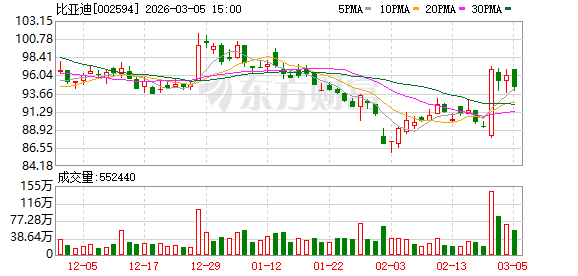
Group 1 - The automotive stocks are collectively rebounding, with notable increases in share prices for companies such as Xpeng Motors (up 4.83% to HKD 65.15), NIO (up 4.37% to HKD 37.74), Geely (up 2.38% to HKD 15.49), and BYD (up 0.37% to HKD 95.4) [1] - BYD is set to release its second-generation blade battery and fast-charging technology on March 5, which follows the first-generation blade battery launch in 2020 that initiated a period of rapid business growth for the company [1] - The anticipated release of the second-generation blade battery is expected to reinforce market optimism regarding technological iterations and cost reduction in the electric vehicle industry [1] Group 2 - According to Everbright Securities, multiple major new car models from various manufacturers are expected to be launched intensively from March to April, with a short-term focus on the impact of rising costs on financial performance [1] - Dongwu Securities indicates that with the implementation of industry subsidy policies, there is a positive outlook for the recovery of passenger vehicle market demand in Q1 2026, maintaining a strong outlook for the passenger vehicle sector [1] - From an annual perspective, the industry is advised to select companies with resilience against volatility domestically and those with certainty in exports [1]
新能源汽车景气度调研:比亚迪恢复最快
数说新能源· 2026-03-05 03:01
Core Viewpoint - The article discusses the current state of the automotive market, particularly focusing on the impact of government subsidy policies on electric vehicle sales and the recovery of various brands in the market. Group 1: Market Performance and Recovery - In January, the automotive market experienced a decline in production and sales due to the withdrawal of national policies, with a notable drop in sales of economic electric vehicles exceeding 30% [2] - By February, the implementation of subsidy policies, such as scrappage and trade-in incentives, helped to stimulate some consumer demand, although overall orders still saw a year-on-year decline of about 15% [2] - The recovery in the automotive market since February has shown improvement compared to last year, but there remains a gap compared to March sales from the previous year [3] Group 2: Brand-Specific Recovery - BYD's Dynasty and Ocean brands have shown a rapid recovery, aided by various promotional policies introduced in late February and early March [4] - Geely has supplemented its entry-level models with additional policies, but overall, BYD is recovering the fastest among competitors [5] - Leap Motor was one of the first brands to introduce significant policy changes, offering substantial discounts on its B-series models [6] Group 3: Consumer Preferences and Technology - Consumer interest in BYD's upcoming technology releases is high, which is expected to significantly impact the brand's market recovery [9] - The key competitive factors in technology are centered around electric motors, control systems, and batteries, with BYD's innovations likely to enhance consumer experience, especially for mid-range vehicles [10] - BYD plans to adopt a new battery technology that could increase energy density to over 200Wh/kg, potentially achieving a range of 1000 kilometers [11] Group 4: Market Dynamics and Pricing Strategies - The introduction of low or zero-interest financing options has had a stimulating effect on the market, particularly for vehicles priced above 200,000 yuan, although acceptance of long-term loans remains low [14] - The actual transaction prices for vehicles above 200,000 yuan have remained stable or slightly declined compared to last year, with sales of mid-range electric vehicles performing well [15] - The pricing strategies of manufacturers like SAIC and Volkswagen are shifting towards higher-priced models, encouraging dealers to focus on selling more premium products [18] Group 5: Inventory and Supply Chain - BYD's inventory levels for its Dynasty and Ocean series are relatively high, exceeding 2.5 months, while other brands like Geely have also seen significant inventory levels [13] - The overall inventory situation varies, with some electric vehicle brands experiencing low inventory levels, while traditional fuel vehicle brands have higher stock [13] Group 6: Future Outlook - Geely plans to focus on the deployment of 800V technology in lower-priced models and enhance its smart driving capabilities across its product range [12] - The automotive market is expected to continue evolving with a focus on improving product quality and avoiding price wars, emphasizing the importance of technological advancements and consumer preferences [19]

港股异动 | 汽车股集体回暖 比亚迪将发布第二代刀片电池及闪充技术 机构看好乘用车景气度复苏
智通财经网· 2026-03-05 02:59
Core Viewpoint - The automotive sector is experiencing a collective rebound, with notable stock price increases for several companies, indicating positive market sentiment towards the industry [1] Group 1: Stock Performance - Xpeng Motors (09868) increased by 4.83%, reaching HKD 65.15 [1] - NIO Inc. (09866) rose by 4.37%, reaching HKD 37.74 [1] - Geely Automobile (00175) saw a 2.38% increase, reaching HKD 15.49 [1] - BYD Company (01211) experienced a modest rise of 0.37%, reaching HKD 95.4 [1] Group 2: Technological Developments - BYD is set to launch its second-generation blade battery and fast-charging technology on March 5 [1] - The first-generation blade battery, released in 2020, significantly contributed to BYD's rapid business growth [1] - The anticipated release of the second-generation blade battery is expected to enhance BYD's technological lead and market optimism regarding cost reduction and efficiency improvements in the electric vehicle supply chain [1] Group 3: Market Outlook - According to Everbright Securities, multiple major new car models from various manufacturers are expected to be launched in March and April [1] - Dongwu Securities indicates that the industry subsidy policies have been implemented, and there is optimism for a recovery in passenger vehicle demand in Q1 2026 [1] - The overall outlook for the domestic market suggests a focus on stability amid fluctuations, while exports are expected to favor certainty [1]
宏观金融类:文字早评2026/03/05星期四-20260305
Wu Kuang Qi Huo· 2026-03-05 02:35
1. Report Industry Investment Rating No relevant content provided. 2. Core Viewpoints of the Report - Amid the US - Iran conflict, global risk appetite is disturbed, oil prices are rising, the Fed's rate - cut expectation is weakening, and US Treasury yields are climbing rapidly. It is recommended to pay attention to domestic Two Sessions policy signals and changes in the war situation and control risks [4]. - Due to the Spring Festival dislocation, the February PMI data shows a decline in manufacturing prosperity. The economy's recovery momentum needs further observation, and domestic demand awaits income stabilization and policy support. The US - Iran conflict may boost the bond market in the short - term, but long - term impacts depend on the conflict's intensity and duration. The bond market is expected to continue to fluctuate [6]. - The near - blockade of the Strait of Hormuz and strong US economic data suppress the Fed's rate - cut expectation and put pressure on precious metals. A cautious bearish view is taken on gold and silver [8]. - For copper, the geopolitical situation and policy factors support the price, and the short - term price may rise with a slowdown in inventory accumulation [11]. - Aluminum prices are expected to be strong in the short - term due to supply concerns from the Middle East conflict and relatively low LME inventory [13]. - Zinc prices are expected to fluctuate widely during the conflict, following the sentiment of the non - ferrous metal sector [15]. - Lead prices are expected to stop falling and stabilize in the short - term and may gradually recover as supply narrows [16]. - Nickel prices are expected to rise slowly in the medium - term, but in the short - term, they will likely fluctuate to digest inventory pressure [17]. - Tin prices are expected to fluctuate widely. It is recommended to wait and see due to the current situation of supply - demand balance and rising inventory [19]. - For lithium carbonate, it is cautiously bullish before the end of the downward trend, and attention should be paid to downstream procurement and market atmosphere [20]. - Alumina futures prices are expected to fluctuate widely. It is recommended to wait and see, focusing on potential supply - side drivers [22]. - Stainless steel is expected to maintain an upward - fluctuating pattern, with supply pressure and improved market procurement [24]. - Cast aluminum alloy prices are expected to be strong in the short - term due to cost support and improved demand [26]. - Steel prices are likely to continue to fluctuate weakly in the short - term, with the core contradiction being inventory digestion and demand verification [28]. - Iron ore prices are expected to fluctuate, with supply recovering and demand affected by important meetings [30]. - Coking coal and coke prices are expected to continue to fluctuate in the short - term, with a potential upward trend in the second half of the year [35]. - Glass prices are expected to maintain a weak - fluctuating pattern due to high inventory and slow demand recovery [37]. - Soda ash prices are expected to maintain a narrow - fluctuating pattern, with supply reduction expectations and slow demand release [39]. - Manganese silicon and ferrosilicon prices are affected by market sentiment and cost factors. It is recommended to pay attention to potential cost - push and supply - contraction factors [43]. - Industrial silicon is expected to have a pattern of both supply and demand increasing, with prices fluctuating due to news disturbances [45]. - Polysilicon prices are expected to be under pressure due to high inventory and weak feedback [48]. - For rubber, it is recommended to trade flexibly according to the market and set stop - losses [53]. - For crude oil, a mid - term layout is recommended, including short - selling strategies and spread - trading strategies [55]. - Methanol is recommended to take profit at high prices as it has fully priced in the geopolitical premium [57]. - Urea is recommended to be short - sold as its fundamental outlook is bearish [60]. - For pure benzene and styrene, wait for the non - integrated profit to fall to a low level before considering long - positions [62]. - PVC has a poor fundamental situation with strong supply and weak demand, and the short - term price is driven by crude oil cost sentiment [65]. - Ethylene glycol has a high inventory and high - load production. There is an expectation of reducing production to improve the supply - demand pattern, and attention can be paid to long - positions at low prices [67]. - PTA is expected to follow PX and crude oil to go long at low prices after observing the maintenance situation [69]. - PX is expected to turn into a de - stocking cycle in March. It is recommended to go long at low prices following crude oil [71]. - Polyethylene prices are expected to rise due to reduced pressure on the supply side and a rebound in demand [73]. - Polypropylene prices are recommended to go long on the PP5 - 9 spread at low prices, with the long - term contradiction shifting from cost - driven to production - mismatch [76]. - For live pigs, a bearish view is taken on the near - term and a cautious bullish view on the far - term [79]. - For eggs, be aware of the valuation pressure on the far - term contracts due to increased inventory - building behavior [81]. - For soybean and rapeseed meal, wait for a callback to buy due to high domestic soybean inventory and expected large - scale purchases [83]. - For oils and fats, a bullish view is taken in the medium - term, and it is recommended to buy at low prices [86]. - For sugar, it is not advisable to be overly bearish on raw sugar. It is recommended to participate in long - positions in the domestic market at low prices [88]. - For cotton, it is recommended to buy at low prices, focusing on the downstream opening rate in March [91]. 3. Summary by Directory 3.1 Macro - Financial 3.1.1 Stock Index - **Market Information**: A 15% global tariff rate may be implemented this week; US ADP employment in February was 63,000, higher than expected; potential price volatility in precious metals if gold and silver transportation is blocked; Huawei and BYD had product launches [2]. - **Strategy**: Pay attention to domestic Two Sessions policy signals and the war situation, and control risks [4]. 3.1.2 Treasury Bonds - **Market Information**: On Wednesday, the main contracts of TL, T, TF, and TS had different changes. In February, the manufacturing PMI declined, the non - manufacturing PMI improved slightly, and the comprehensive PMI decreased. The central bank had a net withdrawal of funds [5]. - **Strategy**: The economic recovery momentum needs observation. The US - Iran conflict may boost the bond market in the short - term, but long - term impacts depend on the conflict. The bond market is expected to fluctuate [6]. 3.1.3 Precious Metals - **Market Information**: Shanghai gold fell 0.22%, and silver rose 1.88%. COMEX gold and silver rose. The US 10 - year Treasury yield was 4.09%, and the US dollar index was 98.82. The Middle East situation and strong US economic data put pressure on precious metals [7]. - **Strategy**: A cautious bearish view is taken on gold and silver, with reference ranges for Shanghai gold and silver contracts provided [8]. 3.2 Non - Ferrous Metals 3.2.1 Copper - **Market Information**: US ADP data was better than expected, and copper prices stopped falling. LME and SHFE inventories changed, and spot discounts narrowed [10]. - **Strategy**: Geopolitical and policy factors support copper prices. The short - term price may rise with a slowdown in inventory accumulation [11]. 3.2.2 Aluminum - **Market Information**: The Middle East conflict affected aluminum supply, and prices rose and then fell. Inventory and other indicators changed [12]. - **Strategy**: Aluminum prices are expected to be strong in the short - term due to supply concerns and low LME inventory [13]. 3.2.3 Zinc - **Market Information**: Zinc prices had small changes, and inventory and other data were reported [14][15]. - **Strategy**: Zinc prices are expected to fluctuate widely during the conflict, following the sentiment of the non - ferrous metal sector [15]. 3.2.4 Lead - **Market Information**: Lead prices fell slightly, and inventory and other indicators were reported [16]. - **Strategy**: Lead prices are expected to stop falling and stabilize in the short - term and may gradually recover as supply narrows [16]. 3.2.5 Nickel - **Market Information**: Nickel prices rose, and spot and cost data were reported [17]. - **Strategy**: Nickel prices are expected to rise slowly in the medium - term, but in the short - term, they will likely fluctuate to digest inventory pressure [17]. 3.2.6 Tin - **Market Information**: Tin prices rose. Supply was affected by the situation in Myanmar, and demand was in a post - holiday recovery period [18]. - **Strategy**: Tin prices are expected to fluctuate widely. It is recommended to wait and see [19]. 3.2.7 Lithium Carbonate - **Market Information**: The MMLC index fell, and the futures price rose [20]. - **Strategy**: It is cautiously bullish before the end of the downward trend, and attention should be paid to downstream procurement and market atmosphere [20]. 3.2.8 Alumina - **Market Information**: The alumina index fell, and inventory and other data were reported [21]. - **Strategy**: Alumina futures prices are expected to fluctuate widely. It is recommended to wait and see, focusing on potential supply - side drivers [22]. 3.2.9 Stainless Steel - **Market Information**: Stainless steel prices rose slightly, and inventory and other data were reported [23]. - **Strategy**: Stainless steel is expected to maintain an upward - fluctuating pattern, with supply pressure and improved market procurement [24]. 3.2.10 Cast Aluminum Alloy - **Market Information**: Cast aluminum alloy prices rose, and inventory and other data were reported [25]. - **Strategy**: Cast aluminum alloy prices are expected to be strong in the short - term due to cost support and improved demand [26]. 3.3 Black Building Materials 3.3.1 Steel - **Market Information**: Rebar and hot - rolled coil prices fell slightly, and inventory and other data were reported [28]. - **Strategy**: Steel prices are likely to continue to fluctuate weakly in the short - term, with the core contradiction being inventory digestion and demand verification [28]. 3.3.2 Iron Ore - **Market Information**: Iron ore prices fell slightly, and some steel enterprises received emission - reduction notices [29]. - **Strategy**: Iron ore prices are expected to fluctuate, with supply recovering and demand affected by important meetings [30]. 3.3.3 Coking Coal and Coke - **Market Information**: Coking coal and coke prices fell, and spot - to - futures spreads were reported [32]. - **Strategy**: Coking coal and coke prices are expected to continue to fluctuate in the short - term, with a potential upward trend in the second half of the year [35]. 3.3.4 Glass and Soda Ash - **Market Information**: Glass prices rose slightly, and inventory increased. Soda ash prices rose, and inventory also increased [36][38]. - **Strategy**: Glass prices are expected to maintain a weak - fluctuating pattern due to high inventory and slow demand recovery. Soda ash prices are expected to maintain a narrow - fluctuating pattern, with supply reduction expectations and slow demand release [37][39]. 3.3.5 Manganese Silicon and Ferrosilicon - **Market Information**: Manganese silicon and ferrosilicon prices rose slightly, and technical analysis was provided [40]. - **Strategy**: Manganese silicon and ferrosilicon prices are affected by market sentiment and cost factors. It is recommended to pay attention to potential cost - push and supply - contraction factors [43]. 3.3.6 Industrial Silicon and Polysilicon - **Market Information**: Industrial silicon prices rose, and polysilicon prices fell. Inventory and other data were reported [44][46]. - **Strategy**: Industrial silicon is expected to have a pattern of both supply and demand increasing, with prices fluctuating due to news disturbances. Polysilicon prices are expected to be under pressure due to high inventory and weak feedback [45][48]. 3.4 Energy and Chemicals 3.4.1 Rubber - **Market Information**: Rubber prices fell slightly, and industry data such as tire - factory开工率 and inventory were reported [50][51]. - **Strategy**: It is recommended to trade flexibly according to the market and set stop - losses. A hedging strategy of buying NR and short - selling RU2609 is suggested [53]. 3.4.2 Crude Oil - **Market Information**: Crude oil and refined - oil product prices rose, and inventory data of Fujeirah port were reported [54]. - **Strategy**: A mid - term layout is recommended, including short - selling strategies and spread - trading strategies [55]. 3.4.3 Methanol - **Market Information**: Regional spot and futures prices of methanol changed [56]. - **Strategy**: It is recommended to take profit at high prices as it has fully priced in the geopolitical premium [57]. 3.4.4 Urea - **Market Information**: Regional spot and futures prices of urea changed [59]. - **Strategy**: Urea is recommended to be short - sold as its fundamental outlook is bearish [60]. 3.4.5 Pure Benzene and Styrene - **Market Information**: Prices of pure benzene and styrene rose, and supply - demand and inventory data were reported [61]. - **Strategy**: Wait for the non - integrated profit to fall to a low level before considering long - positions [62]. 3.4.6 PVC - **Market Information**: PVC prices rose, and cost, supply - demand, and inventory data were reported [63]. - **Strategy**: PVC has a poor fundamental situation with strong supply and weak demand, and the short - term price is driven by crude oil cost sentiment [65]. 3.4.7 Ethylene Glycol - **Market Information**: Ethylene glycol prices rose, and supply - demand, inventory, and cost data were reported [66]. - **Strategy**: There is an expectation of reducing production to improve the supply - demand pattern, and attention can be paid to long - positions at low prices [67]. 3.4.8 PTA - **Market Information**: PTA prices rose, and supply - demand, inventory, and cost data were reported [68]. - **Strategy**: PTA is expected to follow PX and crude oil to go long at low prices after observing the maintenance situation [69]. 3.4.9 PX - **Market Information**: PX prices rose, and supply - demand, inventory, and cost data were reported [70]. - **Strategy**: PX is expected to turn into a de - stocking cycle in March. It is recommended to go long at low prices following crude oil [71]. 3.4.10 Polyethylene - **Market Information**: Polyethylene prices rose, and supply - demand and inventory data were reported [72]. - **Strategy**: Polyethylene prices are expected to rise due to reduced pressure on the supply side and a rebound in demand [73]. 3.4.11 Polypropylene - **Market Information**: Polypropylene prices rose, and supply - demand and inventory data were reported [74]. - **Strategy**: It is recommended to go long on the PP5 - 9 spread at low prices, with the long - term contradiction shifting from cost - driven to production - mismatch [76]. 3.5 Agricultural Products 3.5.1 Live Pigs