ROYALFLUSH INFO(300033)

Search documents
同花顺出海50概念涨0.82% 主力资金净流入17股
Zheng Quan Shi Bao Wang· 2025-12-04 09:31
Group 1 - The Tonghuashun Overseas 50 concept index rose by 0.82%, ranking 6th among concept sectors, with 30 stocks increasing in value [1][2] - Leading gainers included Sanhua Intelligent Control, Jin Chengxin, and Top Group, which rose by 7.51%, 5.12%, and 3.36% respectively [1][2] - The top decliners were Goldwind Technology, Kangguan Technology, and Keda Manufacturing, which fell by 1.70%, 1.40%, and 1.35% respectively [1][2] Group 2 - The Tonghuashun Overseas 50 concept sector saw a net inflow of 2.743 billion yuan, with 17 stocks receiving net inflows, and 7 stocks exceeding 100 million yuan in net inflow [2] - Sanhua Intelligent Control led the net inflow with 2.652 billion yuan, followed by Ningde Times, Shenghong Technology, and Top Group with net inflows of 577 million yuan, 479 million yuan, and 385 million yuan respectively [2][3] Group 3 - In terms of net inflow ratio, Sanhua Intelligent Control, Jiangxin Home, and Sany Heavy Industry had the highest ratios at 18.31%, 14.23%, and 13.06% respectively [3] - The net inflow rankings for the Tonghuashun Overseas 50 concept included Sanhua Intelligent Control, Ningde Times, Shenghong Technology, and Top Group, with respective daily turnover rates of 8.86%, 0.45%, 3.37%, and 3.31% [3][4]




点点数据发布第三季度中国证券服务应用Top50榜
Zheng Quan Ri Bao Wang· 2025-12-04 09:19
Core Insights - The third quarter of 2023 saw a total of 190 million monthly active users in the Chinese securities service application industry, reflecting a 5.4% quarter-on-quarter growth, indicating overall market expansion [1] - The growth in user base is driven by two main factors: an average of 2.5076 million new individual investor accounts opened monthly and an average monthly increase of 3.5052 million active users, showing a strong correlation of 0.75 between the two metrics [1] User Growth Dynamics - The securities industry is currently driven by both "new user acquisition" and "existing user activation," with new accounts serving as a vital source of external growth [1] - The monthly active user growth often surpasses the new account openings, highlighting the importance of product iteration and operational optimization in enhancing the activity levels of existing users [1] Application Performance - Tonghuashun and Dongfang Caifu lead the market with a point index exceeding 8000 and monthly active users in the millions, establishing a significant competitive advantage [2] - Zhangle Wealth Pass, representing a top brokerage's proprietary application, maintains over 10 million monthly active users and shows a remarkable over 100% quarter-on-quarter growth in downloads [2] - The competitive landscape is intense in the four-star range of the point index (7200 to 7799), with over ten applications having monthly active users between 5 million and 12 million [2] Future Trends - The head brokerage firms are solidifying their positions through ecosystem advantages, while smaller brokerages are leveraging high-quality channels and market opportunities [2] - The next phase of competition may hinge on differentiated advantages stemming from AI application innovations, with a focus on the parallel development of algorithms and data [2] - The ability to assetize data and apply it in multidimensional ways is becoming a decisive factor for the scalable implementation of AI and the generation of differentiated value [2]



买港股美股除了新浪财经APP,还有哪个APP好用?
Xin Lang Cai Jing· 2025-12-04 06:50
Core Insights - The article emphasizes the growing importance of financial and trading apps for investors, highlighting their role in enhancing personal investment efficiency by providing quick access to information and market analysis [1][10]. Group 1: Comprehensive Platforms - Comprehensive financial information platforms are ideal for investors seeking one-stop access to global financial data, with notable examples being Tonghuashun and Dongfang Caifu, which offer extensive data coverage and analytical tools [2][13]. - Tonghuashun's "iWencai" intelligent customer service provides quick and understandable market insights, appealing to technical analysis investors [2][13]. - Dongfang Caifu's "Guba" feature serves as a unique window to gauge market sentiment in A-shares, although its coverage of futures and forex markets is limited [2][13]. Group 2: Cross-Border Trading - Professional internet brokerage apps like Futu NiuNiu and Tiger Brokers offer seamless experiences for investors trading in Hong Kong and U.S. markets, combining information access with trading functionalities [3][14]. - Futu NiuNiu provides free LV2 U.S. stock depth quotes and supports fractional shares and dark pool trading, enhancing its competitive edge [3][14]. - Tiger Brokers offers competitive pricing for U.S. stock trades, with a fee structure of $0.01 per share and a minimum of $2.99 per order, while recently adjusting its account opening policy for mainland Chinese residents [4][15]. Group 3: Professional Tools - Professional financial data terminals like Tonghuashun's iFinD are suited for investors needing in-depth data analysis, offering comprehensive market information across various exchanges [5][17]. - iFinD boasts over 700 specialized statistical reports and advanced analytical tools, making it ideal for deep research and data analysis [6][17]. Group 4: Emerging Choices - The rise in cross-border investment demand has led to the emergence of specialized apps like Xueqiu, which serves as a platform for deep discussions among seasoned investors [7][18]. - Hafu Securities, under Dongfang Caifu, offers competitive commission rates for trading in Hong Kong and U.S. markets, facilitating user conversion through its parent platform's traffic resources [8][19]. Group 5: Considerations for Selection - Investors should assess the data coverage of apps based on their investment needs, with Futu NiuNiu and Tiger Brokers being suitable for those focused on Hong Kong and U.S. markets, while platforms like Sina Finance and Tonghuashun are better for global market coverage [9][20]. - Transaction costs and execution efficiency are critical factors, as different brokers have varying commission structures that can impact trading frequency and scale [9][20]. - The quality of community engagement and information is also important, with platforms like Xueqiu and Futu NiuNiu providing valuable insights for users seeking inspiration from other investors [9][20].


证券行业2026年投资策略:本源业务彩彻区明,整合出海铸一流投行
GF SECURITIES· 2025-12-04 02:05
Core Insights - The report emphasizes the recovery of the securities industry in 2025, with a significant increase in profits driven by self-operated businesses, and anticipates continued growth in 2026 due to favorable policies and market conditions [6][15][26]. Section Summaries 1. 2025 Review: Recovery Begins - The securities industry saw a substantial improvement in profitability, with 43 listed brokers achieving a net profit of CNY 1,692.54 billion in the first three quarters of 2025, a year-on-year increase of 63.44% [15]. - The overall revenue for the same period reached CNY 4,216.23 billion, reflecting a 12.85% increase year-on-year [15]. - The recovery is supported by strong performance in brokerage and proprietary trading, with brokerage net income rising by 68% [18]. 2. Incremental Catalysts Expected, Performance Continues to Improve - The "14th Five-Year Plan" outlines a strategic direction for high-quality development in the financial sector, emphasizing the importance of a robust capital market [33]. - There is significant potential for increased market participation from institutional investors and retail investors, as the wealth effect from the capital market is expected to drive demand expansion [44][48]. 3. Comprehensive Performance Recovery, Growth Potential in Light Asset Businesses - The wealth management sector is recovering, with public funds showing high-quality development and increased market activity [18]. - Investment banking activities are also rebounding, particularly in the dual innovation sector, with IPOs and underwriting volumes expected to rise [18]. 4. Industry Structure Optimization: Building a First-Class Investment Bank - The report highlights the acceleration of mergers among leading brokers and the internationalization of Chinese brokers as key strategies for building a first-class investment bank [6][39]. - The integration of mergers and international expansion is seen as crucial for enhancing the competitive landscape of the industry [6][39]. 5. Profit Forecast: Continued ROE Improvement in 2026 - The report predicts that the return on equity (ROE) for the industry will continue to improve, with a projected net profit growth of 13% year-on-year under neutral assumptions for 2026 [6][39]. 6. Investment Recommendations: Focus on Structural Optimization and Alpha Catalysts - Investors are advised to pay attention to brokers benefiting from structural optimization and the recovery of wealth management, such as China International Capital Corporation, Huatai Securities, and CITIC Securities [6][39].


炒股软件最全测评!新浪财经APP、同花顺、东方财富等十大平台,哪个更适合你?
Xin Lang Cai Jing· 2025-12-03 06:30
Core Insights - The article emphasizes the importance of choosing the right stock trading software, as even a millisecond delay in market data can lead to significantly different investment outcomes [1][16] - The Chinese securities app market has over 166 million monthly active users, indicating that one in every six internet users in China utilizes stock trading software [17] Market Landscape: Three Dominant Players and Diverse Options - The stock trading software market has formed a stable "three-legged" structure, with the top three apps being Sina Finance APP, Tonghuashun, and Dongfang Caifu [2][18] - Tonghuashun leads in user activity with 35.02 million monthly active users, while Dongfang Caifu has 17.21 million, and Sina Finance APP ranks first in comprehensive scoring with a score of 9.56 [19] Software Comparison: Comprehensive Evaluation Across Five Dimensions - A thorough evaluation of mainstream stock trading software was conducted based on five core dimensions: data coverage, information quality, intelligent tools, trading experience, and community ecosystem [3][20] Detailed Rankings and Scores - The rankings and scores for the top stock trading software are as follows: - 1. Sina Finance APP: 9.56 - 2. Tonghuashun: 9.16 - 3. Dongfang Caifu: 9.16 - 4. Xueqiu: 8.66 - 5. Dazhihui: 8.36 - 6. Zhangle Wealth: 8.50 - 7. Tongdaxin: 8.30 - 8. Futu NiuNiu: 8.54 - 9. Tencent Self-Selected Stock: 8.32 - 10. Niuguwang: 8.02 [4][21][22] Key Features of Leading Software - **Sina Finance APP**: Notable for its global coverage and AI integration, with a data refresh speed of 0.03 seconds and exclusive access to Nasdaq Level-2 data [6][25] - **Tonghuashun**: Known for its trading efficiency and intelligent tools, supporting lightning-fast transactions within three seconds for over 90% of brokers [8][27] - **Dongfang Caifu**: Aims to create a comprehensive wealth management ecosystem, with a community platform that sees over one million daily posts [9][29] Unique Features of Other Software - **Xueqiu**: Functions like an investment community platform, offering a simulated trading feature for practice [11][31] - **Dazhihui**: Excels in high-frequency trading with a millisecond response time and advanced historical data visualization [11][32] - **Futu NiuNiu**: Focuses on Hong Kong and US markets, providing free Level-2 data for US stocks and supporting after-hours trading [11][32] Matching Needs: Selecting the Right Software - Investors should choose trading software based on their specific needs: - For cross-market investors, Sina Finance APP is recommended for its extensive market coverage and AI alert system [12][33] - Short-term traders may prefer Tonghuashun for its institutional-level backtesting environment [12][33] - Beginners can consider Tencent Self-Selected Stock for its user-friendly interface and integration with WeChat [12][33] Conclusion - When selecting stock trading software, investors should consider global market coverage capabilities, with Sina Finance APP being able to monitor major global indices in real-time [15][34]
DeepSeek发布新模型!创业板50ETF(159949)涨0.48%,机构持续看好AI产业链投资机会
Xin Lang Cai Jing· 2025-12-03 02:33
Core Viewpoint - The news highlights the performance of the ChiNext 50 ETF (159949), which has shown a slight increase of 0.48% to 1.467 CNY, amidst a broader market fluctuation, indicating ongoing investor interest and activity in the growth sector [1][6]. Market Performance - As of 10:20 AM on December 3, the ChiNext 50 ETF (159949) was trading at 1.467 CNY, with a trading volume of 4.22 billion CNY and a turnover rate of 1.66% [1][6]. - The ETF has experienced a cumulative trading amount of 323.05 billion CNY over the last 20 trading days, averaging 16.15 billion CNY per day, and a total of 3,205.79 billion CNY over 222 trading days this year, averaging 14.44 billion CNY per day [7][10]. Top Holdings - The top ten holdings of the ChiNext 50 ETF (159949) include leading companies such as CATL, Zhongji Xuchuang, Dongfang Caifu, Xinyi Technology, Sungrow Power, Shenghong Technology, Huichuan Technology, Mindray, Yiwei Lithium Energy, and Tonghuashun [3][8]. Industry Insights - Longcheng Securities reports that the continuous implementation of AI applications will drive the acceleration of computing infrastructure, particularly in the AIDC industry chain, which includes optical modules, PCBs, and main equipment manufacturers, indicating a strong demand release and potential for performance and valuation growth [10]. - The report suggests that the demand for edge computing modules will steadily increase as AI applications continue to develop, transitioning from traditional data transmission modules to intelligent and computing modules [10]. Investment Recommendations - The ChiNext 50 ETF (159949) is presented as a convenient and efficient investment tool for investors looking to capitalize on the long-term growth of China's technology sector, with recommendations for dollar-cost averaging or phased investment strategies to mitigate short-term volatility [10].





A股轮动频繁 医药商业板块表现强势
Qi Huo Ri Bao· 2025-12-02 14:57
Group 1: Market Performance - The A-share market experienced rapid rotation of hot themes, with the Shanghai Composite Index down 0.42%, the Shenzhen Component Index down 0.68%, and the ChiNext Index down 0.69% at the close [1] - The total market turnover reached 1,607.3 billion [1] Group 2: Sector Performance - The pharmaceutical commercial sector showed strong performance, ranking first in the increase of sector shares, with Haiwang Biological achieving a "five consecutive limit-up" and over 290,000 sealed orders remaining at the limit-up price [1] - The Fujian sector also performed well, with stocks like Jiarong Technology and Haixin Food hitting limit-up prices [1] - Energy metals and film industry sectors, which performed well previously, experienced adjustments [1] Group 3: Market Outlook - The market is expected to remain in a phase of frequent style switching in December, primarily characterized by structural trends [1] - Key areas for potential deployment include technological innovation, domestic demand expansion, anti-involution, and stabilizing the real estate sector, with industry meetings likely to catalyze thematic trends [1] - External uncertainties, particularly the potential impact of the upcoming Federal Reserve meeting on global market liquidity, are also highlighted [1] Group 4: Health Sector Insights - The China CDC reported that the flu positivity rate among emergency and outpatient cases is close to 45%, indicating a rapid increase in flu cases, with some provinces reaching high epidemic levels [2] - According to Everbright Securities, the demand for cold medicines in Q4 is expected to exceed market expectations due to the rising trend of flu cases [2] - The introduction of multi-pathogen detection products and convenient diagnostic tools is anticipated to support the performance of related pharmaceutical companies [2]


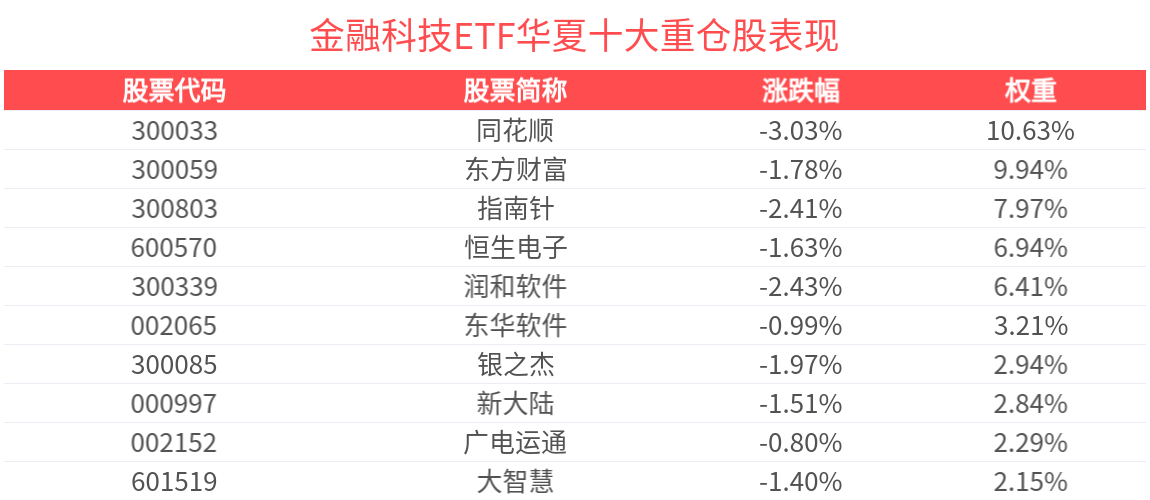
恒银科技涨停,金融科技ETF华夏(516100)或持续受益数字技术与实体经济融合应用
Sou Hu Cai Jing· 2025-12-02 05:33
Core Viewpoint - The financial technology sector is experiencing a decline, with specific ETFs and stocks showing negative performance, while certain sectors like cross-strait integration and ice and snow tourism are leading the gains [1]. Group 1: Financial Technology ETF Performance - The Huaxia Financial Technology ETF (516100) has decreased by 1.50%, with its constituent stocks showing mixed performance [1]. - The top ten weighted stocks in the index account for 53.31% of the total index, indicating a concentration in a few key players [2]. Group 2: Individual Stock Performance - Notable declines in individual stocks include Tonghuashun (-3.03%), Dongfang Wealth (-1.78%), and Hengtong Electronics (-1.63%), among others [3]. - The performance of the top ten stocks in the financial technology ETF reflects a downward trend, with most stocks experiencing losses [3]. Group 3: Strategic Partnerships - Hengyin Technology has announced multiple collaborations with Ant Group, focusing on leveraging software and hardware capabilities to enhance digital technology integration in the real economy [1].


同花顺果指数概念涨2.45%,主力资金净流入15股
Zheng Quan Shi Bao Wang· 2025-12-01 09:07
Core Insights - The Tonghuashun Fruit Index concept rose by 2.45%, ranking 10th among concept sectors, with 16 stocks increasing in value, including Desay Battery and Pengding Holdings reaching their daily limit [1] - The leading gainers in the sector included Lens Technology, Linyu Intelligent Manufacturing, and Crystal Optoelectronics, with increases of 4.22%, 4.17%, and 3.93% respectively [1] - The stocks with the largest declines were Changying Precision, Industrial Fulian, and Zhongshi Technology, which fell by 2.24%, 1.50%, and 0.49% respectively [1] Market Performance - The top-performing concept sectors today included Smart Speakers with a rise of 3.71%, AI Phones at 3.39%, and Zinc Metals at 2.86%, while the worst performers included the Horse Racing concept down by 0.92% and Digital Watermark down by 0.75% [2] - The Tonghuashun Fruit Index concept saw a net inflow of 321 million yuan, with 15 stocks receiving net inflows, and 8 stocks exceeding 100 million yuan in net inflow [2] - Pengding Holdings led the net inflow with 734 million yuan, followed by Linyu Intelligent Manufacturing, Lens Technology, and Desay Battery with net inflows of 344 million yuan, 283 million yuan, and 280 million yuan respectively [2] Fund Flow Ratios - The stocks with the highest net inflow ratios included Pengding Holdings at 23.80%, Desay Battery at 22.87%, and Crystal Optoelectronics at 10.65% [3] - The detailed fund flow for the top stocks showed Pengding Holdings with a daily increase of 9.99% and a turnover rate of 2.77%, while Desay Battery increased by 10.00% with a turnover rate of 10.88% [3][4] - Other notable stocks included Linyu Intelligent Manufacturing with a 4.17% increase and a turnover rate of 3.19%, and Lens Technology with a 4.22% increase and a turnover rate of 2.12% [3][4]





AI全域赋能,业绩周期与技术周期同步向上
Xinda Securities· 2025-12-01 03:03
Core Insights - The report emphasizes the upward synchronization of performance cycles and technology cycles in the computer industry, driven by AI empowerment and structural improvements in fundamentals [1][2][3] - The computer sector is characterized as a "bull market leader," with a significant resonance between fundamentals and liquidity, reflecting strong market recognition of revenue expansion potential [3][20] - The report forecasts substantial growth in various AI applications, including AI Coding, AI in office software, AI in finance, network security, intelligent driving, and industrial software, indicating a broad market opportunity [3][11][12][13][14][16][17] Group 1: AI Applications - AI Coding is projected to reshape software development paradigms, with a global market value expected to grow from $6.7 billion in 2024 to $25.7 billion by 2030, reflecting a compound annual growth rate (CAGR) of 25.2% [3][11][12] - The Chinese AI code generation market is anticipated to expand from 6.5 billion RMB in 2023 to 33 billion RMB by 2028, with a CAGR of 38.4% [3][12] - AI in office software is expected to reach a market size of 30.86 billion RMB in 2024, growing to 191.14 billion RMB by 2028, with a CAGR of 57.75% [3][12] - The network security market is projected to grow to $1.6 billion by 2028, with a CAGR exceeding 230%, driven by the integration of AI technologies [3][14] - Intelligent driving technologies are evolving towards L3 commercial applications, with significant growth in high-speed NOA penetration from 8.7% to 35.7% between 2023 and 2025 [3][16] Group 2: Investment Recommendations - The report suggests focusing on companies involved in AI Coding, such as Zhuoyi Information, and those in AI office software like Kingsoft Office and Foxit Software [3][11][12] - In the AI finance sector, companies like Tonghuashun and Jiufang Zhitu are highlighted for their innovative applications [3][13] - For network security, firms such as Deepin and Anheng Information are recommended due to their advancements in AI-driven security solutions [3][14] - In the intelligent driving space, companies like Desay SV and Zhongke Chuangda are noted for their leadership in high-performance driving solutions [3][16] - Industrial software firms like Zhongkong Technology and Rongzhi Rixin are recognized for their contributions to AI-driven industrial transformations [3][17]