
IMEIK(300896)

Search documents
行业周报:烟火气回归家常菜崛起,潮玩、创作者经济赛道景气度延续-20250713
KAIYUAN SECURITIES· 2025-07-13 14:15
Investment Rating - The industry investment rating is "Positive" (maintained) [2] Core Views - The return of everyday dining and the rise of home-cooked meals are significant trends, with the market for casual dining exceeding 1.2 trillion RMB, emphasizing high cost-performance [5][58] - The creator economy, particularly in the music streaming sector, is experiencing stable growth, with platforms enhancing their bargaining power through non-music content [22][24] - The casual dining market is projected to grow at a compound annual growth rate (CAGR) of 9.1% from 2023 to 2028, reaching 55.87 billion RMB by 2028 [56][58] Summary by Sections 1. Trend in Casual Dining - The average spending on Chinese dining has decreased from 87.6 RMB in 2023 to 79.2 RMB in 2024, a decline of 9.6% [53][55] - The casual dining market is characterized by a shift towards high cost-performance and practicality, with a significant increase in home cooking frequency [53][56] - The market for affordable casual dining (under 100 RMB per meal) is the largest segment, accounting for 88.7% of the total dining market, with a current size of 36.18 billion RMB [56][58] 2. Creator Economy and Music Streaming - The global music streaming market is projected to reach over 20.4 billion USD in 2024, with a year-on-year growth of 7.3% [27][30] - Subscription users in the music streaming sector are expected to grow to 263 million in 2024, reflecting an increase of 11% year-on-year [30] - Spotify's market penetration in emerging markets is driving user growth, with a CAGR of 35% from 2021 to 2025 [26][30] 3. Trends in Toy and Creator Economy - The online sales of trendy toys in June 2025 reached 1.348 billion RMB, with a year-on-year growth of 16% [12][14] - The sales of blind boxes and plush toys showed strong performance, with blind boxes growing by 109% year-on-year [12][13] - The creator economy is bolstered by the growth of non-music content, enhancing platforms' bargaining power [22][24] 4. Beauty and Personal Care Market - The skincare market on Tmall has seen a concentration increase, with the top 20 brands accounting for 46.2% of the total GMV [66] - Domestic brands have seen a decline in both quantity and market share, while international brands have experienced double-digit growth [66][67]



化妆品医美行业周报:再生药械再添两员,轻医美概念方兴未艾-20250713
Shenwan Hongyuan Securities· 2025-07-13 07:12
Investment Rating - The report maintains a positive outlook on the cosmetics and medical beauty industry, indicating a "Buy" recommendation for several companies within the sector [2][14]. Core Insights - The cosmetics and medical beauty sector has shown weaker performance compared to the market, with the Shenwan Beauty Care Index rising by 1.5% from July 4 to July 11, 2025, which is below the market average [3][5]. - The introduction of new products in the regenerative medicine sector, particularly in the "童颜针" (youthful needle) category, is expected to enhance consumer interest and expand the market [2][8]. - The report highlights strong anticipated earnings growth for several key companies in the cosmetics sector for the second quarter of 2025, with notable increases in revenue and net profit for brands like 上美股份 (Shangmei), 丸美股份 (Marubi), and 珀莱雅 (Proya) [9][10][11]. Summary by Sections Industry Performance - The cosmetics and medical beauty sector has underperformed the market, with specific indices showing varied performance, such as the Shenwan Cosmetics Index increasing by 2.6% [3][5]. - The report notes that the demand for cosmetics is recovering, with a 4.1% year-on-year increase in retail sales for the first five months of 2025 [19][20]. Company Performance - 上美股份 (Shangmei) is expected to see a revenue increase of 16% and a net profit increase of 25% in the first half of 2025 [10]. - 丸美股份 (Marubi) anticipates a 22% revenue growth and a 28% increase in net profit for the second quarter of 2025 [10]. - 珀莱雅 (Proya) is projected to achieve a 10% revenue growth and a 15% increase in net profit for the second quarter of 2025 [10]. - 毛戈平 (Mao Geping) expects a significant revenue increase of 38% and a net profit increase of 35% in the first half of 2025 [10]. - 若羽臣 (Ruoyuchen) forecasts a remarkable 70% revenue growth and a 75% increase in net profit for the second quarter of 2025 [10]. Market Trends - The report emphasizes the ongoing trend of domestic brands gaining market share, with national brands occupying five of the top ten positions in the skincare market [32]. - The regenerative medicine sector is expanding, with new products enhancing consumer engagement and market growth potential [2][8]. Investment Recommendations - The report recommends focusing on companies with strong brand matrices and high growth potential, such as 上美股份 (Shangmei), 珀莱雅 (Proya), and 丸美股份 (Marubi) [14]. - It suggests monitoring companies that leverage e-commerce and social media platforms effectively, such as 若羽臣 (Ruoyuchen) and 毛戈平 (Mao Geping) [14].


中证全指医疗保健设备与服务指数上涨0.39%,前十大权重包含迈瑞医疗等
Sou Hu Cai Jing· 2025-07-11 15:40
Core Viewpoint - The China Securities Index for Healthcare Equipment and Services has shown a slight increase of 0.39% recently, reflecting the overall performance of listed companies in the healthcare sector [1] Group 1: Index Performance - The China Securities Index for Healthcare Equipment and Services is currently at 13,682.83 points with a trading volume of 18.089 billion [1] - Over the past month, the index has decreased by 0.83%, while it has increased by 2.95% over the last three months, and has seen a year-to-date decline of 0.43% [1] Group 2: Index Composition - The index is composed of listed companies that correspond to the healthcare theme, with a base date of December 31, 2004, set at 1,000.0 points [1] - The top ten weighted companies in the index include: Mindray Medical (9.44%), United Imaging (8.04%), Aier Eye Hospital (7.55%), Aimeike (3.41%), Huatai Medical (3.23%), New Industry (2.81%), Yuyue Medical (2.7%), Lepu Medical (2.54%), Meinian Onehealth (2.05%), and Shandong Pharmaceutical Glass (1.91%) [1] Group 3: Market Distribution - The index's holdings are primarily listed on the Shenzhen Stock Exchange (60.09%) and the Shanghai Stock Exchange (39.91%) [1] - The healthcare sector accounts for 100% of the index's holdings [1] Group 4: Index Adjustment and Fund Tracking - The index samples are adjusted biannually, with changes implemented on the next trading day following the second Friday of June and December [2] - Public funds tracking the healthcare index include various Southern and Tianhong funds, as well as ETFs from multiple financial institutions [2]




【最全】2025年医美注射材料行业上市公司全方位对比(附业务布局汇总、业绩对比、业务规划等)
Qian Zhan Wang· 2025-07-11 02:56
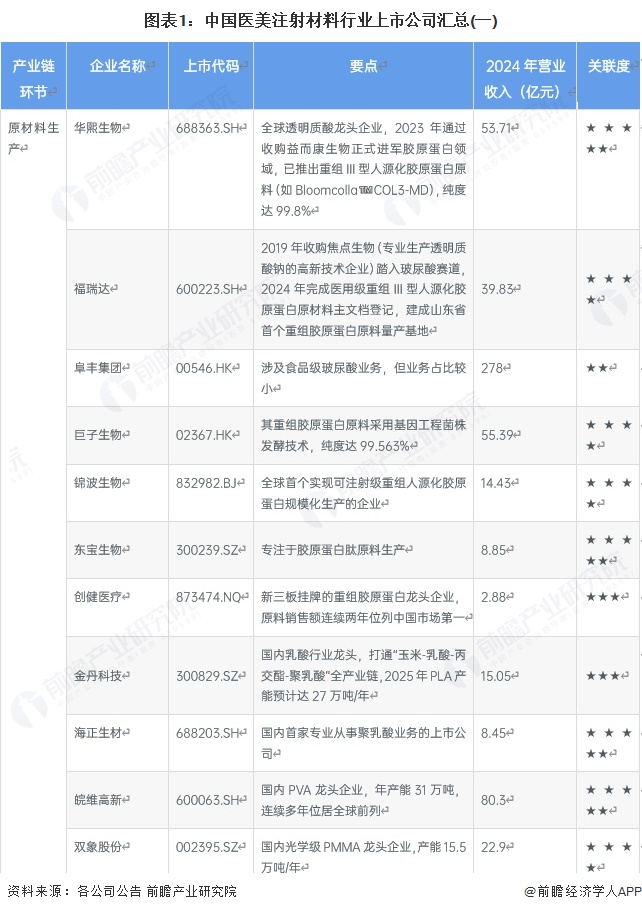
Industry Overview - The medical beauty injection materials industry in China has a limited number of publicly listed companies, primarily including Huaxi Biological, Haohai Biological, Aimeike, and Juzhi Biological, with most companies involved in the supply of upstream raw materials [1][7]. Company Summaries - Huaxi Biological is a global leader in hyaluronic acid, with a projected revenue of 53.71 billion yuan in 2024, and has expanded into collagen products through acquisitions [2][9]. - Haohai Biological has secured exclusive rights for domestic and international botulinum toxin products and is focusing on a dual product line of hyaluronic acid and botulinum toxin [6][15]. - Aimeike is expected to generate approximately 29.60 billion yuan in sales for its medical beauty injection materials in 2024, emphasizing high-end products [9][15]. - Juzhi Biological is projected to achieve sales of around 55.20 billion yuan in 2024, focusing on collagen products and leading the industry in standard-setting [9][15]. Sales and Production Data - Huaxi Biological has sold over 10 million units of its products, while Haohai Biological and Aimeike have sales around 7 million units each [13]. - Juzhi Biological's collagen products have a sales volume of approximately 55.20 billion yuan, indicating a strong market presence [11][13]. Business Strategies - Huaxi Biological is focusing on core technologies in glyco-biology and cell biology, aiming to enhance its position in the extracellular matrix and anti-aging sectors [15]. - Haohai Biological is pursuing international collaborations and technology imports to strengthen its product offerings and market competitiveness [15]. - Aimeike is developing a high-end product matrix centered on regenerative materials, with significant investments in training and technology [15]. - Juzhi Biological is leading the development of industry standards and expanding its product offerings in the collagen segment [15]. Regional Distribution - The majority of medical beauty injection material companies are concentrated in Shandong Province, with key players in raw material production and equipment manufacturing [7].


一支童颜针,卖了14亿
投资界· 2025-07-08 03:06
Core Viewpoint - The article discusses the acquisition of South Korean company REGEN Biotech, Inc. by Aimeike, highlighting the strategic importance of this move in expanding Aimeike's presence in the aesthetic medicine market and its internationalization efforts [4][11]. Summary by Sections Acquisition Details - Aimeike announced it has acquired 85% of REGEN for $190 million (approximately 1.386 billion RMB), with the total valuation of REGEN at about 1.597 billion RMB [6][5]. - Following the acquisition, Aimeike will hold a 59.5% stake in REGEN, which will become a subsidiary [6][7]. Product Popularity - REGEN's product, AestheFill, known as the "childlike needle," is highly popular in the aesthetic medicine sector, with a single injection priced over 10,000 RMB. It sold around 20,000 units within two months of its domestic launch in 2024 [4][6][7]. - The product is primarily targeted at high-net-worth individuals aged 35 to 50, often referred to as "noblewomen's needles" due to the high cost and repeat usage required [6][7]. Financial Performance - REGEN reported a revenue of 15.1 billion KRW (approximately 80 million RMB) and a net profit of 9.2 billion KRW (around 50 million RMB) in 2023 [7]. - The acquisition is characterized as a high-premium purchase, with an appreciation of 278.1 billion KRW and a premium rate of 1344.12% [7]. Strategic Implications - This acquisition marks Aimeike's first significant cross-border merger since its IPO, indicating a strategic shift towards international expansion and strengthening its market position in aesthetic injection products [10][11]. - Aimeike plans to acquire the remaining 15% of REGEN after 18 months, further consolidating its control over the company [8][11]. Industry Context - The article notes a trend of increasing mergers and acquisitions among listed companies in China, driven by the need to enhance growth and competitiveness in the face of external pressures [11][12]. - Other companies in the industry, such as Huaxi Biological, have also engaged in acquisitions to expand their product lines, indicating a broader movement within the sector [11][12].

2025年中国医疗美容细分市场分析:轻医美市场贡献过半
Qian Zhan Wang· 2025-07-07 04:14
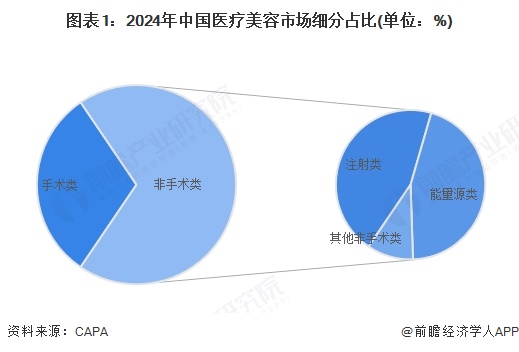
Core Insights - The light medical beauty market in China has surpassed half of the overall medical beauty market, becoming the mainstream beauty method by 2024, with significant contributions from non-invasive and minimally invasive procedures [1][2] Market Overview - Light medical beauty is defined as professional medical beauty projects that fall between surgical procedures and lifestyle beauty, utilizing non-invasive or minimally invasive methods for skin management, contour modification, and anti-aging effects [1] - The rapid growth of the light medical beauty market is attributed to its advantages such as minimal trauma, quick recovery, significant results, and relatively low risks, aligning with modern consumers' dual demands for beauty and quality of life [2] Consumer Trends - The penetration rate of the light medical beauty market is increasing, with 34% of consumers planning to engage in light medical beauty services in the coming year, marking a 36% increase from the previous year [4] - Among the interested consumer group, over one-third are new entrants, injecting fresh growth vitality into the Chinese medical beauty industry [4] Popular Products - Injectable and photothermal products are the main attractions for light medical beauty consumers, with ultrasound-based products (e.g., ultrasound scalpel) rapidly gaining popularity [5] Consumption Behavior - Consumers are increasingly rational in their light medical beauty choices, prioritizing needs-based combinations of projects and products, with over half selecting options based on specific needs [7] - The average planned consumption has increased to 2.4 projects per consumer, reflecting a 14% year-on-year growth [7] Consumer Demographics - The consumer base for light medical beauty exhibits high retention and strong growth, with seasoned consumers making up 35% of the existing market, indicating their essential role in the market [10] - Among the new consumer group, high-end novices represent 38%, characterized by high standards for beauty and a willingness to pay, with a focus on facial anti-aging solutions [10]


简军锚定国际市场谋破局 爱美客14亿收购童颜针寻增量
Chang Jiang Shang Bao· 2025-07-06 22:36
Core Viewpoint - Aimeike, led by founder Jian Jun, is pursuing international expansion through the acquisition of REGEN Biotech, Inc. to navigate challenges in the domestic medical aesthetics market [1][6]. Company Overview - Aimeike was founded in 2004 by Jian Jun, who transitioned from a successful career in international trade to the medical aesthetics industry after witnessing the effects of hyaluronic acid injections [2][3]. - The company initially faced significant competition from foreign brands in the hyaluronic acid market but successfully launched its first product in 2009, breaking the market monopoly [3]. Financial Performance - Aimeike's stock price surged post-IPO, reaching a peak of 1300 CNY per share in July 2021, with a market capitalization exceeding 1800 billion CNY [5]. - In 2021, the company reported a revenue increase of 104.13% to 1.448 billion CNY and a net profit increase of 117.81% to 958 million CNY [5]. - By 2023, revenue rose to 2.869 billion CNY and net profit reached 1.858 billion CNY, showcasing sustained high growth [5]. Market Challenges - The medical aesthetics industry is experiencing increased competition and regulatory scrutiny, leading to a slowdown in growth for Aimeike, with revenue and net profit growth rates dropping to single digits in 2024 [6]. - Despite achieving record revenues of 3.026 billion CNY and net profits of 1.958 billion CNY in 2024, the growth rates were only 5.45% and 5.33%, respectively [6]. Strategic Initiatives - Aimeike is focusing on international market expansion as a growth strategy, having initiated a Hong Kong IPO in 2021, although it has faced challenges in this endeavor [6]. - The acquisition of REGEN Biotech, Inc. for approximately 1.4 billion CNY, representing a 13-fold premium, is part of Aimeike's strategy to enhance its product line and accelerate global market penetration [6].
化妆品医美行业周报:25H1收官国货表现分化,毛戈平等领衔增长-20250706
Shenwan Hongyuan Securities· 2025-07-06 11:44
Investment Rating - The report maintains a "Positive" outlook on the cosmetics and medical beauty industry [2]. Core Insights - The cosmetics and medical beauty sector underperformed the market during the week of June 27 to July 4, 2025, with the Shenwan Beauty Care Index declining by 0.6% and the Shenwan Cosmetics Index down by 1.5% [3][4]. - Domestic brands such as Maogeping and others showed significant growth, with some achieving over 50% growth in June, which is expected to positively impact Q2 performance [3][9]. - The report highlights a strong performance from leading domestic brands during the 618 shopping festival, with a notable increase in sales momentum post-event [9][10]. Summary by Sections Industry Performance - The Shenwan Beauty Care Index decreased by 0.6%, while the Shenwan Cosmetics Index fell by 1.5%, indicating weaker performance compared to the Shenwan A Index [4]. - The personal care products index saw a slight increase of 0.7%, but still lagged behind the Shenwan A Index by 0.4% [4]. Key Company Performance - Expected performance for major companies in Q2 includes: - Upbeauty: Revenue and net profit expected to grow by 16% and 25% respectively [11]. - Marubi: Anticipated revenue and net profit growth of 22% and 28% [11]. - Proya: Projected revenue and net profit growth of 10% and 15% [11]. - Maogeping: Expected revenue and net profit growth of 38% and 35% [11]. - Ruifeng: Anticipated growth of 70% and 75% in revenue and net profit respectively [11]. - Juzhibio: Expected growth of 25% and 20% in revenue and net profit [11]. Market Trends - The report notes a robust recovery in consumer demand, with a 4.1% year-on-year increase in retail sales for cosmetics in the first five months of 2025 [20]. - The domestic market is seeing a shift with local brands gaining market share, as evidenced by the performance of brands like Proya and Maogeping during major shopping events [34]. Investment Recommendations - Recommended stocks include: - Upbeauty, Proya, and Marubi for their comprehensive brand matrices and growth potential [15]. - Maogeping and Juzhibio for their strong positioning in niche markets [15]. - Attention is advised for Shanghai Jahwa, Betaini, and Huaxi Biological for potential growth [15]. E-commerce Insights - Data from Douyin indicates significant growth for domestic brands, with Han Shu achieving a GMV of 7.2 billion yuan, reflecting a 53% year-on-year increase [16]. - The overall GMV for domestic brands in June reached over 50% growth, indicating a strong market presence [9][16].


医药健康行业周报:创新药BD仍是投资主线,关注泛癌种潜力的双/多抗-20250706
SINOLINK SECURITIES· 2025-07-06 05:24
Investment Rating - The report maintains a strong confidence in the pharmaceutical sector, particularly in innovative drugs, predicting a reversal trend in 2025 [4] Core Viewpoints - The innovative drug sector is experiencing strong performance driven by multiple factors, including the completion of quarterly portfolio adjustments, increased policy support from the National Healthcare Security Administration (NHSA) and the National Health Commission, and significant collaborations in the industry [1][11] - The NHSA and the National Health Commission have jointly released measures to support the high-quality development of innovative drugs, which will accelerate the commercialization of domestic innovative products and create a positive cycle of profitability and strong R&D investment [20][21] - The report highlights the potential of dual/multi-target antibodies in cancer treatment and innovative drugs addressing unmet clinical needs in chronic diseases as key investment opportunities [1][4] Summary by Sections Innovative Drugs - The innovative drug sector remains the main investment line, with a focus on dual/multi-target antibodies for various cancers and chronic diseases [1][11] - AstraZeneca is in talks for a collaboration worth up to $15 billion for the AK112 drug, which has catalyzed strong performance in related stocks [1] Pharmaceutical Sector - The NHSA's new measures will direct more healthcare resources towards innovative drugs, enhancing their commercialization and profitability [20][21] - The report notes that since 2018, 149 innovative drugs have been included in the healthcare insurance directory, significantly increasing the proportion of new drugs covered [22] Biologics - Changchun High-tech's new drug, Vuxin Qibai monoclonal antibody, has been approved for treating acute gout arthritis, marking a significant advancement in biologics [29][34] - The drug shows rapid onset of action and a substantial reduction in recurrence risk, highlighting its clinical significance [33][34] Traditional Chinese Medicine - Lingrui Pharmaceutical's new indication for its nasal spray is expected to boost sales, with ongoing efforts to expand hospital coverage and OTC sales [38][41] Medical Devices - The report emphasizes policy support for high-end medical devices, predicting accelerated commercialization in various segments such as medical robots and AI [3][4] Medical Services - Recent policies to enhance maternity benefits are expected to stimulate demand in related services [3][4]


中证全指医疗保健设备与服务指数上涨0.21%,前十大权重包含爱美客等
Sou Hu Cai Jing· 2025-07-04 15:33
Core Viewpoint - The performance of the CSI All Index for Medical Care Equipment and Services has shown mixed results, with a slight increase on the day but a decline over the past month, three months, and year-to-date [1]. Group 1: Index Performance - The CSI All Index for Medical Care Equipment and Services rose by 0.21% to 13,548.3 points, with a trading volume of 19.92 billion [1]. - Over the past month, the index has decreased by 1.41%, by 2.78% over the past three months, and by 1.24% year-to-date [1]. Group 2: Index Composition - The index is composed of listed companies in the medical care sector, reflecting the overall performance of these securities [1]. - The index was established on December 31, 2004, with a base point of 1,000.0 [1]. Group 3: Top Holdings - The top ten holdings in the index are as follows: Mindray Medical (9.65%), United Imaging (8.18%), Aier Eye Hospital (7.43%), Aimeike (3.42%), Huatai Medical (3.23%), Yuyue Medical (2.81%), New Industry (2.79%), Lepu Medical (2.69%), Meinian Onehealth (2.06%), and Shandong Pharmaceutical Glass (1.9%) [1]. Group 4: Market Distribution - The index's holdings are primarily listed on the Shenzhen Stock Exchange (60.10%) and the Shanghai Stock Exchange (39.90%) [1]. - The entire sample of the index is focused on the pharmaceutical and healthcare sector, with a 100% allocation [1]. Group 5: Index Adjustment and Fund Tracking - The index samples are adjusted biannually, with changes implemented on the next trading day following the second Friday of June and December [2]. - Public funds tracking the index include various Southern and Tianhong funds, as well as ETFs from multiple asset management companies [2].
