
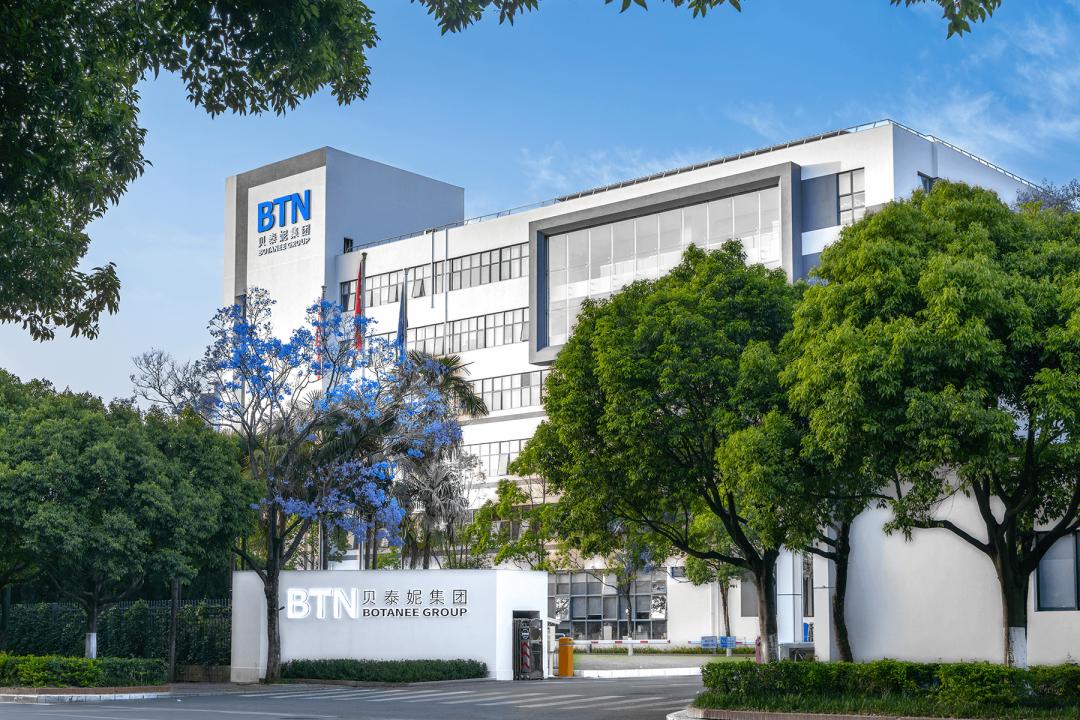
Yunnan Botanee Bio-Technology (300957)

Search documents
化妆品医美行业周报:换季护肤拉开板块消费旺季,上市公司交流会指引发展方向-20250907
Shenwan Hongyuan Securities· 2025-09-07 12:44
Investment Rating - The report maintains a "Buy" rating for the cosmetics and medical beauty sector, highlighting strong growth potential and investment opportunities in the industry [14][19]. Core Insights - The cosmetics and medical beauty sector has shown resilience, outperforming the market during the week of August 29 to September 5, 2025, with the Shenwan Beauty Care Index declining only 0.8% [3][4]. - The transition to autumn skincare marks the beginning of a consumption peak for the sector, with significant sales events such as the Autumn Beauty Consumption Festival and Double 11 approaching, creating new investment opportunities [9][10]. - Major companies in the sector are optimistic about their performance in the second half of 2025, as indicated by a recent conference involving over ten beauty care companies [9]. Summary by Sections Industry Performance - The Shenwan Cosmetics Index remained stable, outperforming the Shenwan A Index by 1.4 percentage points, while the Shenwan Personal Care Index fell by 1.8%, underperforming the Shenwan A Index by 0.3 percentage points [3][4]. Key Company Reviews - **Mao Geping (1318HK)**: Reported a revenue of 2.59 billion yuan for H1 2025, a year-on-year increase of 31%, with a net profit of 670 million yuan, up 36%. The color cosmetics segment saw a revenue of 1.42 billion yuan, while skincare generated 1.09 billion yuan, reflecting strong brand momentum [10][11]. - **Shangmei Co. (02145HK)**: Achieved a revenue of 4.108 billion yuan in H1 2025, a 17.3% increase, with a net profit of 556 million yuan, up 34.7%. The main brand, Han Shu, contributed significantly to growth, with a revenue of 3.344 billion yuan [16][17]. Investment Recommendations - Recommended companies include Shangmei Co., Porlaia, and Shanghai Jahwa, which have strong brand matrices and relatively low PE multiples. Other notable mentions are Marubi Biological and Mao Geping, which are positioned well to benefit from the rise of domestic beauty brands [10][19]. - The report suggests focusing on companies with strong R&D capabilities and product pipelines, particularly in the upstream medical beauty segment, with a recommendation for Aimeike [10][19]. Market Trends - The report notes a significant increase in online sales, with H1 2025 online revenue for Mao Geping reaching 1.297 billion yuan, a 39% year-on-year increase, marking a shift in consumer purchasing behavior towards online platforms [12][18]. - The overall cosmetics retail market showed a 4.5% growth in July 2025, indicating a robust recovery in consumer spending [23][26]. Strategic Developments - Porlaia's investment in Huazhi Xiao reflects a strategic move to enhance its multi-brand strategy and capitalize on the influence of Gen Z consumers [28]. - The report highlights the competitive landscape, noting that domestic brands are increasingly capturing market share, with a notable shift in consumer perception from "value for money" to "quality choice" [32].



营收跌出前五,贝泰妮怎么连巨子生物都干不过了?
3 6 Ke· 2025-09-05 12:01
Core Viewpoint - The competitive landscape of the domestic beauty industry has shifted, with Juzhibio entering the top three and Betaini dropping out of the top five, highlighting significant changes in revenue and profit dynamics among key players [2][3]. Revenue Performance - Prolayya leads with a revenue of 5.362 billion yuan, followed by Shangmei with 4.108 billion yuan, and Juzhibio at 3.103 billion yuan, which represents a year-on-year increase of 22.55% [3][4]. - Betaini's revenue stands at 2.372 billion yuan, reflecting a decline of 15.43% compared to the previous year, marking a significant drop from its previous position as the third-largest player [3][4]. Profitability Analysis - Juzhibio reported a net profit of 1.182 billion yuan, up 20.2% year-on-year, while Betaini's net profit plummeted to 247 million yuan, a decrease of nearly 50% [4][8]. - The profit margin disparity is stark, with Juzhibio achieving a net profit margin of 37.9%, compared to Betaini's 10.4% [8][9]. Brand Strategy and Market Positioning - Juzhibio has successfully developed multiple sub-brands, such as Kefu Mei and Keli Jin, which contribute significantly to its revenue, while Betaini struggles with its primary brand, Weinuona, which has seen declining sales [4][15]. - The strategic focus on brand diversification and effective channel management has allowed Juzhibio to mitigate market fluctuations, whereas Betaini remains heavily reliant on a single brand [15][16]. Sales and Marketing Efficiency - Juzhibio maintains a lower sales expense ratio of 34.0%, while Betaini's sales expenses have surged to 54.2%, significantly impacting its profitability [8][9]. - The average selling price of Betaini's skincare products has decreased, contributing to its revenue decline, while Juzhibio's pricing strategy has allowed it to maintain higher margins [5][6]. Channel Development - Both companies initially built their brands through professional channels, but Juzhibio has expanded its direct sales and online presence more effectively than Betaini, which has seen a decline in offline sales [13][14]. - Juzhibio's direct sales accounted for 74.7% of its revenue, with significant growth in both online and offline channels, contrasting with Betaini's heavy reliance on e-commerce, which has faced challenges [13][14]. Future Outlook - The beauty industry consensus is shifting towards creating a brand matrix to diversify risk and extend growth, a strategy that Juzhibio has successfully implemented, while Betaini needs to develop additional brands to remain competitive [15][16].

135股今日获机构买入评级
Zheng Quan Shi Bao Wang· 2025-09-05 10:02
Summary of Key Points Core Viewpoint - A total of 135 stocks received buy ratings from institutions today, with 17 stocks receiving initial attention from institutions, indicating a strong interest in the market and potential investment opportunities [1]. Institutional Ratings - 140 buy rating records were published today, with 29 of these providing future target prices. 13 stocks have an upside potential exceeding 20%, with AVIC Optoelectronics showing the highest potential at 61.62% [1]. - Notable stocks with high upside potential include Noli Shares at 48.46% and United Imaging Healthcare at 37.22% [1]. - 17 stocks received initial buy ratings from institutions, including Haimeixing and Hengli Hydraulic [1]. Market Performance - Stocks rated with buy ratings saw an average increase of 3.27%, outperforming the Shanghai Composite Index. 119 stocks experienced price increases, with several hitting the daily limit up [1]. - Stocks with significant declines included Noli Shares, Agricultural Bank, and Shoufang Environmental Protection, with declines of 3.23%, 2.93%, and 1.26% respectively [1]. Industry Focus - The most favored industries include power equipment and machinery, each with 17 stocks listed in the buy rating category. The pharmaceutical and communication sectors also attracted attention, with 15 and 6 stocks respectively [2]. - Specific stocks receiving multiple buy ratings include Betaini, Kebo Da, AVIC Optoelectronics, and Yunnan Baiyao, each with two buy ratings [2][3]. Detailed Stock Information - A selection of stocks with buy ratings includes: - Betaini (2 ratings, +2.22% today, PE 40.30) in beauty care - Kebo Da (2 ratings, +10.00% today, PE 27.44) in automotive - AVIC Optoelectronics (2 ratings, +0.57% today, PE 28.83) in defense and military [2][3]. - Other notable stocks include: - Yunnan Baiyao (2 ratings, +1.06% today, PE 14.56) in pharmaceuticals - Zhonglian Heavy Industry (2 ratings, +0.41% today, PE 11.39) in machinery [2][3]. Additional Stock Ratings - Additional stocks with single buy ratings include: - Xuji Electric (1 rating, +2.09% today, PE 18.44) in power equipment - Xugong Machinery (1 rating, -0.20% today, PE 13.29) in machinery - China Rare Earth (1 rating, +2.33% today, PE 174.07) in non-ferrous metals [3][4].


化妆品板块9月5日涨0.61%,贝泰妮领涨,主力资金净流出1.07亿元
Zheng Xing Xing Ye Ri Bao· 2025-09-05 09:06
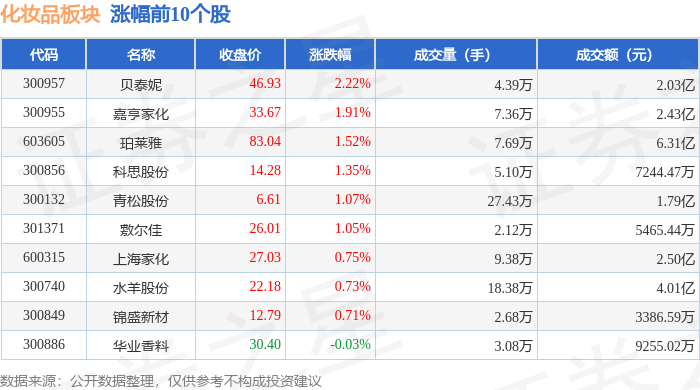
Market Overview - On September 5, the cosmetics sector rose by 0.61% compared to the previous trading day, with Beitaini leading the gains [1] - The Shanghai Composite Index closed at 3812.51, up 1.24%, while the Shenzhen Component Index closed at 12590.56, up 3.89% [1] Individual Stock Performance - Beitaini (300957) closed at 46.93, with a gain of 2.22% and a trading volume of 43,900 shares, amounting to a transaction value of 203 million yuan [1] - Other notable performers included: - Jiahen Home (300955) at 33.67, up 1.91% [1] - Kesheng Co. (300856) at 14.28, up 1.35% [1] - Qing Song Co. (300132) at 6.61, up 1.07% [1] - Conversely, LaFang Home (603630) saw a significant decline of 4.68%, closing at 29.73 [2] Fund Flow Analysis - The cosmetics sector experienced a net outflow of 107 million yuan from institutional investors, while retail investors saw a net inflow of 66.81 million yuan [2] - The detailed fund flow for individual stocks showed: - Jiahen Home had a net inflow of 5.16 million yuan from retail investors [3] - Beitaini experienced a net outflow of 9.28 million yuan from retail investors despite a net inflow of 5.03 million yuan from institutional investors [3] - Qingdao King (002094) had a net outflow of 11.19 million yuan from institutional investors [3]
贝泰妮(300957):2025H1业绩承压,静待拐点到来
Great Wall Securities· 2025-09-05 06:07
Investment Rating - The investment rating for the company is "Maintain Buy" [5] Core Views - The company is experiencing pressure on its performance in the first half of 2025, with both revenue and profit declining. The revenue for the first half of 2025 was 2.372 billion yuan, a year-on-year decrease of 15.43%, and the net profit attributable to shareholders was 247 million yuan, down 49.01% year-on-year [1][2] - The company has a clear brand positioning and strong brand-building capabilities, focusing on natural plant active ingredients for skin care products, particularly targeting sensitive skin. It has successfully integrated online and offline sales channels, leveraging internet and AI technologies to create a new retail system [3][4] Financial Summary - Revenue for 2023 is projected at 5.522 billion yuan, with a growth rate of 10.1%. However, a decline of 4.7% is expected in 2025, with revenue estimated at 5.468 billion yuan [1] - The net profit attributable to shareholders is expected to decrease to 476 million yuan in 2025, reflecting a year-on-year decline of 5.3% [1] - The company's gross margin for the first half of 2025 was 76.01%, an increase of 3.42 percentage points year-on-year, while the net profit margin decreased by 6.48 percentage points to 10.47% [2] - The company is projected to have an EPS of 1.12 yuan in 2025, with a corresponding P/E ratio of 40.7 times [9]
《巴黎合伙人》热播 这款云南护肤成分打动国际消费者
Yang Guang Wang· 2025-09-05 02:37
Group 1 - The cultural export variety show "Paris Partners" features Li Jiaqi as the "Goods Manager," leading 12 domestic brands to Paris for a 16-day beauty pop-up store operation, aiming to promote Chinese products and aesthetics internationally [1][2] - Li Jiaqi emphasizes that domestic brands are innovating and transitioning from followers to leaders in certain fields, showcasing the potential of Chinese products in the global market [2][3] - Winona, a skincare brand from Yunnan, stands out in this initiative, with a focus on sensitive skin and a commitment to globalizing Chinese beauty through pharmaceutical-grade research and clinical evidence [3][4] Group 2 - Winona's core ingredient, "Qingci Fruit PRO MAX," is sourced from the Haba Snow Mountain in Yunnan, and the company has successfully registered 16 new plant ingredients, ranking among the top in the country [4][8] - The company is expanding its global footprint by establishing research institutes in Tokyo and Paris, with a strategy to penetrate Southeast Asia before moving into the European and American markets [8] - Li Jiaqi views the pop-up store as a bridge for cultural dialogue, using beauty products to convey Chinese cultural stories and enhance international consumers' interest in Chinese aesthetics [9]

国货美妆下半场 海外市场成关键
Bei Jing Shang Bao· 2025-09-04 16:11
Core Viewpoint - The performance of various domestic beauty brands in the first half of the year shows a mixed picture, with some brands experiencing growth while others struggle with declining revenues and profits as the industry faces intensified competition and the end of the traffic dividend era [1][3][5]. Financial Performance - Up to now, several domestic beauty brands have reported their half-year results, with Proya, Shangmei, Mao Geping, and Shuiyang showing increases in both revenue and net profit [1]. - Shangmei's revenue reached 4.108 billion yuan, a year-on-year increase of 17.3%, with a net profit of 524 million yuan, up 30.65% [3]. - Mao Geping reported revenue of 2.588 billion yuan, a 31.3% increase, and a net profit of 670 million yuan, up 36.1% [3]. - Shuiyang's revenue was 2.5 billion yuan, growing 9.02%, with a net profit of 123 million yuan, up 16.54% [3]. - Proya's revenue was 5.362 billion yuan, a 7.21% increase, and a net profit of 799 million yuan, up 13.8%, but growth rates have slowed compared to previous years [3][4]. - Conversely, Beitaini and Yixian E-commerce continue to face growth challenges, with Beitaini's revenue down 15.43% to 2.372 billion yuan and net profit down 49.01% to 247 million yuan [4][5]. Strategic Adjustments - Beitaini is focusing on strategic adjustments and operational optimization, emphasizing high-value products and quality growth, which has led to improved gross margins and cash flow despite short-term revenue impacts [4][5]. - Yixian E-commerce is pursuing a strategic transformation driven by innovation, aiming to enhance product competitiveness through collaborative innovation among multiple brands [4][5]. - Proya is adopting a multi-brand strategy, acquiring various brands to strengthen its market position, including cosmetic brands and medical supplies [5][6]. Market Trends - The domestic beauty industry is witnessing a shift from high marketing-driven growth to a focus on strategic brand positioning and international expansion as the traffic dividend diminishes [5][9]. - Brands are increasingly looking for overseas growth opportunities, with Proya planning to issue H-shares for international expansion and Beitaini establishing regional headquarters in Thailand [9][10]. - Water Sheep is also pursuing a high-end transformation by acquiring luxury brands to enhance its market presence [6][10]. Competitive Landscape - The beauty industry is facing intensified competition, with brands needing to adapt to changing consumer behaviors and market dynamics [5][9]. - The low-price competition strategy adopted by Shangmei has raised concerns about its long-term sustainability as consumer rationality increases [7][9]. - Experts suggest that domestic beauty brands must enhance their brand structure and user value to compete effectively on a global scale [10].





十强换血、双百亿在望:国货美妆加速全球抢位
FBeauty未来迹· 2025-09-04 15:30
Core Viewpoint - The article discusses the recent developments in the domestic beauty market, highlighting the completion of a Series B funding round for HuazhiXiao, led by domestic beauty giant Proya, and the strategic shifts among the top ten domestic beauty companies as they seek new growth avenues amid a slowing market [3][4]. Group 1: Financial Performance of Top Domestic Beauty Companies - Proya, Shangmei, and Shanghai Jahwa ranked as the top three domestic beauty companies, with Proya achieving a revenue of 5.362 billion yuan in the first half of the year, surpassing half of last year's total revenue [5][6]. - Shangmei's revenue grew by 17.3% year-on-year to 4.108 billion yuan, with net profit increasing by 34.7% [5][6]. - The top ten domestic beauty companies saw eight achieve revenue growth, and seven companies reported positive net profit growth, indicating a robust overall performance [6][8]. Group 2: Strategic Shifts and Market Positioning - The top domestic beauty companies are rapidly building multi-brand matrices and advancing overseas strategies to adapt to the slowing domestic market [3][4]. - Proya's skincare segment remains dominant, while its hair care and color cosmetics categories have shown significant growth, with hair care growing by 131.25% and color cosmetics by 25.79% [11]. - Shangmei's main brand, Han Shu, generated 3.344 billion yuan in revenue, while its new brand, newpage, focusing on children's skincare, achieved a remarkable 146.5% growth [14][16]. Group 3: International Expansion and Investment Strategies - Proya aims to enter the top ten global cosmetics companies by 2035, targeting a revenue of at least 50 billion yuan, and is actively pursuing international market opportunities [22][23]. - The investment in HuazhiXiao is a strategic move for Proya to enhance its multi-brand strategy and recognize HuazhiXiao's global potential [23]. - Water Sheep Co. is also focusing on international expansion, with a goal to become a global luxury beauty brand management group, launching a "10+3" global strategy [26][28]. Group 4: Challenges and Future Outlook - The domestic beauty market is facing challenges such as slowing growth and increased competition, prompting companies to seek international opportunities to escape price wars [29]. - Companies that possess product originality, brand narrative capabilities, and cross-market operational efficiency are more likely to transition from "Chinese leaders" to "global players" [29].


财报里的国货美妆下半场:谁掉队,谁逆袭
Bei Jing Shang Bao· 2025-09-04 13:40
Core Insights - Several domestic beauty brands have reported mixed results for the first half of the year, with some achieving revenue and net profit growth while others struggle with stagnation or losses [1][3][4] Group 1: Performance Overview - Up to mid-2025, companies like Proya, Shangmei, Mao Geping, and Shuiyang have shown revenue and net profit growth, while Betaini, Huaxi Biology, and Yixian E-commerce continue to face challenges [1][3] - Shangmei achieved revenue of 4.108 billion yuan, a 17.3% increase year-on-year, and a net profit of 524 million yuan, up 30.65% [3] - Mao Geping reported revenue of 2.588 billion yuan, a 31.3% increase, and a net profit of 670 million yuan, up 36.1% [3] - Shuiyang's revenue reached 2.5 billion yuan, growing 9.02%, with a net profit of 123 million yuan, up 16.54% [3] - Proya's revenue was 5.362 billion yuan, a 7.21% increase, and net profit was 799 million yuan, up 13.8% [4] - Betaini's revenue fell to 2.372 billion yuan, down 15.43%, with a net profit decrease of 49.01% to 247 million yuan [4] - Yixian E-commerce reported revenue of 1.92 billion yuan, a 22.48% increase, but a net loss of 22.97 million yuan [4] - Huaxi Biology's revenue dropped 19.57% to 2.261 billion yuan, with a net profit decline of 35.38% to 221 million yuan [4] Group 2: Strategic Responses - Companies are adapting to the end of the traffic dividend era by focusing on multi-brand strategies and high-end product offerings [6][9] - Proya is pursuing a multi-brand strategy, acquiring various brands to strengthen its market position [7] - Shuiyang is focusing on high-end transformation, acquiring international brands to enhance its premium offerings [7] - Betaini is also working on a multi-brand approach, with significant growth in its high-end anti-aging brand [8] - Shangmei is leveraging price advantages in the budget market, but this has led to concerns about entering a price war [8] Group 3: International Expansion - Domestic beauty brands are increasingly looking for growth opportunities overseas [9][10] - Proya plans to issue H-shares for international expansion and has announced overseas acquisitions in various beauty segments [9] - Betaini is establishing regional headquarters in Thailand and expanding its product presence in local markets [9] - Yixian E-commerce has launched a global innovation R&D center and is expanding into Southeast Asia and North America [10] - Shuiyang is also pursuing a global strategy, focusing on brand and supply chain globalization [10]

贝泰妮涨0.39%,成交额2.28亿元,近5日主力净流入-6529.01万
Xin Lang Cai Jing· 2025-09-04 08:41
Core Viewpoint - The company, Betaini, is focusing on expanding its product offerings in the skincare and medical device sectors, particularly targeting anti-aging and sensitive skin care, while also venturing into overseas markets, especially in Southeast Asia [2][3][7]. Group 1: Company Overview - Betaini Biotechnology Group Co., Ltd. is based in Kunming, Yunnan, and was established on May 13, 2010, with its stock listed on March 25, 2021 [7]. - The company primarily operates under the "Winona" brand, specializing in gentle and professional skincare products using natural plant active ingredients, focusing on sensitive skin [7]. - The revenue composition of the company includes skincare products (84.36%), makeup (10.07%), medical devices (4.88%), and other services (0.70%) [7]. Group 2: Financial Performance - For the first half of 2025, Betaini reported a revenue of 2.372 billion yuan, a year-on-year decrease of 15.43%, and a net profit attributable to shareholders of 247 million yuan, down 49.01% year-on-year [8]. - The company has distributed a total of 1.289 billion yuan in dividends since its A-share listing, with 844 million yuan distributed over the past three years [9]. Group 3: Market Position and Strategy - The company is actively developing its high-end anti-aging brand AOXMED, which aims to integrate medical aesthetics with home beauty care, achieving sales of approximately 59.92 million yuan in 2024, a year-on-year growth of about 65.59% [2]. - Betaini is expanding its overseas market presence, particularly in Southeast Asia, with trademark registrations and partnerships with local e-commerce platforms like Shopee and Lazada [3]. - The company is also involved in the research, production, and sales of skin care-related medical devices, including hyaluronic acid repair biological membranes and dressings [3]. Group 4: Stock Performance and Investor Sentiment - On September 4, Betaini's stock rose by 0.39%, with a trading volume of 228 million yuan and a market capitalization of 19.447 billion yuan [1]. - The stock has seen a net outflow of 4.7889 million yuan from major investors, indicating a lack of strong control by major shareholders and a dispersed chip distribution [4][5].