
BABA(BABA)

Search documents
阿里1688:诚信通AI商家交易额平均提升73%,将面向企业端推出独立AI智能体
Xin Lang Cai Jing· 2025-12-31 09:54
Core Insights - In 2025, 1688 will fully integrate AI into its core business scenarios for buyers and merchants, launching various AI products and intelligent agents, including the 1688 AI App for buyers and the 1688 Integrity AI version for merchants [1][2] Group 1: AI Product Launch and Features - The Integrity AI version, launched in October 2025, is designed to assist merchants with AI-driven product selection, marketing, customer management, and business analysis, operating 24/7 to facilitate the entire business process [3][4] - Since the launch of the Integrity AI version, there has been a rise in "AI native stores" with monthly sales exceeding 100,000 yuan, many established by new generation entrepreneurs [3][4] Group 2: Business Impact and Performance Metrics - Over 29,000 merchants are actively using 1688 AI daily, significantly increasing the number of merchants utilizing AI for business [3] - The Integrity AI version has led to an average annual cost saving of 100,000 yuan per merchant, halving the difficulty of business operations and reducing mistakes by 30% [2][3] - Since its launch, merchants using the Integrity AI have seen a 20% increase in buyer numbers, a 73% increase in transaction volume (GMV), and a 31% increase in repurchase rates [2][3] Group 3: Future Developments and Strategy - The General Manager of Merchant Intelligence at 1688 indicated ongoing exploration in the interaction design of B2B AI products, emphasizing the importance of user interface and agent intelligence [4] - In the coming year, 1688 plans to introduce a fully independent AI agent to help businesses leverage AI effectively, promoting an open strategy for collaboration and continuous interaction with the system [4][5]

大厂“抢人”战,从涨薪开始
创业邦· 2025-12-31 09:48
Core Viewpoint - The recent salary increase trend among major companies is a strategic response to the changing competitive landscape, rather than a mere act of generosity, as firms adapt to a new survival logic in a slowing growth environment [5][7][27]. Group 1: Salary Increases and Company Strategies - Major companies like JD and ByteDance have announced significant salary increases and bonuses, with JD's year-end bonus total investment increasing by over 70% year-on-year, and ByteDance's bonus total investment rising by 35% [5][19]. - The salary increase trend is not new; JD initiated a 20-salary upgrade plan last year, and other companies like Alibaba and ByteDance have also been increasing salaries since last year [7][13]. - The competitive pressure in the tech industry has intensified, leading to a shift from collective growth to fierce competition for talent, which is now viewed as the most scarce resource [18][25]. Group 2: Talent Acquisition and Retention - The current salary increase is part of a broader strategy to attract and retain top talent, especially in AI and technology sectors, where competition for skilled workers is fierce [25][27]. - Companies are not only increasing salaries but also restructuring their compensation systems to better reward high-performing employees, moving away from traditional seniority-based pay structures [22][23]. - The need for talent has led to aggressive recruitment strategies, with reports of companies offering double salaries to attract skilled workers from competitors [25][27]. Group 3: Future Investments and Technological Shifts - Major firms are shifting their investment focus towards AI and cloud infrastructure, with Alibaba planning to invest over 380 billion yuan in the next three years, and ByteDance allocating 160 billion yuan for AI development by 2026 [28][29]. - The transition from traditional business models to AI-driven strategies is redefining competitive advantages, with companies recognizing that controlling talent is crucial for future success [28][30]. - The importance of frontline employees is also emphasized, as companies like Ningde Times and JD are increasing base salaries for lower-level employees to ensure operational stability [29][30].





AI年鉴:从“概念充血”到“产业造血” 互联网巨头锚定下一个十年
Sou Hu Cai Jing· 2025-12-31 09:42
Core Insights - The article emphasizes that AI is the only technology in China's tech landscape projected to grow exponentially, with significant investments from major players like Tencent, Alibaba, ByteDance, Baidu, and Huawei, marking AI as a critical driver for future growth [2] Investment Trends - By 2025, China's total investment in AI is expected to reach $56.8 billion, accounting for 27.4% of global AI investment, surpassing Europe for the first time [2] - Major internet companies are directing 63% of their capital expenditures towards AI capabilities, models, and applications, reflecting a 28 percentage point increase year-over-year [2] Model Development - The competition in AI models has shifted from catching up to parallel development, with significant advancements in open-source models and performance metrics [3] - Notable achievements include DeepSeek's R1 model aligning with OpenAI's capabilities at a fraction of the cost and Alibaba's Tongyi Qianwen 3.0 surpassing GPT-4 Turbo in code generation accuracy [3] Computing Power - The race for computing power is characterized by innovations such as Huawei's Ascend supernodes and Alibaba's expansion of its cloud computing capabilities [4][5] - By 2025, China's intelligent computing power is projected to reach 725 EFLOPS, a 74% increase year-over-year, with major companies building their own infrastructure [5] Application Integration - AI applications are becoming deeply integrated into various sectors, with Tencent, Alibaba, ByteDance, and Baidu reporting significant improvements in efficiency and cost reductions through AI tools [6] - For instance, Tencent's AI-generated content has increased ad click-through rates by 18%, while Alibaba's tools have significantly reduced product photography costs [6] Financial Impact - AI is reshaping traditional revenue streams in advertising, e-commerce, and gaming, with companies reporting substantial growth in customer numbers and sales due to AI-driven innovations [8] - Tencent anticipates that AI-related revenue will reach 36.2 billion yuan by 2025, constituting 12% of its total revenue [9] Policy Support - The Chinese government is actively promoting AI development through initiatives aimed at building a national integrated computing network and supporting AI applications across various sectors [10] - These policies are expected to generate over 200 billion yuan in market demand by 2026 [10] Challenges Ahead - The industry faces challenges related to energy consumption, talent shortages, and ethical concerns, with projections indicating a significant increase in energy use by AI data centers [11] - The talent gap is projected to reach 5 million by 2025, while ethical issues related to AI are becoming more prevalent [11] Future Outlook - By 2026, the core AI industry in China is expected to exceed 1 trillion yuan, with a shift from a focus on scale to efficiency in AI applications [13] - The article concludes that AI is not just a trend but a foundational element for future growth, with significant transformations anticipated across various industries [13]


美国《连线》杂志:2026年将是阿里千问之年
Guan Cha Zhe Wang· 2025-12-31 09:40
Core Insights - The article highlights a significant shift in the global AI industry, indicating that 2026 will be a pivotal year for Alibaba's Qwen model, as it gains traction against competitors like OpenAI's GPT-5 and Google's Gemini 3 [1][3][6] Industry Trends - The performance of Chinese AI models such as Qwen, DeepSeek, and others is increasingly recognized, with their flexibility and developer-friendly nature contributing to their rising popularity [3][6] - The article notes a transition in Silicon Valley, where companies are beginning to favor Chinese models for their cost-effectiveness and performance, as exemplified by Airbnb's CEO praising Qwen over OpenAI's offerings [6][7] Technological Advancements - Chinese AI models are not only competing on price but are also advancing in technology, with a commitment to openness and continuous improvement, contrasting with the more closed-off approach of some American companies [7][9] - The rise of Chinese models reflects a new industry standard that prioritizes application breadth and deployment flexibility over mere parameter size and conversational intelligence [9][12] Capital Market Dynamics - MiniMax and Zhizhu AI have successfully attracted significant international investment, validating the global value of Chinese AI as a core asset, with MiniMax securing approximately $350 million from 14 cornerstone investors [13][14] - The article emphasizes that the recognition of Qwen by a leading tech media outlet signifies a broader acceptance of Chinese AI models in the global market, suggesting a collective movement towards international expansion [14]

夸克AI眼镜持续升级:首次OTA,支持89种语言翻译
Huan Qiu Wang· 2025-12-31 08:47
Core Insights - Quark AI glasses have received their first OTA update, enhancing AI capabilities with five new features including recording minutes, graphic memos, multi-intent understanding, Blue Ring payment, and community services [1][2] - The upgraded recording feature supports audio capture within a ten-meter range and effectively reduces noise, with capabilities for transcription and translation in four languages: Chinese, English, Japanese, and Korean [1] - The memo feature allows users to record notes via voice or photo, with AI capabilities for categorization and semantic understanding [1] Feature Enhancements - The multi-intent understanding allows the glasses to process and execute 2-3 complex tasks simultaneously, improving efficiency in both work and daily life [2] - The translation feature has been upgraded to support 89 languages, catering to diverse needs for cross-border travel and business communication [2] - The OTA update is delivered through the Quark AI glasses app, which also includes a user community for sharing product information and experiences [2] Product Development - Quark AI glasses are part of Alibaba's Qianwen C-end business direction, with two series (S1 and G1) and six SKUs currently available [2] - The Qianwen AI assistant is positioned as a core entry point, expanding its reach across multiple devices including glasses, PCs, and cars [2]
夸克AI眼镜,智能穿戴设备如何突破?
Jing Ji Guan Cha Wang· 2025-12-31 07:18
Core Insights - The Quark AI Glasses S1 addresses multiple pain points in the smart glasses market, including outdoor display brightness, voice interaction accuracy in noisy environments, bulky design, comfort, and limited battery life [1][2] - The product features significant technological innovations, including dual flagship chips, a dual optical display solution, adjustable focal distance technology, and a display brightness of up to 4000 nits, ensuring clear visibility even in bright outdoor conditions [1] - The voice interaction is enhanced with five microphone arrays and bone conduction technology, allowing for precise voice capture and effective noise filtering [1] - The camera capabilities include rapid 0.6-second capture, 3K video recording, and Super Raw low-light enhancement technology, which integrates mobile-level imaging capabilities into smart glasses [1] - The design of the glasses is significantly lighter and slimmer than traditional smart glasses, with a 7.5mm leg width, making it the narrowest in its category, and a 3.3mm frame that is approximately 25% thinner than mainstream products [1] - The glasses feature a unique dual battery design that allows users to quickly replace batteries, addressing concerns about battery life [1] Industry Impact - The technological innovations of the Quark AI Glasses S1 provide a new direction for the development of smart wearable devices, promoting upgrades in hardware miniaturization, performance integration, and user experience [2] - As a key achievement in Alibaba's smart wearable strategy, the product showcases the company's technical innovation capabilities and deep understanding of user needs [2] - Alibaba aims to continue deepening the integration of artificial intelligence and smart hardware, optimizing the Quark AI Glasses series, and exploring more application scenarios to enhance user experience [2] - The company emphasizes technology innovation as a core driving force, focusing on artificial intelligence, big data, and smart hardware to build a diversified ecosystem covering consumption, technology, and industry [2] - Alibaba's successful launch of the Quark AI Glasses S1 reflects its commitment to addressing real user needs and leveraging its strong R&D capabilities and ecosystem resources [2]
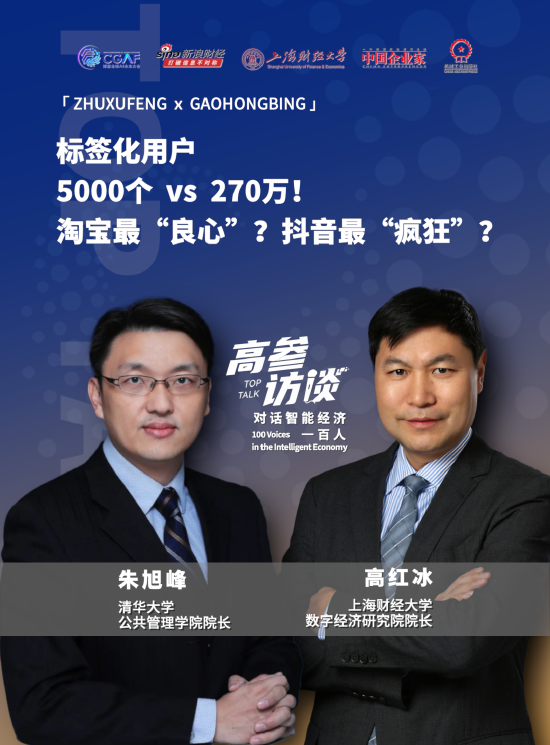
标签化用户5000个vs270万!淘宝最“良心”?抖音最“疯狂”?
Xin Lang Cai Jing· 2025-12-31 07:14
在《高参访谈》节目中,上海财经大学数字经济研究院院长高红冰与清华大学公共管理学院院长朱旭峰 进行对话。 高红冰提到,淘宝为每个用户打上5000个标签,而淘宝闪购和本地即时消费市场则使用了4万个标签, 进一步提高了匹配的精细化程度。 高红冰提到,淘宝为每个用户打上5000个标签,而淘宝闪购和本地即时消费市场则使用了4万个标签, 进一步提高了匹配的精细化程度。 而抖音则使用了270万个标签,达到了前所未有的高度精细化水平。 高红冰强调,这种高度标签化的系统能够精准捕捉和利用任何行为,为用户提供高度个性化服务和解决 方案,体现了当前智能系统在精准性和预见性方面的强大能力。 而抖音则使用了270万个标签,达到了前所未有的高度精细化水平。 高红冰强调,这种高度标签化的系统能够精准捕捉和利用任何行为,为用户提供高度个性化服务和解决 方案,体现了当前智能系统在精准性和预见性方面的强大能力。 新浪声明:所有会议实录均为现场速记整理,未经演讲者审阅,新浪网登载此文出于传递更多信息之目 的,并不意味着赞同其观点或证实其描述。 责任编辑:李思阳 在《高参访谈》节目中,上海财经大学数字经济研究院院长高红冰与清华大学公共管理学院院长朱 ...
支付服务暂停?微信、支付宝辟谣
财联社· 2025-12-31 06:35
Core Viewpoint - Recent rumors circulated on social media claiming that Alipay and WeChat Pay would be unavailable on December 30 and 31, which have been officially denied by both companies [1][2]. Group 1 - Alipay confirmed that all functions and services are operating normally, and the claim of service suspension is false [1]. - WeChat Pay also stated that its services are functioning without interruption, labeling the rumors as misinformation [2].

AI算力方向强势收官2025!云计算ETF(159890)午后上攻强势冲击6连阳
Sou Hu Cai Jing· 2025-12-31 06:27
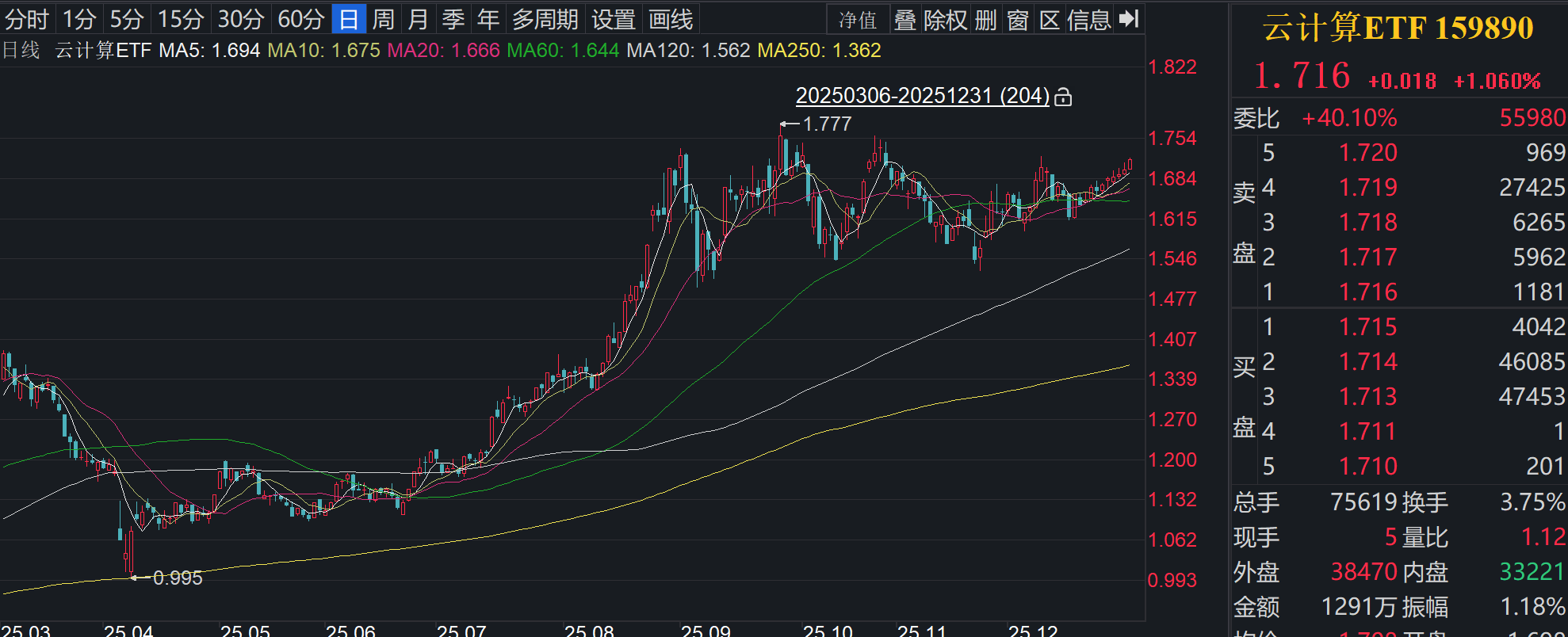
Core Viewpoint - The AI computing power sector is experiencing significant growth, driven by government initiatives and increasing demand for domestic AI chips, particularly the H200 chip, which is set to be delivered to Chinese customers soon [3][4][5]. Group 1: Market Performance - On the last trading day of 2025, AI computing stocks saw a strong afternoon rally, with the cloud computing ETF (159890) rising over 1% and achieving a six-day winning streak [1]. - Notable stock performances included a rise of 11.46% for Yidian Tianxia, over 8% for Hand Information, and more than 4% for companies like Zhongke Xingtai and Wanxing Technology [1]. Group 2: Policy and Industry Developments - A key government official announced the implementation of the "AI+" initiative, which aims to create extensive application scenarios for AI computing power chips, leading to rapid growth in demand and innovation within the sector [3]. - The conditional opening of the H200 chip to China is seen as a positive development, with major tech companies like Alibaba and ByteDance planning significant purchases to enhance their AI capabilities [4]. Group 3: Domestic Chip Strategy - Domestic companies are adopting varied strategies in response to the H200 chip's availability, with Alibaba and ByteDance pursuing large-scale purchases, while Baidu focuses on self-developed Kunlun AI chips to reduce reliance on external suppliers [4]. - Tencent is exploring indirect methods to acquire advanced computing power, aiming to secure over $1.2 billion in usage rights for the latest B200/B300 chips [4]. Group 4: Growth Projections - According to IDC and Inspur, China's intelligent computing power is projected to reach 1,037.3 EFLOPS by 2025, with a compound annual growth rate of 46.2% from 2023 to 2028 [6]. - The general computing power in China is expected to grow to 85.8 EFLOPS by 2025, with a compound annual growth rate of 18.8% during the same period [6]. Group 5: Investment Opportunities - The current landscape of the AI computing market presents numerous opportunities for investment, with a focus on domestic chip development and technological innovation [5][6]. - The cloud computing ETF (159890) tracks a diverse range of companies involved in AI infrastructure and applications, indicating a comprehensive approach to the AI computing era [6].


股票市场概览:资讯日报:中国提前下达625亿元超长期特别国债支持以旧换新-20251231
Guoxin Securities Hongkong· 2025-12-31 06:23
Market Overview - The Hang Seng Index closed at 25,855, down 0.86% for the day but up 28.89% year-to-date[1] - The Hang Seng Technology Index rose 1.74% to 5,578, with a year-to-date increase of 24.85%[1] - The Hang Seng China Enterprises Index increased by 1.12% to 8,991, with a year-to-date rise of 23.34%[1] Sector Performance - Baidu's stock surged nearly 9% due to advancements in AI and smart cloud business, with significant growth in its self-developed AI chip and smart driving orders[7] - The semiconductor sector saw strong gains, with InnoTek rising over 15% and SMIC up more than 4% following Nvidia's announcement of partnerships for a new power architecture[7] - Robotics stocks were active, with Yujing Technology up over 13% and Sanhua Intelligent Control up over 12%, supported by a significant increase in industrial robot production[7] Oil and Entertainment - Oil stocks continued to perform well, with CNOOC rising nearly 4% as international oil prices increased due to geopolitical tensions[7] - The entertainment sector saw a boost, with Emperor Culture Industries rising nearly 9% as the 2025 New Year box office surpassed 5.3 billion yuan, a near eight-year high[7] Economic Indicators - The WTI crude oil price surpassed $58 per barrel, while Brent crude approached $62 per barrel, driven by rising geopolitical risks[7] - The US Federal Reserve indicated potential future interest rate cuts if inflation continues to decline, as noted in the December meeting minutes[11]



