BABA(BABA)

Search documents
格隆汇2025年十大核心ETF年终盘点② | 科创芯片ETF(588200)涨超64%,港股通互联网ETF(159792)“吸金”569亿元,居ETF市场第一
Ge Long Hui· 2025-12-30 07:20
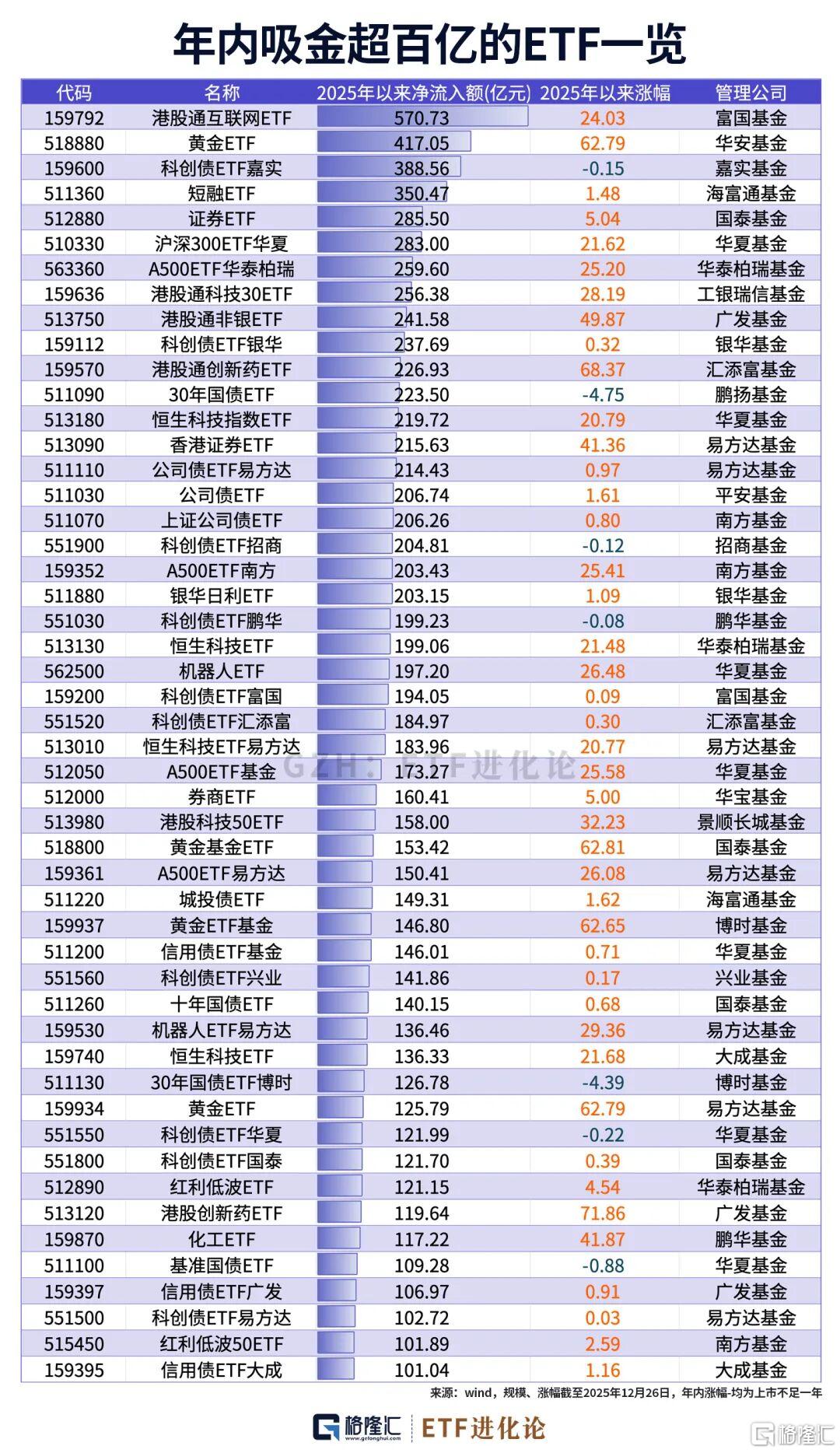
Core Insights - The 2025 "Global Vision, Betting on China" top ten core ETFs recorded a 28.86% increase, significantly outperforming the CSI 300 index by 10.96 percentage points [1] - The semiconductor sector and Hong Kong internet stocks were key contributors to market performance, with the Sci-Tech Chip ETF (588200) and Hong Kong Internet ETF (159792) rising 64.32% and 21.73% respectively in 2025 [1] Semiconductor Sector - The domestic semiconductor sector's growth is driven by strong policy support and capital investment in "self-controllable" technologies, leading to accelerated industry consolidation [1] - Mergers and acquisitions in the semiconductor industry are becoming more active, with leading companies expanding through horizontal integration and supply chain strengthening [2] - The Sci-Tech Chip ETF (588200) focuses on leading chip companies in the Sci-Tech board, with a semiconductor purity of 94.21%, covering the entire semiconductor industry chain [2] - The latest scale of the Sci-Tech Chip ETF (588200) is 39.086 billion yuan, making it the largest product in the semiconductor theme, with a daily average trading volume of 2.612 billion yuan in 2025 [2] Hong Kong Internet Sector - The Hong Kong internet sector has shown strong performance due to a clearer regulatory environment, AI transformation of enterprises, and significant net inflows of southbound funds [3] - Major internet companies are increasing investments in AI infrastructure, with Alibaba's cloud and AI product revenues growing rapidly, and a significant investment of 380 billion yuan in AI and cloud infrastructure [3] - The Hong Kong Internet ETF (159792) has seen a net inflow of 56.997 billion yuan in 2025, leading the entire ETF market in capital attraction [3][4] - The ETF tracks the CSI Hong Kong Internet Index, focusing on 30 pure internet companies, with over 70% of its top ten holdings in major firms like Alibaba and Tencent [7] Future Outlook - The outlook for the Hong Kong internet sector remains positive, with attractive valuations despite macroeconomic pressures, suggesting a profit valuation midpoint of 15-20 times for leading companies in 2026 [7]


淘宝内容种草曝光方法有哪些?淘宝代运营公司
Sou Hu Cai Jing· 2025-12-30 04:16
Core Insights - The article emphasizes the transformation of Taobao from a simple transaction platform to a "content + e-commerce" ecosystem, highlighting that content-driven strategies are now essential for brands to thrive on the platform [1][11] Group 1: Content Strategy - Taobao users spend over 30% more time on the platform when engaging with content, leading to a conversion rate increase of over 50% [1] - Professional operation companies are favored by brands for their ability to integrate systematic content strategies with Taobao's algorithm, enabling precise targeting of users in an information-saturated environment [1][9] - Brands are encouraged to create a content roadmap that includes goals, budget allocation, channel combinations, and performance evaluation metrics [8] Group 2: Influencer Collaboration - Collaborating with top influencers like Viya and Li Jiaqi can lead to explosive brand visibility in a short time [4] - Brands should match specialized influencers in categories such as beauty, maternity, and home goods to build category-specific recognition [4] - A matrix of mid-tier influencers can create a content surround effect, continuously influencing potential users [4] Group 3: Content Formats and Optimization - Content should be optimized for Taobao's recommendation algorithms, including video cover images, tags, and initial content [5] - Diverse content formats such as product explanations, usage tutorials, and interactive entertainment should be incorporated into live streams [5] - High-quality images and authentic experience narratives should be used in content to enhance product usage scenarios [5] Group 4: Data-Driven Insights - Brands can utilize tools like Alibaba's data bank to analyze target user preferences and track content effectiveness through a comprehensive exposure-to-purchase tracking system [10] - Continuous A/B testing on content formats, posting times, and influencer selection is essential for ongoing optimization [10] - Monitoring competitors' content strategies allows brands to adjust their own content direction in a timely manner [10] Group 5: Long-term Partnerships - Professional operation companies can significantly reduce trial and error costs for brands by providing strategic insights and ensuring high-quality content production [9] - Brands must either build their own professional teams or collaborate deeply with specialized operation companies to navigate the evolving landscape of Taobao [11] - Choosing a reliable content operation company can maximize return on investment within limited budgets and timeframes [12]

异动盘点1230 |石油股早盘上扬,昭衍新药跌超6%;铜矿板块集体下挫,Ultragenyx Pharmaceutical股价暴跌42.32%
贝塔投资智库· 2025-12-30 04:06
Group 1 - Zijin Mining (02899) rose nearly 3% after announcing the completion of the main construction and core equipment installation for the second phase of the Xizang Julong Copper Mine, marking a key step before production [1] - Asia Pacific Satellite (01045) increased over 5.4%, with a cumulative rise of nearly 30% over the past five trading days, as it operates multiple satellites under China Satcom [1] - Zhaoyan New Drug (06127) fell over 6% following an announcement that its actual controller plans to reduce holdings by up to 14.98 million shares, representing 20.0466% of his holdings and 1.99873% of the company's total share capital [1] - Zhongwei New Materials (02579) surged nearly 7% after signing a strategic cooperation framework agreement with Xinwanda for solid-state batteries [1] Group 2 - Dongyue Group (00189) rose nearly 5% as the long-term contract prices for refrigerants were confirmed, with R32 priced at 61,200 yuan/ton (+1,000 yuan) and R410A at 55,100 yuan/ton (+1,900 yuan) [2] - MicroPort Scientific Corporation (02252) increased over 1.2%, reporting that its core products' cumulative order volume exceeded 230 units [2] - Oil stocks saw gains, with CNOOC (00883) up 4.17%, PetroChina (00857) up 2.91%, and Sinopec (00386) up 1.31%, driven by a rise in international crude oil prices due to geopolitical tensions [2] - Baidu Group (09888) rose nearly 7% after announcing a partnership with Uber and Lyft to launch a robotaxi pilot project in the UK by 2026 [2] Group 3 - NIO (09866) rose over 2.4% after announcing that it successfully delivered over 40,000 units of its new ES8 model within 100 days of the official delivery start [3] - Damai Entertainment (01060) increased nearly 5%, with the total box office for the 2025 New Year’s season reaching 5.245 billion yuan as of December 28 [3] Group 4 - Copper mining stocks collectively declined, with Hudbay Minerals (HBM.US) down 4.01%, Taseko Mines (TGB.US) down 3.1%, and Ero Copper (ERO.US) down 1.64%, as international copper futures fell over 4% [5] - Some cryptocurrency-related stocks fell, with IREN Ltd (IREN.US) down 2.21% and Circle (CRCL.US) down 0.94% [5] - NIO (NIO.US) rose 4.71% in the US market, echoing its performance in Hong Kong [6] - The Nasdaq Golden Dragon Index fell nearly 1%, with major Chinese concept stocks declining, including Alibaba (BABA.US) down 2.46% and Xpeng Motors (XPEV.US) down 1.35% [6]




六部门公告《2025年度国家绿色算力设施名单》
国家能源局· 2025-12-30 03:35
Core Viewpoint - The announcement of the 2025 National Green Computing Power Facility List aims to promote the green and low-carbon development of computing power facilities in accordance with the national energy-saving and carbon reduction action plan [1]. Group 1: Industrial Sector - The list includes various computing power facilities in the industrial sector, such as Hongsheng Copper Industry Data Center [2]. - The facilities are part of a broader initiative to enhance energy efficiency and reduce carbon emissions in the industrial domain [1]. Group 2: Information and Communication Sector - Numerous data centers from China Telecom and China Mobile are featured, including the China Telecom Hangzhou Smart Computing Center and the China Mobile Yangtze River Delta (Jinhua) Data Center [2][3]. - These facilities are expected to contribute significantly to the digital infrastructure and support the transition to a low-carbon economy [1]. Group 3: Energy Sector - The list highlights energy-related computing power facilities, such as the State Power Investment Corporation Guian Data Center and the Southern Power Grid Green Smart Data Center [3][4]. - These facilities are crucial for integrating renewable energy sources and enhancing the overall efficiency of energy management [1]. Group 4: Internet Sector - The Internet sector is represented by facilities like the Karamay Carbon and Water Cooling Data Center and the New Silk Road Cloud Computing Center [4]. - These centers are designed to support large-scale data processing and storage while adhering to green standards [1]. Group 5: Financial Sector - Financial institutions are also included, with data centers such as the Bank of Communications Data Center and the People's Insurance Group Northern Information Center [4]. - This inclusion reflects the financial sector's commitment to sustainability and efficient data management practices [1]. Group 6: Public Institutions - The list features data centers from public institutions, including the Beijing Urban Sub-center Administrative Office Data Center [4]. - These facilities are essential for improving public service delivery and enhancing data management capabilities in government operations [1].




财报盘点| 宁愿透支当下的利润,阿里巴巴也要为AI和即时零售撕开一道口子
Sou Hu Cai Jing· 2025-12-30 02:52
对于2025年的阿里巴巴来说,在外卖市场和AI赛道风云变幻的局势下,阿里巴巴的战略重心也在无形 之中发生了调整。 这种变化,尤其是在阿里巴巴在2026财年第二季度(对应自然年2025年7月-9月)能找到答案。为了抓 住AI和即时零售这两个未来的机会,阿里正在进行一场豪赌式的巨额投入,这直接导致了利润的大幅 下滑。 利润"腰斩" 这一季度,阿里的营收虽然实现了增长,但赚钱的能力却因为战略投入而被大幅稀释。 从总营收来看,阿里巴巴在这一财季实现了2478亿元的营收,同比增长5%。如果剔除已出售的高鑫零 售和银泰业务,同口径下的收入增速高达15%,说明核心业务其实恢复得不错。 不过阿里巴巴的净利润206.1 亿元,同比大幅下滑53%,经营利润更是下滑到了53.7亿元,同比暴跌 85%。 真正让投资者出现担忧的还不是净利润,比起净利润,自由现金流才是衡量一家公司生存能力的终极指 标。本季度阿里巴巴自由现金流为-218.4亿元,这是阿里自由现金流首次大额净流出,去年同期还是净 流入137.35亿元。 这意味着什么? 阿里巴巴不仅把这季度赚的钱全花出去了,还倒贴了近200亿的家底。这种"入不敷出"的状态,如果持 续超过一 ...

腾讯、阿里、字节、百度等千亿重注AI
2 1 Shi Ji Jing Ji Bao Dao· 2025-12-30 02:27
Core Insights - AI has become the central theme in China's technology industry throughout 2025, viewed as a key driver for the next productivity revolution and business model iteration [2] - Major internet companies like Tencent, Alibaba, and ByteDance are intensifying their focus on AI, with significant investments and strategic moves to secure their positions in the market [2][4] Investment Trends - Alibaba announced a three-year investment plan of 380 billion yuan for cloud and AI hardware infrastructure, which is more than its total investment over the past decade [4] - ByteDance plans to increase its capital expenditure to 150 billion yuan in 2025, marking an 88% year-on-year increase, with expectations to further raise it to 160 billion yuan in 2026 [4] - Tencent's capital expenditure is projected to reach around 100 billion yuan in 2025, with a 386% year-on-year increase in Q4 2024 [5] Financial Performance - Alibaba's cloud revenue grew by 34% year-on-year in Q3 2025, with AI-related product revenue maintaining triple-digit growth for nine consecutive quarters [5] - Tencent's marketing services revenue increased by 21% year-on-year, driven by improvements from AI-driven advertising platforms [5][10] - Baidu's AI business revenue grew over 50% year-on-year, becoming a core growth engine despite a decline in total revenue [5] AI Integration in Business - Major companies are integrating AI into their core business lines to enhance operational efficiency and create new growth engines [8][9] - Alibaba's AI tools improved operational efficiency for 500,000 merchants during the "Double 11" shopping festival, with an average efficiency increase of 1.5 times [9] - AI is transforming advertising from traditional methods to intelligent advertising, enhancing user engagement and return on investment [10] New Market Opportunities - The competition for AI-native applications is emerging as a new growth area, with companies vying to establish the next "super entrance" in the AI era [12] - The market is witnessing the rise of AI hardware, such as smart glasses, with significant growth in shipments and market share in China [14] - The introduction of AI-integrated smartphones represents a new direction in user interaction and data aggregation [14] Future Outlook - The competition among major players in AI applications, hardware, and native applications is still in its early stages, with the potential for significant developments in user engagement and commercial viability [15]



腾讯、阿里、字节、百度等千亿重注AI
21世纪经济报道· 2025-12-30 02:23
Core Insights - AI has become the central theme in China's technology industry throughout 2025, seen as a driving force for the next productivity revolution and business model iteration [3] - Major internet companies like Tencent, Alibaba, and ByteDance are intensifying their focus on AI, with significant capital expenditures expected to reach hundreds of billions [3][5] - The emphasis in 2025 is on the practical application of AI technology rather than just competing on model parameters [3] Investment Trends - Alibaba announced a three-year investment plan of 380 billion yuan for cloud and AI hardware infrastructure, which is more than its total investment over the past decade [5] - ByteDance plans to spend 150 billion yuan in 2025, an 88% increase year-on-year, with expectations to further increase to 160 billion yuan in 2026 [5] - Tencent's capital expenditure is projected to reach around 100 billion yuan in 2025, with a significant increase of 386% in Q4 2024 [6] Financial Performance - Alibaba's cloud revenue grew by 34% year-on-year, with AI-related product revenue maintaining triple-digit growth for nine consecutive quarters [7] - Tencent's marketing services revenue increased by 21%, driven by AI improvements in its advertising platform [7][9] - Baidu's AI business revenue grew over 50% year-on-year, becoming a core growth engine despite a decline in overall revenue [7] AI Application Integration - Major companies are integrating AI into their core business lines to enhance operational efficiency and create new growth engines [8] - Alibaba's AI tools improved operational efficiency for 500,000 merchants during the "Double 11" shopping festival, with an average efficiency increase of 1.5 times [9] - Tencent's advertising revenue growth is attributed to AI-driven precision targeting, enhancing the effectiveness of ad placements [9][10] New Market Opportunities - The competition for AI-native applications is emerging as a new growth area, with companies vying to establish the next "super entrance" in the AI era [12] - The market for AI applications has formed a competitive landscape, with ByteDance's Doubao and Tencent's Yuanbao leading in user engagement [12] - The hardware sector, particularly AI smart glasses, is gaining traction, with significant growth in shipments and market share in China [15] Future Directions - The integration of AI into consumer and enterprise applications is blurring lines, with a focus on productivity-oriented AI rather than entertainment [13][14] - Companies are exploring AI hardware as a potential new interaction point, with products like smart glasses and AI-integrated smartphones being developed [15] - The competition for AI's first touchpoint with users is still in its early stages, with ongoing developments needed to validate user engagement and commercial viability [15]

阿里公益携手多家品牌 共同助力磐安香榧“出山”
Huan Qiu Wang· 2025-12-30 02:12
Core Insights - Alibaba's charity initiative has facilitated a strategic partnership between Zhejiang Pan'an and several well-known domestic nut brands to enhance the market presence of Pan'an's fragrant nuts [1][2] - The collaboration aims to address the challenges of low product visibility and brand recognition, despite Pan'an's rich resources and unique varieties of fragrant nuts [1][2] Group 1: Strategic Collaboration - The partnership is not merely a supply-demand connection but involves multi-party collaboration among the government, platforms, and enterprises to enhance the entire industry chain of Pan'an fragrant nuts [2] - Initiatives include the release of a proposal for high-quality development, cooperation agreements with brands like Miguo for raw materials and processing, and the introduction of standardized products into major retail channels [2] Group 2: Sustainable Development Initiatives - Alibaba's charity has launched a "Digital Talent Cultivation Program" to provide local businesses with training in e-commerce operations and live streaming sales, aiming to support the sustainable development of the fragrant nut industry [2] - The "Thousand-Year Ancient Tree Protection Plan" has been initiated to protect Pan'an's ancient fragrant nut trees, with funding directed towards their maintenance and ecological preservation [3] Group 3: Market Transformation - The collaboration is expected to transform the traditional low-price selling model of mountainous agricultural products by integrating brand standards and user engagement capabilities, thereby converting high-quality raw materials into valuable end products [3]
字节京东比亚迪等大厂逆势涨薪,AI时代抢人大战开启
Sou Hu Cai Jing· 2025-12-30 01:33
Core Insights - Major companies in the tech and automotive sectors, including ByteDance, JD.com, BYD, and CATL, have announced salary increases and bonuses for employees, indicating a shift in compensation strategies despite a challenging economic environment [2][9][14] - The current wave of salary increases is seen as a strategic move to attract and retain talent in a competitive market, particularly in the context of the AI talent war [21][22] Group 1: Salary Increases and Bonuses - JD.com reported that 92% of its employees received full or excess year-end bonuses, with total bonus investment increasing by over 70% year-on-year [2] - ByteDance announced a 35% increase in bonus investment and a 1.5 times increase in salary adjustment budget, raising both the lower and upper limits of salary packages [2][15] - BYD and CATL also implemented salary increases for a large number of grassroots employees, reflecting a broader trend across major companies [2][9] Group 2: Competitive Landscape - The tech industry is experiencing a shift from rapid expansion to a focus on talent acquisition, with companies competing for top talent amid a tightening labor market [22][24] - Companies like Tencent and Alibaba have also initiated salary increases and new incentive structures to attract and retain skilled employees, indicating a strategic pivot from cost-cutting measures [9][18] - The competition for AI talent has intensified, with reports of companies offering significantly higher salaries to attract skilled professionals from competitors [21][22] Group 3: Structural Changes in Compensation - Companies are restructuring their compensation frameworks to better align with performance, moving away from traditional hierarchical salary structures that may have led to inefficiencies [18][19] - Alibaba has replaced its long-standing "P series" job level system with a new grading system to provide clearer pathways for advancement and better reward high-performing employees [18] - ByteDance has expanded its job level system to address talent inflation and create more opportunities for salary increases [19] Group 4: Future Investments - The current salary increase trend is viewed as a strategic investment in the future, with companies shifting focus from cost-cutting to talent acquisition and retention [22][24] - Major firms are committing substantial resources to AI and technology infrastructure, with Alibaba planning to invest over 380 billion yuan in cloud and AI hardware over the next three years [25] - The emphasis on both high-end technical talent and the stability of grassroots employees highlights the dual focus on innovation and operational efficiency in the AI era [26][28]




2025年第51周:数码家电行业周度市场观察
艾瑞咨询· 2025-12-30 00:07
Industry Environment - In 2025, a stark contrast is observed between the "Six Little Dragons" in Hangzhou and the "Invisible Champions" in Shenzhen, with Hangzhou focusing on narrative and traffic operation while Shenzhen emphasizes technical refinement and a pragmatic approach [3] - The AI landscape is witnessing a competition akin to the Android vs. Apple battle, with the launch of the open-source AI Agent model AutoGLM by Zhiyu, which supports cross-device operations and aims to prevent AI monopolies [4] - The AI glasses market is experiencing intense competition, with major players like Google and Alibaba entering the fray, focusing on vertical scenarios and data control, despite consumer hesitance [5] - The evolution of IoT in China is shifting towards emotional value, driven by the "loneliness economy," with AI emotional products gaining traction among young consumers [6] - The humanoid robot sector is facing scrutiny over its reliance on remote control rather than autonomous intelligence, with significant discrepancies between market sentiment and actual order volumes [8] AI Transformation in Healthcare - The modern healthcare system is grappling with digital transformation challenges, necessitating a comprehensive overhaul of data governance and decision-making processes to effectively integrate AI [9] AI Unicorn IPO Race - Domestic AI unicorns MiniMax and Zhiyu are preparing for IPOs in Hong Kong, marking a shift from technology to commercialization, with significant backing from industry giants [10] AI Content Creation - The rise of "manga dramas" as a new content form is driven by AI technology, significantly lowering production costs and attracting major IP and platform players [12] AI Companion Toys Market - The AI companion toy market is rapidly growing but facing challenges of high return rates due to low emotional connection and user experience issues [13] Small Home Appliances Industry - The small home appliance sector is experiencing a bifurcation, with companies like Delmar adjusting strategies amid declining performance, while others expand production and explore overseas markets [14] AI Model Competition - The AI model landscape is diversifying into three camps, with ByteDance's Doubao leading in user engagement, DeepSeek excelling in technology, and Alibaba's Tongyi Qianwen focusing on practical applications [16] Future of AI - The year 2026 is projected to be pivotal for AI, transitioning to an "AI-native" era characterized by natural language interaction and autonomous task completion [17] AI Agent Development - The AI Agent market is expected to grow significantly, with applications across various sectors, although companies face challenges in implementation and compliance [18] Humanoid Robot Development - Japan is re-entering the humanoid robot development race, aiming for prototype release by 2030, intensifying global competition in the sector [19] AI Toys and Emotional Economy - Major tech companies are entering the AI toy market, which is projected to grow significantly, but face challenges related to pricing and user experience [21] AI Mapping Services - AI is becoming central to the mapping industry, with major players like Baidu and Gaode launching AI strategies, but user experience and privacy concerns remain critical issues [22] AI Investment Trends - The AI investment landscape is evolving, with figures like Duan Yongping advocating for rational participation and practical applications of AI technology [31] Apple’s Entry into Robotics - Apple is accelerating its entry into the humanoid robot market, aiming to leverage its brand and manufacturing capabilities, despite facing significant challenges [32] Robotics and AI Commercialization - Companies like Yundongchu Technology are securing funding to advance embodied intelligence technologies and expand market applications [34]