BIDU(BIDU)

Search documents
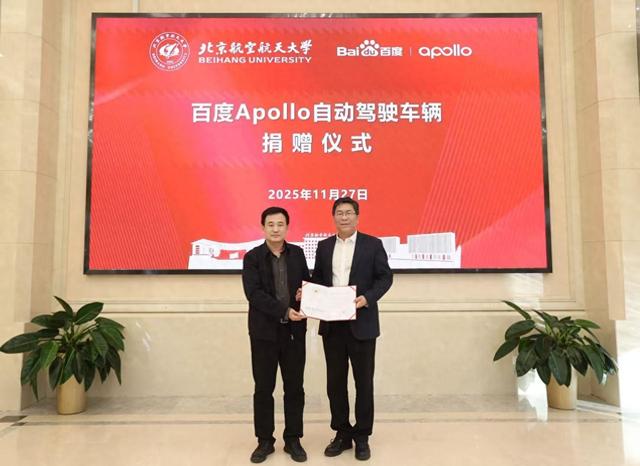
百度Apollo向北航捐赠自动驾驶车辆 深化产学研融合助力科技自强
Huan Qiu Wang· 2025-11-28 06:50
Core Viewpoint - Baidu Apollo donated a batch of autonomous driving vehicles to Beihang University to support research, education, and talent cultivation in the field of autonomous driving, enhancing the integration of industry and academia in China [1][3]. Group 1: Donation and Collaboration - The donation aims to deepen the collaboration between Baidu Apollo and Beihang University, promoting the development of the autonomous driving ecosystem and talent cultivation in China [1][3]. - Beihang University is recognized for its prestigious programs in transportation engineering and computer science, making it a key partner for Baidu Apollo in advancing autonomous driving technology [1][3]. Group 2: Statements from Representatives - Professor Tian Daxin from Beihang University expressed gratitude for the donation, highlighting the importance of the autonomous driving industry in building a strong transportation nation and the historical opportunity it presents for technological revolution and industrial transformation [3][5]. - Baidu Group Vice President Wang Yunpeng emphasized the university's role in nurturing high-level innovative talents and the significance of the "Spark Program" initiated by Baidu Apollo to support educational and research initiatives [3][5]. Group 3: Historical Context and Future Plans - The collaboration between Beihang University and Baidu Apollo has a long history, including joint publications and the establishment of the first "autonomous driving" major in China [5]. - Baidu Apollo's "Spark Program" aims to donate autonomous driving vehicles and experimental platforms to multiple universities, symbolizing the mission of passing on autonomous driving technology and continuously cultivating talent for the industry [5].

Baidu is emerging as a major AI chip player in China to fill the Nvidia gap
CNBC· 2025-11-28 06:20
Core Viewpoint - Baidu is positioning itself as a significant player in China's AI chip market, aiming to challenge Huawei and fill the gap left by Nvidia's absence in the country [1][7]. Company Strategy - Baidu has shifted its focus from being primarily a search engine to developing driverless cars and AI technologies, including its majority-owned subsidiary Kunlunxin, which specializes in chip design [2][4]. - The company has outlined a five-year roadmap for its Kunlun AI chips, starting with the M100 in 2026 and the M300 in 2027, and is already utilizing its self-developed chips in data centers for its ERNIE AI models [3][4]. Market Position - Baidu generates revenue by selling chips to third parties for data centers and renting out computing capacity through its cloud services, aiming to create a comprehensive AI infrastructure [4]. - Analysts have noted that Kunlunxin has become a leading domestic AI chip developer, focusing on high-performance chips for various applications, including large language model training [5]. Competitive Landscape - With Nvidia's advanced GPUs being restricted from sale in China, Baidu is expected to capitalize on the growing domestic demand for AI computing, especially as Huawei is currently out of the market [6][7]. - Analysts from JPMorgan predict that Baidu's chip sales could increase six-fold, reaching 8 billion Chinese yuan (approximately $1.1 billion) by 2026, indicating strong growth potential [7]. Valuation Insights - Analysts at Macquarie estimate that Baidu's Kunlun chip unit could be valued at around $28 billion, highlighting the significant market potential for the company in the semiconductor space [8].

百度集团-SW(09888.HK):AI收入展现强劲增长势头 无人驾驶业务维持全球扩张趋势
Ge Long Hui· 2025-11-28 05:20
Core Viewpoint - Baidu Group reported a decline in Q3 2025 revenue and profits, but showcased strong growth in AI-related business and autonomous driving services [1][2][3] Group 1: Financial Performance - In Q3 2025, Baidu Group achieved revenue of 31.174 billion yuan, a year-on-year decrease of 7.10% and a quarter-on-quarter decrease of 4.70% [1] - Non-GAAP operating profit was 2.205 billion yuan, down 69% year-on-year and 50% quarter-on-quarter [1] - Non-GAAP net profit attributable to shareholders was 3.770 billion yuan, a decline of 36% year-on-year and 21% quarter-on-quarter [1] - Baidu's core business generated revenue of 24.659 billion yuan, a year-on-year decrease of 7% [1] Group 2: AI Business Growth - Baidu Group disclosed AI-related business revenue for the first time, reporting over 50% year-on-year growth, reaching approximately 10 billion yuan in Q3 2025 [2] - AI cloud services revenue was 4.2 billion yuan, up 33% year-on-year, with high-performance computing subscription revenue increasing by 128% [2] - AI applications revenue reached 2.6 billion yuan, growing 6% year-on-year, while AI native marketing services revenue surged to 2.8 billion yuan, a 262% increase [2] - AI native marketing services accounted for 18% of Baidu's core online marketing revenue, up from 4% in Q3 2024 [2] Group 3: Autonomous Driving Expansion - Baidu's autonomous driving service, "Luobo Kuaipao," saw a 212% year-on-year increase in operational orders, reaching 3.1 million orders in Q3 2025 [3] - The service averaged over 250,000 fully autonomous driving operational orders per week as of late October 2025 [3] - The global expansion of "Luobo Kuaipao" increased its operational cities from 16 to 22, with significant progress in Europe, the Middle East, and Hong Kong [3] - The autonomous driving business is expected to maintain rapid growth in order volume and revenue, expand into new markets, and accelerate the application of new vehicle models [3] Group 4: Investment Outlook - The company is actively exploring commercialization of AI search, while maintaining high growth in smart cloud and autonomous driving businesses [4] - Revenue projections for 2025-2027 are 129.7 billion yuan, 135.5 billion yuan, and 143.9 billion yuan, respectively [4] - Adjusted net profit attributable to shareholders is expected to be 19.5 billion yuan, 19.8 billion yuan, and 23.4 billion yuan for the same period [4]
超6亿港元!多家企业驰援香港火灾救援





Xin Lang Cai Jing· 2025-11-28 04:37
Core Points - A major fire occurred in Hong Kong's Tai Po district, resulting in 94 fatalities, including one firefighter, and 76 injuries, with 11 being firefighters [1] - The Hong Kong government established a relief fund with an initial allocation of 300 million HKD to assist affected residents [1] - Over 40 companies have contributed more than 600 million HKD in donations and supplies for disaster relief efforts [1] Company Contributions - Alibaba Group announced an initial donation of 20 million HKD for disaster relief and additional support for affected residents [2] - Tencent Charity Foundation pledged a total of 30 million HKD, including an additional 20 million HKD to the government relief fund [2] - ByteDance (Hong Kong) committed 10 million HKD for emergency relief and community recovery efforts [2] - Baidu, NetEase, and Xiaomi each donated 10 million HKD for urgent assistance and post-disaster recovery [3] - Kuaishou, Meituan, and Xiaohongshu each contributed 5 million HKD for emergency relief and support for affected residents [4] Additional Corporate Donations - Anta Group donated a total of 30 million HKD, including cash and supplies, for emergency assistance [6] - Bosideng Group and Li Ning Group each donated 30 million HKD and 20 million HKD respectively for disaster relief efforts [7][8] - Various companies from different sectors, including automotive and pharmaceuticals, have also made significant contributions, with notable donations from Chery Automobile, BYD, and GAC Group [13][14] Summary of Donations - The total contributions from various companies and organizations have reached nearly 2 billion HKD, showcasing a strong community response to the disaster [5] - Companies like JD.com, Didi, and Meituan have initiated emergency response mechanisms to provide immediate support and supplies to affected areas [18][19]
多家企业驰援香港大埔火灾救援,捐款捐物总额超6亿港元
Xin Lang Cai Jing· 2025-11-28 02:02
Group 1: Incident Overview - A major fire occurred in Hong Kong's Tai Po district, resulting in 94 fatalities, including one firefighter, and 76 injuries, with 11 being firefighters [1] - The Hong Kong government established a relief fund with an initial allocation of 300 million HKD to assist affected residents [1] Group 2: Corporate Donations - Alibaba Group announced a donation of 20 million HKD for immediate relief efforts and additional support for affected families [2] - Tencent Charity Foundation pledged a total of 30 million HKD, including an initial 10 million HKD and an additional 20 million HKD to the relief fund [2] - ByteDance (Hong Kong) and Baidu each committed 10 million HKD for emergency relief and community recovery efforts [2] Group 3: Additional Corporate Contributions - Various companies, including NetEase, Xiaomi, and Kuaishou, each donated 10 million HKD to support emergency relief and community recovery [3] - Anta Group and Bosideng Group each contributed 30 million HKD, while Li Ning Group and Xtep Group donated 20 million HKD each for disaster relief [4][5][6] - Other companies like 361°, Chow Tai Fook, and Nongfu Spring also made significant contributions, totaling millions in cash and supplies [7][8] Group 4: Broader Industry Response - Multiple sectors, including automotive, real estate, and finance, participated in the relief efforts, with companies like Chery Automobile and BYD each donating 10 million HKD [9][10] - Financial institutions and logistics companies, such as Didi and SF Express, also pledged substantial amounts for emergency aid and recovery efforts [15]




想留在牌桌上,大厂们必须要“卷”AI TO C | 马上评
Tai Mei Ti A P P· 2025-11-27 23:25
Core Insights - Alibaba's CEO Wu Yongming emphasized the dual strategy of "AI to C" and "AI to B" as core directions for the company, signaling a shift towards consumer-facing AI applications in the competitive landscape of internet giants [1][3] - The launch of the "Qianwen" app represents a significant move in this new battle for user engagement and market share, as companies seek to control the next generation of digital interaction [1][10] Group 1: Strategic Focus - Alibaba's AI strategy includes becoming a leading full-stack AI service provider in the "AI to B" sector while developing AI-native applications for consumers in the "AI to C" sector, leveraging its ecosystem advantages [3][4] - The timing of this push into AI to C is critical, as large model technologies have matured, providing a solid foundation for high-quality consumer applications [3][4] - The competitive landscape in e-commerce is intensifying, with rivals like Pinduoduo and Douyin posing significant challenges to Alibaba's market dominance, necessitating new traffic sources [3][10] Group 2: Market Dynamics - The AI-native applications are reshaping traffic distribution rules, with the ability to control the new generation of AI entry points becoming crucial for future e-commerce positioning [4][5] - The future online ecosystem will center around AI-native applications that serve as both traffic distribution points and value transmission hubs, akin to the roles of browsers and search engines in the past [5][6] - The transition from traditional interaction methods to conversational interfaces represents a fundamental shift in user engagement, with AI-driven chatbots emerging as key entry points [5][6] Group 3: Competitive Landscape - The AI to C battlefield is characterized by a bifurcated structure, with native AI companies on one side and traditional tech giants like Google, Microsoft, and Alibaba on the other, all vying for high-frequency user interactions [7][8] - ByteDance is leveraging its extensive content ecosystem and user behavior data to enhance its AI capabilities, creating a feedback loop that optimizes user experience and engagement [8][9] - Other companies like Tencent and Baidu are also navigating their strategies, with Tencent embedding AI into its WeChat ecosystem while Baidu struggles with a lack of diverse user scenarios [11][13] Group 4: Future Outlook - The competition for AI entry points is ultimately a contest for control over user scenarios, with companies needing to integrate AI deeply into everyday life to establish user habits and barriers to entry [12][17] - The success of AI strategies will depend on the ability to create a "scene-data-model" closed loop, ensuring continuous user feedback and model optimization [17][18] - The future landscape may see a few dominant AI applications emerging as primary entry points, while traditional platforms adapt to maintain relevance in a rapidly evolving digital environment [18][19]



【西街观察】AI洗牌,机会均等
Bei Jing Shang Bao· 2025-11-27 14:25
Core Insights - The AI industry is experiencing rapid changes, with major players like Google and Alibaba launching new models and technologies to compete in the market [1][2] - The emergence of new competitors, such as DeepSeek, demonstrates that established companies are not guaranteed dominance in the AI space [1][3] - The fast-paced technological advancements in AI are reshaping user expectations and competitive dynamics, making traditional advantages less relevant [3] Group 1: Market Dynamics - Google is pushing its market value close to $4 trillion with the introduction of its Gemini 3 pro model and self-developed TPU chips [1] - Alibaba is aggressively entering the AI to C market with multiple initiatives, while Baidu is establishing new model development departments [1] - The AI landscape is characterized by rapid iterations and unexpected shifts, as seen with the rise of DeepSeek and the challenges faced by established players like Nvidia [2] Group 2: Competitive Landscape - The AI sector allows for a level playing field, with decreasing computing costs and abundant open-source resources enabling new entrants [2] - Companies are facing diverse demands across industries, leading to a situation where specialized teams can outperform larger firms in niche areas [2] - The shift from closed development to open collaboration is changing the competitive landscape, allowing for faster innovation and shared technological advancements [2] Group 3: Future Outlook - The rapid pace of technological change means that traditional advantages such as user base and financial strength are becoming less secure [3] - Future competition will hinge on technological prowess and execution efficiency, with teams that can effectively integrate resources and optimize products having a better chance of success [3] - The AI industry is marked by a lack of permanent leaders, with new entrants continuously emerging to challenge established players [3]


香港大埔火灾已致65人遇难!蜜雪冰城:捐赠2000万港元!腾讯追加2000万港元 农夫山泉、百度、吉利等企业出手


Mei Ri Jing Ji Xin Wen· 2025-11-27 14:05
Group 1 - The fire in Hong Kong's Tai Po district resulted in 65 fatalities, including one firefighter, and 70 injuries, with 10 being firefighters [1] - The fire occurred on November 26, causing significant casualties and prompting widespread concern [3] Group 2 - Over 40 companies and organizations have pledged donations exceeding 600 million HKD for rescue and disaster recovery efforts [3] - Tencent Foundation announced an additional donation of 20 million HKD, bringing its total to 30 million HKD for fire relief efforts [3] - Other notable donations include 20 million HKD from SF Express, 10 million HKD from Nongfu Spring, and 30 million HKD from the Jack Ma Foundation [5][9][12] Group 3 - Alibaba Group initiated a donation of 20 million HKD and activated an emergency response mechanism to provide essential supplies to affected residents [14] - The Li Ka Shing Foundation allocated 30 million HKD for immediate aid and an additional 50 million HKD for community rebuilding [18] - Various companies, including Xiaomi, BYD, and Ctrip, also contributed 10 million HKD each to support disaster relief efforts [20][22][23]

最高 N+3.5 赔偿!某度大规模裁员,某些部门最多 30%,外包无赔偿
程序员的那些事· 2025-11-27 12:41
Core Insights - The article discusses a significant layoff event at a major internet company, marking the largest personnel adjustment since 2018, with a focus on optimizing workforce efficiency amid declining traditional business revenues and a strategic shift towards AI [2][4][11] Layoff Scale and Scope - The layoffs affect multiple business lines, with non-core departments experiencing cuts of 20%-30%. The mobile ecosystem group, responsible for core products, is particularly impacted, with the gaming department facing nearly total layoffs and the live streaming business seeing a 90% reduction [4][11] - The AI research teams remain relatively stable, indicating a strategic resource allocation towards AI development [4][11] Layoff Targets and Criteria - The layoffs primarily target two groups: new employees with less than one year of service and older employees over 35 years of age. Recent graduates are particularly affected, as they are seen as lower-cost and easily replaceable [5][11] - Employees with poor performance ratings over the past two years are also included in the layoff list, while those in maternity-related situations are exempt [5][11] Compensation Scheme - The compensation for laid-off employees varies based on tenure, with new hires receiving N+1.5 and long-serving employees potentially receiving up to N+3.5, reflecting a tiered approach to severance [6][8] Strategic Context - The layoffs are closely tied to the company's recent financial performance, which showed a 7% year-over-year revenue decline and significant losses, despite a 50% increase in AI-related business revenue. The traditional marketing business saw an 18% revenue drop [10][11] - The company is undergoing a strategic transformation, focusing on high-growth areas like AI while streamlining operations to cut costs and improve efficiency [10][11] Outsourcing and Business Focus - Concurrently, the company is implementing a "westward migration" plan for outsourced teams, requiring relocation to Xi'an, which has raised concerns about job security for those unwilling to move [10][11] - This approach highlights a disparity in treatment between full-time employees receiving generous severance packages and outsourced workers facing potential job loss without compensation [10][11]

净亏112亿、广告收入跌19%,百度交出史上最差季度报
Sou Hu Cai Jing· 2025-11-27 12:33
Core Insights - Baidu's third-quarter report revealed a significant revenue decline of 7% year-on-year, marking the largest single-quarter drop in its history, with a net loss of 11.2 billion yuan [2][3] - Despite a 50% increase in AI-related revenue to 10 billion yuan, this growth was insufficient to offset the decline in traditional business segments, particularly online marketing, which saw a 19% drop [2][3][6] - The company is facing intense competition from rivals like ByteDance and Alibaba, leading to a painful transition period for its AI strategy [2][4] Revenue Performance - Baidu's core search advertising revenue fell by 19%, indicating a fundamental challenge to its traditional business model [3] - In contrast, the overall Chinese internet advertising market grew by 6.4% during the same period, with competitors like Tencent and Bilibili experiencing revenue growth of 21% and 23% respectively [3][4] Market Position and User Behavior - Advertisers are shifting their budgets towards platforms that offer shorter conversion paths, such as e-commerce and short video platforms, which has led to Baidu's marginalization [4] - User search habits are changing, with more users opting for platforms like Xiaohongshu and Douyin for information, resulting in Baidu's media position index dropping to ninth place [5] Cost Structure and Profitability - Baidu's revenue costs increased by 12% year-on-year, with sales and administrative expenses rising by 14%, primarily due to investments in AI cloud infrastructure [5][6] - The rising costs are squeezing profit margins, as the company spends more to generate revenue, making it difficult for AI business growth to compensate for losses in traditional advertising [6] Strategic Execution Challenges - Baidu's historical tendency to lag behind competitors in execution, despite early recognition of AI's potential, has hindered its ability to capitalize on its technological advancements [7][9] - The company has struggled to transform its AI capabilities into competitive consumer products, with its AI applications showing slow growth and low user engagement compared to rivals [7][8] Future Directions - Baidu is attempting to pivot towards an "Orion AI Engine" to shift its search model from traditional link retrieval to task-oriented solutions, aiming to maintain relevance in the AI era [8] - The company must transition from an advertising-centric model to one focused on user value and product experience to avoid further marginalization [9]