
BIDU(BIDU)

Search documents
为了 AI 变现,李彦宏躬身入局
Sou Hu Cai Jing· 2026-01-28 09:56
文 | 时间线Timelines,作者 | 王志,编辑 | 周易 进入到 2026 年,围绕着 AI,李彦宏又向前探出一步。 就在近日,百度成立了一个全新的业务群组——个人超级智能事业群组(PSIG),该群组涵盖了百度体系内最为 To C 的两个业务,也就是百度文库与百 度网盘。这一事业群组由百度集团副总裁王颖担任负责人。 但更重要的是,以副总裁的身份,王颖将跨级直接向李彦宏汇报。 对于百度来说,向李彦宏汇报的业务,往往是体系内优先级最高的之一。事实上,在最近一段时间的一系列业务调整中,李彦宏以董事长兼 CEO 的身 份,已经往前探出一步,将新设立的基础模型研发部和应用模型研发部的汇报对象,设定给自己。 毕竟,在 AI 的大变革中,百度无论是在技术、应用方面,还是在财务层面,都面临着前所未有的危机——尤其是在 AI 的投入和产出比方面,百度正面 临着严重的不平衡状态。 基于此,李彦宏有足够多的动力去推动百度用 AI 去变现。 当文库 + 网盘遇 AI 百度 PSIG 的成立,是一个渐进式的成长故事。 2024 年 2 月,百度移动生态事业群组(MEG)进行了一轮架构调整,其中,百度文库业务部被正式升级为 BU ...


通信行业月报:光模块上游关键物料供应持续紧张,AWS规模部署空芯光纤-20260128
Zhongyuan Securities· 2026-01-28 08:29
Investment Rating - The report maintains an "Outperform" investment rating for the communication industry [2][9]. Core Insights - The communication industry index outperformed the Shanghai Composite Index in December 2025, rising by 12.82% compared to +2.06% for the Shanghai Composite Index and +2.28% for the CSI 300 Index [8][14]. - Key material supply for optical modules remains tight, with major players like Longfei and Hengtong winning bids for China Unicom's hollow-core fiber cable procurement [8][9]. - The retail sales of communication equipment in China increased by 20.9% year-on-year in December 2025, driven by the demand for smartphones [8][41]. - The global smartphone shipment is projected to grow by 2% year-on-year in 2025, reaching 1.25 billion units, with AI smartphones expected to penetrate 34% of the market [8][29]. - The export value of optical modules from China decreased by 15.6% year-on-year in 2025, while Thailand's communication equipment exports surged by 152.1% [8][9]. Summary by Sections Market Review - The communication industry index rose by 12.82% in December 2025, outperforming major indices [14]. - Sub-sectors such as cables and network equipment saw significant gains, with increases of 22.05% and 19.44% respectively [15][19]. Industry Tracking - The capital expenditure of major cloud providers in North America reached $112.43 billion in Q3 2025, a 76.9% increase year-on-year [25][28]. - AI applications are driving cloud business growth, with major companies like Amazon, Microsoft, Google, and Meta significantly increasing their capital expenditures [25][29]. - The Chinese ICT market is expected to grow to approximately $889.43 billion by 2029, with a CAGR of 7.0% [39][40]. Domestic Telecom Industry - Telecom business revenue in China reached 1.6096 trillion yuan from January to November 2025, a year-on-year increase of 0.9% [48]. - The number of 5G mobile phone users reached 1.193 billion by November 2025, accounting for 65.3% of total mobile phone users [49]. - The number of fixed broadband users with gigabit access reached 239 million, representing 34.3% of total users [52].





百度AI,“惊险一跃”
3 6 Ke· 2026-01-28 07:31
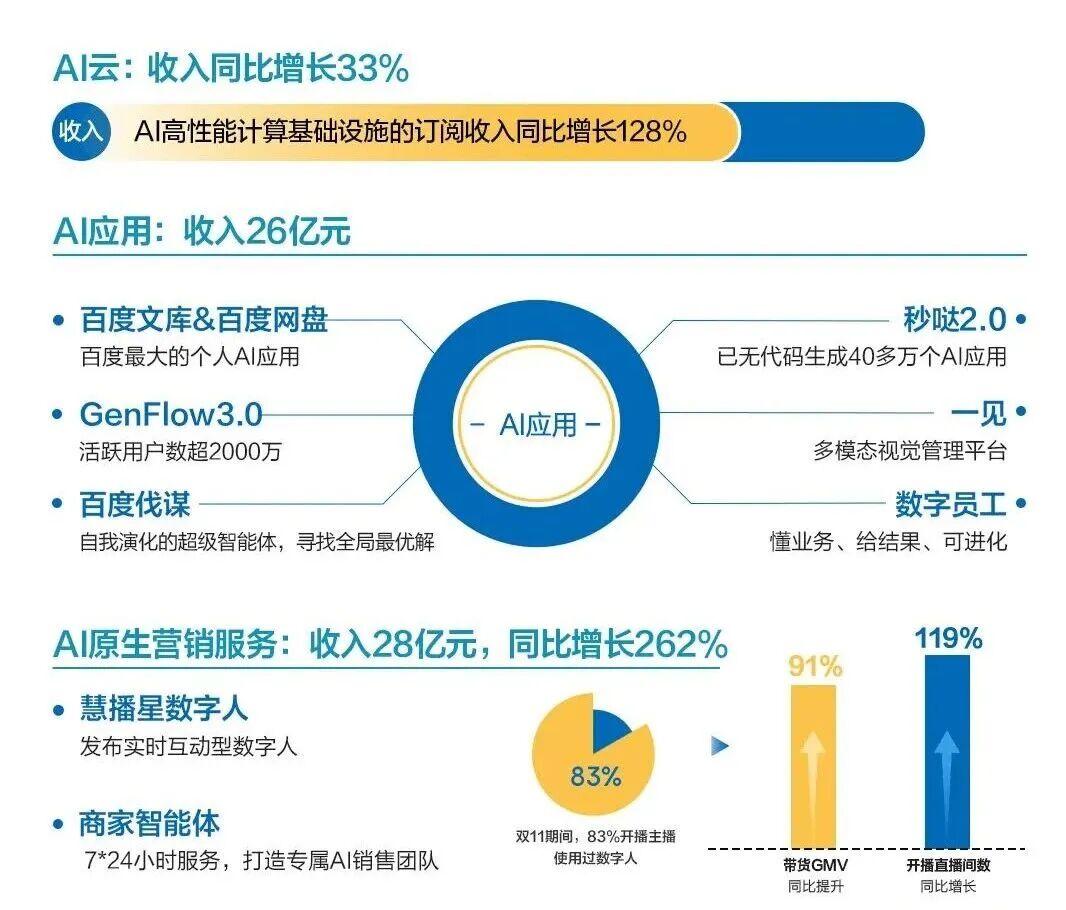
广告收入承压、传统搜索边界被不断侵蚀,百度早已不再满足于"有没有AI应用",而是在更现实地追问:还有哪些AI能力,能够跑出高ROI的商业回报。 PSIG的成立,正是这一转向的集中呈现:在AI应用进入规模化竞争阶段,百度需要创始人亲自下场,将已验证商业潜力的C端资产独立出来,抬升战略权 重,其背后,是对AI投入回报的重新排序。 最近,百度在To C领域的排兵布阵明显加快了节奏。 相比之下,百度的AI叙事显得极为克制,甚至更像一场"结算",其对外口径并未强调未来投入规模,而是称自23年文心大模型推出后,在AI领域已累计投 入超1000亿元。 这种"谨慎",并非是财力不足,恰恰相反,百度的现金及等价物占总资产比例高达45%,在互联网大厂中居于首位,根源还是百度营收支柱的结构性承 压。 流量广告作为百度的生命线,近两年在短视频分流与生成式 AI 的冲击下持续萎缩。 原散落在各部门(如大搜索)的数字人团队统一收拢至电商部门,由百度集团副总裁平晓黎统一负责。 又将AI商业化跑得最好的两大业务百度网盘和百度文库合并,组建了个人超级智能事业群组(PSIG),由百度集团副总裁王颖挂帅,直接向李彦宏汇 报。 C端AI应用正式脱离 ...
产业经济周报:BD出海加速,AI应用竞赛升级
Tebon Securities· 2026-01-28 07:25
Market Performance - The market showed mixed performance from January 19 to January 23, with the Shanghai Composite Index rising by 0.84% and the Shenzhen Component Index increasing by 1.11%[5] - The average daily trading volume was 2.80 trillion yuan, a decrease compared to the previous week[5] Healthcare Sector - At the JPM 2026 conference, over 20 Chinese innovative pharmaceutical companies showcased their products, with significant business development (BD) transactions announced[16] - In 2025, the value of China's innovative drug patent licensing transactions reached approximately $135.7 billion, a 143% increase year-on-year, with 157 total transactions[20] Consumer Sector - The Qianwen APP integrated with Alibaba's ecosystem, achieving over 100 million monthly active users within two months of launch, marking its entry into the "billion-level club"[25] - This integration allows for a seamless process from search to decision-making and payment, establishing a comprehensive AI application ecosystem[26] Hard Technology Sector - The supply of storage and logic chips remains tight, leading to widespread price increases across the industry[32] - The price of enterprise SSDs continues to rise, with a projected increase of 33-38% for NAND Flash products due to supply constraints[36] High-end Manufacturing - The State Grid announced a total fixed asset investment of 4 trillion yuan for the 14th Five-Year Plan period (2026-2030), a 40% increase from the previous period, averaging 800 billion yuan annually[42] - The goal is to achieve a 30% share of renewable energy in total power generation by 2030, indicating significant growth potential for the solar and wind energy sectors[46]


春晚未启,AI先战!字节腾讯百度等大厂出手
新华网财经· 2026-01-28 07:15
Core Viewpoint - The article discusses the competitive marketing strategies of AI companies during the Spring Festival, highlighting their efforts to capture the AI application market and user engagement through cash red envelope promotions and innovative AI features [2][5][6]. Group 1: Marketing Strategies - ByteDance's Volcano Engine has become the exclusive AI cloud partner for the 2026 Spring Festival Gala, while Tencent and Baidu are also launching cash red envelope activities, with Tencent offering a total of 1 billion yuan in red envelopes [2][5]. - Tencent's chairman, Ma Huateng, emphasized the strategy of converting marketing expenses into cash red envelopes to replicate the success of WeChat's red envelope feature from 11 years ago, which significantly expanded WeChat Pay's user base [4]. - Baidu plans to distribute 500 million yuan in cash red envelopes, incentivizing users to engage with its AI assistant, Wenxin Yiyuan, during the Spring Festival [5]. Group 2: AI Application Development - The user base for generative AI in China reached 515 million by June last year, doubling in six months, with a penetration rate of 36.5% [5]. - AI companies are diversifying their application forms, with ByteDance exploring AI hardware, Alibaba integrating various services into its AI platform, and Tencent enhancing its AI functionalities across existing products [5][7]. - Tencent is adopting a decentralized approach to AI integration, allowing users to define when to trigger AI features, while also enhancing its input method with AI capabilities [8][9]. Group 3: User Interaction and Experience - The AI capabilities in input methods are evolving, with Tencent's Sogou input method achieving a recognition accuracy rate of 98% and supporting over 30 languages for translation [9][10]. - The industry is exploring new input methods beyond traditional keyboards, indicating a dynamic evolution in user interaction with AI [10]. - The emergence of new AI products globally, such as ClawdBot, reflects the growing potential of AI to transform daily life, paralleling the competitive marketing efforts seen in China [10].


春晚未启,AI先战!字节腾讯百度等大厂出手
Xin Lang Cai Jing· 2026-01-28 06:52
Core Insights - The article discusses the marketing strategies of various AI application companies during the Spring Festival, highlighting their efforts to differentiate their AI applications and compete for AI entry points [2][11]. Group 1: Marketing Strategies - ByteDance's Volcano Engine has become the exclusive AI cloud partner for the 2026 Spring Festival Gala, while Tencent's Yuanbao app will distribute 1 billion cash red envelopes starting February 1 [2][11]. - Tencent aims to replicate the success of its 11-year-old WeChat red envelope campaign, increasing the total cash amount for this year's event to 1 billion yuan, with users having a chance to win limited cash cards worth 10,000 yuan [3][12]. - Baidu plans to distribute 500 million yuan in cash red envelopes through its app, rewarding users who utilize its Wenxin assistant [3][12]. Group 2: AI User Growth - As of June last year, the user base for generative AI in China reached 515 million, doubling in six months, with a penetration rate of 36.5% [3][12]. Group 3: AI Application Development - AI companies are exploring diverse application forms, with discussions intensifying on which forms are most effective [4][14]. - Alibaba is integrating its ecosystem into a single AI platform, while ByteDance is focusing on AI hardware [4][14]. - Tencent is adopting a collaborative design approach for its AI products, emphasizing integration with large models [4][14]. Group 4: AI Social Features - Tencent is testing social features within the Yuanbao app, allowing users to create groups and interact with AI for various tasks [6][15]. - The company is also decentralizing AI access in its products, allowing users to define when to trigger AI functionalities [6][15]. Group 5: Input Method Innovations - Tencent's Sogou input method has upgraded to a fully AI-driven version, enhancing its capabilities in voice recognition and translation [7][16]. - The input method's daily request volume has reached nearly 2 billion, with an accuracy rate of 98% for voice input [7][16]. Group 6: Global AI Trends - The emergence of new AI products, such as the ClawdBot, reflects a growing global interest in AI applications, paralleling the domestic marketing efforts during the Spring Festival [8][17].

春晚未启,AI先战!字节腾讯百度等大厂出手
第一财经· 2026-01-28 06:43
2026.01. 28 春节成为多家AI应用厂商的"营销档"。先是字节跳动旗下火山引擎宣布成为2026年春晚独家AI云合作伙伴、 豆包将深度嵌入晚会互动,接着,1月25日,腾讯宣布元宝将在2月1日上线春节活动,用户可以在元宝App 上分10亿现金红包。同日,百度也宣布入局春节现金红包活动。 AI厂商开始集体营销了,这不再是一年前围绕聊天助手的投流大战。接近2026年春节,AI厂商拿出了更多 差异化的AI应用,各展身手,焦点在于抢夺AI入口。 AI入口争夺战 "友商投放在电视台的一些巨额的营销费用,我们直接转成红包,希望能够重现11年前微信红包春晚的时 刻。"1月26日,腾讯董事会主席马化腾在一年一度的员工大会上表示。 11年前的春节,腾讯通过微信"摇一摇"形式向全民发放5亿现金红包,通过微信红包这一社交玩法,带动微 信支付迅速扩大用户群,完成微信支付的"诺曼底登陆"。 本文字数:2199,阅读时长大约4分钟 今年腾讯元宝的春节现金红包活动,总金额扩充到10亿元,用户有概率能抽中限量100张的价值1万元现金 小马卡。 作者 | 第一财 经 郑栩彤 百度准备发放的现金红包总金额则是5亿元。用户要在百度App中使用 ...

四家大厂集体发力,发红包、晚会合作……春节撒钱砸出国民级AI应用?复盘豆包、元宝、文心、千问的2025年:4.5亿存量搏杀下的生死突围
Mei Ri Jing Ji Xin Wen· 2026-01-28 04:58
Core Insights - The Chinese New Year presents a significant opportunity for major tech companies to create "national-level products" through innovative marketing strategies and user engagement initiatives [1][14] - Four major AI companies—Tencent, Baidu, ByteDance, and Alibaba—are launching various interactive features and cash red envelope campaigns to attract users during the festive season [1][2] Group 1: Company Strategies - Tencent plans to distribute 1 billion cash red envelopes starting February 1, with individual amounts reaching up to 10,000 yuan, aiming to replicate the success of WeChat's previous red envelope campaigns [1] - Baidu is offering a total of 500 million yuan in cash red envelopes through its app, with a maximum reward of 10,000 yuan, and will collaborate with the 2026 Beijing Spring Festival Gala [2] - ByteDance's Volcano Engine will serve as the exclusive AI cloud partner for the 2026 Spring Festival Gala, while its smart assistant Doubao will introduce various interactive features [2] - Alibaba's Qianwen app has already secured exclusive naming rights for the 2025 Bilibili New Year's Eve Gala, which achieved a peak viewership of over 350 million [2] Group 2: User Engagement and Growth Metrics - By 2025, Doubao's monthly active users (MAU) are projected to double to 226 million, while Qianwen is expected to see a significant increase in user engagement [1][3] - The total MAU for the top five AI applications in China remained stagnant for the first three quarters of 2025, with a slight increase in Q4 due to the efforts of Ant Group's Aifu and Qianwen [3] - Doubao's MAU surged by 126 million in 2025, while DeepSeek experienced a decline of approximately 51 million users over the same period [8] Group 3: Market Dynamics and Competition - The competition among the four AI giants during the Chinese New Year is seen as a battle for user acquisition rather than just a marketing campaign, with a focus on enhancing AI capabilities [14] - The effectiveness of traditional marketing strategies, such as cash red envelope campaigns, may be diminished in the AI era due to increased competition and advertising saturation [14] - The overall user engagement and retention will depend on the core capabilities of AI products rather than just traffic generation, indicating a shift in competitive dynamics [14]

2026年中国AI发展趋势前瞻
Xin Hua Wang· 2026-01-28 03:56
Core Insights - The number of AI companies in China has exceeded 6,000, with the core AI industry expected to surpass 1.2 trillion yuan, reflecting a nearly 30% year-on-year growth [1] - China has become the largest holder of AI patents globally, indicating a significant advancement in AI technology and innovation [1] - The shift from a "Chat" paradigm to an "intelligent agent" era is recognized, emphasizing the need for AI to solve real-world problems [2] Industry Development - The AI sector is experiencing a dual advancement: technological breakthroughs and application integration into various industries [2] - Major companies like Tencent and Baidu are rapidly deploying AI in real-world scenarios, with Tencent integrating its self-developed models into over 900 applications [2] - The competition in AI is now focused on who can effectively address specific problems, marking a transition in the industry [2] Computational Power - China has established 42 intelligent computing clusters, with a total computing power exceeding 1,590 EFLOPS, ranking among the top globally [5] - The development of computing power is characterized by a dual drive of government planning and market innovation, moving towards a more integrated national framework [6] - The "East Data West Computing" project has created eight major hub nodes, which account for over 80% of the national intelligent computing capacity [6] Data Utilization - The data annotation industry is evolving from labor-intensive to knowledge-intensive, focusing on high-quality industry-specific datasets [9] - High-quality data is becoming the focal point of AI competition, essential for training industry models to solve deep sector-specific issues [10] - China possesses a vast amount of data across various industries, which is seen as a valuable resource for AI development [10] Application in Traditional Industries - AI is increasingly being integrated into traditional industries, driving transformation and modernization [13] - The rapid growth in AI applications is reflected in the significant increase in daily token consumption, indicating widespread adoption [14] - AI applications are expanding across manufacturing, with notable increases in research, production, and operational management [16] Social Impact - AI is transforming governance and public services, enhancing efficiency and responsiveness in urban management [18] - The integration of AI into consumer services is changing how businesses understand and meet customer needs [18] - The focus on AI is shifting towards meeting societal demands, with initiatives aimed at fostering a comprehensive ecosystem of smart products [19] Safety and Regulation - The rise of AI-generated low-quality content has raised concerns about safety and ethical challenges, prompting discussions on regulatory frameworks [24][25] - The Chinese government is implementing policies to strengthen AI governance, emphasizing the need for a balanced approach to innovation and risk management [25]
涨价视角下解读火山云和行业竞争格局
2026-01-28 03:01
Summary of Conference Call Records Industry Overview - The cloud service industry is facing significant challenges due to rising costs, with large firms like ByteDance, Alibaba, and Baidu potentially benefiting from price increases, while smaller firms like Kingsoft, Qcloud, and UCloud are adversely affected due to weaker bargaining power [1][4][5]. Key Points and Arguments Price Increase Strategies - Domestic cloud service providers are experiencing pressure to raise prices due to increased costs of key components, with delivery times for general CPU machines in mainland China reaching approximately 40 weeks [2][11]. - Major cloud service providers like AWS, Alibaba, and Baidu are raising prices primarily due to rising costs in critical components, which increases overall supply chain pressure [2][11]. - ByteDance's procurement budget for 2026 has increased from 65 billion to 80 billion RMB due to rising storage costs, which now account for 30%-40% of overall operational costs [3][12]. Market Dynamics - The domestic cloud service market is in the early stages of price negotiations, with downstream customers reacting strongly against price increases, believing they should not bear the costs of expansion [8][14]. - Firefly Engine is adopting a counter-cyclical expansion strategy, maintaining lower prices to attract customers while competitors raise their prices [9]. Profitability and Cost Management - The ability to increase gross margins through price hikes depends on various factors, including the scale of operations and supply chain negotiation power. Large companies may see some revenue benefits, while smaller firms may struggle to maintain profitability [4][7]. - Alibaba is facing internal resource pressures and must manage costs effectively to avoid losses in its cloud business. The company can accept a price increase of 20%-25% for most clients, but this may only offset rising storage costs without significantly improving gross margins [10][11]. Customer Reactions and Acceptance - Different customer segments are responding variably to price increases, with large, profitable firms less sensitive to price hikes compared to smaller end-users who are more affected by cost increases [13][14]. - Many companies are reluctant to migrate resources to other cloud platforms due to operational complexities and the challenges of purchasing and maintaining their own hardware [15]. Additional Important Insights - The pricing strategies of major cloud service providers vary significantly, with discounts for different customer tiers reflecting their bargaining power [16]. - The overall impact of rising storage costs is substantial, with storage costs now comprising 20%-30% of total server costs, significantly affecting the cloud computing ecosystem [11][12]. - Future demand for cloud resources is expected to increase, potentially leading to more companies opting for public cloud services rather than private deployments due to procurement difficulties [18]. Conclusion - The cloud service industry is navigating a complex landscape of rising costs and competitive pressures, with large firms leveraging their scale to manage price increases while smaller firms face significant challenges. The market dynamics suggest a cautious approach to pricing strategies, with varying customer reactions influencing the overall landscape.