
BIDU(BIDU)

Search documents
春晚未启,AI先战!字节腾讯百度等大厂出手
Xin Lang Cai Jing· 2026-01-28 06:52
Core Insights - The article discusses the marketing strategies of various AI application companies during the Spring Festival, highlighting their efforts to differentiate their AI applications and compete for AI entry points [2][11]. Group 1: Marketing Strategies - ByteDance's Volcano Engine has become the exclusive AI cloud partner for the 2026 Spring Festival Gala, while Tencent's Yuanbao app will distribute 1 billion cash red envelopes starting February 1 [2][11]. - Tencent aims to replicate the success of its 11-year-old WeChat red envelope campaign, increasing the total cash amount for this year's event to 1 billion yuan, with users having a chance to win limited cash cards worth 10,000 yuan [3][12]. - Baidu plans to distribute 500 million yuan in cash red envelopes through its app, rewarding users who utilize its Wenxin assistant [3][12]. Group 2: AI User Growth - As of June last year, the user base for generative AI in China reached 515 million, doubling in six months, with a penetration rate of 36.5% [3][12]. Group 3: AI Application Development - AI companies are exploring diverse application forms, with discussions intensifying on which forms are most effective [4][14]. - Alibaba is integrating its ecosystem into a single AI platform, while ByteDance is focusing on AI hardware [4][14]. - Tencent is adopting a collaborative design approach for its AI products, emphasizing integration with large models [4][14]. Group 4: AI Social Features - Tencent is testing social features within the Yuanbao app, allowing users to create groups and interact with AI for various tasks [6][15]. - The company is also decentralizing AI access in its products, allowing users to define when to trigger AI functionalities [6][15]. Group 5: Input Method Innovations - Tencent's Sogou input method has upgraded to a fully AI-driven version, enhancing its capabilities in voice recognition and translation [7][16]. - The input method's daily request volume has reached nearly 2 billion, with an accuracy rate of 98% for voice input [7][16]. Group 6: Global AI Trends - The emergence of new AI products, such as the ClawdBot, reflects a growing global interest in AI applications, paralleling the domestic marketing efforts during the Spring Festival [8][17].




春晚未启,AI先战!字节腾讯百度等大厂出手
第一财经· 2026-01-28 06:43
2026.01. 28 春节成为多家AI应用厂商的"营销档"。先是字节跳动旗下火山引擎宣布成为2026年春晚独家AI云合作伙伴、 豆包将深度嵌入晚会互动,接着,1月25日,腾讯宣布元宝将在2月1日上线春节活动,用户可以在元宝App 上分10亿现金红包。同日,百度也宣布入局春节现金红包活动。 AI厂商开始集体营销了,这不再是一年前围绕聊天助手的投流大战。接近2026年春节,AI厂商拿出了更多 差异化的AI应用,各展身手,焦点在于抢夺AI入口。 AI入口争夺战 "友商投放在电视台的一些巨额的营销费用,我们直接转成红包,希望能够重现11年前微信红包春晚的时 刻。"1月26日,腾讯董事会主席马化腾在一年一度的员工大会上表示。 11年前的春节,腾讯通过微信"摇一摇"形式向全民发放5亿现金红包,通过微信红包这一社交玩法,带动微 信支付迅速扩大用户群,完成微信支付的"诺曼底登陆"。 本文字数:2199,阅读时长大约4分钟 今年腾讯元宝的春节现金红包活动,总金额扩充到10亿元,用户有概率能抽中限量100张的价值1万元现金 小马卡。 作者 | 第一财 经 郑栩彤 百度准备发放的现金红包总金额则是5亿元。用户要在百度App中使用 ...

四家大厂集体发力,发红包、晚会合作……春节撒钱砸出国民级AI应用?复盘豆包、元宝、文心、千问的2025年:4.5亿存量搏杀下的生死突围
Mei Ri Jing Ji Xin Wen· 2026-01-28 04:58
Core Insights - The Chinese New Year presents a significant opportunity for major tech companies to create "national-level products" through innovative marketing strategies and user engagement initiatives [1][14] - Four major AI companies—Tencent, Baidu, ByteDance, and Alibaba—are launching various interactive features and cash red envelope campaigns to attract users during the festive season [1][2] Group 1: Company Strategies - Tencent plans to distribute 1 billion cash red envelopes starting February 1, with individual amounts reaching up to 10,000 yuan, aiming to replicate the success of WeChat's previous red envelope campaigns [1] - Baidu is offering a total of 500 million yuan in cash red envelopes through its app, with a maximum reward of 10,000 yuan, and will collaborate with the 2026 Beijing Spring Festival Gala [2] - ByteDance's Volcano Engine will serve as the exclusive AI cloud partner for the 2026 Spring Festival Gala, while its smart assistant Doubao will introduce various interactive features [2] - Alibaba's Qianwen app has already secured exclusive naming rights for the 2025 Bilibili New Year's Eve Gala, which achieved a peak viewership of over 350 million [2] Group 2: User Engagement and Growth Metrics - By 2025, Doubao's monthly active users (MAU) are projected to double to 226 million, while Qianwen is expected to see a significant increase in user engagement [1][3] - The total MAU for the top five AI applications in China remained stagnant for the first three quarters of 2025, with a slight increase in Q4 due to the efforts of Ant Group's Aifu and Qianwen [3] - Doubao's MAU surged by 126 million in 2025, while DeepSeek experienced a decline of approximately 51 million users over the same period [8] Group 3: Market Dynamics and Competition - The competition among the four AI giants during the Chinese New Year is seen as a battle for user acquisition rather than just a marketing campaign, with a focus on enhancing AI capabilities [14] - The effectiveness of traditional marketing strategies, such as cash red envelope campaigns, may be diminished in the AI era due to increased competition and advertising saturation [14] - The overall user engagement and retention will depend on the core capabilities of AI products rather than just traffic generation, indicating a shift in competitive dynamics [14]

2026年中国AI发展趋势前瞻
Xin Hua Wang· 2026-01-28 03:56
Core Insights - The number of AI companies in China has exceeded 6,000, with the core AI industry expected to surpass 1.2 trillion yuan, reflecting a nearly 30% year-on-year growth [1] - China has become the largest holder of AI patents globally, indicating a significant advancement in AI technology and innovation [1] - The shift from a "Chat" paradigm to an "intelligent agent" era is recognized, emphasizing the need for AI to solve real-world problems [2] Industry Development - The AI sector is experiencing a dual advancement: technological breakthroughs and application integration into various industries [2] - Major companies like Tencent and Baidu are rapidly deploying AI in real-world scenarios, with Tencent integrating its self-developed models into over 900 applications [2] - The competition in AI is now focused on who can effectively address specific problems, marking a transition in the industry [2] Computational Power - China has established 42 intelligent computing clusters, with a total computing power exceeding 1,590 EFLOPS, ranking among the top globally [5] - The development of computing power is characterized by a dual drive of government planning and market innovation, moving towards a more integrated national framework [6] - The "East Data West Computing" project has created eight major hub nodes, which account for over 80% of the national intelligent computing capacity [6] Data Utilization - The data annotation industry is evolving from labor-intensive to knowledge-intensive, focusing on high-quality industry-specific datasets [9] - High-quality data is becoming the focal point of AI competition, essential for training industry models to solve deep sector-specific issues [10] - China possesses a vast amount of data across various industries, which is seen as a valuable resource for AI development [10] Application in Traditional Industries - AI is increasingly being integrated into traditional industries, driving transformation and modernization [13] - The rapid growth in AI applications is reflected in the significant increase in daily token consumption, indicating widespread adoption [14] - AI applications are expanding across manufacturing, with notable increases in research, production, and operational management [16] Social Impact - AI is transforming governance and public services, enhancing efficiency and responsiveness in urban management [18] - The integration of AI into consumer services is changing how businesses understand and meet customer needs [18] - The focus on AI is shifting towards meeting societal demands, with initiatives aimed at fostering a comprehensive ecosystem of smart products [19] Safety and Regulation - The rise of AI-generated low-quality content has raised concerns about safety and ethical challenges, prompting discussions on regulatory frameworks [24][25] - The Chinese government is implementing policies to strengthen AI governance, emphasizing the need for a balanced approach to innovation and risk management [25]
涨价视角下解读火山云和行业竞争格局
2026-01-28 03:01
Summary of Conference Call Records Industry Overview - The cloud service industry is facing significant challenges due to rising costs, with large firms like ByteDance, Alibaba, and Baidu potentially benefiting from price increases, while smaller firms like Kingsoft, Qcloud, and UCloud are adversely affected due to weaker bargaining power [1][4][5]. Key Points and Arguments Price Increase Strategies - Domestic cloud service providers are experiencing pressure to raise prices due to increased costs of key components, with delivery times for general CPU machines in mainland China reaching approximately 40 weeks [2][11]. - Major cloud service providers like AWS, Alibaba, and Baidu are raising prices primarily due to rising costs in critical components, which increases overall supply chain pressure [2][11]. - ByteDance's procurement budget for 2026 has increased from 65 billion to 80 billion RMB due to rising storage costs, which now account for 30%-40% of overall operational costs [3][12]. Market Dynamics - The domestic cloud service market is in the early stages of price negotiations, with downstream customers reacting strongly against price increases, believing they should not bear the costs of expansion [8][14]. - Firefly Engine is adopting a counter-cyclical expansion strategy, maintaining lower prices to attract customers while competitors raise their prices [9]. Profitability and Cost Management - The ability to increase gross margins through price hikes depends on various factors, including the scale of operations and supply chain negotiation power. Large companies may see some revenue benefits, while smaller firms may struggle to maintain profitability [4][7]. - Alibaba is facing internal resource pressures and must manage costs effectively to avoid losses in its cloud business. The company can accept a price increase of 20%-25% for most clients, but this may only offset rising storage costs without significantly improving gross margins [10][11]. Customer Reactions and Acceptance - Different customer segments are responding variably to price increases, with large, profitable firms less sensitive to price hikes compared to smaller end-users who are more affected by cost increases [13][14]. - Many companies are reluctant to migrate resources to other cloud platforms due to operational complexities and the challenges of purchasing and maintaining their own hardware [15]. Additional Important Insights - The pricing strategies of major cloud service providers vary significantly, with discounts for different customer tiers reflecting their bargaining power [16]. - The overall impact of rising storage costs is substantial, with storage costs now comprising 20%-30% of total server costs, significantly affecting the cloud computing ecosystem [11][12]. - Future demand for cloud resources is expected to increase, potentially leading to more companies opting for public cloud services rather than private deployments due to procurement difficulties [18]. Conclusion - The cloud service industry is navigating a complex landscape of rising costs and competitive pressures, with large firms leveraging their scale to manage price increases while smaller firms face significant challenges. The market dynamics suggest a cautious approach to pricing strategies, with varying customer reactions influencing the overall landscape.
AI 硬件?
小熊跑的快· 2026-01-28 02:23
Core Viewpoint - The domestic AI large model sector is experiencing a vigorous development characterized by simultaneous "technological breakthroughs and commercial implementation," shifting from mere parameter competition to a fierce contest for actual value creation [1]. Group 1: General Large Models - Alibaba released its flagship reasoning model Qwen3-Max-Thinking in January 2026, achieving multiple global records with over one trillion parameters and a new "test-time expansion" mechanism that significantly enhances reasoning efficiency and performance, scoring 58.3 in the "Human Last Test" (HLE), surpassing GPT-5.2-Thinking and Gemini 3 Pro [3]. - Baidu launched its native multimodal model Wenxin 5.0 in December 2025, featuring over 2.4 trillion parameters and topping the LMArena text leaderboard with a score of 1451, marking it as the best in China [3]. - ByteDance's Doubao model version 1.8, released in December 2025, optimized for multimodal agent scenarios, has shown impressive growth with a daily token usage exceeding 50 trillion [3]. Group 2: Vertical Models - Baidu's Wenxin 5.0 has been applied in the education sector, collaborating with publishers to create "AI picture books" for special needs children [5]. - iFLYTEK continues to leverage its voice interaction advantages with its Xinghuo model, achieving significant commercial success in medical and government sectors through voice transcription and meeting minutes generation [5]. - Tencent's Mixuan model has made breakthroughs in 3D generation, with the open-source Mixuan World model 1.1 enabling rapid 3D world creation for industries like gaming and design [5]. - Baichuan Intelligent announced the full opening of the M3 Plus API, with its Baichuan-M3 model ranking first globally in the HealthBench medical evaluation with a score of 65.1, surpassing GPT-5.2 [5]. Group 3: Hardware Developments - The year is marked as the "Battle of Hundreds of Chips," with companies like Birun Technology delivering over 12,000 GPU chips and holding unfulfilled orders worth 822 million yuan as of December 2025 [8]. - Baidu's Kunlun chip is preparing for an IPO on the Hong Kong Stock Exchange, having released multiple AI processing units and achieving significant shipment volumes [8]. - Alibaba's Pingtouge plans to pursue a separate listing, alongside other companies like Moer Thread and Muxi Integrated Circuit, which are also preparing for IPOs [9]. - Current policies are supportive of the AI hardware sector, with overall positive trends in the market, exemplified by the strong performance of the Sci-Tech Semiconductor ETF (588170) [10][11].
百度、腾讯旗下AI应用发起春节红包大战,花旗预计阿里巴巴也将加入
Mei Ri Jing Ji Xin Wen· 2026-01-28 02:13
Group 1 - The core viewpoint of the article highlights the positive impact of the Chinese New Year on tech stocks, particularly those related to AI applications, with companies like Tencent and Alibaba expected to benefit significantly from promotional activities [1] - Citigroup predicts that Alibaba's Tongyi Qianwen will also participate in the cash red envelope promotions, which historically attract significant consumer attention to internet companies' applications during the Spring Festival [1] - Based on recent stock performance, Citigroup's current preference ranking for AI concept stocks is Tencent > Alibaba > Baidu [1] Group 2 - Investment tools such as the Hong Kong Stock Connect Technology ETF (159101.SZ) and the Hang Seng Internet ETF (513330.SH) provide A-share investors with convenient access to the Hong Kong market, supporting T+0 trading for flexibility [2] - The Hong Kong Stock Connect Technology ETF has a high overlap with the Hang Seng Technology Index, featuring a combined weight of 31% for Alibaba and Tencent, while also including biotech and reducing exposure to automotive and retail sectors [1] - The Hang Seng Internet ETF has the highest market share for holdings in Tencent, Alibaba, and Baidu among similar products, with a combined holding ratio of approximately 36% [1]
至少有九家中国AI芯片公司出货量超万卡
3 6 Ke· 2026-01-28 01:46
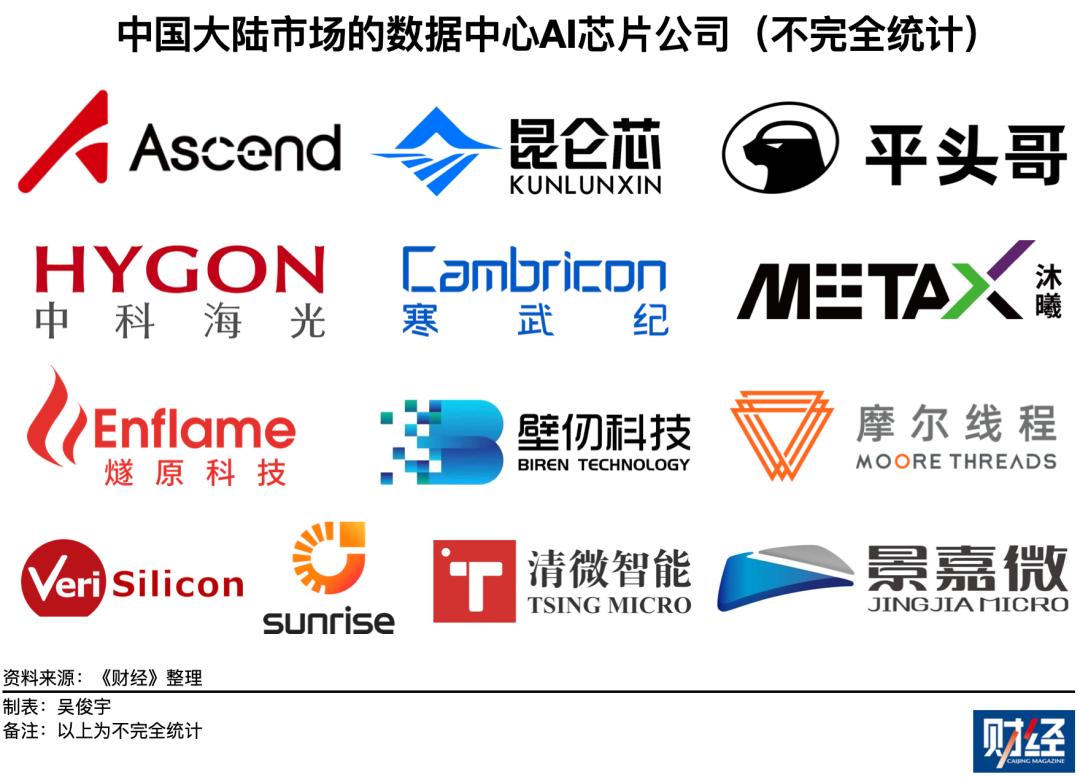
Core Insights - The self-sufficiency process of domestic AI chips in data centers is accelerating due to strict chip export controls, with over ten brands including Huawei Ascend, Baidu Kunlun, and Alibaba PingTouGe emerging in the market [1] - At least nine Chinese AI chip companies have reported shipment or order volumes exceeding 10,000 units, indicating a growing market acceptance of domestic AI chips [1][2] - The average price of domestic inference AI chips ranges from 30,000 to 200,000 yuan per unit, reflecting their performance, stability, and total cost of ownership [1] Group 1: Market Dynamics - The Chinese AI chip server market is projected to reach $16 billion in the first half of 2025, with domestic AI chips capturing approximately 35% market share, significantly growing faster than Nvidia [2] - The emergence of companies with 10,000-unit shipments marks the beginning of a "scale delivery verification" phase in the industry [2][15] - Major players like Huawei Ascend and Baidu Kunlun are leading in market share, with Huawei Ascend being used in various domestic clusters [5] Group 2: Company Performance - Companies like Mozi, Tianshu Zhixin, and Suiruan Technology have reported cumulative shipments exceeding 10,000 units, with Mozi achieving over 25,000 units by August 2025 [8] - Sunrise and Qingwei Intelligent, still in startup phases, have also surpassed the 10,000-unit mark, although they lag behind leading companies in terms of volume [10] - The performance of some domestic AI chips has reportedly reached or exceeded that of Nvidia's H20, particularly in inference scenarios [14] Group 3: Competitive Landscape - Domestic AI chip companies are focusing on usability and controllability rather than peak performance, often utilizing more mature manufacturing processes like 12nm due to limited advanced process capacity [11] - The push to lower inference costs is a common goal among industry players, with some companies aiming to reduce the cost of generating one million tokens to one cent [13] - The software ecosystem remains a challenge, with many domestic chips facing difficulties in model adaptation compared to Nvidia's offerings [15] Group 4: Future Outlook - The domestic AI inference chip market is expected to experience explosive growth between 2026 and 2027, with multiple new products anticipated [11] - The competitive landscape is likened to the early stages of the photovoltaic industry, with rapid growth driven by policy support and market dynamics [16] - However, the unique nature of AI chip development, influenced by software, hardware, and ecosystem factors, suggests that competition will differ fundamentally from that of standardized manufacturing products like solar panels [16]


2026年,巨头疯抢这个赛道
3 6 Ke· 2026-01-28 01:34
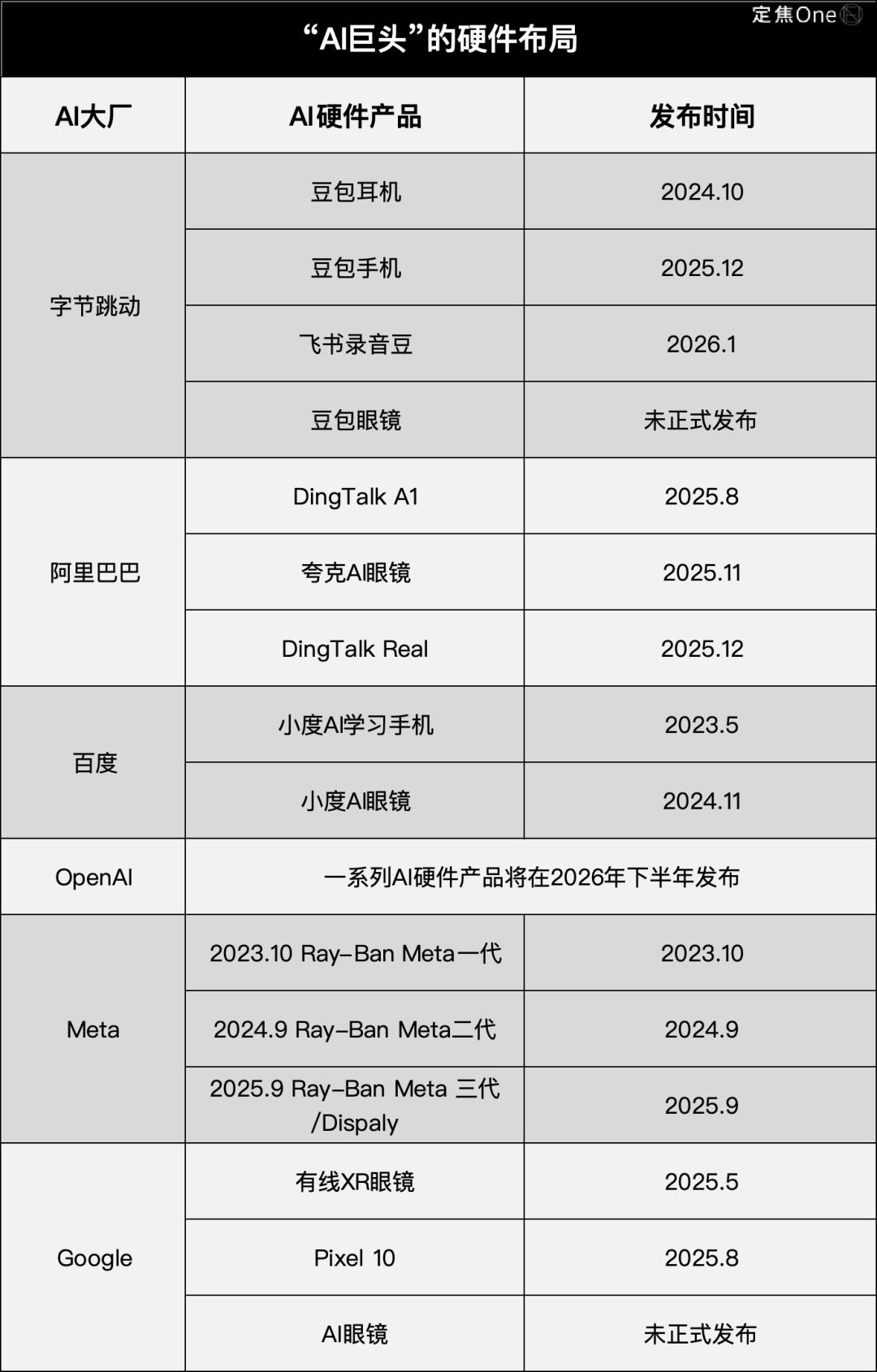
Core Insights - The AI hardware race has intensified with major players like OpenAI, Google, Alibaba, and ByteDance entering the market, with OpenAI planning to launch its first hardware device in the second half of 2026 [1][5] - Domestic companies are diversifying their AI hardware offerings, focusing on proven product categories rather than new hardware forms [1][3] Group 1: AI Hardware Landscape - OpenAI is set to release a series of AI hardware products, including a device codenamed "Sweetpea" and another called "Gumdrop," which is a smart pen or wearable audio device [2][3] - Major AI companies are focusing on three main categories: AI glasses, AI office tools, and AI smartphones, with AI glasses being the most frequently mentioned product type [4][6] - Meta's Ray-Ban Meta smart glasses have sold over 2 million units, indicating a strong market for AI glasses, while Google and other companies are also developing similar products [6][20] Group 2: Market Dynamics and Competition - The entry of AI giants into hardware is driven by the saturation of the AI software market and the decreasing barriers to hardware development [12][14] - Different companies have varying strategies: ByteDance is aggressively testing multiple hardware forms, while Alibaba is more cautious, aiming to integrate hardware into its existing software ecosystem [15][18] - The competition between ByteDance and Alibaba centers on who can establish a hardware presence first, while overseas companies like Meta and Google face their own challenges in the hardware market [19][22] Group 3: Commercial Viability and Challenges - AI hardware products are currently seen as experimental, with initial sales figures indicating market interest but not substantial volume [26][30] - Successful examples of AI hardware commercialization exist, such as Plaud's AI recording card achieving $250 million in annual recurring revenue [27] - The challenge remains whether AI hardware can replace smartphones as the next universal interface, with current products not yet meeting consumer demand for necessity [30][33]

2025中国企业出海年鉴:不确定时代中的全球化韧性:中国企业的实践与趋势
EqualOcean· 2026-01-28 01:10
Investment Rating - The report does not explicitly provide an investment rating for the industry. Core Insights - In 2025, Chinese companies' overseas expansion did not experience a singular turning point but rather accelerated along multiple changing trajectories, significantly impacting their overseas operations [6] - The focus of overseas market layout has shifted, with compliance and organizational setup becoming prerequisites, and localization evolving from a strategic option to a fundamental requirement [6] - The importance of 2025 lies not only in what occurred but in the changes that have begun to emerge, reshaping the decision-making logic of overseas enterprises and influencing their long-term choices [6] Summary by Sections Overall Changes in 2025 - The industry coverage for Chinese companies going abroad has expanded, encompassing retail e-commerce, tea drinks, entertainment, AI, automotive, and hardware, with Southeast Asia, the Middle East, Latin America, and Africa becoming significant growth sources [14] - The technological investment has increased, and compliance challenges have intensified, with a notable shift in export structure, as evidenced by a trade surplus exceeding $1 trillion for the first time in 2025 [19][21] Country-Specific Roles in Overseas Expansion - The Global South has emerged as a crucial growth source for Chinese companies, transitioning from a supplementary market to a core strategic depth [28] - The Gulf region is becoming a key node in the global AI capability competition, with significant investments in digital infrastructure and AI technologies [31] - Competition in the European and American markets has shifted towards regulatory and compliance aspects, with stringent measures impacting market access for Chinese firms [34] Industry-Specific Changes in Overseas Expansion - The automotive industry's focus has shifted from export expansion to deep localization, with significant investments in overseas manufacturing facilities [43][48] - The global AI landscape is being restructured, with Chinese AI capabilities transitioning from a follower to a leader in the market [49] - The competitive focus in cross-border e-commerce has shifted towards fulfillment and infrastructure capabilities, reflecting the need for robust operational frameworks [6] Strategic Responses of Companies and Service Systems - Chinese brands are entering a critical window for global reputation and brand premium, with the first generation of overseas experience beginning to systematically fail [4][10] - The overseas service system is evolving from a reactive response to customer needs to a proactive global service model, indicating a shift towards comprehensive service offerings [10]


