Glencore(GLNCY)

Search documents
锌:内外价差僵持,沪锌底部支撑强
Guo Tou Qi Huo· 2025-11-12 11:41
Report Summary 1. Industry Investment Rating No investment rating is provided in the report. 2. Core Viewpoints - In Q4 2025, the TC of zinc ore continued to decline, strengthening the expectation of domestic smelter production cuts. The opening of the zinc ingot export window reduced the pressure of domestic zinc ingot inventory accumulation. The high spread between the domestic and overseas markets attracted attention, with domestic smelters and traders actively seeking exports. The LME zinc has limited room for further significant upside. - There is a need for profit - taking of cross - market long - spread funds, while the participation enthusiasm of cross - market short - spread funds is currently limited. It is a good opportunity to enter cross - market short - spread trades as the inventory difference between domestic and overseas markets has shown signs of convergence, and the fundamentals no longer support the further expansion of the spread. The spread is expected to converge to the range of 1,000 - 1,500 yuan/ton. - The high - low rotation of funds has spread from the stock market to the futures market, and a rebound of oversold varieties can be expected. In Q4, Shanghai zinc is not recommended as a short - allocation. The rebound height is temporarily seen at the annual line of 23,200 yuan/ton. It is unlikely to rebound to the high - level range of 24,200 yuan/ton at the beginning of the year unless the domestic deflation expectation is broken and overseas consumption exceeds expectations. - The price range of Shanghai zinc in Q4 is expected to be 22,200 - 23,200 yuan/ton, and the price range of LME zinc is 2,900 - 3,100 US dollars/ton. [73][74] 3. Summary by Relevant Catalogs 3.1 Zinc Price History and Current Situation - Historically, factors such as the European debt crisis, US QE policies, mine shortages, and changes in TC have affected zinc prices. In 2025, the zinc market has complex supply - demand and price relationships. The LME zinc inventory is 35,300 tons, SMM zinc inventory is 159,600 tons, and the smelter raw material inventory is 26 days. The LME 0 - 3 month premium is 117.04 US dollars. [5][21] - In 2025, from January to July, China's zinc ingot production was 3.8425 million tons, a year - on - year increase of 4.65%. From January to September, the output was 5.0685 million tons, a year - on - year increase of 8.83%. However, some overseas refineries have reduced production due to factors such as low TC and profit problems. In H1 2025, the overall output of major overseas refineries decreased by 89,900 tons year - on - year, a decline of 4.34%. [28][29][39] 3.2 Market Factors - **Supply - side factors**: New domestic mines such as Huoshaoyun, Russia's OZ mine, and Congo's Kipushi lead - zinc mine have been put into production, effectively alleviating the raw material constraints on domestic refineries. However, overseas refineries' profit recovery will lead to competition for mines between overseas and domestic refineries. [30][41] - **Demand - side factors**: The real estate market has shown signs of weakness, with a decline in real estate investment and a mixed situation in housing sales. The photovoltaic industry has passed the high - growth stage, and the growth rate of new installed capacity has slowed down. However, the export of galvanized sheets has increased, with the cumulative export of 10 - tariff - number galvanized sheets from January to September 2025 reaching 10.42 million tons, a year - on - year increase of 9.61%. [62][64][58] - **Policy factors**: The import and export tariffs of zinc products have been adjusted. For example, the export tariff of 0 zinc is 20%, but the provisional tariff in 2025 is 0%. The export of zinc ingots is subject to a 13% VAT, and the export tax rebate has been cancelled since 2008. [34][35] 3.3 Trading Strategies - **Cross - market arbitrage**: Cross - market short - spread is recommended as the inventory difference between domestic and overseas markets is converging, and the fundamentals no longer support the further expansion of the spread. - **Unilateral trading**: For LME zinc, beware of sudden warehouse deliveries due to low inventory. The upside space above the 3,100 - dollar integer mark is limited, so short - allocation on rallies is recommended. For Shanghai zinc, it is expected to fluctuate at a low level. In Q4, short - allocation is not recommended. Look for short - allocation opportunities above 23,000 yuan/ton or short - term long positions on pullbacks. - **Inter - period trading**: Due to the weak current situation and unclear prospects for expectation repair, the inter - period spread is difficult to widen, maintaining a normal positive market structure, and there are no inter - period arbitrage opportunities. [74][75]

海外锌矿山三季度财报梳理-20251110
Yin He Qi Huo· 2025-11-10 12:49
Group 1: Report Overview - The report is a zinc special report dated November 10, 2025, focusing on the Q3 financial reports of overseas zinc mines [4][8][12] Group 2: Overseas Mine Production Overseas Part - Mine Output Aggregation - The report provides a detailed table of the production of overseas mining enterprises from 2021Q1 to 2025Q3, including Vedanta, Glencore, TECK, etc. The total production shows fluctuations over different quarters and years, with varying year - on - year growth rates [16] Global Zinc Concentrate Annual Output - The annual output and year - on - year growth rate of global zinc concentrate from 2017 to 2025E are presented. The output in 2025E is expected to be 1262.05 million tons, with a year - on - year growth of 5.90% [70] Zinc Concentrate Production Change Forecast - In 2025, overseas mines are expected to have a net increase of 59.49 million tons in production, with new mines, production increases, restarts, and some mines reducing production or shutting down. Domestic mines are expected to have a new production increase of 10.80 million tons, with a total global net increase of 70.29 million tons [73] - Forecasts for production changes from 2026 - 2030 are also provided, with a total net increase of 23.27 million tons in 2026, 5.60 million tons in 2027, 12.10 million tons in 2028, 6.30 million tons in 2029, and 0.70 million tons in 2030 [75]



铜业股拉升反弹,江西铜业涨3% 中国有色矿业涨1.3%
Ge Long Hui· 2025-11-05 03:45
Group 1 - Hong Kong copper stocks experienced a collective rebound, with China Daye Nonferrous Metals leading the rise at approximately 9%, followed by Jiangxi Copper at 3%, and China Gold International and China Nonferrous Mining both up by 1.3% [1] - Mining giant Glencore is reportedly planning to close its Horne smelter and associated copper refinery in Quebec, Canada, due to environmental issues and the substantial capital required for upgrades [1] - The Horne smelter has an estimated annual production capacity of over 300,000 tons, accounting for about 17% of copper imports to the United States, indicating a significant impact on the North American copper supply chain [1] Group 2 - Earlier this year, traders moved large quantities of copper into the U.S. market in anticipation of potential tariffs on copper, which led to a surge in copper prices on the New York Mercantile Exchange (Comex) [1] - In August, former President Trump decided against imposing tariffs on bulk copper, instead targeting value-added copper products, while still leaving the possibility of tariffs on raw copper starting in 2027 [1]

全球矿山供应紧张加剧 LME期铜创下历史新高
Jin Tou Wang· 2025-10-30 03:04
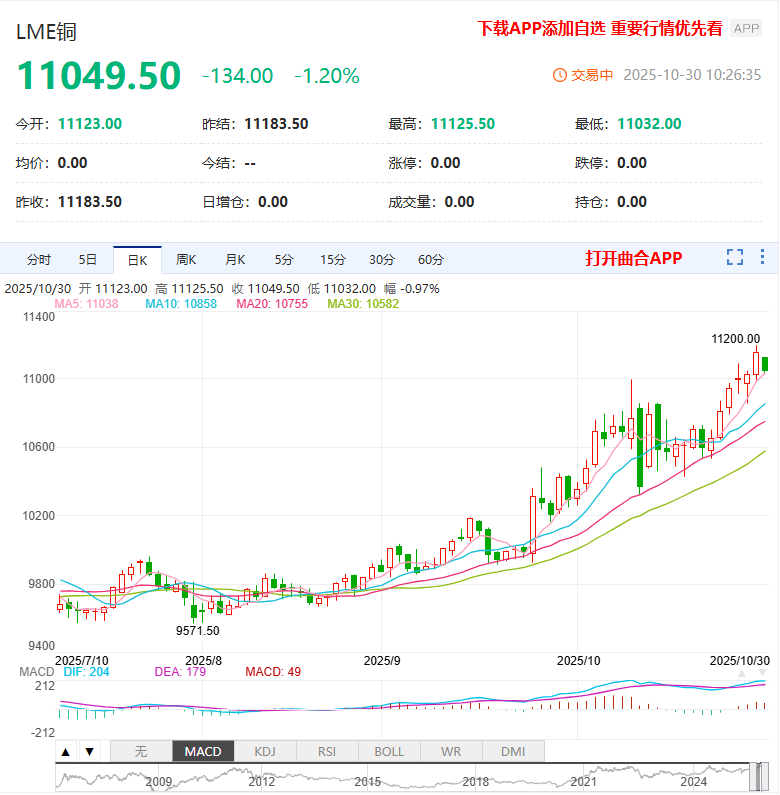
Core Viewpoint - Global mining supply tightens, leading to a historic high in LME copper prices, with an increase of 8.86% this month and 27.38% year-to-date [1] Group 1: Copper Market Dynamics - LME copper price reached $11,049.50 per ton, experiencing a slight decline of 1.20% [1] - Glencore reported a 17% decrease in copper production for the first nine months of the year, prompting a tightening of production guidance for 2025 despite a rise in Q3 output [1] - The China smelter group decided not to set a guidance price for copper concentrate treatment and refining charges (TC/RC) for Q4 [1] Group 2: Industry Developments - Chile's national mining company Enami received environmental approval for a new $1.7 billion copper smelter [1] - Shenyin Wanguo Futures indicated that the Federal Reserve is expected to cut rates by 25 basis points, while smelting profits remain at breakeven levels despite high growth in smelting output [1] Group 3: Economic Indicators and Future Outlook - National Bureau of Statistics data shows positive growth in power grid investment, while power supply investment is slowing; automotive production and sales are growing, but home appliance production is declining, and real estate remains weak [1] - An Indonesian mining accident is likely to shift global copper supply-demand dynamics, providing long-term support for copper prices [1] - Attention is drawn to changes in the US dollar, copper smelting output, and downstream demand [1]

刚刚,再次见证历史!
中国基金报· 2025-10-29 12:48
Core Viewpoint - The article highlights the significant rise in copper prices, with LME copper reaching a historical high of $11,146 per ton, driven by strong demand from sectors like electric vehicles and AI infrastructure [2][4][6]. Supply and Demand Dynamics - The global copper supply has shifted from a "tight balance" to a "shortage," with major mining companies reducing their copper production forecasts [8][9]. - Glencore reported a 17% decrease in copper production for the first three quarters of the year, adjusting its annual target to 850,000 - 875,000 tons from a previous range of 850,000 - 890,000 tons [9][10]. - Significant production disruptions have occurred, including a 120,000-ton reduction from Freeport's Grasberg mine and a 50,000-ton impact from social unrest at the Constancia mine in Peru [10]. - Chile's Codelco reported a 25% drop in production at its El Teniente mine, reaching a 20-year low, while other Chilean mines also lowered their production forecasts [10][11]. Market Outlook - The International Copper Study Group (ICSG) revised the global mine production growth rate down to 1.4% for 2025, predicting a supply shortfall of 150,000 tons in 2026, contrary to earlier forecasts of a surplus [11]. - LME copper inventories fell below 140,000 tons, increasing the risk of short squeezes for bearish positions [12]. - Analysts suggest that while short-term demand may be subdued, the overall trend for copper prices remains bullish due to supply constraints and improving macroeconomic conditions [14][15][16]. - The expected trading range for copper prices in November is projected to be between 85,000 - 92,000 yuan per ton, with a cautious approach recommended for trading strategies [16].

铜价创新高,供应紧张升级:嘉能可铜产量或连降四年
智通财经网· 2025-10-29 11:33
Group 1 - Glencore (GLNCY.US) announced it is likely to meet its annual production targets, alleviating investor concerns about operational deterioration [1] - The company's copper production for the first nine months of the year was 583,500 tons, a 17% decrease year-on-year, primarily due to lower ore grades [2] - Glencore's copper production guidance for 2025 has been narrowed from 850,000-890,000 tons to 850,000-875,000 tons, representing a 40% decrease from 2018 levels [2] Group 2 - The company expects its marketing profit for the year to be near the midpoint of its long-term guidance range of $2.3 billion to $3.5 billion [3] - Glencore's coal production for the year is projected to be between 92 million and 97 million tons, with coking coal production between 30 million and 35 million tons [3] - The company restructured its coal business after abandoning plans to spin off the entire coal division, integrating recently acquired Canadian mines into a unified management unit in Australia [3] Group 3 - The copper market is experiencing supply tightness, with prices reaching historical highs, driven by various operational issues at major mines [2] - Factors contributing to the copper supply crunch include a deadly landslide at Freeport-McMoRan's Grasberg mine, flooding at Ivanhoe Mines' Kamoa-Kakula complex, and rockfall incidents at Codelco's main copper mines [2]
嘉能可前三个季度铜产量下降17% 因部分矿场矿石品位下降
Wen Hua Cai Jing· 2025-10-29 10:24
Group 1 - Glencore reported a 17% decrease in copper production for the first three quarters of the year, attributed to declining ore grades at some mines, despite an increase in output in the third quarter [2] - The company has revised its copper production target for the year to 850,000-875,000 tons, down from the previous target of 850,000-890,000 tons [2] - For the period of January to September, Glencore's copper production fell to 583,500 tons, while cobalt production increased by 2,000 tons to 28,500 tons [2] Group 2 - China's copper industry faces three major challenges: increasing reliance on foreign resources, overcapacity in the midstream processing sector, and downstream demand being suppressed by high copper prices [2] - To assist the industry in navigating these challenges, Shanghai Nonferrous Metals Network has collaborated with copper industry enterprises to compile the "2026 China Copper Industry Chain Distribution Map" [2]

Glencore Trims Top End of Copper Production Guidance After Output Declines
WSJ· 2025-10-29 08:06
Group 1 - Copper production decreased by 17% compared to the same period last year [1] - Gold production also experienced a decline [1] - Steelmaking-coal production continued to rise [1]

铁矿石与煤炭:黄金周后关键信号表现如何-Iron Ore & Coal_ How are key signals tracking post-Golden Week_
2025-10-19 15:58
Summary of Key Points from the Conference Call Industry Overview - The conference call primarily discusses the **Iron Ore and Coal** industry, focusing on market trends, production data, and trade dynamics. Core Insights and Arguments 1. **Iron Ore Prices and Market Sentiment** - Iron ore prices have increased to **$109/t**, aligning with other commodities due to improved sentiment from the China Work Plan and Fed rate cut expectations [5][6] - The positioning in the Dalian market shifted from a net short position of approximately **-3Mt** before the Golden Week to a broadly neutral stance [5] 2. **China's Iron Ore Inventory and Shipments** - Iron ore inventories in China are stable at ports and have increased seasonally at mills ahead of the Golden Week [5] - Year-to-date shipments from Brazil and Australia have increased by **3%** and **1%** respectively, while non-traditional supply and domestic production in China remain soft [5] 3. **Steel Production and Exports in China** - Steel production in China slowed seasonally in late September, but the MySteel utilization rate remains high at over **90%** post-Golden Week [5] - China's steel exports reached approximately **120Mtpa** in September, reflecting a **10%** month-over-month increase despite rising trade restrictions [6] 4. **Company Ratings and Free Cash Flow Estimates** - Neutral ratings are maintained for Vale, RIO, BHP, and FMG, with a Sell rating on KIO. Estimated spot 2026 free cash flow yields are **5%** for BHP, **10%** for RIO, and over **15%** for Vale [5] 5. **September Trade Data from China** - Preliminary September trade data indicates a **10%** month-over-month increase in iron ore imports to a record high of **116Mt**, while coal imports decreased by **3%** year-over-year [6] Additional Important Insights 1. **Production Guidance and Performance** - RIO's 3Q production is expected to be **84Mt**, down **1Mt** year-over-year, while BHP's shipments are projected at **69Mt**, down **3Mt** year-over-year [9] - Vale's production is anticipated to increase by **2Mt** year-over-year to **93Mt** in the September quarter [9] 2. **Future Production Estimates** - RIO has trimmed its 2025 guidance by approximately **7Mt** due to weather disruptions, now targeting the lower end of the **323-338Mt** range [9] - BHP's FY26 guidance is set at **284-296Mt**, with FMG targeting **195-205Mt** including contributions from Iron Bridge [9] 3. **Coal Market Dynamics** - Glencore announced a **5-10Mt** curtailment at the Cerrejon thermal coal mine due to weak market conditions, with FY production now estimated at **11-16Mt** [9][12] 4. **Regional Production Trends** - Brazilian iron ore producers, including Vale, are tracking towards the mid-point of their 2025 guidance range of **325-335Mt** [9] - South African and Canadian producers are also adjusting their production estimates based on market conditions and operational performance [11] This summary encapsulates the key points discussed in the conference call, providing insights into the current state and future outlook of the iron ore and coal industries.


全球金属贸易商迎来创纪录盈利年 嘉能可、托克业绩井喷引领行业狂欢
Zhi Tong Cai Jing· 2025-10-17 12:51
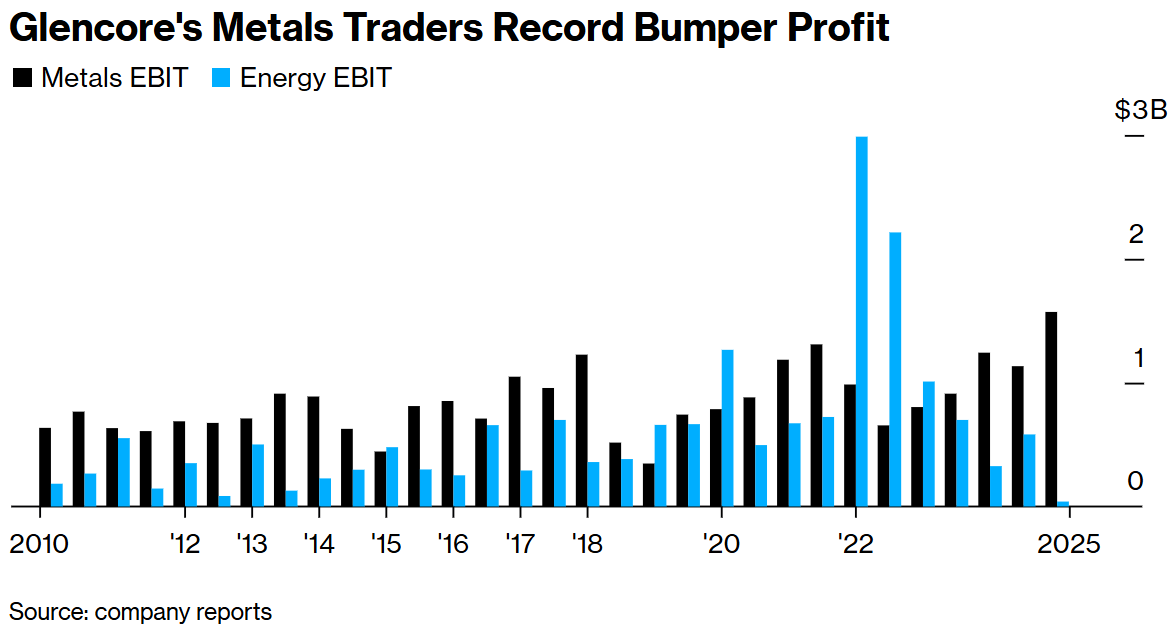
Core Insights - Global metal traders are experiencing a record year of profits due to supply disruptions pushing metal prices near historical highs [1] - Major players like Glencore and Trafigura are expected to achieve their best trading performance, while IXM's CEO indicates the company will set a record for the third consecutive year [1][5] - The industry is witnessing a significant shift as energy traders enter the metal market, betting on increasing government focus on this strategic sector [1] Group 1: Profit Growth Drivers - Profit growth for large traders is primarily driven by a series of supply tightness and disruptions [3] - The exemption of import tariffs on refined copper by the U.S. created substantial arbitrage opportunities, allowing traders to profit from transporting spot metals to the U.S. [3] - Prices for copper, lead, and zinc have surged due to smelting capacity expansion and limited new supply, benefiting traders with long-term contracts [4] Group 2: Market Dynamics - The surge in gold and silver prices has also provided lucrative profit opportunities for traders, leading many firms to establish dedicated precious metals teams [5] - Glencore's metal trading business achieved a record adjusted EBITDA of $1.57 billion in the first half of 2025, with similar growth expected in the second half [5] - The industry boom has triggered a talent war in metal trading, with companies like Mercuria rapidly expanding their teams [8] Group 3: Competitive Landscape - New entrants like Vitol and Gunvor are adopting more cautious expansion strategies, resulting in modest profits from metal trading [2][8] - Gunvor's CEO noted that building a metal trading portfolio from scratch takes time and that the market is highly competitive [8] - Smaller trading firms are receiving acquisition offers, indicating a strong interest in the booming market, although some are not in a hurry to sell [8]