
Goldman Sachs(GS)

Search documents
新兴市场套利狂潮未止!华尔街看好2026年高收益货币前景
智通财经网· 2025-12-14 23:25
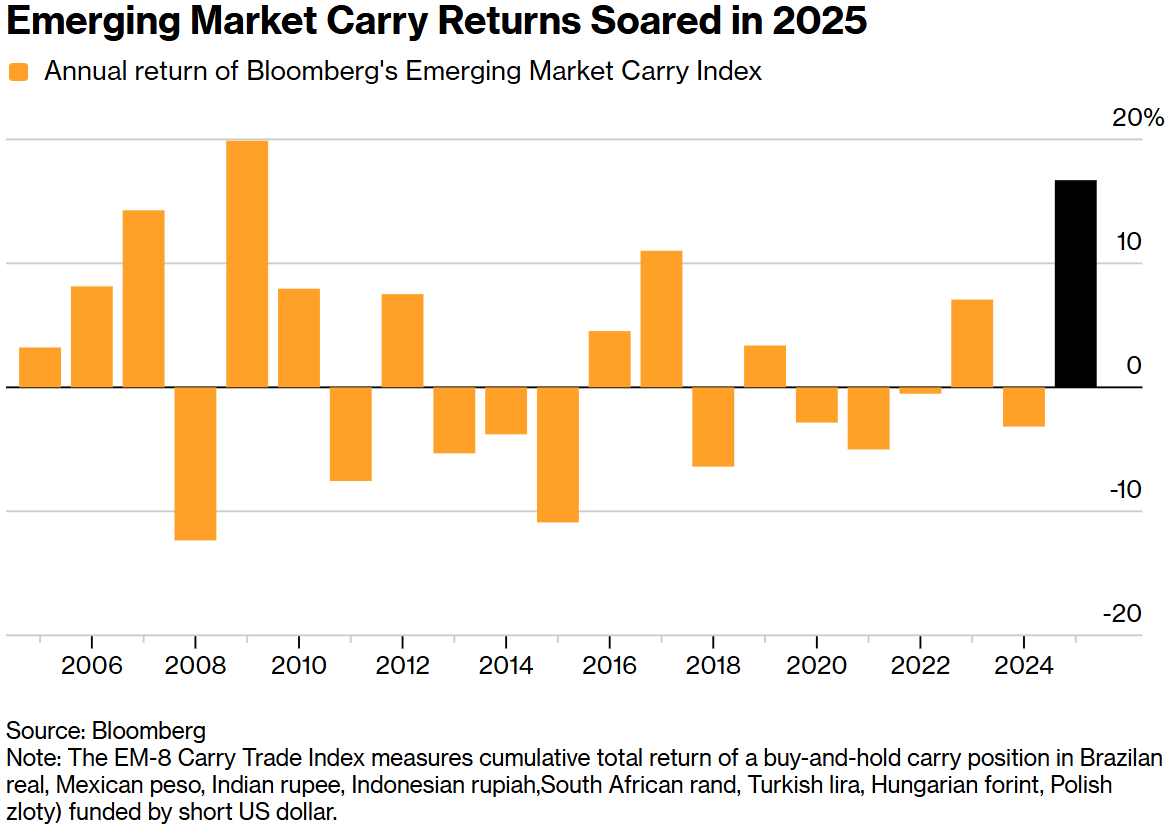
Group 1 - Emerging market carry trades are expected to continue thriving in 2026, supported by reduced forex market volatility and a weak US dollar [1] - A key indicator for this strategy has shown a return of approximately 17% this year, marking the highest increase since 2009 [1] - Major asset management firms and banks anticipate that the interest rate gap between developed and emerging markets will persist, with the Federal Reserve and other wealthy nations' central banks likely to maintain low borrowing costs [1] Group 2 - Emerging market stocks, bonds, and currencies have seen significant increases this year, with countries like Brazil and Colombia experiencing currency appreciation of over 13% against the US dollar [3] - The performance of these markets is closely tied to the US economic outlook, with investors hoping for weak growth to encourage further easing of monetary policy by the Federal Reserve [3] - Goldman Sachs has highlighted the attractiveness of shorting the US dollar against currencies like the Brazilian real and South African rand, with a basket of these trades yielding approximately 20% returns this year [3] Group 3 - Investors are assessing whether forex volatility will remain low, as adverse currency movements can quickly erase months of gains [6] - Current market expectations for volatility are low, with a JPMorgan indicator nearing a five-year low, raising concerns among market participants [6] - Despite potential factors that could increase currency volatility, such as US midterm elections and central bank policy divergences, Vanguard Group expects that market disruptions will remain controlled into 2026 [6]


Banking giant updates S&P 500 target for 2026
Finbold· 2025-12-14 18:50
Core Viewpoint - Goldman Sachs projects that the S&P 500 will surpass 7,600 by 2026, driven by expanding corporate earnings and accelerated AI adoption across the economy [1][3]. Group 1: S&P 500 Projections - Goldman Sachs raised its outlook for U.S. equities, forecasting an 11% growth from the last closing value of 6,827 to approximately 7,600 by 2026 [2]. - Morgan Stanley is even more optimistic, predicting the S&P 500 will reach 7,800 by the end of 2026, attributing recent market corrections to valuation pressures rather than weakening fundamentals [6]. Group 2: Earnings Growth - S&P 500 earnings per share are expected to increase by 12% in 2026 to about $305, with an additional 10% rise anticipated in 2027 [3]. - Productivity gains from AI are projected to contribute significantly to earnings growth, adding an estimated 0.4% in 2026 and 1.5% in 2027 [3]. Group 3: Key Contributors to Growth - Mega-cap technology stocks are expected to be the primary drivers of profit growth, with firms like Nvidia, Apple, Microsoft, Alphabet, Amazon, Broadcom, and Meta projected to account for roughly 46% of total earnings expansion in 2026 [4]. - There is an expectation of improving earnings momentum across the broader index, indicating a gradual expansion beyond just Big Tech [4]. Group 4: Market Sentiment and Risks - Despite a constructive outlook, potential risks include slower-than-expected Federal Reserve easing and pressure on corporate margins [5]. - Other Wall Street strategists generally expect the S&P 500 to trade near or above 7,000 in the medium term, although concerns about stretched valuations in large technology stocks and the risk of an AI-driven bubble remain [7].


华尔街投行:明年更大的风险不是“美国衰退导致市场崩盘”,而是“市场崩盘导致美国衰退”
美股IPO· 2025-12-14 11:57
Core Viewpoint - Wall Street strategists are advising clients to shift investment focus from "Tech Giants" to traditional cyclical sectors such as healthcare, industrials, energy, and finance by 2026, driven by doubts about the sustainability of tech valuations and optimism about the U.S. economic outlook [1][3][4]. Investment Shift - A consensus is forming on Wall Street that the tech giants, which have led the bull market, may step back, with a market rotation becoming the new investment theme for 2026 [3]. - Major firms like Goldman Sachs, Bank of America, and Morgan Stanley are recommending a greater focus on traditional sectors rather than tech stocks like Nvidia and Amazon [3][4]. - Concerns have risen as earnings reports from AI bellwethers like Oracle and Broadcom failed to meet high market expectations, leading to a shift in investor sentiment [3][4]. Market Performance - Since November 20, the Russell 2000 small-cap index has risen by 11%, while the "Tech Giants" index's gains were only half of that [3]. - The S&P 500 equal-weighted index has outperformed its market-cap-weighted counterpart, indicating a broader market rotation [5]. Economic Outlook - Goldman Sachs predicts a 2.5% GDP growth for the U.S. in 2026, higher than the market consensus of 2.0%, suggesting further upside for cyclical sectors [3][7]. - The report emphasizes that the market has not fully priced in the potential economic acceleration expected in 2026 [7][8]. Sector Opportunities - Goldman Sachs highlights non-residential construction stocks as having significant potential, as they have underperformed due to weak earnings but are expected to improve by 2026 [9]. - The earnings growth for the "S&P 493" (excluding the Tech Giants) is projected to accelerate from 7% this year to 9% by 2026, while the Tech Giants' contribution to S&P 500 earnings is expected to decrease from 50% to 46% [9]. Risks - Key risks for cyclical stocks include disappointing economic growth and a potential decline in construction activity for non-residential construction companies [10]. - A sharp rise in interest rates could also pose a threat, as historical data suggests that significant increases in 10-year U.S. Treasury yields can lead to market sell-offs [10].

10月净买入49吨!央行购金依然强劲,高盛:“代币化黄金”目前还非金价主力
美股IPO· 2025-12-14 11:57
Core Viewpoint - Global central banks continue to show strong demand for gold, with net purchases of 49 tons in October, significantly above the pre-2022 monthly average of 17 tons, indicating a long-term strategy to hedge against geopolitical and financial risks [1][3][5] Central Bank Gold Purchases - Goldman Sachs emphasizes that the substantial increase in gold purchases by central banks is a long-term trend, driven by the need for reserve asset diversification to mitigate rising geopolitical and financial risks [5][6] - The report indicates that the average monthly purchase by central banks is expected to remain at 70 tons through 2026, providing solid fundamental support for the gold market [6] Private Investor Impact - Private investors are viewed as a key variable that could amplify gold prices, with a potential significant effect if their interest in gold increases [7] - Goldman Sachs' model suggests that a 1 basis point (0.01%) increase in gold holdings within U.S. private financial portfolios could lead to a price increase of approximately 1.4% [7] - Currently, gold ETFs represent only 0.17% of U.S. investors' portfolios, indicating substantial room for growth in private investment in gold [7][8] Tokenized Gold - The impact of "tokenized gold," such as Tether Gold, on the recent rise in gold prices is considered limited, with its demand significantly smaller compared to traditional channels like gold ETFs and central bank purchases [9] - Tokenized gold is viewed as a potential substitute for gold ETFs rather than a major new source of demand, although it remains a trend worth monitoring [9]

10月净买入49吨!央行购金依然强劲 高盛:“代币化黄金”目前还非金价主力
智通财经网· 2025-12-14 11:07
Core Insights - Despite significant market volatility in October, global central banks continue to show strong demand for gold, providing solid support for gold prices, while emerging "tokenized gold" has not yet become a major market driver [1] Group 1: Central Bank Gold Purchases - Goldman Sachs' latest report indicates that global central banks net bought 49 tons of gold in October, significantly higher than the pre-2022 monthly average of 17 tons, reflecting robust and sustained demand from official sectors [1][2] - Notably, Qatar purchased 20 tons and China bought 15 tons in October, suggesting that central banks' purchasing behavior is driven by long-term strategic considerations to hedge geopolitical and financial risks rather than short-term price sensitivity [1][3] - Goldman Sachs maintains an optimistic forecast for gold prices, projecting they will rise to $4,900 per ounce by the end of 2026, supported by strong official demand and expectations of a shift to looser monetary policy by the Federal Reserve [1][5] Group 2: Private Investor Demand - The report highlights that the behavior of private investors will be a key variable influencing future gold prices, with potential significant "amplifying effects" if their interest in gold increases [4] - Goldman Sachs' model suggests that a 1 basis point (0.01%) increase in the share of gold in U.S. private financial portfolios could lead to a price increase of approximately 1.4%, indicating substantial growth potential as current holdings in gold ETFs are only 0.17% of these portfolios [4][5] Group 3: Tokenized Gold - Regarding the role of "tokenized gold" such as Tether Gold, Goldman Sachs notes that its impact on recent gold price increases appears limited, with a reported increase of about 26 tons in Tether Gold holdings compared to 197 tons in Western gold ETF inflows and 134 tons in central bank purchases during Q3 2025 [6] - The firm views tokenized gold as similar to gold ETFs, both backed by physical gold, but believes it is more likely to serve as a partial substitute for gold ETFs rather than a significant new source of demand, warranting ongoing market monitoring [6]
10月净买入49吨!央行购金依然强劲,高盛:“代币化黄金”目前还非金价主力
Hua Er Jie Jian Wen· 2025-12-14 09:44
Core Insights - Despite significant market volatility in October, global central banks continue to show strong demand for gold, providing solid support for gold prices, while emerging "tokenized gold" has not yet become a major market driver [1][4]. Central Bank Gold Purchases - Goldman Sachs reported that global central banks net purchased 49 tons of gold in October, significantly higher than the pre-2022 monthly average of 17 tons, indicating robust and sustained demand from official sectors [1][4]. - Notably, Qatar purchased 20 tons and China bought 15 tons in October, reflecting a strategic move by central banks to diversify reserve assets and hedge against geopolitical and financial risks [1][4]. Future Gold Price Predictions - Based on strong official demand and expectations of a shift towards looser monetary policy by the Federal Reserve, Goldman Sachs maintains an optimistic forecast for gold prices, predicting they will rise to $4,900 per ounce by the end of 2026 [1][5]. Private Investor Demand - Private investor behavior is seen as a key variable influencing future gold prices. An increase in the allocation of gold in U.S. private financial portfolios could significantly amplify gold prices [1][6]. - Currently, gold ETFs, the most common tool for U.S. investors, represent only 0.17% of their portfolios, indicating substantial room for growth as interest in gold is expected to rebound alongside potential Federal Reserve policy changes [1][6]. Tokenized Gold - Goldman Sachs notes that the impact of "tokenized gold," such as Tether Gold, on recent gold price increases appears limited. In Q3 2025, Tether Gold holdings increased by approximately 26 tons, while Western gold ETFs saw inflows of about 197 tons, and central bank purchases reached around 134 tons [1][7]. - Tokenized gold is fundamentally similar to gold ETFs, both backed by physical gold, but its ownership is recorded on a blockchain. While this may lower entry barriers for some investors, it does not necessarily add significant intrinsic value [1][8].
华尔街的“2026美股主题”是轮动!“老登”胜过Mag 7 高盛高呼“周期股尚未被完全定价”
智通财经网· 2025-12-14 08:40
Core Viewpoint - As 2026 approaches, Wall Street is increasingly consensus that the technology giants leading the bull market may step aside, with market rotation becoming the main investment theme for the new year [1] Group 1: Market Sentiment and Trends - Major Wall Street strategists, including those from Bank of America and Morgan Stanley, are advising clients to focus more on traditional sectors like healthcare, industrials, and energy, rather than the "Tech Seven" giants like Nvidia and Amazon [1] - Recent earnings reports from AI bellwethers such as Oracle and Broadcom have failed to meet high market expectations, heightening investor concerns [1] - Since the market hit a short-term low on November 20, the Russell 2000 small-cap index has risen by 11%, while the "Tech Seven" index's gains have been only half of that [1] Group 2: Economic Outlook and Sector Rotation - Goldman Sachs predicts that the U.S. GDP growth rate will reach 2.5% next year, higher than the 2.0% market consensus, suggesting that cyclical sectors still have room for growth [1][4] - The market has already begun to rotate, with the S&P 500 equal-weight index outperforming its market-cap-weighted counterpart since November 20 [3] - Strategists believe that a "great rotation" towards financials and consumer discretionary sectors will occur in 2026, as large tech stocks may lag behind new leading sectors [3] Group 3: Sector Opportunities - Goldman Sachs highlights non-residential construction stocks as having significant potential, as these stocks have underperformed due to weak earnings over the past two years [5] - The report indicates that the earnings growth for the "S&P 493" (excluding the Tech Seven) is expected to accelerate from 7% this year to 9% by 2026, while the Tech Seven's contribution to S&P 500 earnings will decrease from 50% to 46% [5]
华尔街的“2026美股主题”是轮动!“老登”胜过Mag 7,高盛高呼“周期股尚未被完全定价”
Hua Er Jie Jian Wen· 2025-12-14 08:06
Core Insights - Wall Street is shifting focus from technology giants to traditional sectors like healthcare, industrials, and energy as 2026 approaches, driven by skepticism over tech stock valuations and AI investment returns [1][2] - Recent earnings reports from AI bellwethers like Oracle and Broadcom have heightened investor concerns, leading to a rotation towards lower-valued cyclical stocks and small-cap stocks [1][2] - Goldman Sachs predicts a 2.5% GDP growth for the U.S. in 2024, higher than the market consensus of 2.0%, suggesting further upside for cyclical sectors [1][4] Group 1 - The consensus among major Wall Street strategists is to reduce exposure to the "Tech Seven" and increase investments in traditional sectors [1][2] - The Russell 2000 small-cap index has risen 11% since November 20, while the "Tech Seven" index's gains were only half of that [1] - Piper Sandler's Craig Johnson notes a shift in investor behavior away from tech giants towards broader market opportunities [2] Group 2 - The market is already experiencing a rotation, with the S&P 500 equal-weight index outperforming its market-cap weighted counterpart [3] - Strategas Asset Management anticipates a significant rotation towards financials and consumer discretionary sectors in 2026 [3] - Bank of America highlights a "run-it-hot" strategy, indicating a shift from large-cap stocks to small and micro-cap stocks [3] Group 3 - Goldman Sachs emphasizes that the market has not fully priced in the potential economic acceleration expected in 2026 [4][5] - The report indicates that cyclical assets present opportunities due to the market's conservative pricing of economic growth [5] - Non-residential construction stocks are highlighted as having significant potential for recovery, supported by fiscal incentives and improving forward-looking indicators [6] Group 4 - The earnings growth for the "S&P 493" (excluding the Tech Seven) is projected to accelerate from 7% this year to 9% by 2026, while the Tech Seven's contribution to S&P 500 earnings is expected to decline from 50% to 46% [6] - If employment and inflation data remain stable, the "S&P 493" could see bullish trends next year [6]
机构看好黄金前景,高盛看高金价至4900美元
Huan Qiu Wang· 2025-12-14 02:50
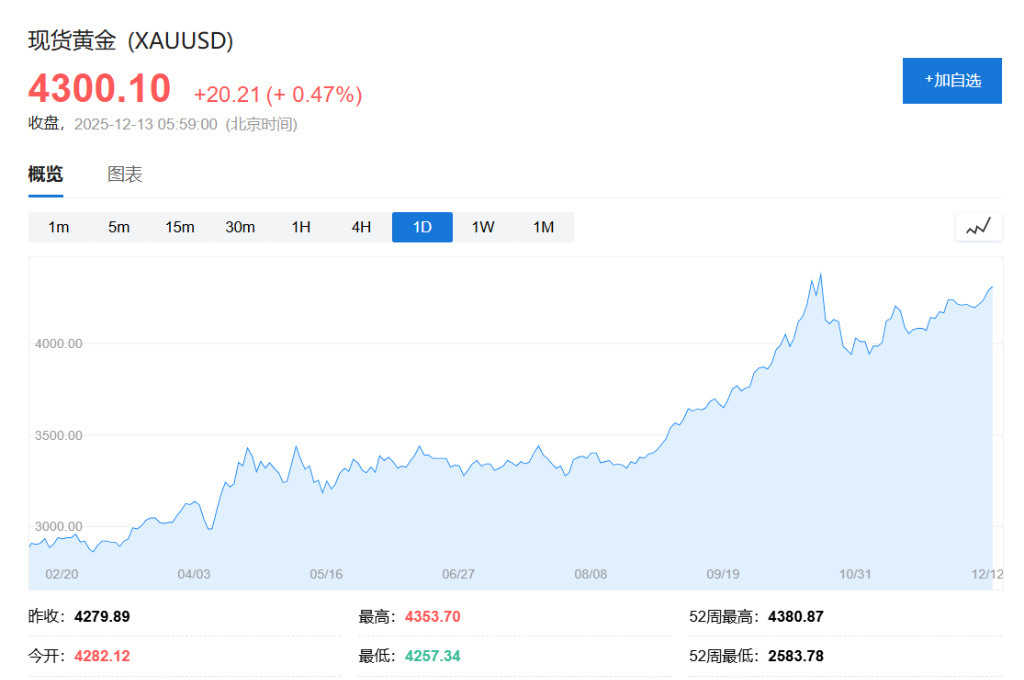
Group 1 - Precious metals, particularly gold and silver, have shown remarkable performance in 2023, with gold up 63.83% and silver up 114.35% as of December 12 [1][3] - Recent price movements indicate a divergence between gold and silver, with gold rising 0.47% to $4299.29 per ounce, while silver fell 2.5% and New York silver futures dropped by 3.88% [1][3] Group 2 - Analysts from Swiss Bank Pictet noted that silver is known for its price volatility, and recent gains were driven by its inclusion in the U.S. critical minerals list and rising expectations for Federal Reserve rate cuts, but the price reaction may have been excessive [3] - The World Gold Council predicts that gold will reach over 50 historical highs by 2025 due to increasing geopolitical and economic uncertainties, a weakening dollar, and sustained buying momentum [3] - Goldman Sachs has set an aggressive target price for gold at $4900 per ounce by the end of 2026, citing potential significant price increases if household or institutional investors continue to increase their gold holdings [3]

David Solomon Praised Trump Accounts – Will Goldman Sachs Billions Follow?
Yahoo Finance· 2025-12-13 16:01
Core Insights - The Trump Account savings accounts represent a federal initiative aimed at building generational wealth through tax-deferred investment vehicles for newborns born between January 1, 2025, and December 31, 2028, with an initial government deposit of $1,000 for each eligible child [1][2] Group 1: Account Structure and Benefits - Modeled after 401(k)s and IRAs, the accounts will track broad stock indexes like the S&P 500, allowing tax-free growth until age 18, when they convert to retirement savings accounts [2] - Families and employers can contribute up to $5,000 annually, promoting early financial literacy and compound returns to help fund education, homes, or startups [2] Group 2: Corporate Involvement - Goldman Sachs CEO David Solomon praised the initiative, emphasizing its potential to connect future generations with the benefits of American companies and markets [3] - Goldman Sachs plans to implement matching programs for employee contributions to Trump Accounts, matching dollar-for-dollar up to $2,500 per year starting in 2026 [6][7] - The investment bank aims to channel approximately $100 million annually based on its global staff of 45,000 and their family sizes [7]