Goldman Sachs(GS)

Search documents
华尔街的“2026美股主题”是轮动!“老登”胜过Mag 7 高盛高呼“周期股尚未被完全定价”
智通财经网· 2025-12-14 08:40
Core Viewpoint - As 2026 approaches, Wall Street is increasingly consensus that the technology giants leading the bull market may step aside, with market rotation becoming the main investment theme for the new year [1] Group 1: Market Sentiment and Trends - Major Wall Street strategists, including those from Bank of America and Morgan Stanley, are advising clients to focus more on traditional sectors like healthcare, industrials, and energy, rather than the "Tech Seven" giants like Nvidia and Amazon [1] - Recent earnings reports from AI bellwethers such as Oracle and Broadcom have failed to meet high market expectations, heightening investor concerns [1] - Since the market hit a short-term low on November 20, the Russell 2000 small-cap index has risen by 11%, while the "Tech Seven" index's gains have been only half of that [1] Group 2: Economic Outlook and Sector Rotation - Goldman Sachs predicts that the U.S. GDP growth rate will reach 2.5% next year, higher than the 2.0% market consensus, suggesting that cyclical sectors still have room for growth [1][4] - The market has already begun to rotate, with the S&P 500 equal-weight index outperforming its market-cap-weighted counterpart since November 20 [3] - Strategists believe that a "great rotation" towards financials and consumer discretionary sectors will occur in 2026, as large tech stocks may lag behind new leading sectors [3] Group 3: Sector Opportunities - Goldman Sachs highlights non-residential construction stocks as having significant potential, as these stocks have underperformed due to weak earnings over the past two years [5] - The report indicates that the earnings growth for the "S&P 493" (excluding the Tech Seven) is expected to accelerate from 7% this year to 9% by 2026, while the Tech Seven's contribution to S&P 500 earnings will decrease from 50% to 46% [5]

华尔街的“2026美股主题”是轮动!“老登”胜过Mag 7,高盛高呼“周期股尚未被完全定价”
Hua Er Jie Jian Wen· 2025-12-14 08:06
Core Insights - Wall Street is shifting focus from technology giants to traditional sectors like healthcare, industrials, and energy as 2026 approaches, driven by skepticism over tech stock valuations and AI investment returns [1][2] - Recent earnings reports from AI bellwethers like Oracle and Broadcom have heightened investor concerns, leading to a rotation towards lower-valued cyclical stocks and small-cap stocks [1][2] - Goldman Sachs predicts a 2.5% GDP growth for the U.S. in 2024, higher than the market consensus of 2.0%, suggesting further upside for cyclical sectors [1][4] Group 1 - The consensus among major Wall Street strategists is to reduce exposure to the "Tech Seven" and increase investments in traditional sectors [1][2] - The Russell 2000 small-cap index has risen 11% since November 20, while the "Tech Seven" index's gains were only half of that [1] - Piper Sandler's Craig Johnson notes a shift in investor behavior away from tech giants towards broader market opportunities [2] Group 2 - The market is already experiencing a rotation, with the S&P 500 equal-weight index outperforming its market-cap weighted counterpart [3] - Strategas Asset Management anticipates a significant rotation towards financials and consumer discretionary sectors in 2026 [3] - Bank of America highlights a "run-it-hot" strategy, indicating a shift from large-cap stocks to small and micro-cap stocks [3] Group 3 - Goldman Sachs emphasizes that the market has not fully priced in the potential economic acceleration expected in 2026 [4][5] - The report indicates that cyclical assets present opportunities due to the market's conservative pricing of economic growth [5] - Non-residential construction stocks are highlighted as having significant potential for recovery, supported by fiscal incentives and improving forward-looking indicators [6] Group 4 - The earnings growth for the "S&P 493" (excluding the Tech Seven) is projected to accelerate from 7% this year to 9% by 2026, while the Tech Seven's contribution to S&P 500 earnings is expected to decline from 50% to 46% [6] - If employment and inflation data remain stable, the "S&P 493" could see bullish trends next year [6]
机构看好黄金前景,高盛看高金价至4900美元
Huan Qiu Wang· 2025-12-14 02:50
Group 1 - Precious metals, particularly gold and silver, have shown remarkable performance in 2023, with gold up 63.83% and silver up 114.35% as of December 12 [1][3] - Recent price movements indicate a divergence between gold and silver, with gold rising 0.47% to $4299.29 per ounce, while silver fell 2.5% and New York silver futures dropped by 3.88% [1][3] Group 2 - Analysts from Swiss Bank Pictet noted that silver is known for its price volatility, and recent gains were driven by its inclusion in the U.S. critical minerals list and rising expectations for Federal Reserve rate cuts, but the price reaction may have been excessive [3] - The World Gold Council predicts that gold will reach over 50 historical highs by 2025 due to increasing geopolitical and economic uncertainties, a weakening dollar, and sustained buying momentum [3] - Goldman Sachs has set an aggressive target price for gold at $4900 per ounce by the end of 2026, citing potential significant price increases if household or institutional investors continue to increase their gold holdings [3]


David Solomon Praised Trump Accounts – Will Goldman Sachs Billions Follow?
Yahoo Finance· 2025-12-13 16:01
Core Insights - The Trump Account savings accounts represent a federal initiative aimed at building generational wealth through tax-deferred investment vehicles for newborns born between January 1, 2025, and December 31, 2028, with an initial government deposit of $1,000 for each eligible child [1][2] Group 1: Account Structure and Benefits - Modeled after 401(k)s and IRAs, the accounts will track broad stock indexes like the S&P 500, allowing tax-free growth until age 18, when they convert to retirement savings accounts [2] - Families and employers can contribute up to $5,000 annually, promoting early financial literacy and compound returns to help fund education, homes, or startups [2] Group 2: Corporate Involvement - Goldman Sachs CEO David Solomon praised the initiative, emphasizing its potential to connect future generations with the benefits of American companies and markets [3] - Goldman Sachs plans to implement matching programs for employee contributions to Trump Accounts, matching dollar-for-dollar up to $2,500 per year starting in 2026 [6][7] - The investment bank aims to channel approximately $100 million annually based on its global staff of 45,000 and their family sizes [7]
Goldman Sachs makes big bet on ETFs specializing in downside protection
CNBC· 2025-12-13 16:00
Group 1: Company Actions - Goldman Sachs Asset Management is acquiring Innovator Capital Management for $2 billion, focusing on defined outcome exchange-traded funds (ETFs) [1] - The acquisition is expected to close in the first half of next year, indicating a strategic move to enhance their product offerings in the ETF market [1] Group 2: Industry Insights - Defined outcome ETFs, also known as buffer ETFs, are gaining traction as they provide downside protection and income for investors, addressing specific market needs [2] - Bryon Lake, co-head of the Third-Party Wealth team at Goldman Sachs, emphasizes the growth potential of defined outcome ETFs, describing them as a fast and attractive space [2] - Kathmere Capital Management, managing $3.4 billion in assets, highlights the role of defined outcome ETFs in client portfolios to reduce downside risk, indicating a growing demand for these products [3] - The appeal of defined outcome ETFs lies in their ability to offer stock market exposure with built-in safety nets, making them suitable for risk-managed equity solutions [4]

从AI交易、美联储新主席到铜,这是高盛列出的“2026年最重要的五大交易主题”
美股IPO· 2025-12-13 11:14
Group 1: Key Investment Themes - Goldman Sachs identifies five key investment themes for 2026, including the transition in the AI investment cycle, the impact of the Federal Reserve leadership change on the dollar, the strategic reassessment of commodities, the necessity of portfolio diversification, and structural changes in the European market [3][4]. Group 2: AI Investment Cycle - The current AI investment cycle is compared to a modern "space race," with significant funding directed towards AI research. However, the era of broad-based AI asset appreciation may be ending, leading to increased differentiation among beneficiaries [6][4]. - Companies providing infrastructure for AI, such as computing hardware and data centers, are expected to remain attractive, while the market will become more discerning in identifying true beneficiaries of AI advancements [6][4]. Group 3: Federal Reserve Leadership Change - The anticipated appointment of Hassett as the next Federal Reserve Chair could mark a turning point, allowing the economy to "run hot" and potentially leading to a sustained weakening of the dollar [7][8]. - Goldman Sachs forecasts a significant depreciation of the dollar by 2026, with the dollar index already showing signs of weakness [8][12]. Group 4: Commodity Investment - In a weakening dollar environment, specific commodity investments, particularly in copper, are becoming increasingly attractive. By 2030, over 60% of copper demand growth is expected to be driven by global power grid and infrastructure needs, equivalent to adding another U.S. demand level [14][15]. - The strategic value of copper is not yet fully recognized by the market, and ongoing mergers and acquisitions may lead to a reassessment of valuations in the near future [15]. Group 5: Portfolio Diversification - Given the high valuation of U.S. equities relative to global markets and the potential for a structurally weaker dollar, diversification is becoming essential for investors to maintain exposure to equities [16][17]. - Strong performance in non-U.S. markets, particularly in the UK and France, suggests that diversification strategies have been validated in 2025 [18][19]. Group 6: European Market Opportunities - The year 2025 is referred to as a "global inflection point," with the U.S. industrial strategy potentially reshaping global asset allocation [20]. - Despite challenges, the European market presents opportunities, as external pressures are driving substantial changes within Europe, making it a focal point for diversified investments [21][24].
突发!美元,利空突袭!
Sou Hu Cai Jing· 2025-12-13 10:25
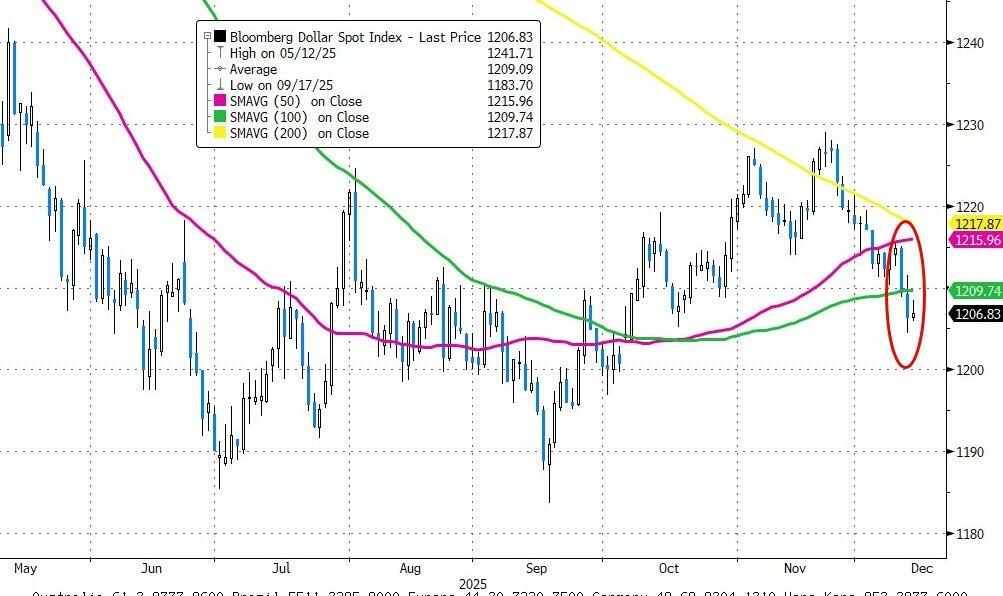
Core Viewpoint - Major Wall Street banks are bearish on the US dollar, predicting a decline as the Federal Reserve continues its easing cycle, with Morgan Stanley forecasting a 5% drop in the first half of next year [1][2]. Group 1: Predictions on Dollar Decline - Deutsche Bank, Morgan Stanley, and Goldman Sachs anticipate that the dollar will weaken again by 2026 due to the Fed's continued easing while other central banks maintain or raise rates [1]. - The Bloomberg dollar index is projected to decline by approximately 3% by the end of 2026 [1]. - The dollar has already experienced a significant drop of nearly 8% this year, marking the largest annual decline since 2017 [2]. Group 2: Economic Implications - A weaker dollar is expected to have a chain reaction on the US economy, increasing import costs, enhancing the value of overseas profits for companies, and potentially boosting exports [3]. - The shift of investor funds to emerging markets for higher yields could extend the rally in these markets, with significant returns recorded in carry trades since 2009 [3]. Group 3: Diverging Opinions - Some analysts, such as those from Citigroup and Standard Chartered, argue that the US economy, driven by AI growth, remains strong and could attract international capital, supporting the dollar [5]. - The Federal Reserve has raised its growth forecast for 2026, indicating potential for stronger-than-expected growth, despite announcing a 25 basis point rate cut [5].


突发!美元,利空突袭!
券商中国· 2025-12-13 10:14
Core Viewpoint - Major Wall Street banks are bearish on the US dollar, predicting a decline as the Federal Reserve continues its easing cycle, with Morgan Stanley forecasting a 5% drop in the first half of next year [1][2]. Group 1: Predictions on the US Dollar - Deutsche Bank, Morgan Stanley, and Goldman Sachs anticipate a weakening of the dollar in 2026 due to the Fed's continued easing while other central banks maintain or raise rates [2]. - The Bloomberg consensus predicts a 3% decline in the dollar index by the end of 2026 [2]. - Morgan Stanley's David Adams states that the dollar has ample room for further depreciation, expecting a 5% drop in the first half of next year [2][3]. Group 2: Economic Implications - A weaker dollar is expected to have a chain reaction on the US economy, increasing import costs, enhancing the value of overseas profits for companies, and boosting exports [4]. - The shift of investor funds to emerging markets for higher yields could extend the rally in these markets, with significant returns recorded in carry trades since 2009 [4]. Group 3: Market Sentiment and Currency Trends - Analysts note that the dollar tends to depreciate when global economic performance is strong, with G10 currencies like the Canadian and Australian dollars benefiting from better-than-expected data [5]. - Some institutions, like Citigroup and Standard Chartered, maintain a bullish outlook on the dollar, citing the strength of the US economy driven by AI and potential international capital inflows [5]. Group 4: Federal Reserve's Stance - The Federal Reserve has raised its growth forecast for 2026 while announcing a 25 basis point rate cut, indicating a cautious approach to future monetary policy [6]. - Market expectations include two more 25 basis point cuts next year, with a focus on the new Fed chair's potential influence on future rate decisions [6].
高盛预测黄金ETF增仓或推动金价达4900美元 多家投行看空美元
Sou Hu Cai Jing· 2025-12-13 06:53
高盛集团在电邮公告中透露,若美国私人投资者将资金投入黄金交易所交易基金(ETF),到 2026 年底金价达到 每盎司4900美元的预期存在很大上调空间。分析师 Lina Thomas 和 Daan Struyven 指出,黄金 ETF 是衡量美国市 场黄金敞口的最通用工具,然而目前其在私人金融投资组合中的占比仅为 0.17%,不仅远低于合理水平,也低于 2012 年的峰值,当前黄金持仓处于低位。 高盛估计,美国金融投资组合中黄金占比每增加一个基点,金价就会基于新增购买的影响上涨1.4%。报告还提 及,长期资本配置者正考虑将黄金作为战略性投资组合多元化工具,增加黄金配置。即便只是从全球债券和股票 投资组合中适度抽离资金重新配置到黄金,鉴于黄金市场规模相对较小,也可能大幅推高其价格。据高盛对13F 文件的分析,美国最大的投资者中持有黄金 ETF 的不到一半,相关风险敞口的配置比例仅为已报告资产的0.1%至 0.5%。这意味着黄金市场存在巨大的资金流入潜力,未来金价有望在资金推动下大幅上扬。 多重因素致美元跌势难改 近日,华尔街两大重要议题引发市场广泛关注。高盛集团就黄金市场走势给出积极预期,同时包括高盛在内的多 ...

从AI交易、美联储新主席到铜,这是高盛列出的“2026年最重要的五大交易主题”
Hua Er Jie Jian Wen· 2025-12-13 03:03
Group 1: Key Investment Themes for 2026 - Goldman Sachs identifies five key investment themes for 2026, including the turning point in the AI investment cycle, the impact of the Federal Reserve leadership change on the dollar, the strategic reassessment of commodities, the necessity of portfolio diversification, and structural changes in the European market [1] Group 2: AI Investment Cycle - Goldman Sachs compares the current AI investment cycle to a modern "space race," suggesting that the era of broad optimism around AI-related assets may be ending [2] - Companies providing infrastructure for AI, such as computing hardware and data centers, are expected to remain attractive investments, while the market will become more discerning in identifying true beneficiaries of AI [2] Group 3: Federal Reserve Leadership and Dollar Weakness - The anticipated appointment of Hassett as the next Federal Reserve Chair could lead to a scenario where the economy is allowed to "run hot," resulting in a weaker dollar [3] - Goldman Sachs' foreign exchange team predicts significant depreciation of the dollar by 2026, with the dollar index already showing signs of weakness [3][7] Group 4: Commodities and Copper - The performance of precious metals underscores the necessity of investing in "hard assets," with copper emerging as a particularly attractive option due to tightening supply and increasing demand [8] - Goldman Sachs forecasts that over 60% of copper demand growth by 2030 will be driven by power grid and infrastructure needs, equating to an additional demand level comparable to that of the United States [8] Group 5: Importance of Diversification - Given the high valuation of the U.S. stock market relative to global markets, diversification is emphasized as essential for investors to maintain exposure to equities [9] - Strong performance in non-U.S. markets has been observed, with European and emerging market assets gaining traction as investors shift away from U.S. equities [9] Group 6: European Market Opportunities - The year 2025 is described as a "global inflection point," with significant changes anticipated in the European market [10] - Despite challenges, Europe is seen as having strong industries and research capabilities, making it an important area for diversified investment [12][13]