Honda Motor(HMC)

Search documents
跨国车企“渡劫”
Xin Jing Bao· 2025-08-15 08:07
Core Viewpoint - Honda's financial performance in the first quarter of FY2026 shows a significant decline in both operating profit and net profit, primarily due to U.S. tariffs on Japanese imports, alongside challenges in the Chinese market and the electric vehicle transition [1][2][5]. Financial Performance - Honda's operating profit fell by 49.6% to 244.17 billion yen, while net profit decreased by 50.2% to 196.67 billion yen in the first quarter [1]. - The company estimates a total loss of 450 billion yen for the fiscal year due to tariffs [1]. Market Challenges - The automotive industry is facing a complex global challenge, including the impact of U.S. tariffs, fluctuating yen exchange rates, and poor performance in the electric vehicle sector [2]. - Honda's sales in China dropped by 14.74% year-on-year in July, with cumulative sales for the first seven months also showing a double-digit decline [3]. Competitor Performance - Other major automakers, including Toyota and Nissan, also reported declines in profits, with Toyota's operating profit down 11% and Nissan experiencing its first quarterly loss in five years [5][6]. - BMW, Mercedes-Benz, and Ford reported significant drops in net profits, with Ford's decline exceeding 80% [6]. Importance of the Chinese Market - The Chinese market is increasingly critical for multinational automakers, with many facing intense competition and declining sales [7]. - Honda and Nissan both saw substantial sales declines in China, with Honda's sales down nearly 40% in the first half of the year [7]. Strategic Adjustments - Honda plans to continue adjusting production capacity in China, although no concrete discussions have taken place yet [2]. - Executives from Honda and other automakers acknowledge the need for significant internal reforms and a shift in strategy to better align with local market demands [4][8].

索尼本田合资Afeela电动车预生产启动,2026年中首发
Cai Jing Wang· 2025-08-15 02:36
Core Viewpoint - Sony and Honda's joint venture brand Afeela has announced the commencement of pre-production for its first electric vehicle, with initial deliveries expected in mid-2026 in Japan and California [1] Company Summary - Afeela is a collaboration between Sony and Honda, focusing on the electric vehicle market [1] - The first electric vehicle from Afeela is set to be produced and delivered in two key markets: Japan and California [1] Industry Summary - The announcement highlights the growing trend of traditional automotive companies partnering with technology firms to innovate in the electric vehicle sector [1] - The timeline for the vehicle's launch indicates a strategic move to enter the competitive electric vehicle market by 2026 [1]

成本冲击 跨国车企遭遇业绩压力
Zhong Guo Zheng Quan Bao· 2025-08-14 20:17
Core Insights - Major international automakers are facing significant profit declines in the first half of 2025, with only Toyota, Volkswagen, and Hyundai expected to exceed $5 billion in net profit [1] - Several automakers, including Stellantis, Nissan, Renault, Ford, and Volvo, reported losses in the second quarter or first half of the year [1] Group 1: Financial Performance - Volkswagen Group's revenue for the first half of 2025 was €158.4 billion, remaining stable year-on-year, but operating profit fell by approximately 33% to €6.7 billion, with net profit down over 38% to €4.477 billion [2] - Mercedes-Benz reported second-quarter revenue of €33.153 billion, a decline of 9.8% from €36.743 billion the previous year, with net profit dropping 68.7% to €0.957 billion [2] - BMW's revenue decreased by 8% to €67.685 billion, with net profit down 29% to €4.015 billion, although the company maintained its full-year financial outlook [3] Group 2: Impact of Tariffs and Costs - The increase in U.S. tariffs on electric vehicles and components has significantly impacted Volkswagen's profits, with an estimated loss of €1.3 billion due to tariff adjustments [2][4] - Ford reported tariff costs of $800 million in the second quarter, while General Motors faced $1.1 billion in tariff expenses [4] - Tesla indicated that tariffs have added $200 million in costs, with high tariffs on raw materials like steel and aluminum further increasing production costs for U.S. automakers [5]


奔驰净利腰斩,多家燃油车企业绩滑铁卢
3 6 Ke· 2025-08-12 10:08
Core Insights - Traditional fuel vehicle manufacturers are facing significant financial challenges, with many reporting declines in revenue and profit due to the costs associated with the transition to electric vehicles [1][2][4][5] - Companies like Audi and BMW are adjusting their strategies, opting for a more flexible approach that allows for the coexistence of fuel and electric vehicles, rather than a strict timeline for phasing out internal combustion engines [9][12] Financial Performance - Major Japanese and German automakers, including Toyota, Honda, Nissan, Volkswagen, and BMW, reported a downturn in their financial results for the first half of the year, attributing this to the costs of electrification [2][3][4] - Toyota's first fiscal quarter saw a 3.5% increase in sales to 12.25 trillion yen, but an 11% drop in operating profit to 1.17 trillion yen, and a 37% decrease in net profit to 841.35 billion yen [2] - Honda's sales revenue decreased by 1.2% to 5.34 trillion yen, with operating profit down 49.6% and net profit down 50.2% [2] - Volkswagen's sales revenue fell by 0.3% to 158.4 billion euros, with operating profit down 32.8% and net profit down 38.3% [3] - Mercedes-Benz reported an 8.6% decline in revenue to 66.377 billion euros and a 55.8% drop in net profit [4] - BMW's sales revenue decreased by 8% to 67.7 billion euros, with net profit down 29% [5] Strategic Adjustments - Honda announced a reduction in its planned investment in electric vehicles from 10 trillion yen to 7 trillion yen and adjusted its sales targets for electric vehicles [6] - Audi has retracted its plan to stop developing internal combustion engine vehicles by 2033, opting for a more flexible strategy [9] - Mercedes-Benz has also adjusted its electric vehicle strategy, allowing for a coexistence of fuel and electric vehicles [9] Market Trends - Despite the challenges, there are signs of recovery in the Chinese market, with several brands reporting increased sales in the first half of the year [10][11] - The introduction of fixed pricing strategies and price reductions for fuel vehicles has contributed to a rebound in sales [12] - Companies are enhancing the intelligence of fuel vehicles through partnerships with technology firms, aiming to close the gap with electric vehicles in terms of smart features [15][16]

本田汽车2026财年首财季净利“腰斩” 为何仍上调全年业绩预期?
Xi Niu Cai Jing· 2025-08-12 07:49
Core Viewpoint - Honda's financial performance for the first quarter of the fiscal year 2026 shows significant declines in revenue and profits, primarily due to high tariffs and currency fluctuations impacting operations in key markets [2][3]. Financial Performance - Honda's sales revenue for Q1 FY2026 was 5.34 trillion yen (approximately 260.05 billion yuan), a year-on-year decrease of 1.2% [2][3]. - Operating profit fell to 244.17 billion yen (approximately 11.89 billion yuan), a substantial decline of 49.6% year-on-year [2][3]. - Net profit dropped to 196.67 billion yen (approximately 9.58 billion yuan), reflecting a year-on-year decrease of 50.2% [2][3]. Market Performance - Global vehicle sales for Honda in the first half of 2025 totaled 1.784 million units, down 5.1% year-on-year [4]. - North America showed a positive trend with sales of 841,000 units, an increase of 7.6% year-on-year, while other regions like Japan, Europe, and China experienced declines [4]. - In Japan, sales were 319,000 units, down 6.5% year-on-year, and in Europe, sales were 45,000 units, down 19.1% year-on-year [4]. - The Chinese market faced the most significant challenges, with sales dropping over 24% to 315,200 units in the first half of 2025, and June sales decreased by 15.2% [4]. Strategic Adjustments - Honda announced the closure of its factories in Guangzhou and Wuhan, reducing annual production capacity for fuel vehicles in China from 1.49 million to 1 million units [4]. - Despite the challenges, Honda raised its full-year operating profit forecast from 500 billion yen to 700 billion yen, although this remains below market expectations of 896.24 billion yen [5]. - The company plans to focus on hybrid products and strengthen its automotive business in North America, India, and Japan, while continuing to adjust capacity and enhance technology in the Chinese market [5].

美国汽车能否如愿大量销入日本
Di Yi Cai Jing· 2025-08-10 11:18
Core Viewpoint - The article discusses the implications of a recent trade agreement between Japan and the United States, particularly focusing on the automotive industry, highlighting the challenges faced by American cars in the Japanese market and the contrasting performance of Japanese cars in the U.S. market [1][2][3]. Group 1: Trade Agreement Details - On July 23, Japan and the U.S. reached a trade agreement that includes a 15% tariff on automobile exports between the two countries [1]. - The agreement is described as a comprehensive package covering economic, trade, and investment aspects, with President Trump labeling it as the largest agreement to date [1]. - Japanese automakers reacted positively to the agreement, with stock prices for companies like Toyota and Honda rising nearly 9% [1]. Group 2: Market Performance - In 2023, American cars accounted for only 4.1% of Japan's imported vehicles, with Jeep being the best performer at 1,000 units sold [3]. - By 2024, the total number of imported vehicles in Japan is expected to rise to 330,000, but Jeep's sales are projected to decline to 9,633 units, placing it 12th among imported vehicles [3]. - In contrast, Japanese car exports to the U.S. are projected to reach nearly 1.37 million units in 2024, constituting over 30% of Japan's total automobile exports [3]. Group 3: American Automakers' Concerns - The American automotive industry expressed concerns that the agreement could create unfair competition, as U.S. automakers rely on parts from Canada and Mexico, which face a 25% tariff [2]. - The United Auto Workers (UAW) criticized the agreement, stating it is detrimental to American workers and the domestic automotive industry [2]. Group 4: Reasons for Poor Performance of American Cars in Japan - Japanese consumers prefer smaller cars due to narrow roads and limited parking, which aligns with the offerings of local manufacturers [5]. - American cars are generally larger and less fuel-efficient, failing to meet the economic and practical preferences of Japanese consumers [5][6]. - The higher price point of American cars, combined with additional taxes and maintenance costs, makes them less appealing to cost-conscious Japanese buyers [6]. - American automakers have a limited presence in Japan, with only 163 sales points, lacking a robust sales and service network [6]. Group 5: Strategies for Improvement - To increase American car imports to Japan, measures such as utilizing Japanese automakers' sales networks for American vehicles have been suggested [8]. - American automakers need to build a consumer-friendly system that aligns with Japanese preferences, enhancing the "presence" of American cars in the Japanese market [8].
本田第一财季净利腰斩
Sou Hu Cai Jing· 2025-08-10 01:26
Group 1 - Honda reported a significant decline in net profit for the first quarter of fiscal year 2026, with a net profit of 196.67 billion yen (approximately 9.578 billion RMB), a year-on-year decrease of 50.2% [1] - The company's operating profit for the same period was 244.17 billion yen (approximately 11.891 billion RMB), down 49.6% year-on-year, while sales revenue decreased by 1.2% to 5.34 trillion yen (approximately 260.053 billion RMB) [1] - Honda revised its full-year operating profit forecast for fiscal year 2026 to 700 billion yen (approximately 34.089 billion RMB), up from a previous estimate of 500 billion yen, but still below market expectations of 896.24 billion yen (approximately 43.648 billion RMB) [2] Group 2 - The company expects full-year sales revenue of 21.1 trillion yen (approximately 1.023 trillion RMB), an increase from the previous estimate of 20.3 trillion yen, but slightly below market expectations of 21.21 trillion yen [2] - Honda's global retail sales volume for fiscal year 2026 is projected to remain at 3.62 million units, unchanged from previous forecasts [2] - The automotive industry is facing challenges due to changing global dynamics, with Honda's performance impacted by tariff effects and currency fluctuations [3] Group 3 - Other Japanese automakers, such as Nissan and Mazda, have also reported disappointing financial results, indicating a broader trend of declining performance in the industry [3] - In the competitive Chinese market, Honda's sales in June were 58,596 units, a year-on-year decline of 15.2%, highlighting the need for the company to accelerate its electric vehicle transition to enhance competitiveness [3]
美股三大指数集体收涨,纳指涨近1%,苹果本周累涨13%
Ge Long Hui A P P· 2025-08-08 22:25
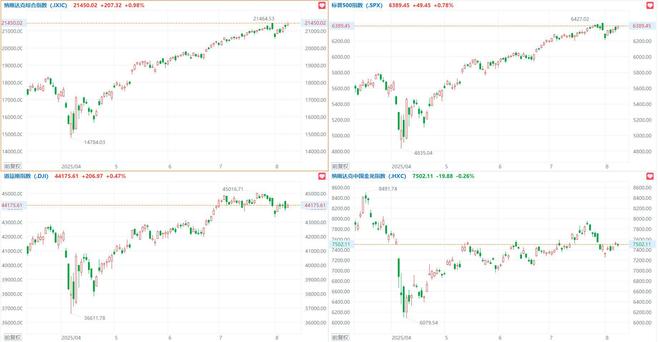
Core Viewpoint - US stock markets experienced collective gains, with the Dow Jones up 0.47%, the Nasdaq up 0.98%, and the S&P 500 up 0.78%, indicating a positive market sentiment for the week [1] Group 1: Market Performance - The Dow Jones increased by 1.35% over the week, while the Nasdaq saw a significant rise of 3.87%, and the S&P 500 rose by 2.43% [1] - Notable tech stocks performed well, with Apple rising over 4% and achieving a weekly gain of 13%, marking its best weekly performance since July 2020 [1] - Other tech stocks like Google and Tesla increased by over 2%, while Nvidia saw a rise of over 1% [1] Group 2: Sector Performance - The automotive and consumer electronics sectors led the gains, with GoPro rising over 7%, Sony up over 4%, and both Toyota and Honda increasing by over 3% [1] - Conversely, the sports betting and cruise sectors faced declines, with Flutter Entertainment dropping over 8%, and Carnival and Royal Caribbean cruise lines falling by over 2% [1] Group 3: Chinese Stocks - The Nasdaq Golden Dragon China Index fell by 0.26% but still recorded a weekly gain of 2.39% [1] - Among popular Chinese stocks, NIO rose over 3% and XPeng Motors nearly 3%, while Bilibili, iQIYI, and Miniso saw declines of over 1% [1]


美国开征“黄金税”了丨今日财讯
Sou Hu Cai Jing· 2025-08-08 16:08
Group 1 - The Supreme People's Court of China issued guidelines to implement the Private Economy Promotion Law, aiming to refine adjudication rules and improve work mechanisms to address practical issues [2][7] - China Mobile reported a net profit of 84.2 billion yuan for the first half of 2025, with total revenue of 543.8 billion yuan, a 0.7% year-on-year increase, and a digital transformation revenue of 156.9 billion yuan, up 6.6% year-on-year [9][7] - A new company, Xinjiang Railway Co., Ltd., was established with a registered capital of 95 billion yuan, focusing on various services including construction, railway transportation, and real estate [9][7] Group 2 - The 2025 World Robot Conference opened in Beijing, featuring over 1,500 exhibits from more than 200 companies, including over 100 new products and 50 humanoid robot manufacturers, marking a record for similar events [6][7] - The Chinese shipbuilding industry set a new record with the delivery of the 9,000-car capacity automobile carrier "GRANDE TIANJIN," built in just 179 days [5][7] - OpenAI launched GPT-5, a new AI model that significantly outperforms previous versions in various fields including coding, mathematics, writing, health, and visual perception [10][7] Group 3 - International gold prices reached a new intraday high of $3,534.1 per ounce, with the U.S. imposing tariffs on gold imports, affecting major products like 1-kilogram and 100-ounce gold bars [11][7] - Toyota Motor Corporation projected a significant drop in net profit to 2.66 trillion yen for the 2025 fiscal year, a decrease of approximately 44% due to U.S. tariff policies and yen appreciation [13][7]


Honda: Eyes On Results Miss And Re-Rating Potential
Seeking Alpha· 2025-08-08 15:51
Group 1 - The article focuses on the Asia Value & Moat Stocks research service, which targets value investors looking for Asia-listed stocks with significant discrepancies between price and intrinsic value [1] - The service emphasizes deep value balance sheet bargains, such as net cash stocks and low price-to-book (P/B) stocks, as well as wide moat stocks that represent high-quality businesses [1] - The author provides a range of watch lists with monthly updates, particularly concentrating on investment opportunities in the Hong Kong market [1]