
Intel(INTC)

Search documents
英特尔中国区董事长王稚聪:若中国客户有‘点菜式’的需求,我们也可以生产定制芯片
Sou Hu Cai Jing· 2025-11-20 05:00
Core Insights - Intel is shifting from designing large, complex single chips to a modular approach using chiplets, allowing for more flexible and customizable chip designs to meet specific customer needs [1] - The company plans to offer both standard "package" products and customizable "a la carte" options for Chinese customers, indicating a more open and adaptable business model [1] - Intel's future strategy will focus on integrating smaller functional units within a single package, enhancing flexibility and responsiveness to market demands [1] Group 1 - Intel's China Chairman, Wang Zhichong, emphasized the company's commitment to creating chips that can be tailored to specific customer requirements, likening the process to a hot pot where customers can choose their preferred ingredients [1] - The transition to chiplet-based designs is exemplified by upcoming products like Meteor Lake, Panther Lake, and Clearwater Forest, which will utilize smaller functional units for integration [1] - The company aims to maintain its competitive edge by adapting to uncertainties and challenges in the market while continuing to innovate [1]


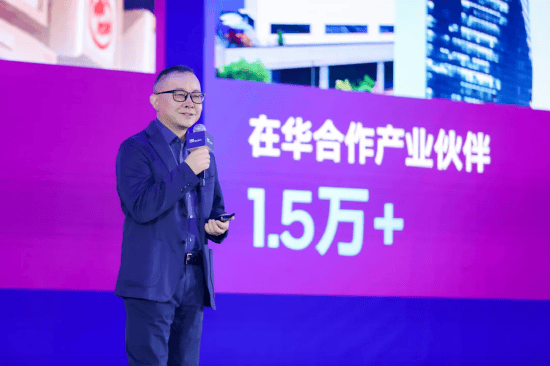
芯片就像重庆,英特尔说的
量子位· 2025-11-20 04:09
Core Insights - The article discusses Intel's innovative approaches and technological advancements in the semiconductor industry, particularly in relation to AI and PC platforms, as highlighted during the recent technology innovation conference in Chongqing [6][10][12]. Group 1: Intel's Technological Innovations - Intel's next-generation AI PC platform, Panther Lake, has entered mass production, marking the company's entry into the "Aemi era" (1 Aemi = 0.1 nm) [9]. - The Intel 18A process technology enables over 15% performance improvement at the same power consumption, or a 25% reduction in power consumption at the same performance level, with a 30% increase in transistor density [10]. - Panther Lake is expected to deliver a 50% increase in multi-core and graphics performance, alongside a 40% reduction in power consumption, with an overall AI computing power of 180 TOPS [14][15]. Group 2: AI and Edge Computing - The article emphasizes the transformation of AI PCs from mere tools to partners, with future AI-native PCs expected to possess five core capabilities: perception, cognition, execution, memory, and learning [17][18]. - Intel is addressing the growing demand for edge computing by integrating SoC solutions to assist partners like CVTE in transitioning from traditional operations to comprehensive AI solutions [25]. - The emergence of generative AI and the integration of AI with control systems are identified as key trends in edge computing [24]. Group 3: Collaboration and Ecosystem Development - Intel is focusing on building a robust local ecosystem in China, collaborating with various partners to enhance the capabilities of domestic AI models through instruction set optimization and quantization techniques [27]. - A notable example includes a specialized re-ranking model that improved accuracy from 85% to 96% after fine-tuning, surpassing some larger general models [28]. - The strategy of leveraging "small models with significant impact" is seen as crucial for the widespread adoption of AI PCs [29]. Group 4: Data Center and Power Consumption - The article highlights the exponential growth of data, with predictions indicating a 3.5-fold increase in global power consumption to support AI over the next five years, alongside an estimated $7 trillion investment in data centers [34]. - Intel's Xeon 6 processors are designed to complement GPUs in AI model training, featuring enhanced data transfer capabilities and dedicated AI acceleration [38]. - The focus on reliability aims for a 99.999% uptime in data centers, ensuring continuous operation and security [39].

英特尔中国区董事长王稚聪:若中国客户想“点菜”,我们也可以定制芯片
Xin Lang Ke Ji· 2025-11-20 04:07
Core Insights - Intel is shifting from designing large, complex single chips to a modular approach using chiplets, allowing for customized chip production based on specific customer needs [1] - The company aims to provide both standard "package" products and customizable "a la carte" options for Chinese customers, indicating a more flexible and open business model [1] - Intel's future strategy includes adapting to uncertainties and challenges while continuing to innovate and grow [1] Summary by Categories Business Model Evolution - Intel is transitioning to a chiplet-based design starting with Meteor Lake, and upcoming products like Panther Lake and Clearwater Forest will follow this modular approach [1] - The company will offer both general-purpose "package" products and customizable designs tailored to the specific demands of Chinese clients [1] Product Strategy - Each functional IP, such as CPU, GPU, NPU, or I/O, is compared to a dish in a hot pot, emphasizing the flexibility in product offerings [1] - The focus on customization reflects Intel's commitment to meeting diverse customer requirements in the evolving tech landscape [1] Future Outlook - Intel's leadership emphasizes the importance of adaptability in the face of future uncertainties and challenges [1] - The dual approach of providing standard and customized solutions is seen as a key direction for Intel's technological and business evolution [1]
传台积电75岁退休老将携2nm机密回到“老东家”英特尔担任研发副总裁,带走了“20多箱”涉及台积电先进工艺技术的机密资料
Ge Long Hui· 2025-11-20 02:46
Core Insights - Recent rumors suggest that TSMC's former Senior Vice President of Technology Development and Corporate Strategy, Luo Wei-ren, has returned to Intel as Vice President of R&D after retiring in October [1] - There are allegations that Luo took "more than 20 boxes" of confidential materials related to TSMC's advanced process technologies before his retirement, raising significant concerns [1] Company Insights - TSMC is facing potential intellectual property risks due to the alleged transfer of sensitive technology information to a competitor [1] - Intel may benefit from Luo's expertise and insights into TSMC's advanced technologies, potentially enhancing its competitive position in the semiconductor industry [1]


英特尔入华40周年 看好中国市场长期机遇
Zhong Guo Xin Wen Wang· 2025-11-20 02:43
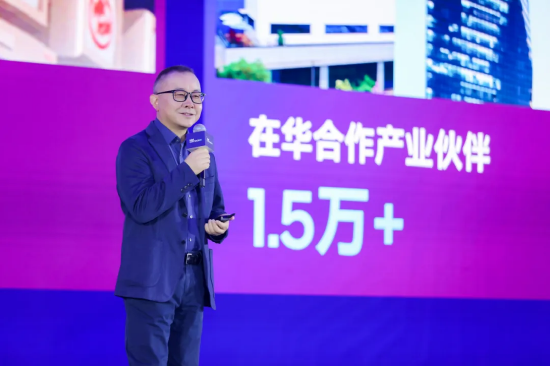
Core Insights - Intel celebrates its 40th anniversary in the Chinese market, highlighting long-term opportunities for growth and collaboration in the region [2][3] Group 1: Market Presence and Growth - Intel has established a vast business network in China, with over 15,000 long-term partners [2] - The Chinese PC and cloud computing markets are approaching a scale of one trillion yuan, while the Internet of Things (IoT) and smart manufacturing are also identified as trillion-yuan markets [2] Group 2: Strategic Directions - Intel's CEO emphasizes the importance of collaboration with partners across various sectors, including client devices, data centers, and edge computing, to seize new opportunities in the AI wave [2] - The company plans to focus on four development directions in the Chinese market: digitalization, intelligence, integration, and globalization, while also exploring new markets such as robotics and consumer applications [3]
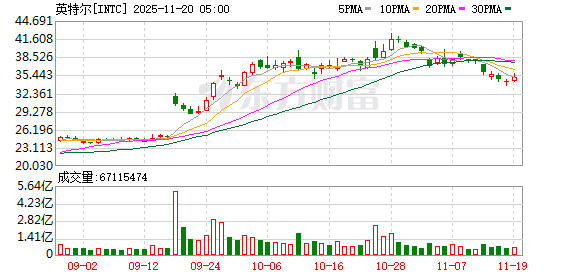
英特尔披露:18A 制程 “Panther Lake” 处理器月良率提升 7% 量产进程加速
Huan Qiu Wang· 2025-11-20 02:35
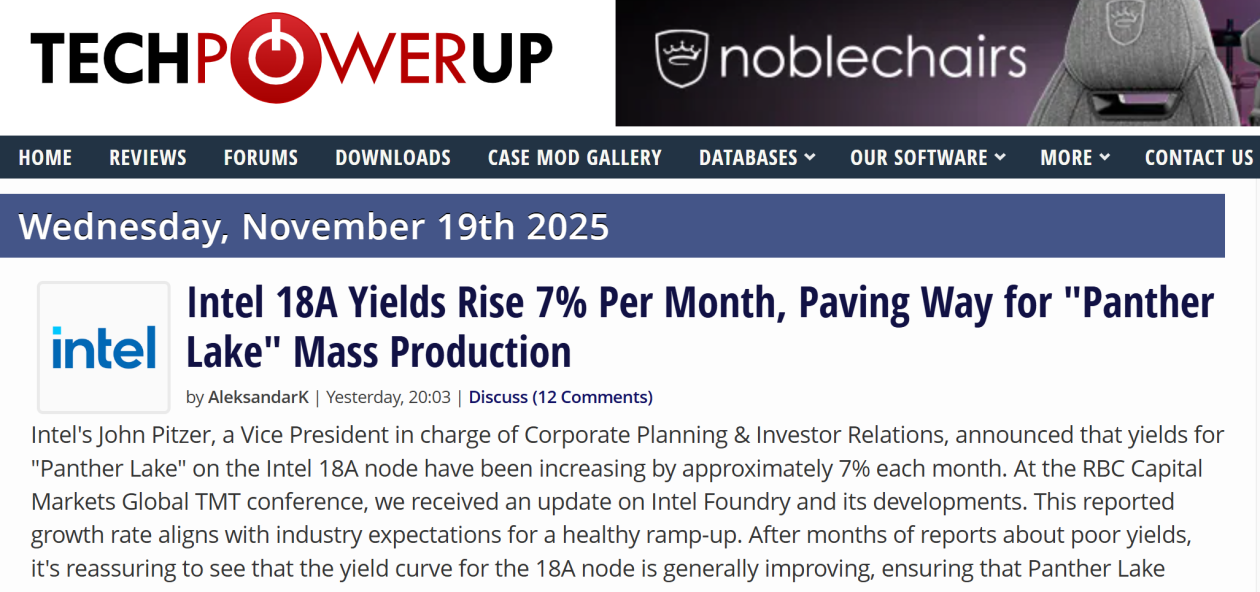
Core Insights - Intel's Vice President John Pitzer disclosed that the yield rate of the "Panther Lake" processor, based on the 18A process technology, is improving at a rate of 7% per month, aligning with industry expectations for healthy growth [1][3] Group 1 - The yield improvement trend over the past 7 to 8 months suggests that Intel can gradually scale up the production capacity of the "Panther Lake" processors without increasing the cost per chip, laying the groundwork for future mass production [3] - John Pitzer expressed confidence in the upcoming product launches this quarter, indicating that Intel has identified a predictable path for yield improvement [3] - Intel plans to reveal more technology and product details at the CES event in January 2026 [3] Group 2 - Pitzer also mentioned progress in the development of the 14A process technology, which is advancing faster than the 18A process at the same development stage [3] - The 14A process will utilize second-generation GAAFET technology and incorporate a backside power delivery scheme, enhancing chip performance and energy efficiency [3]
美国科技行业 - 2025 年第三季度大盘股机构持仓:英伟达仍是机构持仓比例最低的大型科技股-US Technology-Large-Cap Institutional Ownership 3Q25 NVDA Remains The Most Under-Owned Mega-Cap Tech Stock
2025-11-20 02:17
Summary of Key Points from the Conference Call Industry Overview - **Industry**: US Technology, specifically focusing on large-cap tech stocks - **Key Findings**: Mega-cap tech stocks are currently the most under-owned in over 16 years, with a widening gap compared to the S&P 500 Core Insights - **Under-Ownership of Mega-Cap Tech Stocks**: - The gap in institutional ownership for mega-cap tech stocks compared to the S&P 500 increased to -148 basis points (bps) at the end of Q3 2025, up from -140 bps at the end of Q2 2025 [2][12] - Nvidia (NVDA) is identified as the most under-owned large-cap tech stock, followed by Apple (AAPL), Microsoft (MSFT), Amazon (AMZN), and Broadcom (AVGO) [1][2] - **Specific Stock Analysis**: - **Nvidia (NVDA)**: - Institutional ownership decreased by 20 bps quarter-over-quarter (QoQ), ending at -2.61% [9] - **Apple (AAPL)**: - Institutional ownership increased by 36 bps QoQ to 4.45%, while S&P 500 weighting rose by 90 bps, resulting in a widening gap of 53 bps to -2.19% [15] - The iPhone 17 cycle is expected to benefit from a longer replacement cycle and upgrades, with a price target of $305 [15] - **Microsoft (MSFT)**: - Institutional ownership increased by ~40 bps QoQ to 5.1%, but remains ~200 bps below its S&P 500 weighting of 7.1% [16] - The company is positioned well for growth beyond GenAI, with a focus on accelerating revenue growth and margin expansion [16] - **Amazon (AMZN)**: - Remains under-owned with a weighting approximately 144 bps below the S&P 500 [17] - AWS revenue growth is expected to accelerate, with a price target of $315 [17] - **Meta (META)**: - Under-owned with a weighting about 40 bps below the S&P 500, with a price target of $820 [19] - **Alphabet (GOOGL)**: - Under-owned with a price target of $330, driven by GenAI innovation and cloud business growth [17][19] Additional Insights - **Institutional Ownership Trends**: - The average active ownership for large-cap tech stocks is significantly lower than their S&P 500 weightings, indicating potential for future stock performance improvements [12] - The analysis suggests a statistically significant relationship between low active ownership and future stock performance, indicating potential upward price movement for under-owned stocks [12] - **Market Dynamics**: - The report highlights the importance of understanding the dynamics of institutional ownership as it relates to stock performance, particularly in the context of mega-cap tech stocks [12] - **Risks and Considerations**: - Rising commodity input costs may pressure margins for companies like Apple, but manageable due to better supply chain leverage [15] - Concerns regarding the broader return on investment for Nvidia's AI spending, despite strong demand indicators [25] Conclusion - The current landscape for mega-cap tech stocks presents a unique investment opportunity due to their under-ownership status, particularly for stocks like Nvidia, Apple, and Microsoft. The analysis indicates potential for upward price movement as institutional ownership adjusts to reflect their market performance.


大芯片封装,三分天下
3 6 Ke· 2025-11-20 01:42
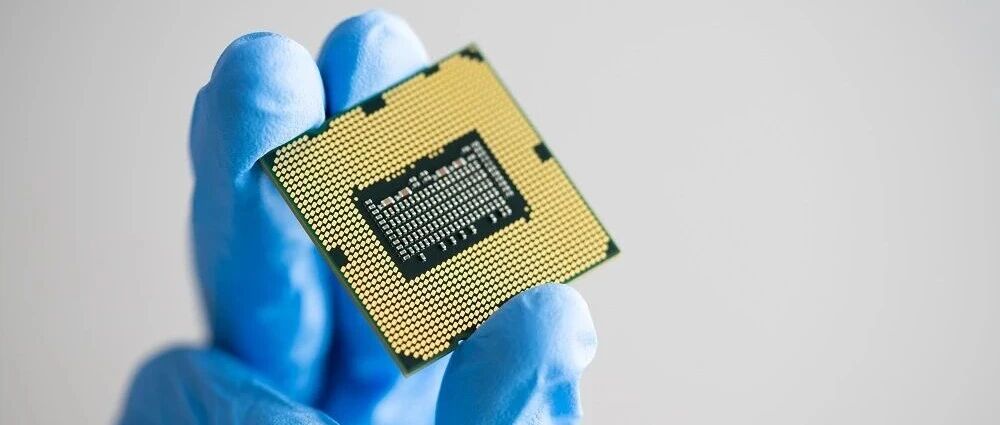
Core Insights - The rapid development of AI chips is driving the demand for high-performance computing (HPC) components such as GPUs, AI ASICs, and HBM, with advanced packaging technologies like 2.5D/3D becoming crucial in the semiconductor industry [1][3] - Intel's advanced packaging technology EMIB is being evaluated by major tech companies like Apple and Qualcomm, indicating a potential shift in the competitive landscape as these companies consider alternatives to TSMC [1][11] - The advanced packaging market is projected to grow significantly, with revenues expected to exceed $12 billion by Q2 2025 and reach approximately $45 billion by 2024, growing at a compound annual growth rate (CAGR) of 9.4% to around $80 billion by 2030 [3] Advanced Packaging Landscape - TSMC, Intel, and Samsung have established a competitive "three-horse race" in the advanced packaging sector, each playing different roles in the supply chain [3][20] - TSMC's CoWoS technology has become the de facto standard for high-bandwidth packaging, but it faces capacity constraints primarily due to Nvidia's significant demand [7][8] - Intel's EMIB technology offers flexibility and cost advantages, making it suitable for custom ASICs and AI inference chips, positioning it as a viable alternative to TSMC's offerings [11][15] Market Dynamics - The demand for advanced packaging is driven by the strong growth in AI and HPC sectors, with TSMC planning to expand its CoWoS capacity by over 20% by the end of 2026 [8][24] - Samsung's advanced packaging technologies, I-Cube and X-Cube, are designed to leverage its HBM supply chain, aiming to enhance its influence in the AI chip market [20][23] - The competition in AI chip manufacturing is no longer limited to packaging technologies but encompasses computational architecture, supply chain security, capital expenditure, and ecosystem integration [24]


大芯片封装,三分天下
半导体行业观察· 2025-11-20 01:28
Core Insights - The article discusses the rapid development of AI chips, highlighting the importance of advanced packaging technologies like 2.5D/3D packaging, particularly focusing on GPU, AI ASIC, and HBM as key components in high-performance computing [2][4]. Group 1: Advanced Packaging Technologies - Advanced packaging platforms are crucial for enhancing device performance and bandwidth, becoming a hot topic in the semiconductor industry, even surpassing traditional cutting-edge process nodes [2]. - TSMC, Intel, and Samsung have established a "triple dominance" in the advanced packaging field, each playing different roles in the supply chain [4]. - TSMC's CoWoS technology has become the de facto standard for high-bandwidth packaging, with significant adoption by major companies like NVIDIA and AMD [6]. Group 2: Market Projections - The advanced packaging market is projected to exceed $12 billion by Q2 2025, driven by strong demand in AI and high-performance computing [4]. - By 2024, the advanced packaging market size is expected to reach approximately $45 billion, with a robust compound annual growth rate of 9.4%, potentially reaching around $80 billion by 2030 [4]. Group 3: Capacity and Cost Challenges - CoWoS capacity is severely constrained, primarily due to NVIDIA's long-term commitments, which occupy over half of the available capacity [7]. - TSMC plans to expand its CoWoS capacity by over 20% by the end of 2026, aiming for a capacity of at least 120-130 thousand wafers per month [7]. - The high cost of the intermediate layer in CoWoS packaging can account for 50%-70% of the total packaging cost, leading to situations where packaging costs exceed the chip costs [8]. Group 4: Intel's EMIB Technology - Intel's EMIB technology is gaining attention as a flexible alternative to TSMC's CoWoS, with major companies like Apple and Qualcomm evaluating it for their next-generation chips [11]. - EMIB allows for cost-effective heterogeneous integration and supports large-scale system expansion, making it suitable for custom ASICs and AI inference chips [18]. - The combination of EMIB with Foveros technology creates a hybrid architecture that balances packaging size, performance, and cost efficiency [21]. Group 5: Samsung's Position - Samsung's advanced packaging strategy is driven by its HBM supply chain, leveraging its position to influence packaging and system architecture decisions [23]. - Samsung's I-Cube technology offers a different approach to advanced packaging, focusing on high-density interconnects and cost-effective solutions [24][28]. - The X-Cube technology represents a significant advancement in 3D packaging, enhancing chip density and performance through innovative bonding techniques [28]. Group 6: Competitive Landscape - The competition in the AI chip foundry sector is no longer just about packaging processes but involves a comprehensive strategy encompassing computational architecture, supply chain security, capital expenditure, and ecosystem integration [30]. - For downstream chip design companies, navigating between different packaging camps will be crucial for determining the performance limits and delivery certainty of future AI products [30].
影响市场重大事件:闪存全面大幅涨价,最高涨幅达38.46%;华为完成IMT-2020(5G)推进组5G-A蜂窝无源物联技术测试,业界首次
Mei Ri Jing Ji Xin Wen· 2025-11-19 23:47
Group 1: Flash Memory Price Increase - Flash memory prices have significantly increased, with the highest rise reaching 38.46% [1] - Specific price changes include: 1Tb QLC up 25.00% to $12.50, 1Tb TLC up 23.81% to $13.00, 512Gb TLC up 38.46% to $9.00, and 256Gb TLC up 14.58% to $5.50 [1] Group 2: Huawei's 5G-A Technology Testing - Huawei has completed all use case tests for 5G-A cellular passive IoT technology, marking an industry first [2] - The tests were conducted under the IMT-2020 (5G) promotion group using a 3GPP standard-based separated base station architecture [2] Group 3: AI Toy Market Growth - The AI toy market in China is projected to grow to 29 billion yuan by 2025, up from approximately 24.6 billion yuan in 2024 [3] - The application of AI and large models has significantly enhanced the interactive experience of toys, making them popular among young consumers [3] Group 4: Intel's Next-Generation AI PC Platform - Intel is developing a next-generation AI PC platform, named Panther Lake, which is based on the latest Intel 18A process technology [4] - The platform is expected to be a cornerstone for future PC and data center products, with a formal announcement scheduled for CES in January [4] Group 5: Neutrino Experiment Achievements - The Jiangmen neutrino experiment has achieved a measurement precision improvement of 1.5 to 1.8 times compared to previous experiments [5] - This experiment aims to detect neutrinos, known as "ghost particles," and officially began data collection on August 26, 2025 [5] Group 6: Electric Vehicle Charging Infrastructure - As of October 2025, China has a total of 18.645 million electric vehicle charging facilities, marking a 54.0% year-on-year increase [6] - Public charging facilities account for 4.533 million units, with a 39.5% increase, while private charging facilities reached 14.112 million, up 59.4% [6] Group 7: China-Europe Railway Express Cargo Structure - The China-Europe Railway Express has seen a continuous optimization in cargo structure, with high-value-added goods accounting for over 60% of exports [7][8] - By the end of 2024, the cumulative transport value of the railway express is expected to reach $426.4 billion [8] Group 8: Chemical Industry Trends - The chemical sector is focusing on three main trading lines: energy storage demand boosting upstream material market, ongoing "anti-involution" efforts leading to price recovery, and high growth potential in core chemical businesses [9] Group 9: New Company Formation by China Electric Power Construction - China Electric Power Construction has established a new company focusing on AI, smart unmanned aerial vehicle manufacturing, and general aviation services [10] Group 10: Growth of Collectible Toys Market - The collectible toy market, represented by blind boxes and figurines, is experiencing rapid growth, with retail sales expected to reach 55.83 billion yuan in 2024 [11] - Innovative domestic companies are enhancing China's toy industry's international influence through original IP development and brand management [11]