LI AUTO(LI)

Search documents
9月车市的权力转移:从“比亚迪一家独大”到“群雄并起”
Jing Ji Guan Cha Wang· 2025-10-02 04:00
Core Insights - The Chinese automotive market in September continues to be dominated by new energy vehicles (NEVs), but there is a noticeable internal structural differentiation [2][3] - The market has shifted from a "universal growth phase" to a "structural competition phase," with BYD's decline serving as a significant uncertainty signal [3][7] Market Performance - BYD's NEV sales in September reached 396,000 units, a year-on-year decrease of 5.5%, marking a rare pullback in its years of rapid growth [3] - Changan and Geely showed robust performance, with Changan's sales at 266,000 units (up 25% year-on-year) and Geely's at 273,000 units (up 35% year-on-year) [3][4] - Great Wall Motors sold 134,000 units, a year-on-year increase of 23.3%, with NEV sales of 46,000 units [4] New Entrants and Technology Brands - New entrants and tech brands showed significant growth, with Leap Motor delivering 66,700 units (up nearly 100% year-on-year) and Xiaopeng delivering 41,600 units (up 95%) [5] - NIO delivered 34,700 units (up 64%), while Xiaomi's automotive deliveries exceeded 40,000 units, maintaining momentum since its launch [5] Joint Ventures and Traditional Brands - Joint ventures remain conservative, but some brands are finding support; FAW-Volkswagen sold 146,000 units, with Audi leading the luxury fuel vehicle market [6] - GAC Aion delivered 29,100 units, a year-on-year decline of 18.6%, but showed a 7.6% increase compared to the previous month [6] Export and Internationalization - Exports and internationalization are becoming new growth pillars for Chinese automakers, with Changan's overseas sales exceeding 60,000 units (up 23% year-on-year) [6][7] - Great Wall's overseas sales reached 50,000 units, and SAIC-GM-Wuling's cumulative sales for the first three quarters were 1.175 million units, with significant contributions from NEV exports [6][7] Competitive Landscape - The market is now characterized by a "multi-polar" competitive landscape, with BYD's decline being a key variable for industry observation [7] - The next steps for the Chinese automotive market will depend not only on the speed of NEV adoption but also on advancements in intelligence and globalization [7]



新能源汽车,最新“成绩单”来了
Shang Hai Zheng Quan Bao· 2025-10-02 03:51
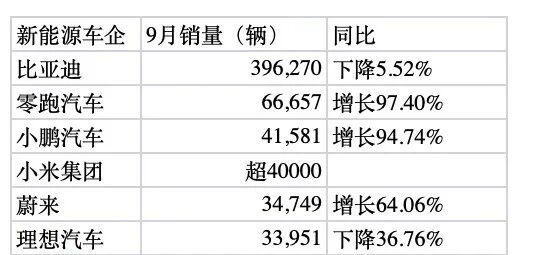
Core Insights - In September 2025, major Chinese electric vehicle manufacturers reported varying sales figures, with NIO, Xpeng, and Li Auto showing month-on-month growth, while BYD experienced a decline in sales compared to the previous year [1][2][5]. Sales Performance - BYD's total sales for September reached 396,270 units, a decrease of 5.52% year-on-year, with cumulative sales for the year surpassing 3.26 million units, reflecting an 18.64% increase [2][5]. - Leap Motor achieved sales of 66,657 units in September, marking a significant year-on-year growth of 97.4% [2][5]. - Xpeng delivered 41,581 vehicles in September, representing a 95% year-on-year increase and a 10% month-on-month growth, setting a new monthly record [3][5]. - NIO's September deliveries totaled 34,749 units, a 64.06% increase year-on-year, with the introduction of new models contributing to this growth [2][3]. - Li Auto reported 33,951 units delivered in September, showing a year-on-year decline of 36.76% but a month-on-month increase of 19.01% [3][4]. Market Trends - The demand for electric vehicles in China is expected to grow significantly, driven by shorter vehicle ownership cycles due to the electrification of automobiles [1][7]. - The Ministry of Industry and Information Technology indicated plans to optimize tax incentives for electric vehicle purchases, which could further stimulate market demand [1][7]. - The China Automotive Industry Association forecasts that the total sales of electric vehicles in 2025 will reach 16 million units, representing a 20% year-on-year growth and accounting for over 50% of total new car sales [7]. Company Developments - NIO's new model, the L90, has been pivotal in boosting sales, achieving 20,000 deliveries within two months of its launch [2][3]. - Xpeng plans to launch a flying car by 2026, which could revolutionize urban transportation [3]. - Xiaomi's automotive division reported over 40,000 deliveries in September and plans to expand its retail presence with new stores [6].
9月新势力销量:零跑6万,“鹏界米”4万
Xin Lang Cai Jing· 2025-10-02 02:21
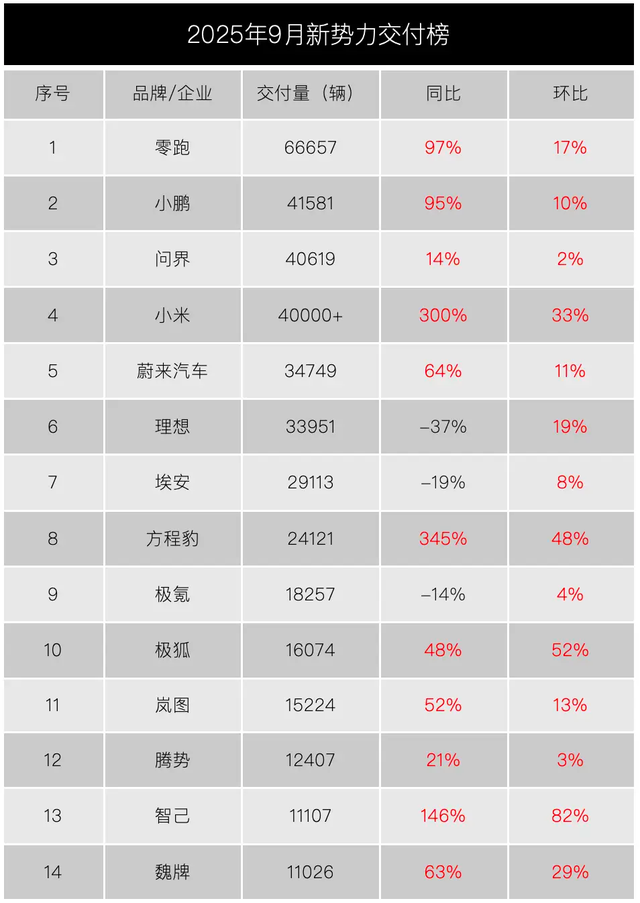
Core Viewpoint - The new energy vehicle market is experiencing significant changes, with new players like Leap Motor and Xiaomi making substantial gains in delivery volumes, while traditional brands face challenges in maintaining their positions [1][20]. Group 1: Delivery Rankings and Performance - Leap Motor leads the delivery rankings with 66,657 units, showing a 97% year-on-year increase and a 17% month-on-month increase [2][3]. - Xiaomi enters the top four for the first time with over 40,000 deliveries, marking a 300% year-on-year increase and a 33% month-on-month increase [2][4]. - NIO ranks fifth with 34,749 units delivered, reflecting a 64% year-on-year growth, indicating the effectiveness of its multi-brand strategy [5][14]. - Li Auto's performance is mixed, with 33,951 units delivered, a 19% month-on-month increase but a 37% year-on-year decline [6][18]. Group 2: Market Dynamics and Strategies - The market is seeing a shift where traditional automakers' new energy brands are growing but struggle to pose a significant threat to the top six new energy players [7]. - Leap Motor's strategy focuses on offering high-value features in mainstream models, appealing to cost-conscious consumers [8][9]. - Xiaomi's growth is attributed to improved production capacity, although it faces challenges with long wait times for customers [12][13]. Group 3: Competitive Landscape - The competitive landscape is evolving, with brands like Aion experiencing a nearly 20% year-on-year decline, while BYD's Equation Leopard sees a 345% increase [7][14]. - The delivery threshold for the top tier has risen to 40,000 units per month, creating a gap for brands unable to meet this benchmark [7][20]. - The introduction of new models, such as Li Auto's i6, is seen as a potential solution to declining sales, but internal competition may pose challenges [18][19]. Group 4: Future Trends - The market is expected to further differentiate, with technological advancements becoming crucial for maintaining competitiveness [21][22]. - Traditional luxury brands are beginning to take the electric vehicle market seriously, as seen with the local production of Mercedes-Benz's electric CLA [21]. - The overall conclusion points to a future where the winners will be those who can balance cost control through scale while offering differentiated experiences through technology and multi-brand strategies [23].
理想汽车9月交付3.4万辆,Q3合计达9.32万辆
Ju Chao Zi Xun· 2025-10-02 02:06
Core Insights - Li Auto reported a total delivery of 33,951 vehicles in September 2025, with a cumulative delivery of 93,211 vehicles in Q3 2025, and a historical total of 1,431,021 vehicles as of September 30, 2025 [2] - The company continues to lead the market for SUVs priced above 200,000 yuan, surpassing Tesla in cumulative sales [2] - The newly launched Li MEGA achieved the highest sales in both the pure electric and MPV categories for vehicles priced above 500,000 yuan in Q3 [2] - The production of the six-seat pure electric SUV, Li i8, is ramping up, aiming to create a popular model in its segment [2] - The five-seat SUV, Li i6, was officially launched on September 26, 2025, featuring advanced technology such as the VLA driver model and self-developed components [2] - Li Auto has signed Yi Yangqianxi as its first brand ambassador in ten years, reflecting a new phase in the brand's development [2] - The company aims to enhance the concept of "home" for users, focusing on creating a unique space experience and continuous innovation in technology and products [2] - As of September 30, 2025, Li Auto operates 542 retail centers across 157 cities and has established 546 after-sales service and authorized repair centers in 225 cities [2] - The company has deployed 3,420 supercharging stations and has a total of 18,897 charging piles nationwide [2]
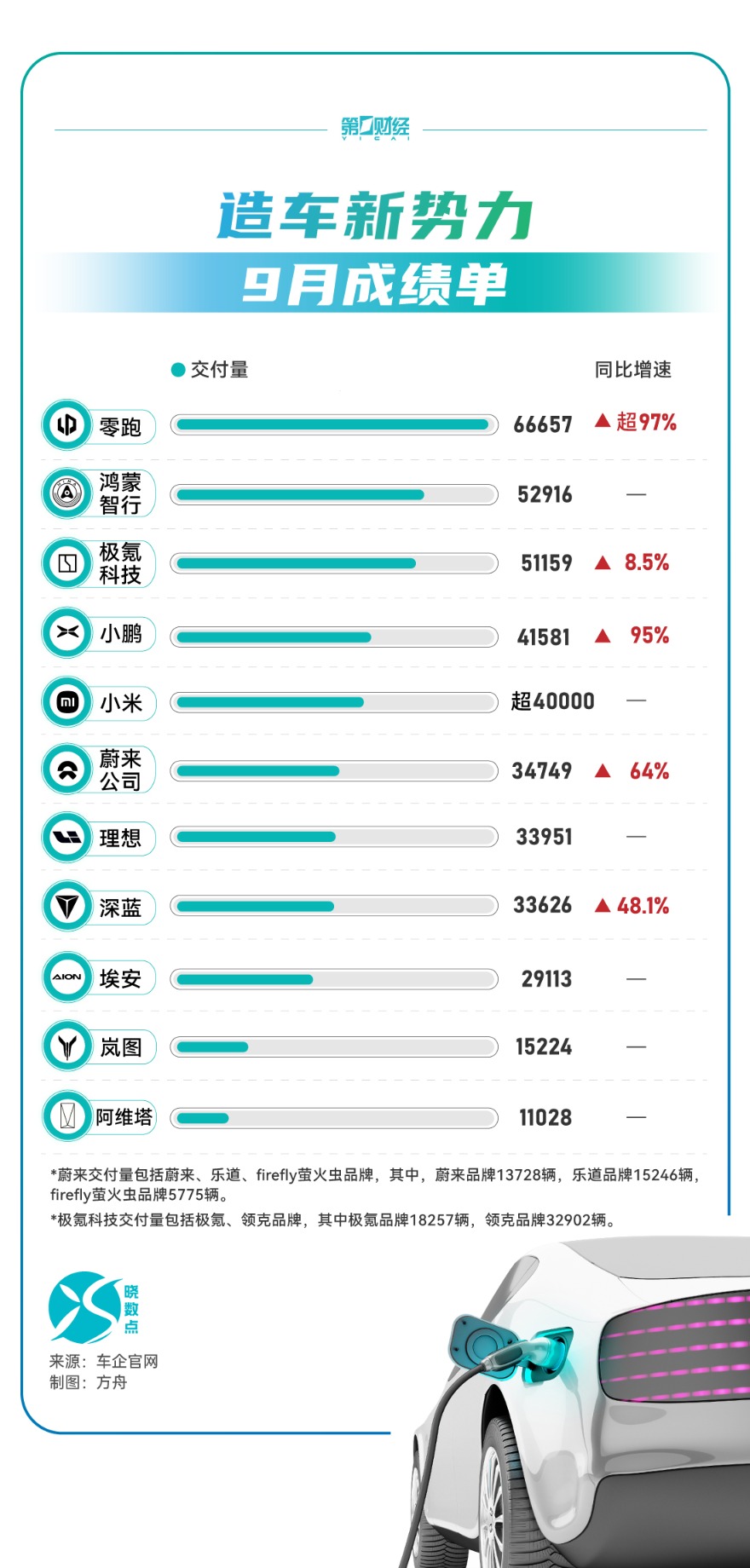
造车新势力9月成绩单:零跑汽车首破六万大关
Di Yi Cai Jing· 2025-10-02 01:45
(文章来源:第一财经) 第7财经 造车新势力 9月成绩单 同比增速 ● 交付量 ▲ 超97% D 66657 U 零跑 n 10 k 52916 极镜 ▲ 8.5% 51159 小鹏 95% 41581 ▲ 超40000 小米 E 尉米 34749 ▲ 64% 33951 理想 33626 ▲ 48.1% 深蓝 29113 埃安 15224 岚图 ...

西贝大降价,部分菜品降幅超20%;马斯克成全球首位身家突破5000亿美元富豪;王腾小红书账号注销丨邦早报
Sou Hu Cai Jing· 2025-10-02 01:31
Group 1: Price Adjustments at Xibei - Xibei has announced significant price reductions on its menu items, with some dishes seeing price cuts exceeding 20% [1] - The price changes were implemented on October 1, with staff updating old menus with new price tags due to the sudden notice [1] - Examples of price changes include: - Scallion Grilled Fish reduced from 89 yuan to 79 yuan (11% decrease) - Sesame Oil Cucumber reduced from 23 yuan to 19 yuan (17% decrease) - Five Tomato Sour Soup Fish reduced from 29 yuan to 23 yuan (20% decrease) [1] Group 2: Tesla's Market Performance - Elon Musk has become the world's first billionaire to surpass $500 billion in net worth, largely due to Tesla's stock performance [2] - Tesla's stock rose by 2.6% to $456.29, reaching a year-high and bringing its market capitalization back to $1.5 trillion [2] - The increase in Tesla's sales in Europe, particularly in France and Denmark, is attributed to strong demand for the Model Y [2] Group 3: New Energy Vehicle Deliveries - In September, seven car manufacturers delivered over 30,000 new energy vehicles, with five companies reporting year-on-year growth exceeding 50% [3] - BYD delivered 396,000 units, a year-on-year decrease of 5.52%, but a month-on-month increase of 6.06% [3] - Leap Motor and Xiaopeng reported significant growth, with deliveries increasing by 97.4% and 94.74% respectively [3] Group 4: Investment Activities - Mixue Group plans to invest 285.6 million yuan to acquire a 51% stake in Fulu Family (Zhengzhou) Enterprise Management [2] - After the investment, Mixue will hold a total of 53% of Fulu Family, making it a non-wholly owned subsidiary [2] Group 5: Apple and AI Developments - Apple has denied any wrongdoing in its collaboration with OpenAI, stating that it plans to work with various AI companies, including xAI [3] - The company is facing a lawsuit from Musk's xAI, which claims that Apple's partnership with OpenAI stifles innovation [3] Group 6: Microsoft and AI Integration - Microsoft is integrating AI services into its Office software, launching a higher-priced version of Microsoft 365 at $19.99 per month [5] - This move aims to enhance competition with OpenAI's ChatGPT [5] Group 7: Automotive Industry Developments - Toyota Kirloskar Motor is reportedly considering an IPO in India, aiming to raise approximately $700-800 million [6] - The formal IPO process has not yet begun, and the company has denied any such plans [6] Group 8: Financial Performance of Nike - Nike reported Q1 revenue of $11.72 billion, a year-on-year increase of 1.1%, surpassing expectations [6] - The company's gross margin was 42.2%, down from 45.4% in the previous year [6] Group 9: ExxonMobil's Workforce Reduction - ExxonMobil announced a global workforce reduction of approximately 2,000 positions, representing about 3-4% of its total workforce [6] - This move is part of a long-term restructuring plan to consolidate smaller offices into regional centers [6]






西贝大降价,部分菜品降幅超20%;马斯克成全球首位身家突破5000亿美元富豪;王腾小红书账号注销丨邦早报
创业邦· 2025-10-02 01:09
Group 1: Price Adjustments at Xibei - Xibei has implemented significant price reductions across its menu, with some dishes seeing price drops exceeding 20% [1] - Specific examples of price changes include: - Grassland Tender Grilled Lamb Chops reduced from 119 RMB to 109 RMB - Scallion Grilled Fish reduced from 89 RMB to 79 RMB - Yellow Rice Cake (6 pieces) reduced from 29 RMB to 26 RMB [1][2] Group 2: Tesla's Market Performance - Elon Musk has become the world's first billionaire to surpass 500 billion USD in net worth, largely due to Tesla's stock performance [2] - Tesla's stock rose by 2.6% to 456.29 USD, reaching a year-to-date high and a market capitalization of 1.5 trillion USD, driven by strong demand for the Model Y in Europe [2] Group 3: New Energy Vehicle Deliveries - In September, seven companies delivered over 30,000 new energy vehicles, with five companies reporting year-on-year growth exceeding 50% [3][4] - BYD delivered 396,000 vehicles, a year-on-year decrease of 5.52%, but a month-on-month increase of 6.06% [3] - Other notable deliveries include: - Leap Motor: 67,000 vehicles, up 97.4% year-on-year - Xiaopeng: 42,000 vehicles, up 94.74% year-on-year - NIO: 35,000 vehicles, up 64.06% year-on-year [4] Group 4: M&A Activity in the Food and Beverage Sector - Mixue Group plans to invest 285.6 million RMB to acquire a 51% stake in Fulu Family (Zhengzhou) Enterprise Management [4] - This acquisition will make Fulu Family a non-wholly owned subsidiary of Mixue Group [4] Group 5: Technology and AI Developments - Apple has denied any wrongdoing in its collaboration with OpenAI, stating that it plans to work with various AI chatbots in the future [8] - Microsoft is integrating AI services into its Office suite to compete with ChatGPT, launching a higher-priced version of Microsoft 365 [11] - Apple is shifting focus from upgrading its Vision Pro headset to developing smart glasses to compete with Meta's products [11] Group 6: Financial Performance of Nike - Nike reported Q1 revenue of 11.72 billion USD, a year-on-year increase of 1.1%, surpassing estimates [11] - The gross margin for the quarter was 42.2%, down from 45.4% year-on-year but above the expected 41.7% [11] Group 7: Employment Changes in Major Corporations - ExxonMobil announced a global workforce reduction of approximately 2,000 positions, representing about 3% to 4% of its total workforce [12] - The layoffs are part of a long-term restructuring plan focused on core growth projects [12]

理想汽车失速,持续下滑
Shen Zhen Shang Bao· 2025-10-02 00:45
Core Insights - Li Auto reported a total delivery of 33,951 vehicles in September, with a year-on-year decline of 36.8% compared to 53,709 vehicles delivered in September 2024, marking a decrease of nearly 20,000 units [1] - The third quarter saw Li Auto deliver 93,211 vehicles, continuing a downward trend for the fourth consecutive month since June, although September's deliveries showed a 19% month-on-month increase from August's 28,529 vehicles due to the delivery of two new electric models, the i8 and i6 [1] - In contrast, Leap Motor led the market with a record delivery of 66,657 vehicles in September, achieving over 97% year-on-year growth, and a total of 395,516 vehicles delivered from January to September, reflecting a 128.8% increase [1] - Xpeng Motors delivered 41,581 vehicles in September, marking a year-on-year increase of approximately 95% and a month-on-month growth of 10%, with total deliveries reaching 313,196 vehicles for the year, up about 218% [1] - NIO reported 34,749 vehicle deliveries in September, a year-on-year increase of 64% and a month-on-month increase of 11%, setting a new historical high [1] - Xiaomi Auto also surpassed 40,000 vehicle deliveries in September, marking its first month of exceeding this threshold, following a previous milestone of over 30,000 deliveries in August [2] Company Performance - Li Auto's September deliveries: 33,951 vehicles, down 36.8% year-on-year [1] - Leap Motor's September deliveries: 66,657 vehicles, up over 97% year-on-year [1] - Xpeng Motors' September deliveries: 41,581 vehicles, up approximately 95% year-on-year [1] - NIO's September deliveries: 34,749 vehicles, up 64% year-on-year [1] - Xiaomi Auto's September deliveries: over 40,000 vehicles, first month exceeding this figure [2] Market Trends - Li Auto's deliveries show a recovery trend with a 19% month-on-month increase in September [1] - Leap Motor and Xpeng Motors demonstrate significant growth rates, indicating a competitive market landscape [1] - The overall performance of the electric vehicle sector remains strong, with multiple companies achieving record deliveries [1][2]
9月电车成绩单:零跑交付首破6万,小鹏与小米双双突破4万
Hua Er Jie Jian Wen· 2025-10-01 23:23
Core Insights - The Chinese new energy vehicle (NEV) industry has shown remarkable growth in September, with multiple companies achieving record delivery numbers, indicating a strong performance during the peak sales season [1] Group 1: Company Deliveries - Leap Motor achieved a delivery volume of 66,657 units in September, marking a year-on-year increase of over 97% [26] - Xiaopeng Motors and Xiaomi both surpassed 40,000 units in September, with Xiaopeng delivering 41,581 units, a 95% year-on-year increase [2][4] - Li Auto delivered 33,951 units in September, with a total of 93,211 units delivered in Q3, maintaining a leading position in the SUV market above 200,000 yuan [8][9] - NIO delivered 34,749 units in September, a 64% year-on-year increase, contributing to a cumulative total of 872,785 units [12][14] - Zeekr achieved a delivery of 51,159 units in September, with a year-on-year growth of 8.5% [31][32] - Lantu Motors delivered 15,224 units in September, a 52% year-on-year increase, with a cumulative total of 96,992 units for the year [41] Group 2: Market Trends - The NEV industry in China is experiencing a significant surge, with companies like BYD reporting a total NEV sales of 396,270 units in September, showing an 18.64% year-on-year growth [23][25] - The overall market is characterized by a strong performance in the "golden September" sales season, with various brands achieving historical highs in delivery numbers [1][26] - The competitive landscape is intensifying as companies like Xiaopeng and Xiaomi emerge as significant players in the market, reflecting a shift towards more established competition in the NEV sector [4][2] Group 3: Future Outlook - Leap Motor plans to showcase its flagship technology platform and the first flagship model D19 in October, aiming to set a new standard in the luxury segment [27] - Lantu Motors is expanding its product matrix with new models and has seen significant interest, with over 10,000 orders for the 2026 model within 18 hours of its launch [53] - The global expansion of Chinese automakers is accelerating, with companies like Zeekr and Xiaopeng entering multiple international markets, indicating a strategic focus on global growth [56]
媒体跑断腿,明星被哄抢,9月车市卖疯了
汽车商业评论· 2025-10-01 23:07
Core Viewpoint - The automotive market in China experienced a significant surge in September 2025, with over 70 new car models launched and numerous promotional events, driven by the "Golden September and Silver October" sales peak and the impending changes in tax policies for electric vehicles [4][6][10]. Group 1: New Energy Vehicle Sales - New energy vehicle sales saw remarkable growth, with companies like Leap Motor delivering a record 66,657 units in September, marking a significant milestone [12]. - Xiaopeng Motors reported a delivery of 41,581 units in September, a 95% year-on-year increase, with a total of 313,196 units delivered from January to September, reflecting a 218% growth [12][15]. - Li Auto delivered 33,951 units in September, while NIO delivered 34,749 units, achieving a year-on-year growth of 64% [15][17]. Group 2: Marketing and Sales Strategies - Car manufacturers are increasingly investing in marketing, utilizing celebrity endorsements and extended sales hours to boost sales, with some dealerships offering test drives until midnight [8][10]. - The trend of late-night car shopping has emerged, with customers actively engaging in purchasing vehicles during unconventional hours [10][12]. Group 3: Traditional Automakers' Performance - Major traditional automakers also reported strong sales, with Changan Automobile selling 266,000 units in September, a 25% increase, and Great Wall Motors achieving a record 133,639 units sold [30][32]. - Geely's sales exceeded 270,000 units, with a 35% year-on-year increase, and BYD sold 396,270 vehicles, highlighting the competitive landscape among traditional manufacturers [32][40]. Group 4: Market Dynamics and Competition - The automotive industry is witnessing a shift as new energy vehicle manufacturers gain market share, while traditional automakers are working to enhance their technological capabilities and product offerings [41][47]. - The competition is intensifying, with both new and established players striving to meet consumer demands for smarter and more efficient vehicles [41][48].