
LI AUTO(LI)

Search documents
全球关注,美国重要数据今晚公布;美股三大期指齐跌;甲骨文近3个月暴跌46%;国际油价大跌,布油跌破60美元/桶【美股盘前】
Mei Ri Jing Ji Xin Wen· 2025-12-16 12:35
Market Overview - Major U.S. stock index futures are experiencing declines, with Dow futures down 0.18%, S&P 500 futures down 0.36%, and Nasdaq futures down 0.54% [1] Company News - Oracle's stock continues to decline, down 1.3% to $182.5 per share, marking a 46% drop from its historical high of $345 per share reached in September [1] - Ford has announced the cessation of production for its all-electric F150 Lightning truck, shifting focus to hybrid vehicles and smaller, more affordable electric cars. This decision is expected to result in a $19.5 billion reduction in revenue, with most losses accounted for in the current quarter [2] - PayPal has submitted an application to become a bank in the U.S., named "PayPal Bank," aiming to expand its financial services [1] Industry Developments - Nasdaq has filed a proposal with the SEC to extend trading hours to 23 hours on weekdays, which would significantly increase trading time for stocks and exchange-traded products [2] - Tesla's market capitalization is projected to potentially reach $3 trillion by the end of 2026, driven by advancements in artificial intelligence and the commercialization of autonomous driving and robotics. Currently, Tesla's stock is down 1.13% [2] Energy Sector - Brent crude oil futures have fallen below $60 per barrel for the first time since May, currently trading at $59.42 per barrel, reflecting a 1.43% decline [3] Economic Indicators - The U.S. is set to release a combined non-farm payroll report for October and November, with economists predicting an addition of 50,000 jobs in November and an unemployment rate of 4.5%. This data suggests a weak labor market without rapid deterioration, which could influence the stock market positively by increasing the likelihood of further interest rate cuts by the Federal Reserve [3]




多家企业押注VLA背后:智驾路线要趋于融合?
Mei Ri Jing Ji Xin Wen· 2025-12-16 12:21
Core Insights - Xiaopeng Motors is set to release its VLA 2.0 (Vision Language Action) model in the next quarter, with significant pressure on the team as it is the first version [1] - A bet was placed between Xiaopeng's chairman and the autonomous driving team, aiming to match Tesla's FSD V14.2 performance by August 30, 2026, or face a challenge [1] - The autonomous driving sector is experiencing a paradigm shift, moving from traditional sensor-based systems to AI-driven models [1][2] Group 1: VLA Model Overview - The VLA model is seen as an "intelligent enhanced version" of end-to-end solutions, integrating visual perception, action execution, and language modeling [3] - It aims to overcome the black-box issue of traditional models by incorporating a reasoning chain through language models, enhancing interpretability and adaptability to complex environments [3][4] - The model's architecture allows for better integration of vast knowledge bases, improving its generalization capabilities [3] Group 2: Industry Perspectives - There is a divergence in the industry regarding the VLA and world model approaches, with companies like Li Auto and Xiaopeng favoring the VLA model [2] - Critics, such as Wang Xingxing, express skepticism about the VLA model's effectiveness in real-world interactions due to data quality concerns [4] - Li Auto emphasizes the importance of real data in developing effective autonomous driving systems, arguing that the VLA model's success relies on a robust data loop [4] Group 3: Technological Integration - The world model approach focuses on creating an internal simulation of the physical world, enabling better prediction and decision-making capabilities [5] - Companies like NIO and SenseTime are also exploring the world model technology, indicating a broader industry trend [5] - Despite differing opinions, there is a trend towards integrating VLA and world model technologies, with both approaches potentially complementing each other [6] Group 4: Future Directions - Xiaopeng is moving towards a hybrid approach, aiming to combine VLA and world model technologies, as indicated by the recent updates to their VLA model [7] - The second generation of the VLA model aims to reduce information loss by streamlining the process from visual input to action execution [7] - The industry is witnessing a shift where companies are choosing different paths based on their specific goals, whether it be selling vehicles or developing autonomous taxi services [7]

AI眼镜大决战已到?对话9位操盘手和专家真相:蛋糕分得心慌慌
3 6 Ke· 2025-12-16 12:21
Core Viewpoint - The entry of major companies into the AI glasses market is seen as a double-edged sword, potentially benefiting both startups and established players by expanding the market rather than creating direct competition [1][4][15]. Group 1: Market Dynamics - Major companies like Xiaomi, Baidu, and Alibaba have entered the AI glasses market, with significant sales reported, indicating a growing interest and demand [3][11]. - The sales of lightweight, screenless AI glasses in China surged by 463% in the first half of 2025, marking a historical high [11][14]. - The overall market for AI glasses is expected to grow rapidly, with projections indicating that China's market could exceed 1 billion yuan within three years [14][15]. Group 2: Competitive Landscape - The competition is characterized by both major companies and startups coexisting, with startups like Rokid and Thunderbird also achieving significant sales milestones [3][8]. - Analysts suggest that the entry of large firms will accelerate market growth and user education, benefiting startups in the long run [15][18]. - The market is still in its early stages, and there is a consensus that it is not yet time for intense competition, as the focus remains on expanding the market [15][19]. Group 3: Financial Viability - Despite the surge in sales, many companies, including major players, are struggling to achieve profitability due to high R&D costs and competitive pricing strategies [19][20]. - Companies like Xiaomi and Alibaba have indicated that they do not rely on selling glasses for profit, highlighting the industry's current financial challenges [19][20]. Group 4: Supply Chain and Innovation - The supply chain is a critical factor, with major companies leveraging their negotiating power to drive down costs and improve product offerings [22][36]. - Startups are focusing on technological innovation and differentiation to carve out their niche in the market, often achieving breakthroughs that larger companies have not [29][33]. Group 5: Future Outlook - The AI glasses market is anticipated to reach a tipping point similar to the "iPhone moment" by 2025, with significant advancements expected in technology and user adoption [4][51]. - The industry is currently focused on enhancing user experience and integrating AI glasses into daily life, which is seen as essential for widespread acceptance [54][55].




复盘2025AI眼镜:百款产品的聚焦和分化
3 6 Ke· 2025-12-16 12:14
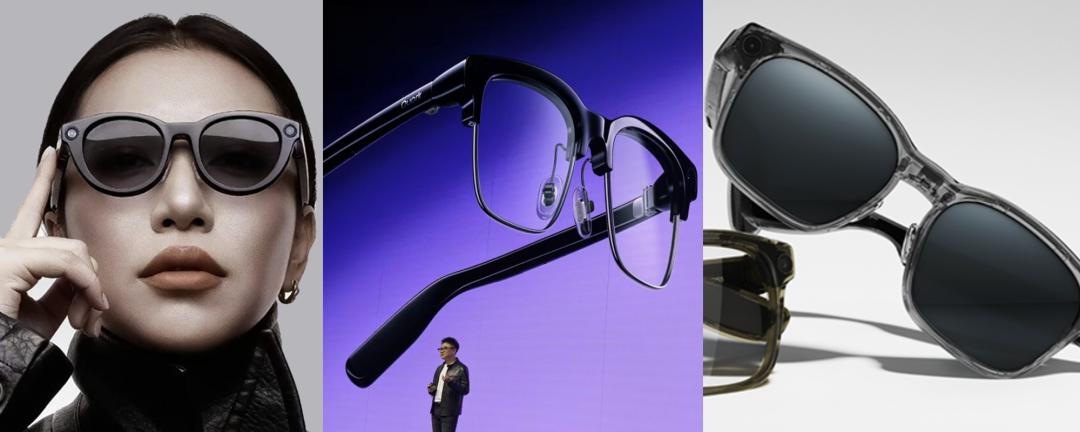
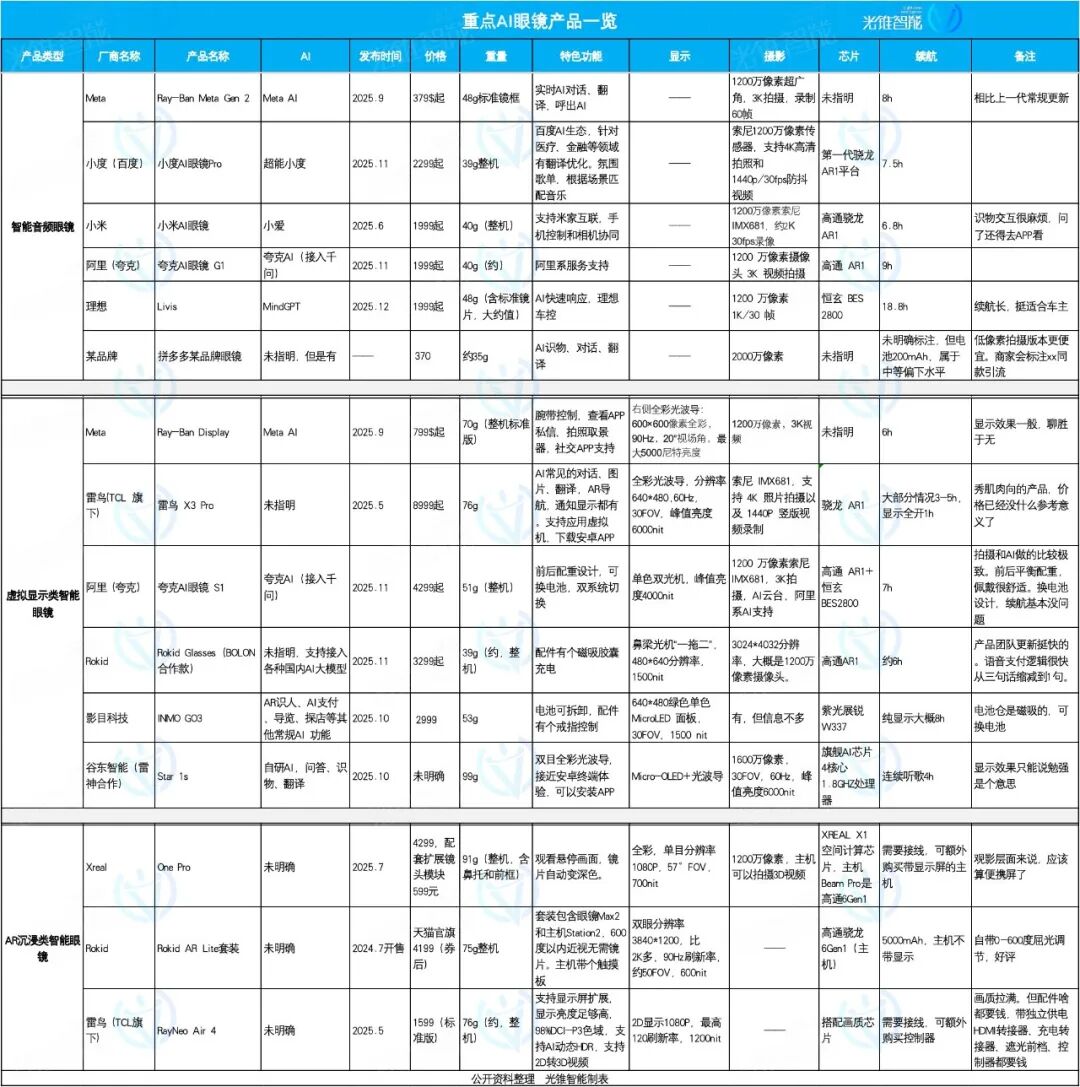
AI眼镜的玩家快要把行业"挤爆了"。 在过去的11月里,就有小度、夸克、Rokid等多家公司发布了AI眼镜新品。整个行业在大厂的扎堆涌入下,打得难舍难分。2026年,追觅也将 加入战场。 就连造车的理想,也按捺不住进来分一杯羹。 12月3日,理想AI眼镜Livis正式发布,起售价为1999元,当晚就被抢购一空。不少消费者抱怨称,"标准版以上的版本,根本抢不到货"。 理想Livis是一款整合了理想自家MindGPT大模型和用于自家车控的智能音频类眼镜。比起一个"替代"手机的智能终端,理想对AI眼镜的看法更像是智能 汽车的周边产品。以买一个驾驶场景的墨镜看待理想Livis,价格还算合理,毕竟线下配一个蔡司镜片的墨镜也要上千。 理想AI眼镜的出现,意味着,AI眼镜行业出现了一个定位更明确的玩家。 回顾2025这一年的AI眼镜新品,不难发现寻找定位是各大AI眼镜厂商推出新品的一大主题。 在AI、续航、硬件参数、软件落地、显示等AI眼镜的基础能力下,我们看到了夸克想要聚焦拍摄、雷鸟主打显示效果、Rokid擅长软件迭代的特征。厂商 的能力和偏好,为AI眼镜行业注入了更多差异化。但也为消费者选购AI眼镜,带来了一定的困难。 ...
American Lithium Corp. Announces Intention to Advance Spin-Out of Macusani Uranium
Globenewswire· 2025-12-16 12:00
Core Viewpoint - American Lithium Corp. is initiating the spin-out of its Macusani Uranium Project into an independent public company, following the resolution of legal matters, to benefit shareholders [1][2]. Group 1: Spin-Out Process - The spin-out of the Macusani project is now possible as all legal appeals have been exhausted and the mining concessions are fully under the company's control [2][5]. - The spin-out is in the planning stages and will require completion of tax, corporate, and securities structuring work, along with definitive documentation [4]. Group 2: Market Context - The current market conditions, including strong uranium pricing and increasing utility contracting, present an opportune moment for the spin-out, allowing the company to unlock the full value of the Macusani asset [2][3]. - The Macusani project is recognized as one of the largest undeveloped uranium deposits globally, which positions it as a significant asset for the company [3][5]. Group 3: Technical Advancements - In conjunction with the spin-out, the company is advancing technical work at Macusani, including an updated Mineral Resource Estimate (MRE) and a Preliminary Economic Assessment (PEA), with results expected in Q1 2026 [3][6]. - Deloitte Mining Technical Advisory and DRA Global Limited have been commissioned to complete the updates, which are well underway [3].
大厂厮杀AI终端,阿里字节理想同场竞速
3 6 Ke· 2025-12-16 11:24
Core Insights - The AI glasses market is experiencing a surge in demand, with Quark AI glasses S1 selling out across multiple channels and extended delivery times of up to 45 days reported [1][3] - Major tech companies are intensifying their focus on AI terminals, with Meta reallocating resources towards AI smart glasses and wearable devices, while Google and other firms unveil new products [1][2] - The competition for AI entry points is heating up, with various players aiming to integrate AI seamlessly into daily user interactions, positioning themselves for the next generation of mobile ecosystems [1][4] Group 1: Market Dynamics - Quark AI glasses S1 are currently sold out on official channels, leading to price surges on second-hand platforms, with some listings exceeding 5000 yuan above the official price [3] - The production capacity for Quark AI glasses is being ramped up, with an internal goal to meet demand by January 2024, coinciding with the Chinese New Year shopping season [3][9] - The global market for smart glasses is projected to grow significantly, with IDC forecasting a shipment of 12.8 million units by 2025, a 26% increase year-on-year, and a 107% increase in China [4] Group 2: Technological Advancements - The maturity of multimodal capabilities, such as image and voice recognition, is enhancing the interactive experience of smart glasses, with Quark AI glasses offering various functionalities like navigation and voice payments [5] - Upcoming products like Apple's Apple Glass and Google's Project Aura are set to integrate advanced AI functionalities, indicating a trend towards more sophisticated AI applications in wearable technology [5][10] Group 3: Industry Trends - Companies are diversifying their product offerings, with AI toys also gaining traction, as seen with the launch of emotional companion robots and AI plush toys by various manufacturers [6] - ByteDance's introduction of the "Doubao Phone" with an AI assistant highlights a shift towards enhancing existing devices rather than solely focusing on new hardware [6][7] - The establishment of dedicated divisions for AI product development, such as Li Auto's wearable robotics department, reflects a long-term commitment to AI terminal innovation [8] Group 4: Supply Chain and Financial Implications - The production ramp-up for Quark AI glasses is impacting the supply chain, with companies like Luxshare Precision and Teige Technology increasing their output to meet demand [9] - Companies specializing in AI storage solutions, such as Baiwei Storage, anticipate significant revenue growth from AI glasses, projecting a 500% increase by 2025 [9] - The semiconductor industry is also responding, with firms like Hengxuan Technology advancing their low-power, high-performance chips for wearable devices [10] Group 5: Challenges and Future Outlook - Despite the excitement surrounding AI terminals, challenges such as ecosystem compatibility, technical reliability, and compliance issues remain prevalent [11] - The AI glasses market faces hurdles related to battery life, comfort, and privacy concerns, which need to be addressed for broader adoption [11] - The ongoing competition among tech giants for AI entry points suggests that the landscape will continue to evolve, with the potential for significant shifts in market leadership as products become more integrated into daily life [12]
理想汽车获北京L3级自动驾驶路测牌照
Mei Ri Jing Ji Xin Wen· 2025-12-16 09:46
Core Insights - Li Auto has obtained an L3 level autonomous driving road test license in Beijing, allowing for conditional autonomous driving tests on high-speed roads [1] Group 1 - The license is specifically for conducting regular L3 level road tests in Beijing [1] - The testing will take place on intelligent connected vehicle testing high-speed roads [1]

【新能源周报】新能源汽车行业信息周报(2025年12月8日-12月14日)
乘联分会· 2025-12-16 08:39
Industry Information - The 2025 Global Unicorn 500 list shows a strong rise of Chinese companies, with AI and new energy vehicles as highlights. The total valuation of the top 500 unicorns reached 39.14 trillion yuan, a year-on-year increase of 30.71% [6][7] - The sales revenue of new energy passenger vehicles in China from January to November increased by 19.1% year-on-year, indicating a robust market performance [10][11] - The global electric vehicle sales from January to November 2025 reached 18.5 million units, a year-on-year increase of 21%, with China maintaining its position as the largest market [21][23] - The cumulative sales of power batteries in China reached 134.0 GWh in November, a year-on-year increase of 52.7% [25] Policy Information - Various provinces in China are implementing their 14th Five-Year Plans, focusing on modernizing manufacturing industries, enhancing infrastructure, and promoting new energy vehicles [8][9][10][12] - The central government is expected to continue optimizing the "National Subsidy" policy in 2026, which supports the replacement of old consumer goods, including new energy vehicles [22] Company Information - Tesla's Shanghai Gigafactory has officially produced its 4 millionth vehicle, showcasing its significant production capacity [4] - NIO Power has accelerated its battery swap station deployment, adding 8 new stations [4] - GAC Energy's V2G project has achieved a cumulative discharge of over 1 million kWh, demonstrating advancements in energy management [21] - Hunan's electric vehicle exports surpassed 10.7 billion yuan, marking a significant increase of over 5 times compared to the previous year [16]


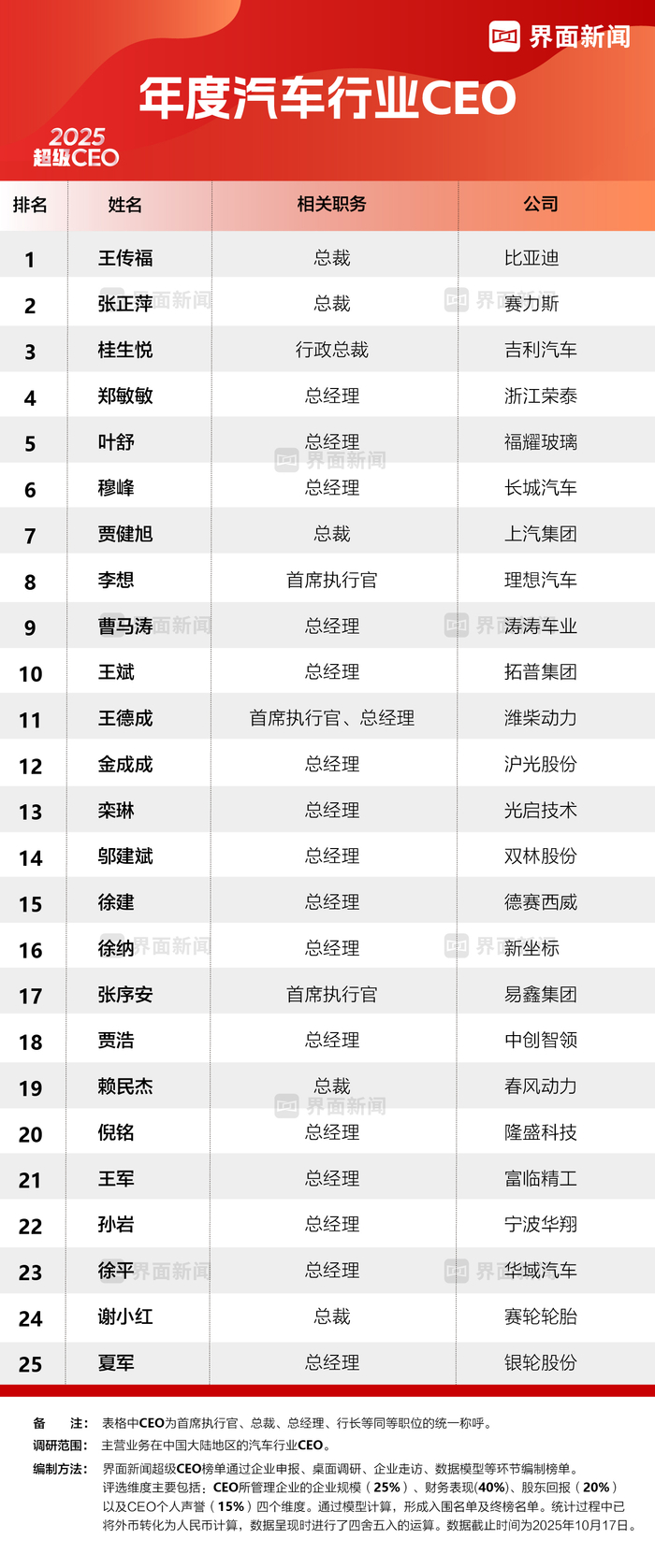
界面新闻发布2025年度汽车行业CEO榜单:比亚迪王传福、赛力斯张正萍、吉利汽车桂生悦位列前三
Xin Lang Cai Jing· 2025-12-16 08:10
Core Insights - The "Super CEO" list by Zhito Finance highlights outstanding leaders in the automotive industry, focusing on their financial growth and reputation, with BYD's Wang Chuanfu ranked first [1][12]. Industry Overview - The automotive industry in China, encompassing vehicles, parts, and services, is projected to produce and sell 31.28 million and 31.44 million units in 2024, reflecting year-on-year growth of 3.7% and 4.5% respectively, maintaining its position as the world's largest market for 16 consecutive years [2]. - In 2024, China's automotive exports are expected to reach 5.859 million units, marking a 19.3% increase, showcasing the industry's resilience amid global trade uncertainties [2]. New Energy Vehicles (NEVs) - NEVs are leading the transformation of the automotive industry, with production and sales expected to exceed 10 million units in 2024, achieving year-on-year growth of 34.4% and 35.5% respectively [3]. - NEV exports are projected to reach 1.284 million units, a 6.7% increase, as China strengthens its competitive edge in key overseas markets [3]. Automotive Parts Industry - The automotive parts sector is experiencing significant growth, with the demand for core components like batteries, motors, and electronic controls surging as NEV penetration exceeds 40% [4]. - In 2024, the installed capacity of power batteries is expected to grow by 47.6% to 531 GWh, with lithium iron phosphate batteries accounting for 69.2% of the total [4]. - The export value of automotive parts is anticipated to reach $105.61 billion, reflecting a 6.8% increase [4]. Intelligent Driving - The intelligent driving sector is witnessing rapid advancements, with consumer demand for safety and efficiency driving the adoption of L2 and higher autonomous driving features in mid-to-high-end vehicles [5]. - Technological breakthroughs in AI algorithms, automotive-grade chips, and high-precision mapping are laying a solid foundation for the industrialization of intelligent driving [5]. CEO Performance - The 25 CEOs on the list have demonstrated impressive performance, with median revenue growth of 23.3%, net profit growth of 31.42%, and return on equity of 15.35% [8]. - The average market capitalization of these companies is approximately 113.6 billion yuan, with 24 CEOs disclosing their 2024 salaries, the highest being 639.134 million yuan [8]. - The representation of post-80s CEOs has increased significantly, indicating a trend towards younger leadership in the automotive sector [8]. Notable CEOs - Wang Chuanfu of BYD leads the list, achieving sales of 4.2721 million units in 2024, with a revenue of 777.102 billion yuan, a 29.02% increase year-on-year [12]. - Zhang Zhengping of Seres has seen a remarkable revenue increase of over 305.04% to 145.176 billion yuan, with NEV sales rising by 182.84% [13]. - Li Xiang of Ideal Auto reported a revenue of 144.460 billion yuan, a 16.64% increase, and is focusing on expanding into the Middle East and Central Asia [14]. - Wang Bin of Top Group achieved a revenue of 26.6 billion yuan, growing by 35.02%, by implementing a Tier 0.5 platform strategy [15].



理想汽车旗下公司重大调整:李想职务变更 注册资本骤减近九成
Feng Huang Wang· 2025-12-16 06:56
Core Viewpoint - Beijing Rockville Technology Co., Ltd. has undergone significant changes, including a major reduction in registered capital and a change in executive leadership [1] Company Changes - The founder, Li Xiang, has stepped down as the executive director and has been reappointed as a board member [1] - The company's registered capital has been drastically reduced from 1 billion RMB to 105 million RMB, representing a decrease of 89.5% [1] Company Background - Beijing Rockville Technology Co., Ltd. was established in December 2017 and is legally represented by Feng Weili [1] - The company's business scope includes technology development and services, enterprise management consulting, and operation of electric vehicle charging infrastructure [1] - The company is wholly owned by Leading Ideal HK Limited, a subsidiary of Li Auto [1]