Morgan Stanley(MS)

Search documents

人民币兑美元中间价报7.1409,下调43点!机构首次定价美联储50基点降息情景,双线资本:美元或将大幅贬值
Sou Hu Cai Jing· 2025-08-06 01:40
Group 1 - The central bank of China set the RMB to USD exchange rate at 7.1409, a decrease of 43 points [2] - Morgan Stanley indicates that the revision of July's non-farm payroll data has increased the probability of an economic recession by 9 percentage points [4] - Citigroup suggests that if the unemployment rate rises to 4.5%, the Federal Reserve may implement a 50 basis point rate cut [4] Group 2 - Bill Campbell from DoubleLine Capital predicts that the US dollar may experience significant depreciation [5] - Campbell states that if the newly appointed Federal Reserve Chair takes swift action to lower interest rates, it could trigger a decline in the dollar [5] - Campbell believes there is still potential for further declines in the dollar's value [5]


华尔街再度集体看空美元
Hu Xiu· 2025-08-05 13:49
Core Viewpoint - The expectation of interest rate cuts by the Federal Reserve has increased significantly due to weak non-farm payroll data, yet the actual decline of the US dollar has been less than anticipated. Despite this, major Wall Street banks are collectively bearish on the dollar, citing overvaluation and weak fundamentals [1][2]. Group 1: Market Analysis - Citigroup, Goldman Sachs, and Morgan Stanley have published reports indicating that the long-term logic for a decline in the dollar remains intact, with significant short-selling potential still available [2][12]. - Following the release of non-farm data, the market's expectation for Fed rate cuts surged from approximately 30 basis points to about 60 basis points, highlighting the weak labor market [5][6]. - Despite the shift in interest rate expectations, the dollar's actual decline has been relatively moderate, suggesting that downward momentum has not been fully realized [6][10]. Group 2: Currency Valuation - Citigroup believes that the current valuation of the euro against the dollar is still below fair value, with potential for the euro/dollar exchange rate to overshoot to 1.20 [3][10]. - Goldman Sachs notes that the dollar's real trade-weighted exchange rate is still 15% above its long-term average, while the US current account deficit stands at 4% of GDP, both of which are unfavorable for the dollar [12]. - Morgan Stanley emphasizes that domestic policy uncertainties, particularly following the resignation of Fed Governor Kugler, add downward pressure on the dollar [12]. Group 3: Short-term Dynamics - The positioning of leveraged funds in dollars has flattened, indicating that previous large-scale liquidations may have concluded, which could affect the dollar's next movements [4][13]. - The dollar's future trajectory will depend heavily on three potential catalysts: the nomination of a new Fed governor, changes in the leadership of the Bureau of Labor Statistics (BLS), and the upcoming CPI inflation report on August 12 [4][14]. Group 4: Potential Catalysts - The nomination of Kugler's successor is seen as a direct catalyst that could likely be bearish for the dollar, with potential candidates being Walsh or Hassett [14]. - Changes in BLS leadership could inject uncertainty into upcoming employment reports, leading to market speculation on data outcomes rather than accuracy [14]. - The CPI report on August 12 is critical, as unexpected inflation data could challenge the narrative of rapid Fed rate cuts and support the dollar [14].

美股多头无视非农“爆雷”,降息预期利好人民币、黄金
Di Yi Cai Jing Zi Xun· 2025-08-05 12:43
美国非农就业数据"爆雷",但美股回调只持续了一日。在疲软的就业数据和超预期的财报数据之间,交 易员似乎暂时选择了后者。 不过,这份就业报告影响深远,不仅将9月美联储降息预期迅速推升至75%,更是将影响大类资产配置 的逻辑,例如对人民币和黄金走势都产生实质性影响。 非农"爆雷"阴霾秒散 这份非农报告"爆雷"程度之大,足以让美国总统特朗普解雇劳工统计局局长。 7月美国非农就业人数仅为7.3万人,远低于预期的10.4万人。更令人大为不安的是,6月数据从14.7万人 大幅下调至1.4万人,5月数据也从14.4万人大幅削减至1.9万人。这意味着两个月里,25.8万个就业岗 位"凭空消失"。这并非小波动,而是彻底的下滑。 上周五(8月1日),美股大跌近2%。这是"对等"关税暂缓以来的首次实质性回调,标普500指数此前一 路反弹,幅度接近25%。 "美股上周无论是LO(长线多头)还是HF(对冲基金)都开始卖出,交易台总体分别净卖出45亿美元 和15亿美元。最大的卖出量发生在上周四,反映月底数据和业绩兑现。8月1日,特朗普宣布更高关税税 率,同时非农就业数据低于预期,引发市场对于9月降息概率提升的预期。由于驱赶非法移民,一些 ...
Should You Invest in the Invesco KBW Bank ETF (KBWB)?
ZACKS· 2025-08-05 11:21
Core Insights - The Invesco KBW Bank ETF (KBWB) is designed to provide broad exposure to the Financials - Banking segment, making it a suitable option for long-term investors and popular among institutional and retail investors due to its low costs and tax efficiency [1][2] Index Details - Sponsored by Invesco, KBWB has over $4.66 billion in assets, positioning it as one of the largest ETFs in the Financials - Banking segment [3] - The ETF aims to match the performance of the KBW Nasdaq Bank index, which reflects publicly-traded banks and thrifts in the US [3] Costs - The annual operating expense ratio for KBWB is 0.35%, making it one of the least expensive ETFs in its category [4] - It has a 12-month trailing dividend yield of 2.21% [4] Sector Exposure and Top Holdings - KBWB has a 100% allocation in the Financials sector, providing diversified exposure [5] - Goldman Sachs Group Inc accounts for approximately 8.42% of total assets, with the top 10 holdings making up about 59.88% of total assets [6] Performance and Risk - The ETF has gained about 12.5% year-to-date and 36.24% over the past year, with a trading range between $53.5 and $75.02 in the last 52 weeks [7] - It has a beta of 1.09 and a standard deviation of 27.13% over the trailing three-year period, indicating higher risk compared to peers [7] Alternatives - KBWB carries a Zacks ETF Rank of 3 (Hold), suggesting it is a reasonable option for exposure to Financials ETFs [8] - Other alternatives include the First Trust NASDAQ Bank ETF (FTXO) and the SPDR S&P Bank ETF (KBE), with FTXO having $227.69 million in assets and KBE at $1.53 billion [9]

非农“急刹车”后,华尔街再度集体“看空美元”
Hua Er Jie Jian Wen· 2025-08-05 11:10
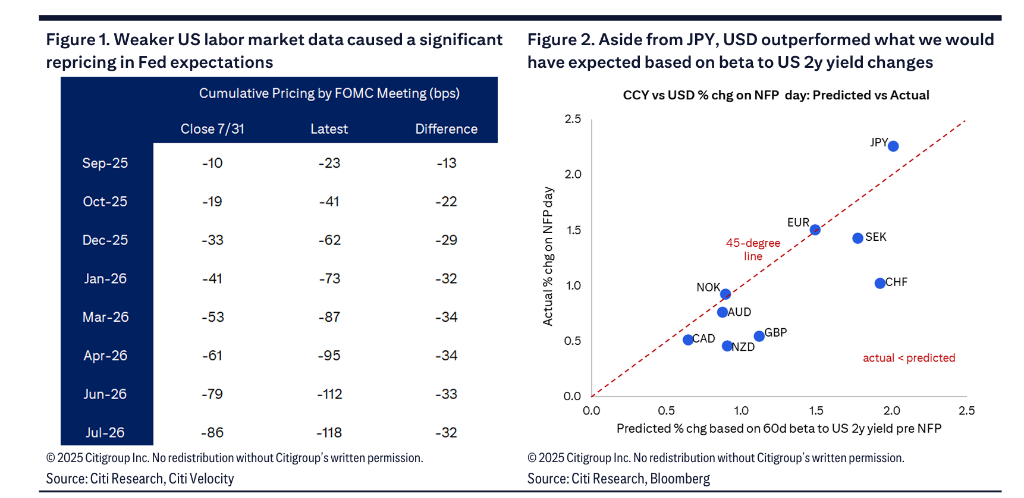
Core Viewpoint - The expectation of a Federal Reserve interest rate cut has increased significantly due to weak non-farm payroll data, yet the actual decline of the US dollar has been less than anticipated. Major Wall Street banks are collectively bearish on the dollar, citing overvaluation and weak fundamentals as key reasons [1][6]. Group 1: Market Analysis - Citigroup, Goldman Sachs, and Morgan Stanley have published reports indicating that the long-term logic for a declining dollar remains intact, with significant short-selling potential still available [1][6]. - Following the non-farm data release, the downward momentum of the dollar was restrained due to the pressure on risk currencies and specific weaknesses in certain currencies, preventing a full release of the dollar's decline [3][9]. - Despite the muted response of the dollar, Citigroup emphasizes that the logic for a dollar decline remains valid from a valuation perspective, with the euro currently undervalued and potential to overshoot to 1.20 against the dollar [7][9]. Group 2: Economic Indicators - Goldman Sachs notes that the dollar's actual trade-weighted exchange rate is still 15% above its long-term average, while the US current account deficit stands at 4% of GDP, both of which are unfavorable for the dollar [9]. - Morgan Stanley highlights domestic policy uncertainties, particularly following the resignation of Fed Governor Kugler, which adds downward pressure on the dollar [9]. Group 3: Short-term Catalysts - The dollar's next movements are expected to depend heavily on three potential catalysts: the nomination of a new Fed governor, changes in the leadership of the Bureau of Labor Statistics (BLS), and the upcoming CPI inflation report on August 12 [11][12]. - The nomination of Kugler's successor is seen as the most immediate catalyst, likely to be interpreted as dovish for the dollar if candidates like Walsh or Hassett are chosen [11]. - The leadership change at the BLS introduces uncertainty into upcoming employment data, which could lead to market speculation and positioning ahead of data releases [11].
Should You Ignore Soft Jobs Data & Bet On Wall Street ETFs?
ZACKS· 2025-08-05 11:01
Market Overview - The S&P 500 experienced a shift in momentum, entering a four-day losing streak after six consecutive all-time highs, driven by soft jobs data, rising unemployment, and new tariffs announced by President Trump [1] Investment Opportunities - Morgan Stanley and Goldman Sachs suggest that the recent market decline could present a buying opportunity, with SPDR S&P 500 ETF Trust (SPY) rebounding after the initial drop [2] - Morgan Stanley strategist Michael Wilson advocates for buying during the recent selloff, citing a strong earnings outlook for the upcoming year despite short-term challenges [3] Economic Recovery Insights - Wilson indicates that signs of a "rolling recovery" are emerging, supported by earnings revisions and expectations of fading inflation later this year, which may lead to a rate-cutting cycle [4] - Structural tailwinds such as AI adoption, a weakening U.S. dollar, and potential tax cuts are expected to support equities moving forward [5] Earnings Performance - Second-quarter earnings for S&P 500 companies are projected to increase by 9.1%, significantly surpassing analysts' forecasts of 2.8%, with the highest percentage of firms exceeding earnings estimates in four years [6] Sector-Specific Outlook - Goldman Sachs strategist David Kostin expresses optimism regarding mega-cap tech firms, noting their ability to manage tariff impacts on profits, while acknowledging potential revenue growth pressures in the latter half of the year [7]
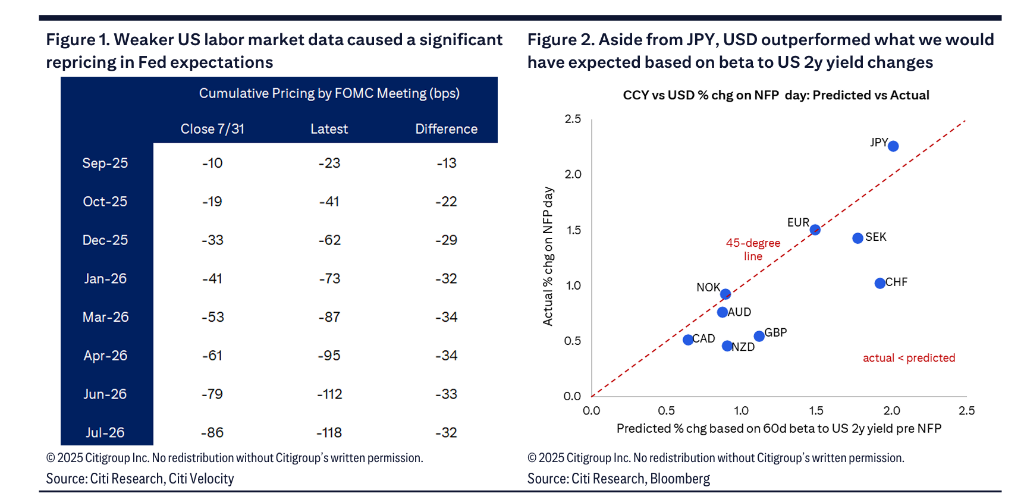
非农“急刹车”后,华尔街再度集体“空美元”
Hua Er Jie Jian Wen· 2025-08-05 10:47
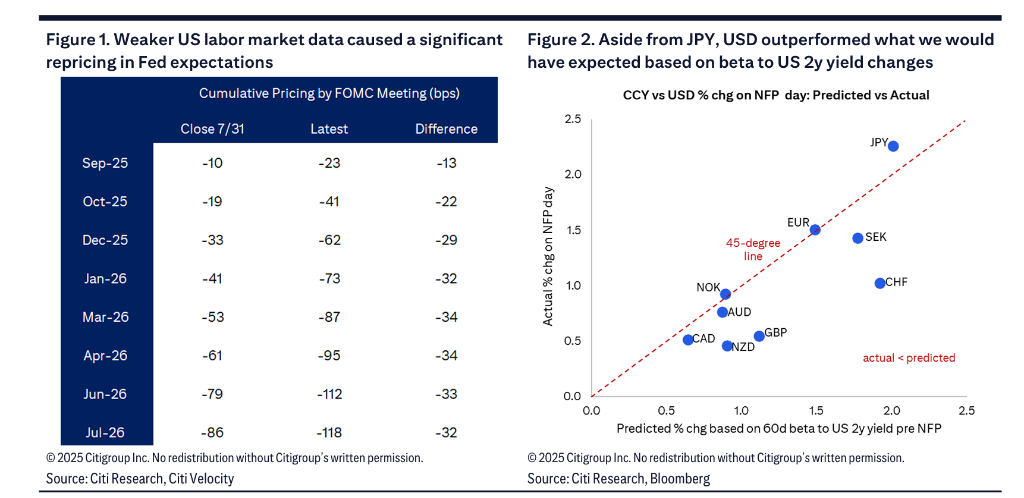
美联储降息预期因非农数据大幅升温,但美元的实际跌幅却低于预期。尽管如此,华尔街三大投行集体看空美元,认为其估值偏高,基本面疲 软。 据追风交易台消息,花旗、高盛、大摩近日发表研报,认为从估值、贸易赤字和利差等多维度分析,美元下跌的长期逻辑依旧成立,美元头寸仍 有巨大的做空空间。上周非农数据后,美元的下跌动能因风险货币承压、以及部分货币特殊性疲软而受到抑制,并未在第一时间完全释放。 展望后市,三大投行一致看空美元。花旗认为欧元/美元当前估值仍低于公允价值,有潜力超调至1.20;高盛指出,美元实际贸易加权汇率仍比其 长期平均水平高出15%;大摩则强调,美联储领导层变动等政策不确定性也为美元增加了下行压力。 然而,短期走势仍存变数。花旗认为,杠杆基金的美元仓位已趋于扁平化,此前的大规模平仓潮可能已告一段落。因此,美元的下一步走势将高 度依赖三大潜在催化剂:美联储新理事的提名人选、劳工统计局领导层变动带来的就业数据不确定性,以及即将于8月12日公布的CPI通胀报告。 | | | Cumulative Pricing by FOMC Meeting (bps) | | | --- | --- | --- | --- | ...
Vatee万腾:华尔街多家巨头同步预警美股回调 美股会掉头向下吗?
Sou Hu Cai Jing· 2025-08-05 10:23
Group 1 - Major financial institutions like Morgan Stanley, Deutsche Bank, and Evercore ISI have issued warnings about the current valuation of the U.S. stock market, suggesting a potential significant correction is imminent [1][3][4] - The S&P 500 index has risen over 20% since its low in April, driven by trends such as artificial intelligence, declining inflation expectations, and bets on Federal Reserve rate cuts, but recent economic data raises concerns [3][4] - Morgan Stanley's chief strategist Mike Wilson predicts a possible decline of up to 10% in the S&P 500 index due to rapid market gains, while Evercore ISI suggests a more aggressive correction of 15% [3][4] Group 2 - Deutsche Bank highlights that the stock market's nearly one-sided rise over the past three months indicates a short-term adjustment is imminent, with investor confidence and positioning levels nearing extremes [4] - The current valuation increase is not supported by broad earnings growth, as significant capital has flowed into a few tech-heavy stocks, creating structural vulnerabilities in the market [4] - Some analysts believe the upcoming correction may be more of a technical adjustment rather than a trend reversal, but market sentiment often shifts when investors are least vigilant [4][5] Group 3 - The market is pricing in at least one rate cut from the Federal Reserve this year, contingent on a "moderate slowdown" in the economy rather than a sudden halt [5] - If employment or consumer data continues to deteriorate without action from the Federal Reserve, the market may reassess the likelihood of a "soft landing," which could lead to volatility [5] - Vatee suggests that the next few trading weeks will be crucial in determining the sustainability of the current bull market, urging investors to focus on fundamentals and prepare for potential fluctuations [5]

华尔街齐声示警:标普500或将下跌10%至15%
华尔街见闻· 2025-08-05 10:21
Core Viewpoint - Analysts from major Wall Street firms are warning clients to prepare for a potential pullback in the U.S. stock market due to high valuations clashing with weakening economic data [1][4]. Group 1: Market Predictions - Morgan Stanley's strategist Mike Wilson predicts a potential adjustment of up to 10% in the S&P 500 index this quarter, citing tariffs impacting consumer and corporate finances [4]. - Evercore's Julian Emanuel forecasts a possible decline of up to 15% [4]. - Deutsche Bank's analyst team, led by Parag Thatte, notes that the market has risen for three consecutive months, indicating that a pullback is overdue [4]. Group 2: Economic Concerns - Recent data shows rising inflation in the U.S., alongside slowing job growth and consumer spending, raising concerns about the economic outlook [6]. - Historically, the S&P 500 index has performed poorly in August and September, averaging a decline of 0.7% during these months over the past 30 years, while other months average a gain of 1.1% [6]. - The S&P 500's 14-day Relative Strength Index (RSI) recently surpassed 76, indicating overbought conditions, which is above the 70 threshold considered "overheated" by technical analysts [6]. Group 3: Market Sentiment and Strategy - Despite the short-term bearish sentiment, analysts maintain a "buy on the dip" stance, emphasizing the long-term bullish trend of the market [7]. - Evercore's Emanuel advises clients to hold positions, particularly in companies benefiting from the AI boom [7]. - Deutsche Bank's Thatte highlights that historically, the S&P 500 experiences a small pullback of about 3% every 1.5 to 2 months and a larger pullback of over 5% every 3 to 4 months [7]. Group 4: Market Reactions - Following these warnings, traders appear to be accepting the advice to buy on dips, as evidenced by the S&P 500 and Nasdaq 100 indices both rising over 1% after a previous decline [8].