
Morgan Stanley(MS)

Search documents
签订“离婚时刻表”!微软和OpenAI“友好分手”,开启AI大时代的“世纪联姻”落幕
Hua Er Jie Jian Wen· 2025-10-29 03:31
Core Viewpoint - Microsoft and OpenAI have restructured their partnership, transitioning from a deep collaboration that began in 2019 to a more independent development phase while retaining a core cooperation framework [1] Group 1: Microsoft and OpenAI Relationship - The restructuring marks the end of a significant partnership that initiated the AI era, with both companies now pursuing independent paths while maintaining essential collaboration [1] - The new agreement extends Microsoft's intellectual property rights until 2032, providing a seven-year certainty window for business continuity, even in scenarios involving AGI [2][3] - OpenAI gains flexibility to collaborate with third parties and develop non-API products, which allows it to operate independently in sensitive areas like national security [3][4] Group 2: Market Reactions - JPMorgan views the restructuring as a "liberation moment" for Microsoft, reducing key uncertainties that have affected its stock performance [2] - Morgan Stanley emphasizes the strategic shift towards a competitive landscape, indicating a transition from alliance to competition in the AGI race [4] - Both firms maintain a bullish outlook on Microsoft, with JPMorgan setting a target price of $565 and Morgan Stanley a higher target of $625, reflecting confidence in the company's future prospects [6] Group 3: Financial Implications - The $250 billion Azure cloud services commitment is seen as a significant rebalancing of Microsoft's position, especially after concerns about competition from Oracle [2] - Morgan Stanley anticipates that the new contract will substantially increase Microsoft's commercial bookings and remaining performance obligations in the upcoming fiscal quarter [5] - The revenue-sharing arrangement and the timeline for AGI verification are critical factors that could impact future financial outcomes for both companies [7]



哪些亚洲经济体更易被中国的通缩压力波及?
2025-10-29 02:52
Summary of Key Points from the Conference Call Industry or Company Involved - The report focuses on the **Asian economies** and their exposure to **deflationary pressures from China**. Core Insights and Arguments 1. **China's Economic Challenges**: China has been facing deflationary pressures for ten consecutive quarters, with the GDP deflator remaining negative as of Q3 2025. This situation is exacerbated by overcapacity and trade tensions with the U.S. [1][2][3] 2. **Impact on Other Asian Economies**: The deflationary environment in China is leading to weaker non-commodity Producer Price Index (PPI) in other Asian economies. Countries like **Thailand, Malaysia, and South Korea** are identified as the most affected, while **Australia and Japan** are the least impacted [2][11][64]. 3. **Central Bank Policies**: Eight out of ten Asian economies are experiencing inflation levels below their central banks' comfort zones, prompting a trend of interest rate cuts. There is still room for further rate reductions to manage real interest rate trends [2][3]. 4. **Risk Factors**: The primary risks to the current deflationary scenario include a global economic recovery, particularly in the U.S., or increased demand stimulation efforts from China [3][4]. 5. **Trade Dynamics**: China's trade surplus has increased significantly, with exports to regions outside the U.S. growing by an average of 10% year-on-year in 2025. This has led to a rise in the share of exports to other Asian economies [46][47]. 6. **Sectoral Analysis**: The report identifies specific sectors that are most affected by deflationary pressures, including **automobiles, electronics, and electrical equipment**. These sectors have contributed significantly to the expansion of China's trade surplus [57][61]. Other Important but Possibly Overlooked Content 1. **Framework for Assessment**: A scoring framework was developed to evaluate the relative exposure of Asian economies to China's deflationary pressures, considering factors such as PPI weight, correlation with Chinese PPI, and export structure similarity [2][64]. 2. **PPI Trends**: Non-commodity PPI trends in Asia outside of China closely follow those in China, indicating a strong correlation in pricing dynamics [12][69]. 3. **Long-term Outlook**: The report suggests that without significant demand stimulation measures, it will be challenging for China and its neighboring economies to escape the deflationary cycle [2][36]. 4. **Sector-Specific Insights**: The automotive sector continues to experience price declines, with electric vehicle discounts widening. Battery manufacturing also remains in a deflationary zone, with prices dropping significantly [45][42]. This summary encapsulates the critical insights from the conference call, highlighting the interconnectedness of China's economic situation with other Asian economies and the implications for future economic policies and investment opportunities.
Citigroup and Morgan Stanley to challenge JPMorgan's grip on London gold vaults - Report
KITCO· 2025-10-28 16:13
Group 1 - The article discusses the roles of JPMorgan and Morgan Stanley in the financial markets, highlighting their influence and strategies [1][2] - It emphasizes the competitive landscape between major investment banks, particularly focusing on how these institutions adapt to market changes [1][2] Group 2 - The article provides insights into the experience and background of Ernest Hoffman, a reporter specializing in crypto and market news, which adds credibility to the information presented [3] - It mentions the importance of accurate information in financial reporting and the challenges faced by journalists in ensuring this accuracy [3]


大摩预计美联储将连续第二次降息25个基点
Ge Long Hui A P P· 2025-10-28 04:24
Core Viewpoint - Morgan Stanley expects the Federal Reserve to lower interest rates by 25 basis points for the second consecutive time this week, bringing the federal funds rate to a range of 3.75%-4.00% [1] Group 1 - The anticipated rate cut is part of the Federal Reserve's ongoing monetary policy adjustments [1] - This move reflects the central bank's response to current economic conditions and inflationary pressures [1] - The reduction in the federal funds rate is expected to influence borrowing costs and overall economic activity [1]
大摩:美国经济放缓、贸易和政策不确定性
Sou Hu Cai Jing· 2025-10-27 15:17
Core Insights - Morgan Stanley strategists predict that the US dollar will decline due to larger interest rate cuts by the Federal Reserve compared to the European Central Bank [1] - Factors contributing to the dollar's potential decline include a slowing US economy, trade and policy uncertainties, and moderate fiscal support [1] - Global fiscal concerns are easing, which may further impact the dollar negatively [1]
深夜,全线上涨!中概股爆发,人民币拉升!
Zheng Quan Shi Bao· 2025-10-27 14:54
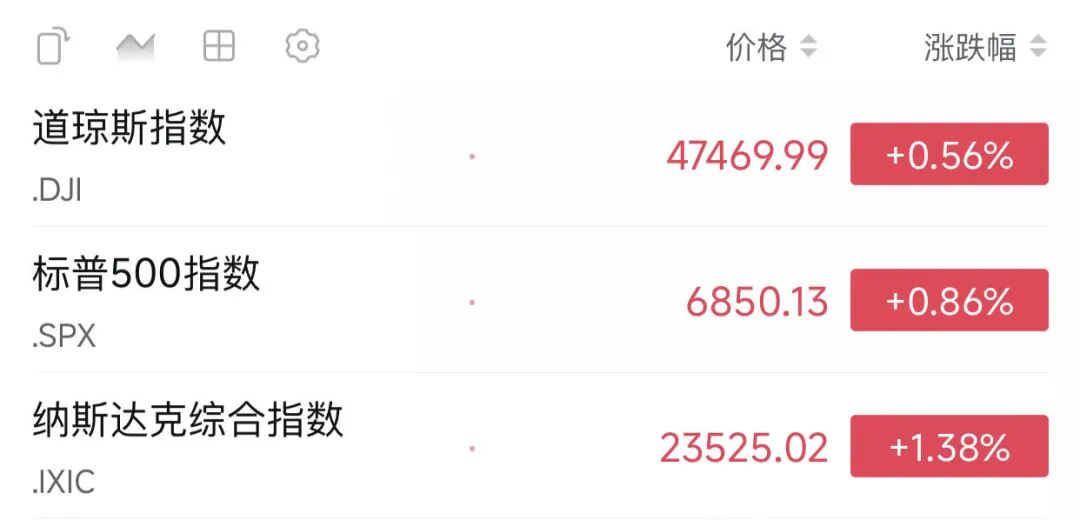
Market Performance - The three major US stock indices opened higher, with the Dow Jones up 0.56%, S&P 500 up 0.86%, and Nasdaq up 1.38%, all reaching new historical highs [1] - Major tech stocks saw significant gains, with Nvidia, Google A, and Tesla rising over 2%, while Microsoft, Amazon, Meta, Broadcom, and Apple increased by more than 1% [2] - Most large bank stocks also rose, with Barclays up over 2%, and Citigroup, UBS, and Morgan Stanley up over 1% [3] Economic Indicators - The upcoming "Super Central Bank Week" is anticipated, with the Federal Reserve's meeting scheduled for October 28-29, where a 25 basis point rate cut to the 3.75%-4% range is widely expected [3] - According to CME's FedWatch, the probability of a 25 basis point cut in October is 98.3%, while the chance of maintaining the current rate is only 1.7% [3] Chinese Market Insights - The Nasdaq Golden Dragon China Index surged over 2% in early trading [3] - Popular Chinese stocks mostly rose, with Baidu up over 5%, Vipshop up over 4%, and NIO, Xpeng, and JD.com up over 3% [6] Currency and Commodity Trends - The offshore RMB strengthened, rising over 200 basis points against the US dollar [8] - Gold prices experienced a significant drop, with London gold and COMEX gold both falling nearly 3%, and London gold dropping below $4000 per ounce [9] - Capital Economics has revised down its gold price forecast, expecting it to fall to $3500 per ounce by the end of 2026 [10] - However, Fidelity International remains bullish on gold, citing factors like Fed rate cuts and geopolitical risks as supportive for gold's performance [11]




全球宏观策略 - 让你陷入麻烦的往往不是未知,而是已知的误解-Global Macro Strategist-It Ain't What You Don't Know That Gets You Into Trouble
2025-10-27 12:06
Summary of Key Points from the Conference Call Industry Overview - The conference call primarily discusses the macroeconomic environment, focusing on the impact of tariffs, inflation, and interest rates in the US and global markets. Core Insights and Arguments 1. **Tariff Impact on Prices** - Evidence suggests that tariffs imposed by the US are exerting upward pressure on goods prices, but other factors are outweighing these inflationary pressures [1][8][9] 2. **Customs Receipts** - Customs receipts into the US Treasury are on track to achieve the largest monthly collections ever, with $64 billion in Q2 2025 and $87 billion in Q3 2025, indicating a significant increase compared to previous quarters [8][13] 3. **Inflation Trends** - Headline CPI inflation year-over-year has been lower than consensus expectations, with a 20 basis point (bp) decrease over the past six months [9][24] - Nonfinancial corporate profits per unit of real gross valued added (GVA) have declined, indicating recession risk territory [15] 4. **Corporate Cost Management** - Companies are faced with higher nonlabor costs without unit pricing power, which may lead to lower unit labor costs to mitigate profit declines [8][15][19] 5. **Economic Growth and Demand** - Real GDP growth has slowed to a 1.6% annualized rate since the start of the year, below potential growth estimates, which may affect inflation expectations [15][24] 6. **Interest Rate Strategy** - The US Federal Reserve is expected to continue quantitative tightening (QT) while managing repo rates, with a focus on the implications of the Treasury General Account (TGA) on funding conditions [27][30] 7. **Global Macro Strategy** - The report emphasizes the importance of understanding macroeconomic factors beyond tariffs, as they increasingly influence investment decisions [1][9] Additional Important Content 1. **German Fiscal Announcement** - The rise in deficit-to-GDP ratios in Germany is seen as positive for growth, with less pressure on the bond market due to non-central government funding sources [4][45] 2. **Japanese Government Bond (JGB) Issuance** - Political uncertainty in Japan is shifting towards policy uncertainty, with misconceptions about JGB market issuance being addressed [5][52] 3. **STRIPS Market Growth** - The STRIPS market has reached $1 trillion outstanding, driven by strong demand for duration from fully funded pensions [54] 4. **Market Reactions to Economic Data** - The market's focus is shifting towards macro data, with expectations of further easing from central banks based on recent economic indicators [62] 5. **Currency Strategies** - The report outlines bearish views on the USD against several currencies, anticipating a decline in USD/CAD and other pairs due to macroeconomic conditions [63][68] This summary encapsulates the key points discussed in the conference call, highlighting the macroeconomic landscape, corporate strategies, and market expectations.
黄金大跌后,性价比还高吗?
华尔街见闻· 2025-10-27 10:41
Core Viewpoint - Short-term investment in gold is no longer considered wise due to high volatility and crowded trades, while medium to long-term outlook remains positive with projected price increases [1][2][18]. Short-term vs Long-term Strategies - For short-term trading funds, the best strategy is to remain on the sidelines and wait for a significant drop in volatility before entering the market, as trading in a high-volatility environment yields low returns [4][7]. - For long-term investment funds, the current strategy should be to wait for buying opportunities in the 3800-3900 USD/oz range, which is identified as a key support level for 2025 [5][13]. Volatility and Market Trends - Historical analysis indicates that a return to low volatility is a prerequisite for the initiation of new market trends, whether upward or downward [6][8]. - The current high volatility environment makes it difficult for new trends to form, necessitating patience from investors [7][8]. Price Projections - The quantitative model from Shenwan Hongyuan predicts that the gold price will stabilize at 4814 USD/oz by 2026, supported by factors such as rising global fiscal deficits and continued central bank purchases [14][15]. - Morgan Stanley expresses a contrasting view, favoring U.S. Treasury bonds over gold, citing that gold has underperformed U.S. Treasuries over the past 50 years [2]. Market Sentiment and Buying Trends - Despite recent price declines, major financial institutions like Morgan Stanley and Goldman Sachs maintain a bullish outlook on gold, with Goldman Sachs suggesting a target price of 4900 USD/oz, indicating potential upward risks [18][20]. - Reports from gold dealers indicate a surge in retail buying, as investors view the price drop as an opportunity to purchase gold at lower prices [21][22][23]. Conclusion - The overall sentiment in the gold market remains cautiously optimistic for the long term, with significant buying interest from both institutional and retail investors, despite short-term volatility challenges [19][24].



卖美债买黄金“中长期并非明智之举”!大摩利率团队:美债终会“闪耀”的
Hua Er Jie Jian Wen· 2025-10-27 01:27
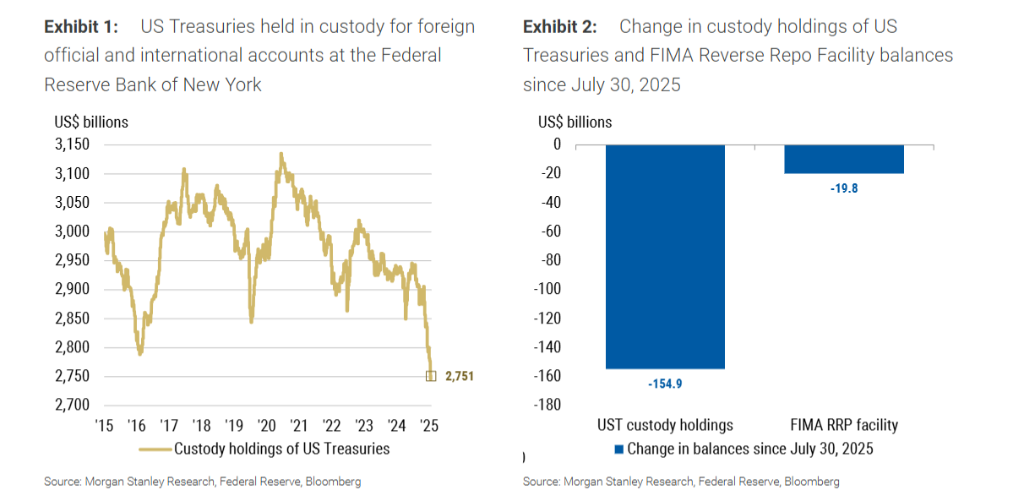
Core Viewpoint - A trend of "selling bonds and buying gold" has emerged, but Morgan Stanley maintains that U.S. Treasuries are a superior long-term choice [1][15] Group 1: Market Dynamics - Foreign official investors have significantly altered their asset allocation, with U.S. Treasuries held in custody by the New York Fed declining by nearly $155 billion from July 30 to October 22, 2025 [1] - During the same period, gold prices surged over 25%, suggesting that foreign official investors may have used proceeds from selling U.S. Treasuries to purchase gold [2] Group 2: Performance Analysis - Despite potential selling pressure, the U.S. Treasury market remains robust, with Treasuries performing well since July [5] - Historical data indicates that gold has underperformed U.S. Treasuries over any given decade in the past 50 years, with specific examples showing gold's negative returns during certain periods [6] Group 3: Volatility Considerations - The report highlights that gold's total return volatility is significantly higher than that of intermediate U.S. Treasuries, making it a questionable choice for central banks focused on managing short- to medium-term Treasury indices [9] Group 4: Long-term Trends - Morgan Stanley expresses no concern over the reduction of U.S. Treasuries held by foreign official investors, noting it as a long-term trend that has seen the proportion of Treasuries held by these investors drop from 41% in mid-2014 to 16% currently [10] - The report emphasizes that the environment for holding U.S. Treasuries is becoming increasingly attractive due to rising economic activity risks, with expectations for lower terminal interest rates from the Federal Reserve [12] Group 5: Investment Recommendations - Morgan Stanley suggests that investors should prepare for an upcoming "shining moment" for U.S. Treasuries, reiterating several trading recommendations, including going long on 5-year U.S. Treasuries and steepening the yield curve [15]
Big Banks Are Setting the Tone as Earnings Season Kicks Off
MarketBeat· 2025-10-25 14:34
Core Insights - The Q3 earnings season began with concerns over two regional lenders, First Brands and Tricolor, filing for bankruptcy, raising fears about potential contagion in the banking sector [1][2] - However, major banks reported strong earnings, indicating that the issues with these smaller lenders are not expected to broadly impact the banking industry [2][4] Financial Performance of Major Banks - The financial sector has seen a year-to-date gain of 9.23%, ranking fifth among the S&P 500 sectors, but still trailing the overall index [3] - Large cap insurers have underperformed, contributing to the financial sector's relative weakness, with notable losses from companies like Progressive, Marsh & McLennan, and UnitedHealth Group [4] - Major banks such as JPMorgan Chase, Bank of America, Morgan Stanley, and Wells Fargo exceeded earnings expectations, while Citigroup and Goldman Sachs fell short in some areas [6] Earnings Highlights - JPMorgan Chase reported quarterly revenues of $46.4 billion, a 9% year-over-year growth, with earnings per share (EPS) of $5.07, surpassing estimates by over 10% [5] - Bank of America saw a 43% year-over-year increase in investment banking revenue, while Wells Fargo achieved a record $840 million in investment banking fees, up 25% year-over-year [12] Market Trends and Activity - Q3 global M&A activity reached $371 billion, the highest in a decade, with North America leading at $246 billion, more than double the previous year [10] - There was a significant increase in IPO filings, indicating a favorable environment for investment banks, with JPMorgan Chase reporting a 9% year-over-year increase in trading revenue [11] Investment Outlook - The Financial Select Sector SPDR Fund (XLF) offers broad exposure to the financial sector, which may rebound in the coming months as underperforming industries improve [14] - Major banks are viewed as safe investments, with analysts projecting potential upside for stocks like Bank of America, Citigroup, Goldman Sachs, JPMorgan Chase, Morgan Stanley, and Wells Fargo [15]
