
NIO(NIO)

Search documents
蔚来确认子公司引入战略投资22.57亿元,智能驾驶芯片业务加速发展
Ju Chao Zi Xun· 2026-02-27 03:06
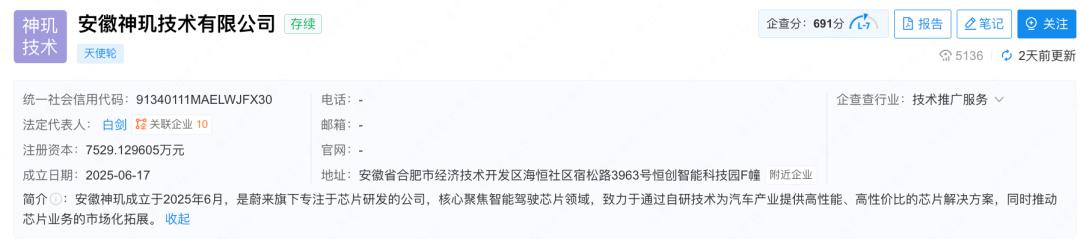
Group 1 - NIO Inc. and its subsidiary GeniTech Co., Ltd. have entered into a final agreement with several Chinese investors to raise a total of 2.257 billion RMB through the issuance of new shares [2] - GeniTech is primarily responsible for NIO's smart driving chip-related business, and after the investment transaction, NIO will retain a 62.7% controlling stake in GeniTech [2] - The investors will collectively hold 27.3% of GeniTech's shares, while entities holding shares for the management incentive plan will hold 10.0% [2] Group 2 - NIO delivered a record 326,028 new vehicles in 2025, representing a year-on-year increase of 46.9% [3] - By the end of 2025, NIO's cumulative vehicle deliveries approached one million, reaching 997,592 units [3] - NIO expects to report an adjusted operating profit of between 700 million and 1.2 billion RMB in the fourth quarter of 2025, marking the first time the company achieves positive adjusted operating profit in a single quarter since its inception [3]


融资22亿,安徽冲出一家AI芯片独角兽,蔚来李斌是背后老板
3 6 Ke· 2026-02-27 02:29
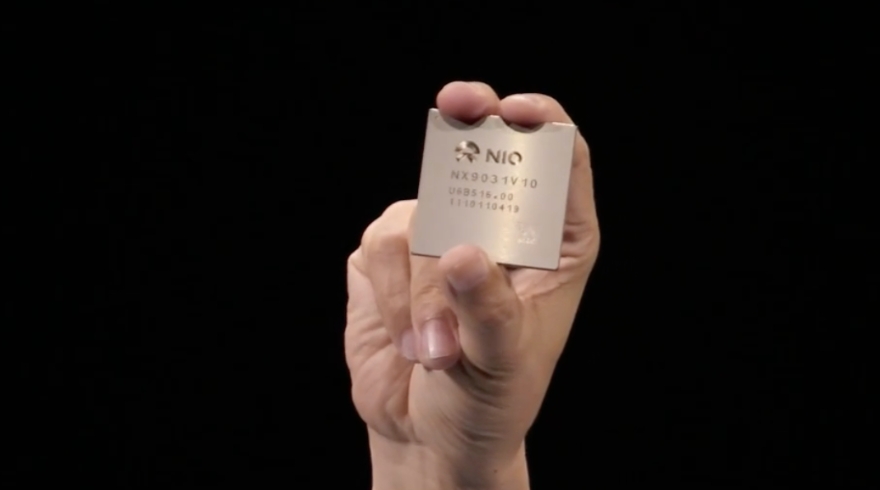
Core Viewpoint - NIO's chip subsidiary, Anhui Shenji, has completed its first round of equity financing, raising over 2.2 billion yuan, with a post-financing valuation nearing 10 billion yuan, supported by various investors [1]. Group 1: Financing and Valuation - Anhui Shenji's first round of financing exceeded 2.2 billion yuan, with a post-financing valuation close to 10 billion yuan [1]. - Investors in this round include Hefei Guotou, Hefei Haiheng, IDG Capital, and others [1]. Group 2: Company Overview - Anhui Shenji, established in June 2025, is the first company in China to develop 5nm automotive-grade chips and achieve large-scale commercialization [1][2]. - The company focuses on high-performance, cost-effective chip solutions for the automotive industry, particularly in smart driving [2]. Group 3: Leadership and Expertise - Key personnel include Chairman Li Bin, General Manager Bai Jian, and Chip Design Head Zhang Danyu, all of whom have significant experience in the tech and automotive sectors [3]. - Li Bin is the founder and CEO of NIO, while Bai Jian has a background in hardware management at OPPO and Xiaomi [3]. Group 4: Product Development - The self-developed smart driving chip, Shenji NX9031, has successfully completed its tape-out and is based on 5nm technology, featuring over 50 billion transistors and a 32-core CPU [5]. - Since its production in 2024, over 150,000 units of the NX9031 chip have been shipped and deployed across NIO's entire vehicle lineup [6]. Group 5: Future Plans - Following this financing, Anhui Shenji plans to launch next-generation high-performance chips and expand into emerging fields such as embodied robotics and AGI solutions [6].
电动汽车市场洞察,全球前20强生产商排名及市场份额
QYResearch· 2026-02-27 02:23
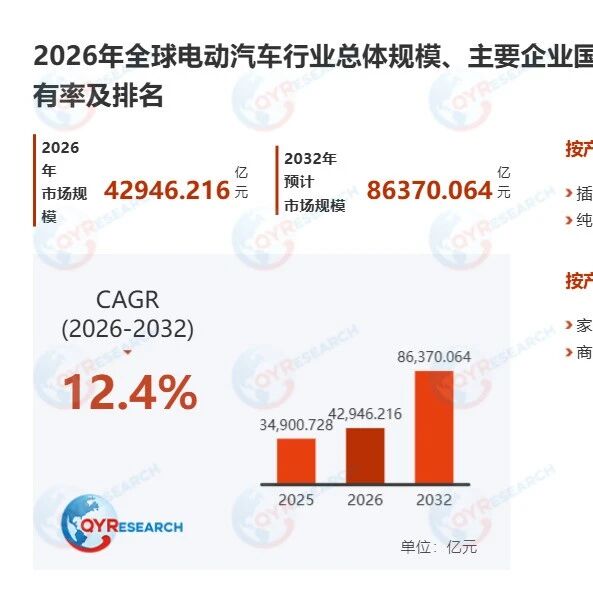
Core Viewpoint - Electric vehicles (EVs) are essential for decarbonizing the transportation sector, offering higher energy conversion efficiency, instant torque, lower noise, and zero tailpipe emissions [2] Market Size - The global electric vehicle market is projected to reach $1,269.9 billion by 2032, with a compound annual growth rate (CAGR) of 12.35% over the coming years [3] Market Landscape - Major global electric vehicle manufacturers include BYD, Tesla, BMW, Volkswagen, Li Auto, Seres Group, Geely, Mercedes-Benz, Volvo, SAIC Motor, Hyundai-Kia, Stellantis, Great Wall Motors, Renault, Chery, NIO, Toyota, GAC Group, Xpeng, Leap Motor, Xiaomi, Ford, and BAIC Group [5][6] - The top five manufacturers hold approximately 47% of the market share [6] Industry Development Opportunities - Advancements in battery technology, thermal management systems, 800V high-voltage architecture, and vehicle electronic platforms provide opportunities for performance enhancement and cost reduction, allowing electric vehicles to penetrate a broader price range [11] - The integration of vehicles with energy systems is expanding application boundaries, promoting a shift from one-time vehicle sales to ongoing service models [11] - The acceleration of electrification in light commercial vehicles, logistics, shared mobility, and emerging markets creates new growth paths for companies with scalable manufacturing, cost control, and localized operations [11] Key Obstacles - Uneven progress in charging network construction across regions affects user experience and convenience [10] - Price fluctuations of key battery materials, supply chain geopolitical risks, and an immature recycling system challenge cost control and long-term stability [10] - Consumer expectations regarding range performance, low-temperature operation, maintenance costs, and second-hand value, along with subsidy policy reductions and electricity price volatility, slow market penetration [10]



蔚来公司与博世签署战略合作协议,将围绕智能电动汽车核心技术领域展开深度协作
Xin Lang Cai Jing· 2026-02-27 01:51
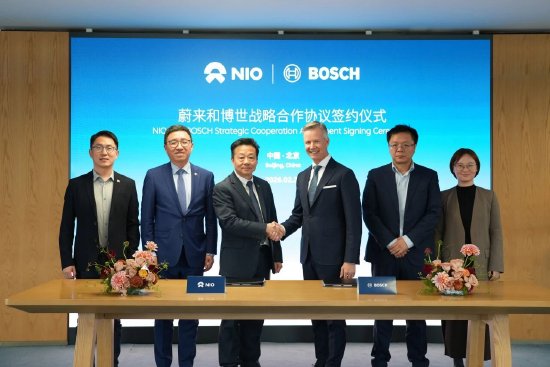
Core Insights - NIO has signed a strategic cooperation agreement with Bosch during German Chancellor Merz's visit to China [1][3] - The collaboration will involve NIO's three brands: NIO, ONVO, and firefly, focusing on core technologies in smart electric vehicles [1][3] Collaboration Details - The partnership will cover key areas such as steer-by-wire chassis and battery management [1][3] - Specific technologies included in the cooperation are brake control, steering systems, drive systems, and vehicle electronics and perception modules [1][3]
四大证券报精华摘要:2月27日
Zhong Guo Jin Rong Xin Xi Wang· 2026-02-27 01:22
Group 1 - In February, nearly 240 listed companies were surveyed by various institutions, with over half achieving positive returns during the same period, and some stocks seeing cumulative gains exceeding 80% [1] - The mechanical equipment and electronics sectors were the primary focus of institutional surveys, with significant attention also given to cyclical sectors like basic chemicals [1] - Institutions are optimistic about investment opportunities in humanoid robots, upstream AI infrastructure, and certain chemical sector stocks that offer high elasticity and dividends [1] Group 2 - In January 2026, domestic automobile sales reached 2.346 million units, with the top ten companies accounting for 1.962 million units, representing 83.6% of total sales, indicating a high concentration in the market [2] - The automotive market is characterized by "steady start and structural differentiation," with increased competition among top manufacturers as they launch new products and technologies [2] - The pharmaceutical and biotechnology sectors saw 80 companies receive institutional surveys, with a focus on brain-computer interface stocks and the trend of innovative drugs going global [2] Group 3 - Several securities firms have held spring strategy meetings earlier than usual, reflecting changes in the competitive landscape of the industry [3] - The shift from "commission for research" to "service for income" is becoming more pronounced among brokerage firms [3] - The AI industry is entering a more pragmatic phase, focusing on revenue and profit, with significant investment opportunities in AI inference computing and domestic AI chips [3] Group 4 - Lithium carbonate futures surged by 11.83% to a high of 187,700 yuan/ton, driven by Zimbabwe's adjustments to lithium export policies, which may tighten global supply in the short term [4] - UBS predicts a potential third price cycle for lithium, raising the average price expectation for 2026 to around 180,000 yuan/ton [4] Group 5 - The A-share merger and acquisition market remains vibrant, with over 500 transactions disclosed since the beginning of the year, totaling over 100 billion yuan [5] - More than 50% of these transactions are driven by industrial synergy, highlighting a core market trend [5] - The hard technology sector is a primary battleground for mergers and acquisitions, with increased participation from the Sci-Tech Innovation Board and the Growth Enterprise Market [5] Group 6 - The Hong Kong Stock Exchange reported record highs in trading volume and revenue for 2025, reaffirming its position as a global leader in new stock financing [6] - The exchange aims to enhance market convenience and competitiveness while continuing to invest strategically in emerging business areas [6] - Export-oriented companies are actively implementing measures to hedge against currency risks amid fluctuations in the renminbi exchange rate [6] Group 7 - Regions like Guangdong, Anhui, and Hubei are strategically positioning themselves in advanced fields such as AI, quantum technology, and high-end manufacturing [7] - The development of future industries relies heavily on original innovation and disruptive technologies, which are still in early stages [7] - Policies are increasingly systematic and comprehensive, supporting innovation from inception to market application [7] Group 8 - NIO's chip subsidiary, Anhui Shenji Technology Co., completed its first round of equity financing, raising 2.257 billion yuan, with a post-investment valuation nearing 10 billion yuan [8] - The financing attracted diverse capital participation, including state-owned capital and semiconductor industry funds, indicating market confidence in the company's technology and production capabilities [8] - The involvement of local state capital aligns with Hefei's ongoing investment in the integrated circuit industry [8]

汽车早报|福特在美召回超430万辆汽车 Stellantis集团2025年净亏损223亿欧元
Xin Lang Cai Jing· 2026-02-27 01:00
Group 1: Automotive Sales and Performance - In January 2026, sales of Chinese brand passenger cars reached 1.329 million units, a year-on-year decrease of 8.9% and a month-on-month decrease of 32.1%, accounting for 66.9% of total passenger car sales, down 1.5 percentage points from the same period last year [1] - Toyota's global sales in January reached 822,577 units, an increase of 4.7% year-on-year, marking a record high for January, while global production decreased by 6.0% to 735,097 units [4] - Stellantis reported a net revenue of €153.5 billion for 2025, a decline of 2% compared to 2024, with a net loss of €22.3 billion [7] Group 2: Corporate Developments and Initiatives - GAC Group aims to achieve automotive production and sales of over 2 million units in 2026, with a focus on positive growth in real estate value and continuous improvement in operational efficiency [1] - NIO's chip subsidiary, Anhui Shenji Technology Co., Ltd., completed its first round of financing with over 2.2 billion RMB, with a post-investment valuation nearing 10 billion RMB, aimed at developing high-end competitive chip products [1] - NIO established a battery technology company in Shanghai with a registered capital of 100 million RMB, focusing on battery sales and technology imports and exports [2] Group 3: Strategic Partnerships and Collaborations - Mercedes-Benz China signed a memorandum of understanding with Momenta to enhance cooperation in the field of future mobility, focusing on the development of intelligent driver assistance systems for various driving scenarios [3] - Stellantis is reportedly considering adopting technology from Chinese partner Leap Motor to reduce electric vehicle manufacturing costs for its European brands [8] Group 4: Recalls and Financial Moves - Ford announced a recall of over 4.3 million vehicles in the U.S. due to a lighting system defect that could lead to brake failure and external light malfunctions [6] - Toyota plans to sell $19 billion worth of stock through financial institutions [5]


智驾平权系列六:AI 智能涌现新阶段,智驾 VLA 与世界模型之争
Changjiang Securities· 2026-02-27 00:50
Investment Rating - The report maintains a "Positive" investment rating for the automotive and automotive parts industry [11] Core Insights - The report highlights a significant leap in the development of general artificial intelligence large models, with continuous breakthroughs in model scale, training paradigms, and reasoning capabilities, establishing a solid technological foundation for various AI applications. Intelligent driving, being an application of "physical AI," is evolving towards large models, marking a new phase of intelligent emergence [3][6] Summary by Sections Introduction: AI Empowerment, Intelligent Driving Enters the Large Model Era - The report discusses the rapid development of general artificial intelligence large models, emphasizing their role in enhancing intelligent driving through technological iterations [6][19] Emergence of General Large Model Capabilities - The AI large model era is characterized by the use of the Transformer architecture, exponential increases in computing power, and the accumulation of vast multimodal data, leading to critical breakthroughs in AI applications [7][21] Progression of Intelligent Driving Large Models - Intelligent driving has transitioned from rule-based models to end-to-end large models, gradually evolving towards VLA (Vision-Language-Action) and world models, enhancing deep reasoning and decision-making capabilities [8][50] Investment Recommendations - The report suggests that the continuous emergence of AI large model capabilities will accelerate the commercialization of high-level intelligent driving. Key recommendations include companies like XPeng Motors, BYD, and Geely in the vehicle sector, and Top Group and Bertelson in the parts sector [9]





新车上市降价18万元被骂惨!莲花CEO回应降价背刺老车主;三只羊否认借壳美股上市:仅为海外直播运营业务合作;字节估值飙升至5500亿美元
雷峰网· 2026-02-27 00:34
Group 1 - Lotus has launched new models with significant price reductions, leading to backlash from existing customers. The CEO acknowledged the decision was made to adapt to market competition and lower costs, but admitted it hurt brand perception and customer loyalty [4][5] - DeepSeek has provided its latest V4 model for testing to domestic companies like Huawei, while excluding NVIDIA and AMD, marking a shift in industry practices and supporting local AI hardware development [8][9] - ByteDance's valuation has surged to $550 billion, reflecting a 66% increase from the previous year, driven by strong market performance and stock buybacks [11][12] Group 2 - Three Sheep Group has denied rumors of a reverse merger for a U.S. listing, clarifying that it is only engaged in overseas live streaming operations [13] - Former Alibaba executive Ren Geng has left New Hope Group after a year, raising questions about leadership stability during a critical digital transformation phase [14] - Nubia's CEO criticized Samsung's Galaxy S26 series for only achieving partial capabilities compared to their own products, highlighting the competitive landscape in AI integration within smartphones [16][17] Group 3 - The Chinese smartphone industry is expected to face a price increase of over 30% due to rising component costs, with major brands planning to raise prices significantly starting in March [18][19] - Ctrip reported a 21% year-on-year increase in net revenue for Q4 2025, driven by resilient travel demand, while also announcing leadership changes [26] - NIO's chip subsidiary, Anhui Shenji, has completed a financing round exceeding 2.2 billion yuan, aiming to enhance its competitive edge in high-performance automotive chips [27][28] Group 4 - Stellantis, the parent company of Maserati, reported a record net loss of €22.3 billion (approximately 180 billion yuan) for 2025, primarily due to strategic restructuring costs and misjudgments in the energy transition [40][41] - Bosch has announced the closure of its Weibling factory by 2028, affecting around 560 jobs, as part of a broader strategy to focus on high-growth areas like semiconductors and electric vehicle components [42][43] - AI's impact on Apple's NAND pricing power has diminished, with contracts now being renegotiated every six months due to increased demand from the AI server market [47][48]


全球大公司要闻 | 李嘉诚再售英国资产,苹果接受三星内存报价翻倍
Wind万得· 2026-02-27 00:31
Group 1 - Nvidia's CEO Jensen Huang stated that the demand for computing is growing exponentially, and the adoption rate of Agentic AI is experiencing explosive growth, with clients accelerating investments in AI computing power [2] - Baidu projects total revenue of 129.1 billion yuan by 2025, with AI business revenue of 40 billion yuan and a net profit of 5.6 billion yuan, driven by growth in core AI new businesses [2] - Cheung Kong Infrastructure, Power Assets, and CK Hutchison announced the sale of their UK Power Networks stake to Engie for over 110 billion HKD, indicating plans for future investments and acquisitions [2] Group 2 - NIO's chip subsidiary Anhui Shenji Technology completed its first round of financing, raising over 2.2 billion yuan, with a post-investment valuation nearing 10 billion yuan [5] - iQIYI expects total revenue of 6.79 billion yuan in Q4 2025, with a net loss of 5.8 million yuan, while annual revenue is projected at 27.29 billion yuan [6] - JD.com launched a "100 Billion Supermarket" channel on its app, planning to invest over 20 billion yuan in subsidies over the next three years to boost sales [7] Group 3 - Amazon plans to invest $50 billion in OpenAI, contingent on two triggers: an IPO or achieving AGI [10] - Apple has accepted a 100% price increase for Samsung's storage chips for the iPhone 17, which may significantly raise production costs [10] - Tesla China is offering promotional financing options for its vehicles, including zero-interest loans for certain models [11] Group 4 - Samsung Electronics reported DRAM sales of $19.3 billion in Q4, regaining a 36% market share, and confirmed plans for silicon-carbon anode batteries for smartphones [15] - Toyota plans to sell approximately $19 billion in cross-shareholdings to advance governance reforms, while January production in Japan fell by 6.1% [15] - LG Energy Solution has reached an agreement with Tesla to produce lithium iron phosphate batteries in the U.S., investing 5.94 trillion KRW [15]


蔚小理,上不去,下不来
3 6 Ke· 2026-02-27 00:10
Core Insights - The automotive industry is witnessing significant shifts, particularly in the electric vehicle (EV) sector, with Tesla's pivot towards AI and robotics, while companies like NIO, Li Auto, and Xpeng are struggling to find their narrative amidst fierce competition from both Tesla and BYD [1][24]. Group 1: Tesla's Strategy and Market Position - Tesla's identity is evolving from an automotive company to an AI and robotics company, maintaining market confidence despite a decline in revenue and delivery volumes in 2025 [1][2]. - The discontinuation of classic models by Tesla serves as a strong narrative, indicating a future focus on AI and robotics rather than traditional vehicles [3][24]. - Tesla's Full Self-Driving (FSD) system exemplifies its narrative strategy, transforming a one-time product sale into a continuous service model, which significantly enhances its valuation compared to traditional automakers [2][3]. Group 2: Competitive Landscape of Chinese EV Makers - NIO, Li Auto, and Xpeng are attempting to establish their narratives but face challenges in competing with Tesla's technological prestige and BYD's cost advantages [1][5]. - The technological gap between these companies and Tesla is narrowing, with substantial investments in R&D, yet market perception remains a significant hurdle [2][3]. - NIO's focus on battery swapping and Xpeng's advancements in autonomous driving are part of their strategies to differentiate themselves in a crowded market [17][18]. Group 3: BYD's Dominance and Cost Structure - BYD's robust performance in 2025, with a revenue of 170.4 billion yuan and a net profit of 9.15 billion yuan, highlights the effectiveness of its vertically integrated supply chain [5][6]. - The company's ability to maintain a gross margin of 20.1% is attributed to its extensive control over the production process, allowing for cost advantages that competitors like NIO, Li Auto, and Xpeng cannot match [5][9]. - BYD's scale, with a quarterly sales volume of 1 million units, starkly contrasts with the combined sales of NIO, Li Auto, and Xpeng, emphasizing the challenges these companies face in achieving profitability [9][10]. Group 4: Financial Performance of NIO, Li Auto, and Xpeng - NIO's revenue growth is accompanied by significant losses, with a net loss of 67.5 billion yuan in Q1 2025, indicating ongoing financial struggles [8][10]. - Xpeng has shown a remarkable revenue increase of 141% in Q1 2025, yet it still faces challenges in achieving profitability [8][10]. - Li Auto's revenue growth is modest, with a net profit margin declining, suggesting potential issues with its new MEGA model [8][10]. Group 5: Strategic Challenges and Future Directions - The three companies face a series of interconnected challenges, including pricing strategies, cash burn rates, and the need for technological breakthroughs [11][14][16]. - NIO's multi-brand strategy and Xpeng's focus on smart technology are attempts to carve out unique market positions, but these strategies come with high costs and uncertain returns [17][18]. - The competitive landscape is evolving rapidly, with new entrants like Huawei and Xiaomi intensifying the competition, necessitating a reevaluation of strategies for NIO, Li Auto, and Xpeng [20][21].

