
NIO(NIO)

Search documents
美股异动 | 新能源车股走高 特斯拉(TSLA.US)一度涨超3%
智通财经网· 2025-12-12 15:20
Core Viewpoint - The news highlights a significant increase in the stock prices of various electric vehicle companies, indicating a positive market sentiment towards the sector [1] Company Performance - Tesla (TSLA.US) saw its stock rise over 2%, with an intraday increase exceeding 3% [1] - Xpeng Motors (XPEV.US) experienced a stock increase of over 1% [1] - Li Auto (LI.US) reported a stock rise of over 2% [1] - NIO (NIO.US) had a stock increase of over 1.6% [1] - Rivian Automotive (RIVN.US) showed a remarkable stock increase of over 16% [1]


2 Top EV Stocks to Buy in December
Yahoo Finance· 2025-12-12 15:20
Industry Overview - The electric vehicle (EV) market has experienced rapid growth despite challenges such as inflation, high interest rates, and tariffs impacting the global economy [1] - The North American EV market has cooled slightly, while the Chinese and European markets continue to provide strong support for the industry [1] Market Projections - The global EV market is projected to grow at a compound annual growth rate (CAGR) of 32.5% from 2025 to 2030, driven by the introduction of cheaper and more power-efficient vehicles [2] Company Analysis: Nio - Nio is a significant EV producer in China, known for its battery-swapping technology, which offers a faster alternative to traditional charging methods [4] - From 2020 to 2024, Nio's annual deliveries increased over fivefold, from 43,728 vehicles to 221,970 vehicles, with annual revenue more than quadrupling during the same period [5] - Despite facing challenges, Nio's vehicle margin improved to double digits over the past two years due to a higher mix of premium sedans and reduced production costs [6] - Analysts forecast Nio's revenue to grow at a CAGR of 31% from 2024 to 2027, driven by increased sales of its Onvo and Firefly vehicles, market share gains, and European expansion [7] - Nio's current valuation is attractive, trading at less than one times this year's sales, with potential for significant investor interest once trade conflicts ease [8] Company Analysis: QuantumScape - QuantumScape is noted for its development of solid-state batteries, which could enhance the power efficiency of EVs [9]
Nio's ET5 Gets Fresh Purple Makeover In New Limited Editions - NIO (NYSE:NIO)
Benzinga· 2025-12-12 13:05
Core Viewpoint - Nio Inc. is actively launching new models and expanding into European markets despite facing softer demand conditions in the global auto market. Group 1: Product Updates - Nio plans to unveil limited-edition versions of its ET5 sedan and ET5 Touring wagon on December 16, aiming to stimulate consumer interest during a challenging sales period [2][3]. - The limited editions will feature an exclusive purple exterior package, but no performance upgrades or pricing changes have been disclosed [3]. - The standard ET5 and ET5 Touring models were refreshed earlier this year, maintaining a starting price of 298,000 Chinese yuan ($42,221.30) [4]. Group 2: European Expansion - Nio has commenced deliveries of its Firefly electric vehicle in several European countries, including the Netherlands, Norway, Belgium, Denmark, and Greece [5]. - The company has also opened reservations and test-drive programs in Portugal and Austria [5]. - The Firefly EV is competitively priced at approximately 29,900 euros ($35,053.71) and 279,900 kroner in Norway [6]. Group 3: Technical Specifications - The Firefly is equipped with a 42.1 kWh lithium iron phosphate battery, providing over 205 miles of range under WLTP testing standards [7]. - The model is positioned as an accessible option for urban drivers, focusing on range reliability and lower ownership costs [7].

如何看待高成长与经典价值?柏基“传奇基金经理”2019年深度撰文 | 思考汇
高毅资产管理· 2025-12-12 07:03
Core Viewpoint - The article discusses the evolving landscape of investment strategies, particularly the tension between growth and value investing, emphasizing the need for a nuanced understanding of these concepts in the context of modern economic changes [6][8][9]. Group 1: Growth vs. Value Investing - James Anderson acknowledges a widening divide between growth and value investing, suggesting that traditional value metrics may not suffice in a changing economic landscape dominated by tech giants like Microsoft and Google [8]. - The article highlights that while growth and value investing appear divergent, they share fundamental principles, such as the importance of honest long-term cash flow estimation and risk awareness [9]. - Anderson emphasizes the need for a longer time perspective and serious company research, valuing patience and governance sensitivity inherent in value investing [9][10]. Group 2: Historical Context and Literature - The article notes a lack of literature supporting growth investing compared to the extensive documentation of value investing, which has a rich tradition and numerous classic texts [11][13]. - It references Benjamin Graham's views on growth stocks, indicating that while he recognized their potential, he also warned of their speculative nature and preferred investing in larger, less popular companies [13][14]. - The article argues that the realities of the past decade have diverged from Graham's observations, with growth stocks outperforming traditional value stocks [15]. Group 3: Future Investment Landscape - The article posits that future returns are highly uncertain, urging a reevaluation of investment beliefs and strategies in light of complex market dynamics [18][30]. - It suggests that understanding structural changes in the global economy is crucial for predicting long-term investment outcomes, rather than focusing solely on short-term financial metrics [33][34]. - The piece warns against relying on historical volatility to forecast future performance, advocating for a mindset open to exploring various possibilities [38][39]. Group 4: Case Studies - The article compares Coca-Cola and Facebook, illustrating how traditional value metrics may misrepresent the potential of high-growth companies [64][69]. - It highlights that Coca-Cola's growth has stagnated, while Facebook has shown significant growth potential, challenging the notion of which company represents true value [66][70]. - The automotive industry is used as a case study, showcasing how different companies within the sector exhibit varying growth and value characteristics, with General Motors and Ferrari serving as contrasting examples [82][88].




固态电池独角兽卫蓝新能源启动IPO辅导 估值一度超180亿元 小米、华为哈勃、蔚来等投了
Xin Lang Cai Jing· 2025-12-12 05:31
Core Viewpoint - Beijing Weilan New Energy Technology Co., Ltd. has submitted an IPO counseling record to the Beijing Securities Regulatory Bureau, with CITIC Construction Investment Securities as the counseling institution, indicating its intention to go public and expand its operations in the solid-state battery sector [1] Group 1: Company Overview - Weilan New Energy is a spin-off from the Chinese Academy of Sciences, focusing on solid-state lithium-ion batteries, and is recognized as a national-level specialized and innovative small giant and unicorn enterprise [1] - The company has achieved a valuation of 18.5 billion RMB, ranking 455th on the Hurun Global Unicorn List [2] Group 2: Product and Technology - Weilan New Energy has developed a product matrix covering three core areas: vehicle and ship power, new energy storage, and low-altitude power [2] - Key products include: - 360Wh/kg high energy density power cells, capable of over 1000 km range, with mass production delivered to NIO in 2023 [2] - 280Ah ultra-safe energy storage cells, also mass-produced in 2023 for various energy storage projects [2] - 320Wh/kg high energy density low-altitude economic power cells supplied to multiple domestic and international clients [2] - The company has applied for over 400 national patents, with more than 100 granted, covering core materials and technologies for solid-state batteries [2] Group 3: Industrialization and Partnerships - Weilan New Energy has established four production bases in Beijing, Jiangsu, Zhejiang, and Shandong, with an annual production capacity of 28.2 GWh and a planned total capacity exceeding 100 GWh [3] - A recent investment cooperation agreement with Shaanxi Forestry Industry Group will establish a new materials company, with a procurement agreement for 4 GWh of solid-state cells valued at approximately 4 billion RMB [3] Group 4: Financing and Shareholding Structure - Weilan New Energy has completed nine rounds of financing, with the latest D+ round occurring in September 2023, attracting strategic investments from various funds including Beijing's green energy fund [4] - Notable investors include Xiaomi and Huawei, who participated in the B+ round financing in 2021 [5] - The actual controller of Weilan New Energy is Yu Huigen, who holds a 29.25% stake through direct and indirect holdings [5]
又一L4玩家冲刺IPO,估值超38亿,前百度大牛创办,博世蔚来资本都投了
3 6 Ke· 2025-12-12 04:18
Core Viewpoint - The company, Mainline Technology, has submitted its IPO application, marking its entry into the capital market as a leading provider of L4 autonomous trucks in China, particularly in port scenarios [3][23]. Financial Performance - Mainline Technology reported a revenue increase from 112 million yuan in 2022 to 254 million yuan in 2024, with a compound annual growth rate (CAGR) of 50.4%. In the first half of 2025, revenue reached 99 million yuan [4][6]. - The company has incurred losses exceeding 600 million yuan over three years, with losses decreasing from 278 million yuan in 2022 to 187 million yuan in 2024. The loss for the first half of 2025 was 96.4 million yuan [4][7]. - Gross profit has shown significant improvement, rising from 4.2 million yuan in 2022 to 57.6 million yuan in 2024, with a CAGR of 272.0%. The gross margin increased from 3.7% in 2022 to 22.7% in 2024, reaching 30.3% in the first half of 2025 [7][6]. Business Operations - Mainline Technology has established a comprehensive product ecosystem centered around its self-developed autonomous driving system, providing full-stack solutions for logistics transportation [15][19]. - The company has delivered 830 intelligent trucks and 349 intelligent terminals, with nearly 100 million kilometers of intelligent transport mileage, of which over 95% is attributed to autonomous driving [14]. Market Position - Mainline Technology holds the leading market share in closed-road scenarios, such as ports, making it the largest provider of L4 autonomous trucks and solutions in China based on product sales revenue in 2024 [22]. Leadership and Team - The company is led by Zhang Tianlei, a PhD from Tsinghua University with nearly 20 years of experience in autonomous driving technology, having previously worked at major tech companies like Microsoft and Baidu [10][8]. Funding and Valuation - Following a strategic financing round in September 2025, Mainline Technology's post-financing valuation reached 3.86 billion yuan. The company has secured multiple rounds of financing since its inception in 2017 [12][13].
固态电池独角兽筹备IPO,蔚来小米都投了
Sou Hu Cai Jing· 2025-12-12 04:15
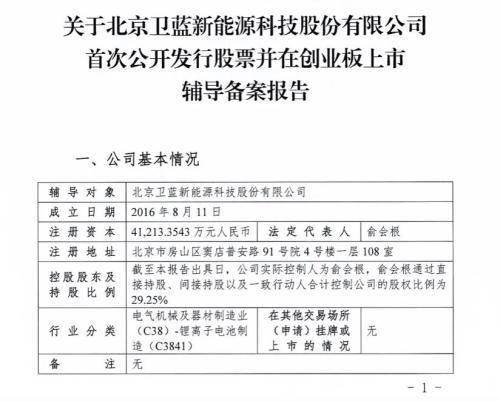
作者丨孙媛 又一独角兽,正式启动IPO进程。 12月11日,证监会网站披露,北京卫蓝新能源科技股份有限公司(简称:卫蓝新能源)启动A股IPO并 提交辅导备案,公司拟在创业板上市,辅导机构为中信建投。 | 辅导对象 | 北京卫蓝新能源科技股份有限公司 | | --- | --- | | 新 成立日 | 2016年8月11日 | | 注册资本 | 41,213.3543 万元人民币 法 定 代 表 人 偷会根 | | 注 费 地 | 北京市房山区襄店書安路 91 号院 4 号楼一层 108 室 | | 控股股东及 持 股 比 例 | 截至本报告出具日,公司实际控制人为禽会根,禽会根遮过直 接持股、间接持股以及一致行动人合计控制公司的股权比例为 29.25% | | 行业分类 | 申气机械及暴材刷造业 在其他交易场所 (申请)挂牌或 无) | | | (C38)-锂离于电池制 | | | 造(C3841) 上市的情况 | | 各 注 | 元 | 来源:证监会 作为国内固态电池领域头部企业,卫蓝新能源与背靠上汽集团的清陶能源有"北卫蓝、南清陶"之称。 自2017年起,公司便获得多轮投资,其中,2022年D轮融资就融了 ...
隔夜欧美·12月12日
Sou Hu Cai Jing· 2025-12-11 23:47
Market Performance - The three major US stock indices closed mixed, with the Dow Jones up 1.34% at 48,704.01 points, the S&P 500 up 0.21% at 6,901 points, and the Nasdaq down 0.25% at 23,593.86 points [1] - Major tech stocks mostly declined, with Google down over 2%, Nvidia down more than 1%, Tesla down over 1%, Amazon down 0.65%, and Apple down 0.27%. Microsoft rose over 1% and Facebook increased by 0.4% [1] - Popular Chinese concept stocks showed mixed results, with NIO up nearly 2%, Baidu and Century Internet up over 1%, while Alibaba, Zhihu, and Bilibili fell over 1%, and Xpeng Motors dropped over 2% [1] European Market - All three major European stock indices closed higher, with Germany's DAX index up 0.68% at 24,294.61 points, France's CAC40 index up 0.79% at 8,085.76 points, and the UK's FTSE 100 index up 0.49% at 9,703.16 points [1] Commodity Markets - International precious metal futures generally rose, with COMEX gold futures up 2.00% at $4,309.30 per ounce and COMEX silver futures up 4.83% at $63.98 per ounce [1] - US oil main contract fell 0.92% to $57.92 per barrel, while Brent crude oil main contract dropped 1.01% to $61.58 per barrel [1] - London base metals mostly increased, with LME tin up 4.69% at $41,880.00 per ton, LME zinc up 3.76% at $3,198.00 per ton, LME copper up 2.40% at $11,833.50 per ton, LME aluminum up 0.98% at $2,895.00 per ton, and LME lead up 0.18% at $1,983.50 per ton. LME nickel decreased by 0.29% to $14,610.00 per ton [1] Bond Markets - US Treasury yields were mixed, with the 2-year yield up 0.23 basis points at 3.538%, the 3-year yield unchanged at 3.586%, the 5-year yield up 0.36 basis points at 3.733%, the 10-year yield up 0.78 basis points at 4.155%, and the 30-year yield up 1.41 basis points at 4.800% [1] - European bond yields collectively fell, with the UK 10-year yield down 2.2 basis points at 4.482%, France's 10-year yield down 1.4 basis points at 3.551%, Germany's 10-year yield down 0.8 basis points at 2.840%, Italy's 10-year yield down 2 basis points at 3.525%, and Spain's 10-year yield down 2.1 basis points at 3.288% [1]


车企集体跨界智能终端 AI入口争夺战中开启生态破局
Zhong Guo Zheng Quan Bao· 2025-12-11 20:31
Core Viewpoint - The launch of Li Auto's AI glasses, Livis, signifies a strategic shift for Chinese electric vehicle manufacturers, expanding competition beyond traditional automotive products into a comprehensive smart ecosystem [1][2]. Group 1: Industry Trends - The current electric vehicle market faces significant homogenization, prompting companies to seek differentiation through smart wearables and digital products [2][3]. - Major players like NIO and XPeng are also venturing into smart devices, indicating a collective industry trend towards integrating technology into user lifestyles [1][2]. Group 2: Product Features and User Engagement - Livis glasses feature a lightweight design at 36 grams, an impressive battery life of 18.8 hours, and deep integration with vehicle systems, enhancing user interaction [1][2]. - The glasses enable quick responses for vehicle controls, such as air conditioning and steering wheel heating, fostering a seamless user experience [2][3]. Group 3: Market Performance and Consumer Behavior - The global smart glasses market is projected to grow, with a 64.2% year-on-year increase in shipments, and automotive-related products contributing 15% to this growth [3]. - Livis achieved over 12,000 orders on its first sales day, with 80% of buyers being existing Li Auto customers, indicating strong brand loyalty and user retention [3]. Group 4: Business Model Challenges - Domestic electric vehicle manufacturers face longer profit cycles in the smart device sector, necessitating innovative business models beyond traditional hardware sales [4][5]. - The comparison with Tesla's successful integration of robotics highlights the need for scale and cost control in developing smart devices [4]. Group 5: Consumer Willingness and Market Potential - A significant 72% of Chinese smart device users are willing to pay a premium for cross-terminal services, compared to only 45% in Western markets, indicating a favorable environment for innovation [5]. - The strategic move towards integrating smart devices into the automotive ecosystem is seen as essential for addressing industry homogenization and capturing AI-driven user engagement [5].
车企集体跨界智能终端AI入口争夺战中开启生态破局
Zhong Guo Zheng Quan Bao· 2025-12-11 20:17
Core Insights - The launch of Li Auto's AI glasses, Livis, signifies a shift in the competitive landscape of the new energy vehicle (NEV) industry, expanding from single automotive products to a comprehensive smart ecosystem [1][2] - Major Chinese NEV companies, including NIO and Xpeng, are diversifying into smart wearables and digital products to break through homogenized competition and capture user engagement in the AI era [1][2] Group 1: Product Features and Market Strategy - Livis features a lightweight design at 36 grams, an impressive battery life of 18.8 hours, and deep integration with vehicle systems, enhancing user interaction and experience [1][2] - The glasses are not standalone hardware but part of a "car + glasses" ecosystem, which increases user stickiness by transitioning customers from car buyers to participants in a smart lifestyle [2][3] Group 2: Industry Trends and Competitive Landscape - The global smart glasses market is experiencing significant growth, with a 64.2% year-on-year increase in shipments, and NEV-related products contributing 15% to this growth [3] - Li Auto's Livis achieved over 12,000 orders on its first sales day, with 80% of orders coming from existing Li Auto vehicle owners, indicating a shift towards an ecosystem competition involving multiple smart terminals [3] Group 3: Business Model and Challenges - Domestic NEV companies face longer profit cycles in their smart device ventures compared to international competitors like Tesla, which has successfully integrated robotics into its business model [4] - The development of smart devices by companies like Xpeng and Li Auto requires substantial investment and innovative business models to ensure long-term cash flow and profitability [4][5] Group 4: Consumer Behavior and Market Potential - A significant 72% of Chinese smart device users are willing to pay a premium for cross-terminal services, compared to only 45% in Western markets, indicating a strong market potential for innovative cross-device solutions [4] - The strategy of extending smart cockpit ecosystems to personal devices is seen as a necessary response to industry homogenization and a way to secure a foothold in the AI-driven market [5]