NIO(NIO)

Search documents
隔夜欧美·12月12日
Sou Hu Cai Jing· 2025-12-11 23:47
Market Performance - The three major US stock indices closed mixed, with the Dow Jones up 1.34% at 48,704.01 points, the S&P 500 up 0.21% at 6,901 points, and the Nasdaq down 0.25% at 23,593.86 points [1] - Major tech stocks mostly declined, with Google down over 2%, Nvidia down more than 1%, Tesla down over 1%, Amazon down 0.65%, and Apple down 0.27%. Microsoft rose over 1% and Facebook increased by 0.4% [1] - Popular Chinese concept stocks showed mixed results, with NIO up nearly 2%, Baidu and Century Internet up over 1%, while Alibaba, Zhihu, and Bilibili fell over 1%, and Xpeng Motors dropped over 2% [1] European Market - All three major European stock indices closed higher, with Germany's DAX index up 0.68% at 24,294.61 points, France's CAC40 index up 0.79% at 8,085.76 points, and the UK's FTSE 100 index up 0.49% at 9,703.16 points [1] Commodity Markets - International precious metal futures generally rose, with COMEX gold futures up 2.00% at $4,309.30 per ounce and COMEX silver futures up 4.83% at $63.98 per ounce [1] - US oil main contract fell 0.92% to $57.92 per barrel, while Brent crude oil main contract dropped 1.01% to $61.58 per barrel [1] - London base metals mostly increased, with LME tin up 4.69% at $41,880.00 per ton, LME zinc up 3.76% at $3,198.00 per ton, LME copper up 2.40% at $11,833.50 per ton, LME aluminum up 0.98% at $2,895.00 per ton, and LME lead up 0.18% at $1,983.50 per ton. LME nickel decreased by 0.29% to $14,610.00 per ton [1] Bond Markets - US Treasury yields were mixed, with the 2-year yield up 0.23 basis points at 3.538%, the 3-year yield unchanged at 3.586%, the 5-year yield up 0.36 basis points at 3.733%, the 10-year yield up 0.78 basis points at 4.155%, and the 30-year yield up 1.41 basis points at 4.800% [1] - European bond yields collectively fell, with the UK 10-year yield down 2.2 basis points at 4.482%, France's 10-year yield down 1.4 basis points at 3.551%, Germany's 10-year yield down 0.8 basis points at 2.840%, Italy's 10-year yield down 2 basis points at 3.525%, and Spain's 10-year yield down 2.1 basis points at 3.288% [1]


车企集体跨界智能终端 AI入口争夺战中开启生态破局
Zhong Guo Zheng Quan Bao· 2025-12-11 20:31
Core Viewpoint - The launch of Li Auto's AI glasses, Livis, signifies a strategic shift for Chinese electric vehicle manufacturers, expanding competition beyond traditional automotive products into a comprehensive smart ecosystem [1][2]. Group 1: Industry Trends - The current electric vehicle market faces significant homogenization, prompting companies to seek differentiation through smart wearables and digital products [2][3]. - Major players like NIO and XPeng are also venturing into smart devices, indicating a collective industry trend towards integrating technology into user lifestyles [1][2]. Group 2: Product Features and User Engagement - Livis glasses feature a lightweight design at 36 grams, an impressive battery life of 18.8 hours, and deep integration with vehicle systems, enhancing user interaction [1][2]. - The glasses enable quick responses for vehicle controls, such as air conditioning and steering wheel heating, fostering a seamless user experience [2][3]. Group 3: Market Performance and Consumer Behavior - The global smart glasses market is projected to grow, with a 64.2% year-on-year increase in shipments, and automotive-related products contributing 15% to this growth [3]. - Livis achieved over 12,000 orders on its first sales day, with 80% of buyers being existing Li Auto customers, indicating strong brand loyalty and user retention [3]. Group 4: Business Model Challenges - Domestic electric vehicle manufacturers face longer profit cycles in the smart device sector, necessitating innovative business models beyond traditional hardware sales [4][5]. - The comparison with Tesla's successful integration of robotics highlights the need for scale and cost control in developing smart devices [4]. Group 5: Consumer Willingness and Market Potential - A significant 72% of Chinese smart device users are willing to pay a premium for cross-terminal services, compared to only 45% in Western markets, indicating a favorable environment for innovation [5]. - The strategic move towards integrating smart devices into the automotive ecosystem is seen as essential for addressing industry homogenization and capturing AI-driven user engagement [5].


车企集体跨界智能终端AI入口争夺战中开启生态破局
Zhong Guo Zheng Quan Bao· 2025-12-11 20:17
Core Insights - The launch of Li Auto's AI glasses, Livis, signifies a shift in the competitive landscape of the new energy vehicle (NEV) industry, expanding from single automotive products to a comprehensive smart ecosystem [1][2] - Major Chinese NEV companies, including NIO and Xpeng, are diversifying into smart wearables and digital products to break through homogenized competition and capture user engagement in the AI era [1][2] Group 1: Product Features and Market Strategy - Livis features a lightweight design at 36 grams, an impressive battery life of 18.8 hours, and deep integration with vehicle systems, enhancing user interaction and experience [1][2] - The glasses are not standalone hardware but part of a "car + glasses" ecosystem, which increases user stickiness by transitioning customers from car buyers to participants in a smart lifestyle [2][3] Group 2: Industry Trends and Competitive Landscape - The global smart glasses market is experiencing significant growth, with a 64.2% year-on-year increase in shipments, and NEV-related products contributing 15% to this growth [3] - Li Auto's Livis achieved over 12,000 orders on its first sales day, with 80% of orders coming from existing Li Auto vehicle owners, indicating a shift towards an ecosystem competition involving multiple smart terminals [3] Group 3: Business Model and Challenges - Domestic NEV companies face longer profit cycles in their smart device ventures compared to international competitors like Tesla, which has successfully integrated robotics into its business model [4] - The development of smart devices by companies like Xpeng and Li Auto requires substantial investment and innovative business models to ensure long-term cash flow and profitability [4][5] Group 4: Consumer Behavior and Market Potential - A significant 72% of Chinese smart device users are willing to pay a premium for cross-terminal services, compared to only 45% in Western markets, indicating a strong market potential for innovative cross-device solutions [4] - The strategy of extending smart cockpit ecosystems to personal devices is seen as a necessary response to industry homogenization and a way to secure a foothold in the AI-driven market [5]
2026年国补政策再升级!5000亿红包来袭,这些领域将迎来爆发
Sou Hu Cai Jing· 2025-12-11 15:45
Core Insights - The 2026 "National Subsidy" policy will continue the "old-for-new" consumption initiative with an increased budget of 500 billion yuan, aimed at stimulating consumption and stabilizing economic growth [1][3][16] Group 1: Policy Overview - The "National Subsidy" policy has shown significant results since its launch in 2024, generating over 2.5 trillion yuan in sales and benefiting 360 million people [3] - The policy will focus on three main upgrades: increasing the subsidy amount, expanding coverage to new sectors, and optimizing the distribution process [4][10] Group 2: Sectoral Impacts - Traditional consumption sectors like home appliances and automobiles are expected to see a second wave of growth, with home appliance subsidies potentially increasing from 12.84 million units to 15 million units [6][8] - The service consumption sector, particularly in tourism and health, is anticipated to become a new focal point, with over 100 billion yuan in tourism vouchers expected to be issued [6][10] - Digital and green consumption will be enhanced, with subsidies for smartphones and energy-efficient appliances, benefiting companies like Apple and Huawei [8][10] Group 3: Economic Implications - The policy aims to boost domestic demand and counter economic pressures, with expectations for retail sales growth to rebound to 5%-6% in 2026 [10] - It promotes industrial upgrades by leading consumption upgrades, encouraging innovation in sectors like electric vehicles and smart home appliances [10][14] Group 4: Investment Opportunities - Key investment targets include essential consumer goods like dairy products and condiments, as well as discretionary items like home appliances and new energy vehicles [15] - The policy is seen as a long-term opportunity for investors, with potential for valuation recovery and growth in the consumer sector [16]





汽车智能化月报系列三十:9月城区NOA渗透率达16%,小鹏发布第二代 VLA、Robotaxi、全新一代 IRON【国信汽车】
车中旭霞· 2025-12-11 15:03
Core Insights - The article highlights the rapid advancements in automotive intelligence, particularly focusing on the penetration rates of various smart driving technologies and the latest developments from key players in the industry. Group 1: Key Developments in Automotive Intelligence - Xiaopeng Motors launched the second-generation VLA, Robotaxi, the new generation IRON, and two flight systems, all with clear mass production plans [10][39] - Pony.ai announced that its fourth-generation autonomous truck family will enter mass production next year [13] - WeRide received a pure unmanned license for its Robotaxi in Switzerland, marking a significant milestone in its global strategy [14] - Horizon Robotics deepened its strategic cooperation with Volkswagen Group to enhance smart driving capabilities [18] - Black Sesame Intelligence introduced the SesameX platform, aiming to revolutionize robotics with comprehensive intelligence [19] - Hesai Technology secured exclusive laser radar supply contracts for Li Auto's new generation of assisted driving platforms [20] - Youjia Innovation is accelerating the large-scale deployment of its unmanned logistics vehicle, the Xiaozhu T5 [21] Group 2: High-Frequency Core Data Updates - As of September 2025, the penetration rate of 800 million pixel cameras in passenger vehicles reached 67.8%, with an increase of 8 percentage points year-on-year [4] - The penetration rate of L2 and above smart driving functions in passenger vehicles reached 34.8%, up 19 percentage points year-on-year [5] - The penetration rate of laser radar in passenger vehicles was 12.2%, reflecting a year-on-year increase of 5.3 percentage points [5] - The penetration rate of OTA (Over-The-Air) updates in passenger vehicles reached 78.1%, with a year-on-year increase of 5 percentage points [6] Group 3: Market Performance and User Engagement - Xiaopeng Motors reported a record high of 42,013 new car deliveries in October 2025, a year-on-year increase of 76% [39] - Li Auto delivered 31,767 new vehicles in October 2025, with a cumulative delivery of 1,462,788 vehicles [42] - The cumulative mileage of Li Auto's assisted driving system reached 55.1 billion kilometers, with significant safety achievements [42][43]


Why Nio Stock’s Probability Curve Points to a Hidden Upside Setup
Yahoo Finance· 2025-12-11 14:15
Core Insights - NIO stock has experienced a significant increase of over 15% since the beginning of January, despite recent market capitalization declines [3] - The options market indicates cautious sentiment among institutional investors, with net trade sentiment dropping significantly [4] - Current technical indicators suggest NIO stock is rated as a 24% Weak Sell, with a notable decline of 25% over the past month [5] Distributional Analysis - A distributional analysis of NIO stock indicates that median outcomes for forward 10-week returns range between $4.40 and $5.25, with price clustering around $4.92 [10] - The current quantitative signal shows a 2-8-D sequence, indicating two up weeks and eight down weeks in the trailing 10 weeks, leading to a downward trend [11] - Under this setup, median outcomes for forward 10-week returns shift to between $4 and $7.40, with clustering around $5.45, indicating a robust structural arbitrage opportunity [12] Probability Density Insights - The densest probability mass for NIO stock is between $5 and $6, with a significant drop in probability density beyond this range [13] - A proposed options strategy involves a 5.50/6.00 bull call spread expiring on February 20, 2026, which could yield a maximum payout of over 257% if NIO stock rises above the $6 strike [14] - The strategy is considered attractive due to the density of probability around the $6 mark, while also mitigating opportunity costs as probability decay accelerates past this level [15]
月渗透率连超五成、桩车增量比1:1.9,新能源车上位卷“车链”
Bei Jing Shang Bao· 2025-12-11 13:48
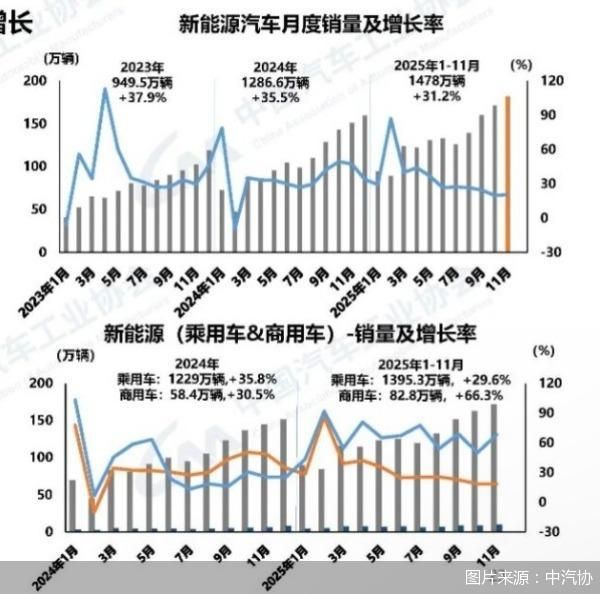
Core Insights - The Chinese automotive market has reported over 30 million vehicle sales this year, with new energy vehicles (NEVs) driving significant growth and influencing upstream and downstream sectors [1] - NEV sales reached 14.78 million units in the first 11 months, achieving a year-on-year growth of 31.2% and a market penetration rate exceeding 50% for two consecutive months [3][4] - Major automotive groups are increasingly dominating the NEV market, with the top 15 groups accounting for 95.2% of total NEV sales [5] Sales Performance - Total automotive sales in China for the first 11 months reached 31.12 million units, a year-on-year increase of 11.4% [1] - NEV sales for the same period were 14.78 million units, with a penetration rate of 47.5% [3] - In November alone, NEV sales surged to 188,000 units, achieving a market share of 53.2% [3] Market Dynamics - The growth in NEV sales is attributed to various vehicle types, with pure electric vehicles and plug-in hybrids showing significant year-on-year increases of 28.9% and 7.9%, respectively [4] - A and B segment vehicles are the primary focus, while A00 and A0 segments have seen remarkable growth rates of 56.9% and 65.1% [4] Competitive Landscape - BYD leads the NEV market with a sales volume of 4.18 million units, capturing 28.3% of the market share [5] - New entrants like Xiaomi and Hongmeng Zhixing have also reported impressive sales figures, with Hongmeng Zhixing delivering over 80,000 units in November, a 89.61% increase [6] Year-End Strategies - As the year-end approaches, automotive companies are intensifying their sales efforts, driven by expiring tax incentives and promotional activities [7][9] - Companies are adopting strategies such as offering existing stock vehicles to meet consumer demand and accelerate sales [8] Supply Chain Impact - The demand for NEVs is boosting the upstream battery market, with battery installation volumes reaching 578 GWh, a 42.4% increase year-on-year [10] - The construction of charging infrastructure is also accelerating, with a 77.2% increase in new charging facilities [10] Future Outlook - The Chinese government aims to enhance charging infrastructure significantly by 2027, targeting 28 million charging facilities to support over 80 million electric vehicles [10][11]



Nio (NYSE: NIO) Stock Price Prediction and Forecast 2025-2030 (Dec 11)
247Wallst· 2025-12-11 12:55
The tariff-driven market volatility has been rough on shares of Chinese electric vehicle (EV) maker Nio Inc. ...
芯片、机器人、AI眼镜,造车新势力要讲新故事
3 6 Ke· 2025-12-11 11:39
Core Insights - Li Auto has launched its first AI glasses, Livis, marking it as the first automotive company to join the "Hundred Glasses War" [2] - The company aims to become a terminal enterprise in the era of general artificial intelligence, planning to develop more hardware products beyond AI glasses [2] - The competition in the electric vehicle market is intensifying, with companies like Tesla and Xpeng also venturing into robotics and AI technologies [4][10] Industry Trends - The market share of fuel vehicles in China has dropped below 50%, with electric vehicles and fuel vehicles now equally represented in new car sales [5] - Predictions indicate that the penetration rate of electric vehicles in China could exceed 85% in the next three years, with high-end electric vehicles expected to surpass 60% by 2026 [5] - The automotive market is experiencing a "zero-sum game," where the growth of electric vehicles comes at the expense of fuel vehicles, leading to a slowdown in overall sales growth [7] Competitive Landscape - New energy vehicle companies are increasingly resembling traditional automakers, focusing on cost control and profitability amid a competitive landscape [8][10] - Li Auto, Seres, and Leap Motor are among the few new energy vehicle companies that have achieved profitability, while others like Xpeng and NIO aim for quarterly profitability [7][10] - The narrative around "automobiles" is shifting, with companies like Li Auto and Xpeng adopting a more diversified approach similar to Tesla's model [8][11] R&D Investments - R&D investments in artificial intelligence and robotics are becoming crucial for new energy vehicle companies, with Li Auto planning to allocate a significant portion of its R&D budget to AI technologies [20][26] - Tesla's R&D expenditures have been steadily increasing, focusing on AI and robotics, while Xpeng and Li Auto are also ramping up their investments in these areas [21][23][26] - The competitive pressure in the market necessitates that new energy vehicle companies maintain a strong focus on their core automotive sales while gradually increasing their investments in AI and technology [26][27]


11月多家新能源汽车销量大增,零跑、小鹏、小米完成全年目标
高工锂电· 2025-12-11 11:10
Core Insights - The article highlights the surge in the electric vehicle (EV) market driven by the impending end of the new energy vehicle purchase tax exemption policy, leading to a year-end consumption peak [2][3] - The battery supply chain is experiencing a rare high production rhythm in December, with material prices rising across the board, prompting several battery companies to announce or plan price increases [2][8] Group 1: Market Performance - In November, the production and sales of new energy vehicles reached 1.88 million and 1.823 million units respectively, both showing a year-on-year increase of 20%, with a penetration rate exceeding 53% [2] - From January to November, cumulative production and sales of new energy vehicles reached 14.907 million and 14.78 million units, respectively, with year-on-year growth exceeding 31% and a penetration rate of 47.5% [2] - Several major automakers, including Li Auto and NIO, have achieved or exceeded their annual sales targets ahead of schedule due to consumer demand driven by the tax policy change [3][4] Group 2: Sales Growth and Market Concentration - Notable sales growth in November includes Leap Motor with a 75.1% year-on-year increase, and Xiaomi Auto with a 99.7% increase [4] - The top fifteen new energy vehicle manufacturers collectively sold 14.072 million units from January to November, representing a year-on-year growth of 32.6% and accounting for 95.2% of total sales [5] - The top three manufacturers (BYD, Geely, SAIC) hold a combined market share of 50.5%, indicating a strengthening head effect in the market [5] Group 3: Battery Production and Pricing - The battery production in December is expected to remain stable at around 220 GWh, marking the first time since late 2022 that production has not decreased in December [6] - The demand from non-power sectors is contributing significantly to the overall production stability, supporting high operational levels in the supply chain [7] - Battery companies are initiating price increases due to rising raw material costs, with Dejia Energy announcing a 15% price hike effective December 16 [9][10]