TSMC(TSM)

Search documents
What Are 3 of the Best AI Stocks to Hold for the Next 10 Years?
The Motley Fool· 2025-12-18 04:00
Core Insights - The article discusses three key companies that are essential players in the AI pipeline, highlighting their potential as long-term investments in the AI sector [2]. Group 1: Taiwan Semiconductor Manufacturing Company (TSMC) - TSMC is the world's leading third-party semiconductor foundry, crucial for manufacturing advanced AI chips, holding a monopoly in this area [4][6]. - The company has experienced impressive growth in revenue and operating income, particularly due to its dominance in advanced AI chip production [7]. - TSMC's market capitalization is $1.5 trillion, with a gross margin of 57.75% and a dividend yield of 1.07% [5][6]. Group 2: Nvidia - Nvidia is a key designer of AI ecosystem components, particularly known for its parallel processors, which have significantly increased its market value to nearly $4.3 trillion [9][11]. - The company reported $57 billion in revenue for the third quarter, a 62% year-over-year increase, with $51.2 billion coming from its data center segment, up 66% [12]. - Nvidia's CUDA platform enhances its competitive edge by allowing its chips to be programmed for specific tasks, creating high switching costs for customers [14][15]. Group 3: Microsoft - Microsoft Azure is the second-largest cloud infrastructure platform, making it a preferred choice for companies developing AI applications [16]. - The company's diverse software portfolio, including Microsoft 365 and LinkedIn, allows for seamless integration of AI technologies, creating additional revenue streams [18][19]. - Microsoft has a market capitalization of $3.5 trillion, with a gross margin of 68.76% and a dividend yield of 0.71% [17][18].




半导体-2026 展望:AI 半导体的强劲势头正将生态推向极限--Semiconductors-2026 Semiconductor Outlook AI semi strength pushing the ecosystem to the limits
2025-12-18 02:35
Summary of Semiconductor Industry Conference Call Industry Overview - **Sector**: Semiconductors, specifically focusing on North America and Greater China - **Outlook**: The semiconductor industry is expected to experience strong growth in 2026, driven primarily by AI demand, with significant implications for memory, foundry, and semiconductor capital equipment sectors [1][4][35] Key Insights - **AI Demand**: The demand for AI semiconductors is projected to dominate the market, with a forecasted 80% year-over-year growth in cloud AI semiconductors in 2026. This growth is expected to maintain strong visibility into 2027 [35] - **Market Dynamics**: The current semiconductor market is characterized by an insatiable appetite for compute power, particularly in processors, which is a critical variable for investment considerations [2] - **Investment Sentiment**: Despite skepticism regarding long-term AI growth, the immediate outlook for 2026 appears robust, with expectations of strong capital spending in AI and data centers [4][11] Company-Specific Insights - **NVIDIA (NVDA)**: - Remains a preferred investment with an overweight rating, expected to be the highest ROI solution in cloud computing. Anticipated product cycles, particularly the Vera Rubin, are expected to enhance its market position [5][18] - Revenue growth is projected to be significant, with sequential increases expected in the coming quarters [18] - **Micron (MU)**: - Identified as a top pick with an overweight rating, driven by structural shortages in DRAM and NAND markets due to AI demand. Price target set at $338, reflecting a premium valuation based on expected earnings growth [15][19] - **Broadcom (AVGO)**: - Also rated overweight, with a price target of $462, supported by strong growth potential in custom silicon and networking [20][23] - **Astera Labs (ALAB)**: - Rated overweight with a price target of $210, showing strong growth rates and a solid position in AI technology [21][23] - **Analog Devices (ADI)** and **NXP (NXPI)**: - Both companies are rated overweight, with price targets of $293, reflecting their strong operational profiles and growth potential in the analog semiconductor market [25][26] Market Challenges - **Supply Constraints**: The semiconductor ecosystem is facing challenges due to capacity constraints, particularly in memory and foundry sectors. The rapid growth in AI demand is straining existing supply chains, leading to concerns about potential bottlenecks [6][84] - **General Purpose Computing**: While AI demand is strong, there are indications that general-purpose computing demand is beginning to correlate with AI needs, which could provide some stability to the market [42][60] Financial Projections - **WFE Market Forecast**: The wafer fabrication equipment (WFE) market is expected to grow by 11% in 2026 and 13% in 2027, driven by demand for DRAM and TSMC's foundry services [29] - **Capex Expectations**: TSMC's capital expenditures are projected to reach approximately $49 billion in 2026, with revenue growth expectations revised up to 30% year-over-year [70][72] Conclusion - The semiconductor industry is poised for significant growth in 2026, primarily driven by AI demand. Key players like NVIDIA, Micron, and Broadcom are expected to benefit from this trend, although supply chain constraints and market dynamics will require careful monitoring. The overall sentiment remains bullish, with strong investment opportunities identified in AI and memory sectors [1][4][11][35]


台民间忧半导体产业优势流失 国台办:绝非危言耸听
Zhong Guo Xin Wen Wang· 2025-12-18 01:44
台民间忧半导体产业优势流失 国台办:绝非危言耸听 中新社北京12月17日电 (张杨彬 黄欣欣)《日经亚洲》日前披露台积电拟在日本第二座工厂生产比原定 计划更先进的4纳米芯片,国务院台办发言人朱凤莲17日表示,台湾民众对半导体产业未来发展的担忧 绝非危言耸听。 就美国《国家安全战略》报告宣称"不支持任何单方面改变台湾海峡现状的行为",朱凤莲指出,应避免 极少数"台独"分裂分子把中美两国拖入冲突对抗的危险境地。(完) 来源:中国新闻网 编辑:董文博 广告等商务合作,请点击这里 本文为转载内容,授权事宜请联系原著作权人 中新经纬版权所有,未经书面授权,任何单位及个人不得转载、摘编或以其它方式使用。 关注中新经纬微信公众号(微信搜索"中新经纬"或"jwview"),看更多精彩财经资讯。 当天在北京举行的国台办例行新闻发布会上,朱凤莲指出,民进党当局早已将台积电视为对美日输诚献 媚的工具,为谋求自身政治私利,不惜榨干台湾半导体产业,彻底沦为外部势力肆意掠夺台湾同胞利益 的帮凶。广大台湾同胞和产业界有识之士应勇于发声、勇于行动,维护自身福祉和产业发展未来。 中国外交部日前发布对日本自卫队前统合幕僚长岩崎茂采取反制措施的决 ...
摩根士丹利将台积电目标价上调12% 营收和利润率料具上升潜力
Ge Long Hui· 2025-12-18 01:07
摩根士丹利上调台积电目标股价,认为其营收和利润率具有增长潜力,并建议投资者在2026年初之前增 持该股。目标价从1688元台币上调至1888元台币。预计台积电将在指引中显示2026年营收增长在20%中 段区间,最终实现同比增长30%;并预计公司在2025年第四季度毛利率将突破60%,2026年全年保持在 60%以上。 ...
台积电真正的瓶颈显现
半导体行业观察· 2025-12-18 01:02
Group 1 - The core viewpoint of the article emphasizes TSMC's acceleration in capacity optimization and process reconfiguration to meet the substantial demand for AI GPUs and custom ASICs as they enter mass production [1] - TSMC is implementing strategies such as optimizing existing production lines and transitioning older nodes (7nm and 5nm) to 3nm processes to enhance capital efficiency [1][4] - The 3nm process is identified as the real bottleneck for the upcoming year, with TSMC's advanced packaging solution, CoWoS, expected to remain the mainstream packaging method for AI chips [1][2] Group 2 - The semiconductor industry is witnessing a decrease in the number of effective chips per wafer due to the introduction of more computational units and I/O designs in AI GPUs and ASICs, leading to increased demand for advanced process wafers [2] - TSMC plans to establish a CoPoS RD experimental line in Q2 of next year, with mass production expected by 2028, focusing on improving the efficiency of chip packaging [2] - TSMC's 2nm process is set to begin next year, with capacity already booked until the end of 2026, driven by the GAA architecture which offers significant performance and efficiency improvements over FinFET technology [4][5] Group 3 - Major clients for TSMC's 2nm process include Qualcomm, MediaTek, Apple, and AMD, with Apple reportedly reserving over half of the initial capacity to suppress competitors [5] - TSMC aims to increase its monthly output of 2nm chips to 100,000 by the end of 2026, positioning this cutting-edge technology as a key growth driver for the company [5]
美股全线下跌!特斯拉重挫超4%
Zhong Guo Zheng Quan Bao· 2025-12-17 23:37
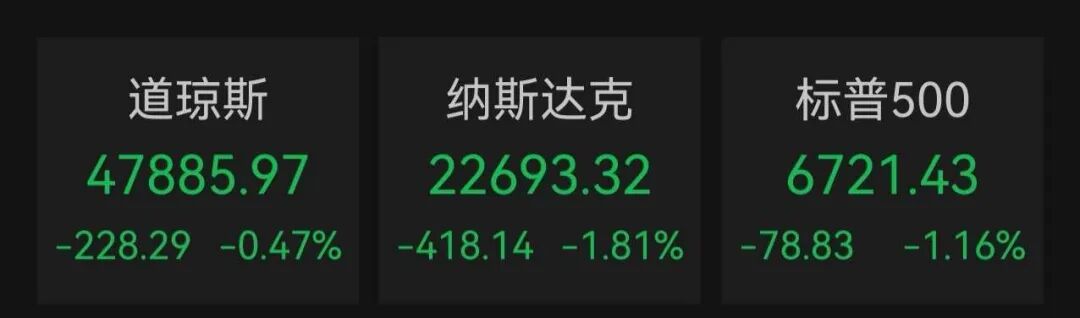
Market Performance - The three major U.S. stock indices closed lower on December 17, with the Dow Jones down 0.47% at 47,885.97 points, the S&P 500 down 1.16% at 6,721.43 points, and the Nasdaq down 1.81% at 22,693.32 points [3]. - Major technology stocks collectively declined, with Tesla dropping over 4%, Nvidia nearly 4%, and Google over 3% [2][5]. Sector Performance - The Philadelphia Semiconductor Index fell by 3.78%, with significant declines in major chip stocks such as ASML, ARM, and AMD, each dropping over 5%, and Broadcom down over 4% [5]. - Chinese concept stocks mostly declined, with the Nasdaq Golden Dragon China Index down 0.73%. Notable declines included Century Internet and NIO, both down over 3%, while Dingdong Maicai surged over 22% [6]. Commodity Market - Precious metals futures saw a general increase, with COMEX gold futures rising by 0.9% to $4,371.40 per ounce and COMEX silver futures up 4.92% to $66.44 per ounce [6]. - Crude oil prices also increased, with light crude oil futures for January delivery rising by $0.67 to $55.94 per barrel (up 1.21%) and Brent crude for February delivery up $0.76 to $59.68 per barrel (up 1.29%) [8]. Monetary Policy - The Federal Reserve's monetary policy remains restrictive, with room for potential interest rate cuts in the future. Fed Governor Christopher Waller indicated that there is no urgency for rate cuts, suggesting a gradual approach towards neutral policy rates to address slowing inflation while maintaining economic resilience [9].


台积电日本熊本厂深陷亏损泥潭
Huan Qiu Wang Zi Xun· 2025-12-17 23:26
Core Viewpoint - TSMC's performance in 2025 is projected to reach NT$3.7 trillion, driven by strong demand for AI, but concerns arise over the ongoing losses at its Kumamoto plant in Japan due to low capacity utilization and market challenges [1][2] Group 1: TSMC's Financial Outlook - TSMC's projected revenue for 2025 is NT$3.7 trillion, reflecting optimism in the AI sector [1] - The company has faced significant losses at its Kumamoto plant, which has raised concerns among stakeholders [1][2] Group 2: Challenges at Kumamoto Plant - The Kumamoto plant's capacity utilization is reportedly low, with ongoing losses attributed to reduced demand for automotive chips from Japanese manufacturers [2] - The plant's 28nm process is particularly affected, leading to a capacity utilization rate of approximately 50% [3] - TSMC is considering changing the planned production from 6nm to 2nm at the Kumamoto plant to address the ongoing losses, which would significantly increase investment costs from over US$10 billion to over US$25 billion [3] Group 3: Market Dynamics - The rise of mature process technology in mainland China has impacted TSMC's mature process capacity utilization, with reports indicating that the advanced 6nm process in Taiwan has also seen a decline to 60-70% utilization [2] - The Japanese automotive market's sluggish recovery has further exacerbated the challenges faced by TSMC's Kumamoto plant [3] Group 4: Government and Investment Considerations - The success of the 2nm process at the Kumamoto plant hinges on whether the Japanese government will provide additional subsidies [3] - TSMC's financial performance in the U.S. has also been under scrutiny, with significant losses reported at its Arizona facility since its establishment [3]
Steve Mandel’s Lone Pine Capital Reveals Major Portfolio Shifts in Latest 13F Filing
Acquirersmultiple· 2025-12-17 22:26
Core Insights - The latest 13F filing from Lone Pine Capital indicates significant portfolio adjustments, particularly in large-cap technology, consumer platforms, and financial services, reflecting a more risk-balanced approach as year-end approaches [1] Portfolio Adjustments - **Meta Platforms Inc. (META)**: Reduced by 342,757 shares (20.59%), maintaining a substantial holding worth over $971 million, indicating profit-taking rather than a loss of conviction [2] - **Vistra Corp (VST)**: Trimmed by 1,770,478 shares (27.37%), likely locking in gains after significant appreciation driven by power-generation strength [3] - **Taiwan Semiconductor (TSM)**: Reduced by 383,520 shares (11.16%), remaining a core holding valued at $852 million amid cyclical uncertainty [4] - **AppLovin (APP)**: Reduced by 152,196 shares (12.07%), reflecting portfolio resizing rather than a fundamental shift [5] - **Microsoft Corp (MSFT)**: Trimmed by 646,251 shares (34.84%), still representing a large stake of $625 million, indicating profit-taking [10] - **Amazon.com Inc. (AMZN)**: Reduced by 2,221,628 shares (44.14%), with a remaining position valued at $617 million, reflecting reallocation within mega-cap tech [11] - **Capital One Financial (COF)**: Reduced by 511,142 shares (16.59%) following strong performance [12] - **KKR & Co (KKR)**: Trimmed by 1,141,208 shares (21.85%), appearing valuation-driven after appreciation [13] Notable Increases - **LPL Financial Holdings (LPLA)**: Increased by 383,466 shares (20.48%), expanding the position to $750 million, reflecting confidence in its scalable advisor platform [6] - **Philip Morris (PM)**: Increased by 1,856,749 shares (67.33%), bringing the position to $748 million, aligning with a strategy of investing in stable, cash-rich companies [7] - **Brookfield Corp (BN)**: Increased by 4,559,963 shares (81.12%), indicating a belief in the stock's undervaluation relative to its diversified asset management ecosystem [8] - **Broadcom Inc. (AVGO)**: New position established with 1,549,412 shares (100.00%), indicating a strong belief in AI infrastructure growth [14] Strategic Themes - **Selective Trimming of Mega-Cap Tech Winners**: Reductions in META, MSFT, AMZN, and TSM reflect disciplined risk management after substantial rallies, moderating concentration risk while maintaining core positions [15] - **Reallocation Toward Cash-Heavy Compounders**: Additions to PM, BN, and LPLA emphasize resilient earnings profiles and attractive valuations [16] - **New Conviction Bet on AI Infrastructure via Broadcom**: The initiation of a large AVGO position signals confidence in the accelerating demand for AI hardware [17] - **Active, High-Conviction Portfolio Rotation**: Lone Pine's approach involves selectively trimming oversized winners and reallocating to durable cash-flow engines while initiating new positions in strong long-term fundamentals [18] Summary - Lone Pine Capital's Q3 2025 13F reveals a portfolio recalibration focused on reducing oversized mega-cap exposures, reinforcing durable cash generators, and launching a significant new position in Broadcom to capture AI-infrastructure tailwinds, resulting in a portfolio geared toward long-term growth while balancing risk as year-end volatility approaches [19]




Sidestepping Concentration: Accessing the Hidden Layer of AI Hardware
Etftrends· 2025-12-17 13:25
Core Insights - The semiconductor investment thesis is evolving, particularly with the rise of application-specific integrated circuits (ASICs), presenting unique structural opportunities for investors [1] - The shift in the AI market is moving from general-purpose hardware to custom silicon designed for specific needs, as major hyperscalers like Alphabet, Meta, and Amazon adopt a "do-it-yourself" model [2] Industry Trends - The demand for bespoke efficiency in AI hardware is increasing, leading to a focus on specialized design firms that connect software giants with physical manufacturing [3] - Global Unichip Corp (GUC) is positioned as a key player in this transition, acting as a specialized ASIC design partner for tech giants [4] Company Analysis - GUC supports ASIC design and advanced packaging for custom chip development, crucial for hyperscale and cloud AI programs [4] - GUC's strategic relationship with Taiwan Semiconductor Manufacturing Company (TSMC), which owns approximately 35% of GUC, provides production security and technical synergy [5] Investment Opportunities - There is a concentration risk in AI-related investments, with many portfolios heavily weighted towards Nvidia and TSMC, while exposure to the specialized ASIC ecosystem remains limited [6] - The ROBO Global Artificial Intelligence ETF (THNQ) offers investors access to GUC, enabling diversification within the semiconductor investment landscape [7]

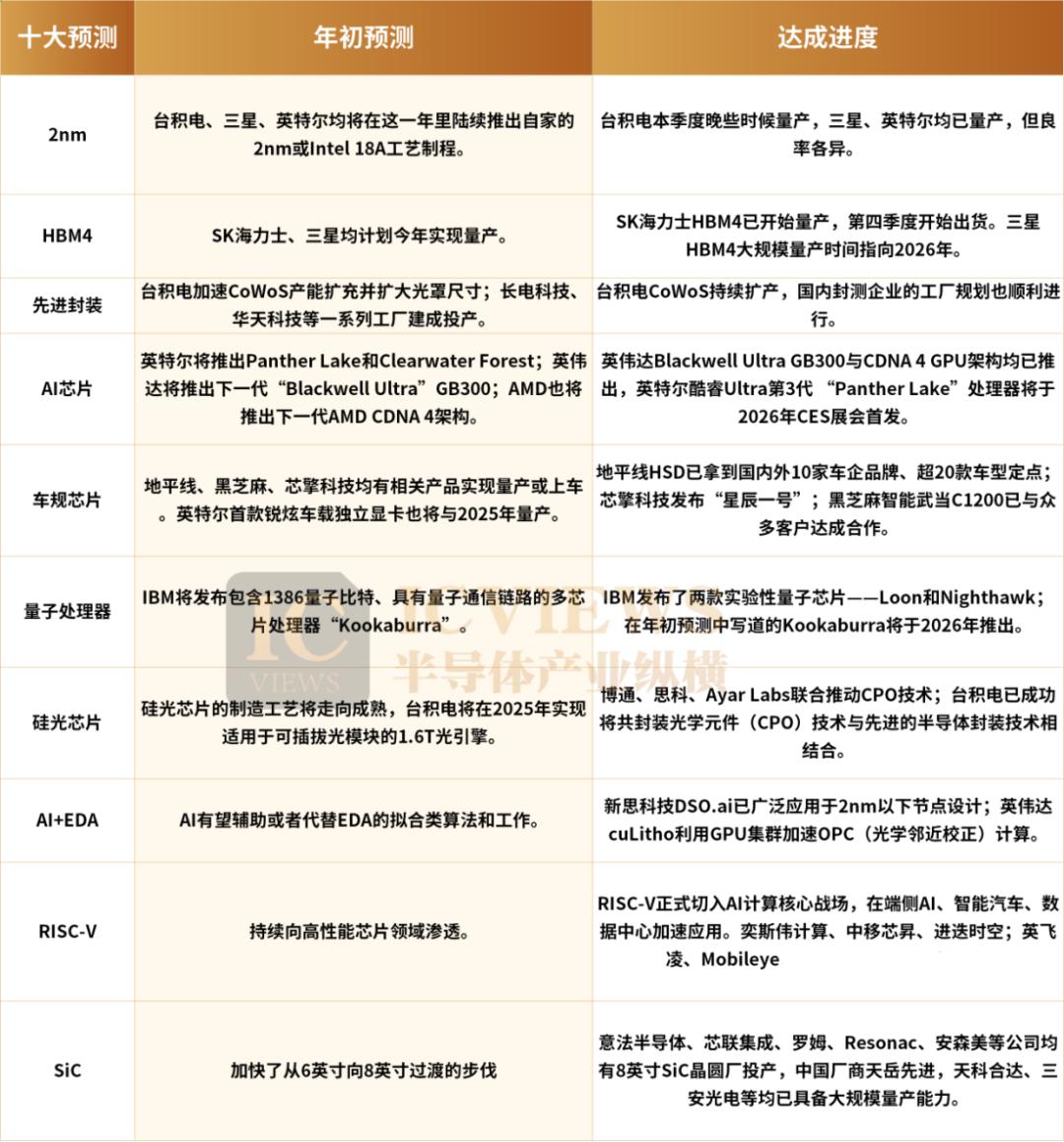
半导体十大预测,“进度条”几何?
3 6 Ke· 2025-12-17 11:59
Core Insights - The semiconductor industry has made significant progress in the ten key technology trends predicted for 2025, including advancements in 2nm technology, HBM4, advanced packaging, AI processors, automotive chips, quantum processors, silicon photonics, AI in EDA, RISC-V, and SiC technology [1][2]. Group 1: 2nm Technology - TSMC, Samsung, and Intel have all initiated mass production of 2nm or equivalent processes, with TSMC planning to ramp up production capacity significantly [2][3]. - TSMC has received orders for 2nm chips from major clients like Apple and NVIDIA, with demand exceeding that of the previous 3nm generation [3]. - Samsung's 2nm mobile application processor, Exynos 2600, has begun mass production, but its yield rates remain uncertain [3][4]. Group 2: HBM4 - SK Hynix has entered mass production of HBM4 memory chips, with shipments expected to start in Q4 2025, while Samsung is still in the final testing phase [5]. - Samsung is negotiating prices for HBM4 supplies with NVIDIA, aiming to maintain its competitive edge in the DRAM market [5]. Group 3: Advanced Packaging - TSMC is expanding its CoWoS capacity and has initiated the development of CoPoS technology, with plans for mass production by 2026 [6][7]. - Domestic packaging companies are also ramping up production capabilities, with several projects already in operation [7]. Group 4: AI Processors - NVIDIA has launched the Blackwell Ultra GB300 chip, which is now in mass production, promising significant improvements in computational throughput [8][9]. - AMD has introduced the CDNA 4 GPU architecture, with plans for the MI400 series GPU to be released in 2026 [9]. Group 5: Automotive Chips - Horizon has secured partnerships with over 10 automotive brands for its high-level intelligent driving solutions, with significant production milestones achieved [11]. - Black Sesame has developed a cross-domain computing chip platform for smart vehicles, with multiple collaborations established [11][12]. Group 6: Quantum Processors - IBM has released experimental quantum chips and plans to launch the Kookaburra processor in 2026, marking a step towards practical quantum computing [13][14]. Group 7: Silicon Photonics - The integration of silicon photonics and CPO technology is advancing, with TSMC expected to provide samples for 1.6T optical transmission technology in 2025 [15][16]. - The demand for 800G optical modules is projected to surge, with significant growth anticipated in the coming years [15][17]. Group 8: RISC-V - RISC-V is expanding its presence in high-performance computing, with various companies developing AI-related chips and platforms [18][19]. - The RISC-V International predicts substantial market share growth across multiple sectors by 2031 [19]. Group 9: SiC Technology - The transition to 8-inch SiC wafer production is underway, with several companies achieving large-scale production capabilities [20][21]. - The shift to 8-inch substrates is expected to reduce costs and increase production efficiency in various applications, including electric vehicles and renewable energy [21][22]. Group 10: AI in EDA - AI is transforming the EDA landscape, with tools like Synopsys DSO.ai enhancing chip design efficiency significantly [22][23]. - The integration of AI in EDA processes is lowering the barriers for high-end chip design, indicating a shift in industry practices [24].