
TSMC(TSM)

Search documents
连MCU都开始涨价了!(附最新涨价函汇总)
芯世相· 2026-01-28 07:07
Core Viewpoint - The semiconductor industry is experiencing a widespread price increase, affecting various segments including memory, passive components, and main control chips, driven by rising raw material costs and strong demand, particularly in AI applications [2][3][35]. Price Increases in Semiconductor Components - Companies like Zhongwei Semiconductor announced price hikes of 15%-50% for MCU and NOR Flash products starting January 2026 [2][60]. - Major memory manufacturers such as Samsung and SK Hynix have also raised prices significantly, with Samsung increasing NAND Flash prices by over 100% in Q1 2026 [20][22]. - Micron has reported a general price increase of approximately 20% across its product lines [23][24]. Price Increases in Raw Materials and PCB - Resonac announced a 30% price increase for copper-clad laminates and adhesive films starting March 1, 2026, due to tight supply and rising costs [8]. - Nanya Plastics raised prices for all CCL and PP products by 8% due to increases in raw material costs [12]. - Taisil has implemented price increases of 5%-10% for its copper-clad laminates in response to rising material costs [9]. Price Increases in Wafer Foundries - TSMC has informed clients of price increases for advanced nodes (5nm, 4nm, 3nm, 2nm) over four consecutive years, with expected increases of 8%-10% for 5nm and up to 50% for 2nm [15]. - SMIC has also raised prices by approximately 10% for certain capacities [16]. - TrendForce predicts that the average capacity utilization rate for 8-inch wafer foundries will rise to 85%-90% in 2026, prompting price increases of 5%-20% across the board [14]. Price Increases in Passive Components - Companies like Yageo and Walsin have announced price increases for tantalum capacitors and resistors, with Yageo raising prices by 15%-20% for certain resistor products [33][34]. - Other passive component manufacturers are also adjusting prices due to rising raw material costs, with increases ranging from 5% to 30% [32][40]. General Market Trends - The semiconductor market is seeing a significant increase in demand driven by AI applications, leading to widespread price adjustments across various sectors [35][58]. - Many companies are experiencing full order books, prompting them to consider further price increases in the near future [19][20].






产业经济周报:BD出海加速,AI应用竞赛升级-20260128
Tebon Securities· 2026-01-28 06:49
Market Performance - The market showed mixed performance from January 19 to January 23, with the Shanghai Composite Index rising by 0.84% and the Shenzhen Component Index increasing by 1.11%[5] - The average daily trading volume was 2.80 trillion yuan, a decrease compared to the previous week[5] Healthcare Sector - At the JPM 2026 conference, over 20 Chinese innovative pharmaceutical companies showcased their advancements, with significant business development (BD) transactions reported[16] - In 2025, the value of China's innovative drug patent licensing transactions reached approximately $135.7 billion, a 143% year-on-year increase, with 157 total transactions[20] Consumer Sector - The Qianwen APP integrated with Alibaba's ecosystem, achieving over 100 million monthly active users within two months of launch, marking its entry into the "billion-level club"[25] - This integration allows for a seamless process from search to decision-making and payment, establishing a comprehensive AI application ecosystem[26] Hard Technology Sector - The supply of storage and logic chips remains tight, leading to widespread price increases across the industry[32] - The price of enterprise SSDs continues to rise due to increased demand from AI servers, with NAND Flash supply expected to decrease by 41.7% in 2026[35] High-end Manufacturing - The State Grid announced a total fixed asset investment of 4 trillion yuan for the 14th Five-Year Plan period (2026-2030), a 40% increase from the previous period, averaging 800 billion yuan annually[42] - By 2030, renewable energy generation is expected to account for approximately 30% of total power generation, indicating significant growth potential in the solar and wind sectors[46]


大行评级|里昂:上调台积电目标价至3030新台币,预期盈利受益于定价改善与毛利率提升
Ge Long Hui· 2026-01-28 06:11
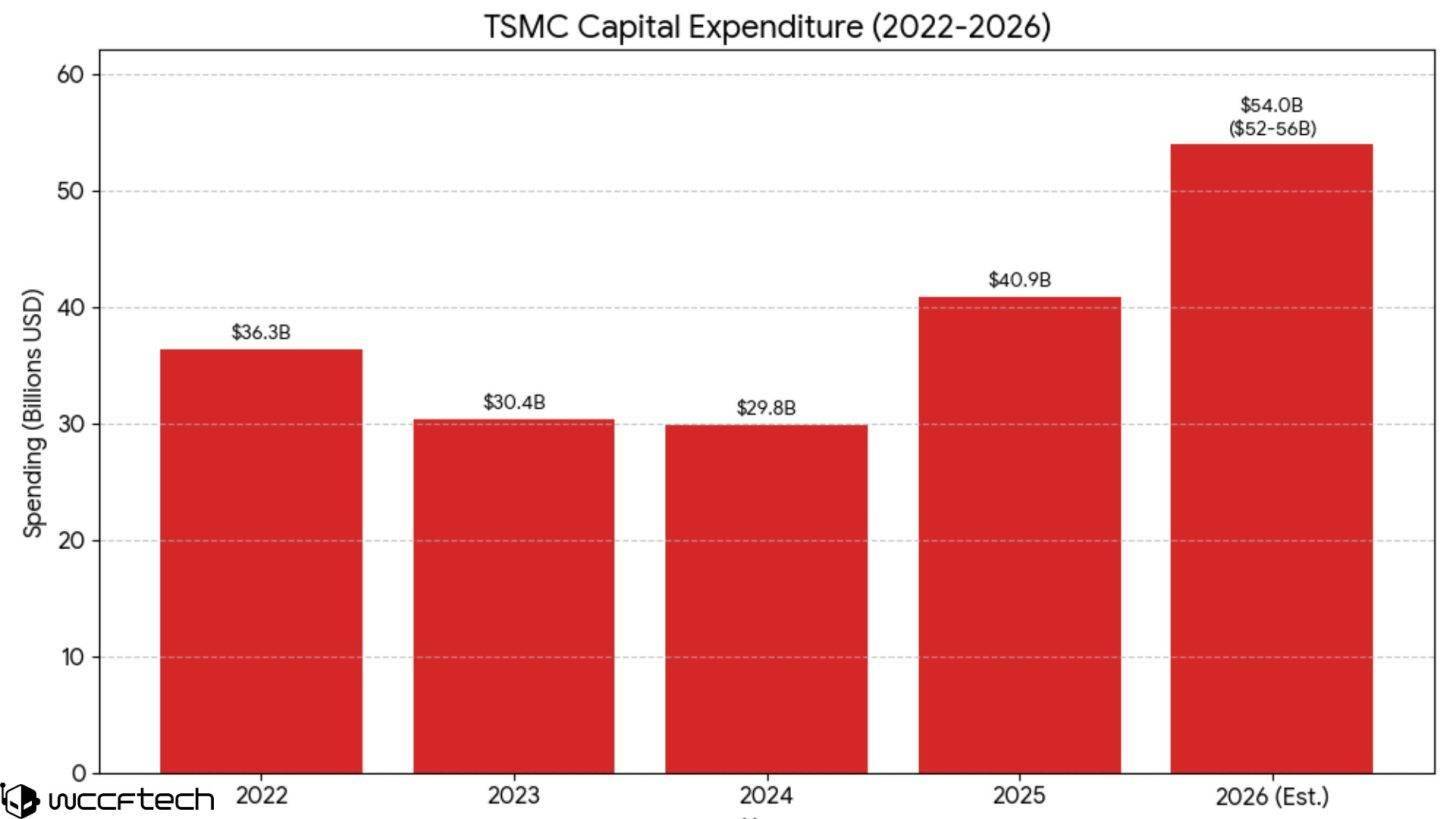
Group 1 - TSMC's capital expenditure guidance for this year is surprisingly high at $52 billion to $56 billion, primarily due to a higher-than-expected proportion of spending on new factory construction [1] - The amount of unfinished projects remains high, indicating that the ramp-up of capacity is slower than anticipated, while spending on land and infrastructure is accelerating [1] - The supply-demand balance is not expected to change significantly in the next two years [1] Group 2 - TSMC's pricing improvements and gross margin enhancements have led to a 14% and 19% upward revision in earnings per share forecasts for this year and next year, respectively [1] - The target price for TSMC has been raised from 2,000 New Taiwan Dollars to 3,030 New Taiwan Dollars, aligning the target price-to-earnings ratio closer to that of NVIDIA [1]
The Top 3 Artificial Intelligence (AI) Chip Stocks to Buy With $50,000 in 2026
The Motley Fool· 2026-01-28 05:00
Core Viewpoint - Semiconductor stocks are expected to gain further as investments in AI infrastructure accelerate, with major tech companies spending hundreds of billions on data centers and AI chip technology [1]. Group 1: Nvidia - Nvidia is a leading choice due to its dominance in GPUs and CUDA software, which are essential for generative AI [3]. - AI processing semiconductor revenue surpassed $200 billion last year, with a projected CAGR of 14% through 2033, reaching a total addressable market of $486 billion; Nvidia is expected to maintain a 75% market share through 2030 [4]. - Nvidia is expanding its business lines, including a $20 billion partnership with Groq for inference capabilities, which may enhance its leadership in the AI chip market [5]. - Despite its strong position, Nvidia's stock is trading at its lowest valuation in over a year, indicating potential investor concerns about competition from AMD and Broadcom [6]. - The AI chip market is still expanding, allowing for multiple winners, and Nvidia is recommended as a buy-and-hold investment for long-term growth [7]. Group 2: Taiwan Semiconductor Manufacturing (TSMC) - TSMC is the largest chip manufacturer globally, holding nearly 70% market share, and serves as a key partner for companies like Nvidia and AMD [8][9]. - TSMC's diverse manufacturing capabilities position it well to benefit from the growing AI chip market, as it can produce various chip types [10]. - The company is set to capture significant market share in the AI chip sector as hyperscalers increase their capital expenditures on AI infrastructure [11]. - TSMC is investing in new manufacturing facilities and expanding its geographic presence, indicating potential for further growth in the ongoing chip supercycle [12]. Group 3: Micron Technology - The rise of large language models and generative AI has created a demand for high-bandwidth memory (HBM) and storage solutions, benefiting Micron Technology [13]. - Micron's revenue in its DRAM division increased by 69% year-over-year, with NAND sales rising by 22% in the fiscal first quarter of 2026 [14]. - Micron's earnings per share (EPS) are projected to triple this year, indicating strong pricing power in the memory and storage market [15]. - Despite its strong outlook, Micron is undervalued with a forward P/E of 11, suggesting it may be an attractive investment opportunity [16].


TSMC Has Become A Buy Again (Rating Upgrade)
Seeking Alpha· 2026-01-28 04:39
Core Viewpoint - The article emphasizes the importance of core values such as excellence, integrity, transparency, and respect for long-term success in the investment sector [1]. Group 1 - The author identifies as a full-time investor with a strong focus on the tech sector and holds a Bachelor of Commerce Degree with Distinction, majoring in Finance [1]. - The author is a lifetime member of the Beta Gamma Sigma International Business Honor Society, indicating a commitment to academic excellence [1]. - The article invites readers to provide constructive criticism and feedback to enhance the quality of future work [1]. Group 2 - The author discloses having no stock, option, or similar derivative positions in any mentioned companies and has no plans to initiate such positions within the next 72 hours [1]. - The article expresses the author's personal opinions and states that no compensation is received for the article, except from Seeking Alpha [1].
Stratechery称台积电已成为全球AI供应链中最大的“风险”因素
Sou Hu Cai Jing· 2026-01-28 04:25
Core Viewpoint - TSMC has been identified as the largest "risk" factor in the global AI supply chain due to its conservative early predictions regarding AI demand, despite its dominant position in the semiconductor foundry sector [1] Group 1: TSMC's Position and Challenges - TSMC's CEO has shown caution towards large-scale construction, leading to insufficient early investments and resulting in a severe supply shortage [2] - The impact of capacity bottlenecks has spread from chip manufacturers to downstream hyperscalers, with companies like Nvidia and AMD facing extended delivery cycles [2] - Major tech companies such as Microsoft, Google, and Meta are currently unable to secure guaranteed delivery schedules, with Microsoft's Maia 200 AI chip facing significant supply constraints [2] Group 2: Financial Implications and Production Capacity - Analysts warn that the current risks could translate into revenue losses amounting to billions of dollars for hyperscale operators [2] - In addition to wafer manufacturing, the shortage of advanced packaging capacity is another critical issue, with TSMC's CoWoS technology being the preferred solution for AI chip manufacturing [2] - TSMC plans to increase capital expenditures to $56 billion this year to alleviate pressure, but it is unlikely to meet the surging market demand in the short term [2] Group 3: Competitive Landscape - Competitors like Intel Foundry and Samsung are attempting to enter the AI chip manufacturing space, but manufacturers remain hesitant to switch from TSMC due to the irreplaceable supply chain ecosystem and trust established by TSMC [4]
AI 供应链:TPUASIC 动态;ICMS 存储芯片需求测算Asia-Pacific Technology-AI Supply Chain TPUASIC updates; ICMS NAND demand calculation
2026-01-28 03:03
January 27, 2026 10:15 PM GMT Asia-Pacific Technology | Asia Pacific AI Supply Chain: TPU/ASIC updates; ICMS NAND demand calculation We sense that AI semi vendors have started securing critical 2027 components – T-Glass/ABF, HBM, and TSMC 3nm – (e.g., MediaTek's 3nm TPU). Downgrade Egis to EW, as its 2026 appears to be shaping up as a year of transition. ASIC – Volume upside for MediaTek's 3nm TPU project in 2027: In our Target Price Up report, we highlighted the supply chain's bull case of 6-7mn TPU units ...
格林大华期货早盘提示:全球经济-20260128
Ge Lin Qi Huo· 2026-01-28 01:22
Report Summary 1. Investment Rating - No investment rating for the industry is provided in the report. 2. Core Viewpoints - The global economy has passed its peak and is on a downward trend due to consecutive wrong policies in the US [4]. - The US's return to the Monroe Doctrine and global contraction will have a profound and disruptive impact on major asset classes such as the global economy, US Treasuries, US stocks, the US dollar, precious metals, and industrial metals [3]. 3. Summary by Related Catalogs Global Economic News - Bridgewater Associates founder Ray Dalio warns that the US is like a powder keg on the verge of civil war, having deeply entered the "pre - collapse stage" and at risk of entering the sixth stage marked by the collapse of the existing order [1]. - Emerging market stock and bond ETFs have seen a total of $6.83 billion in capital inflows, with Chinese - related ETFs being the most favored. $1.65 billion flowed into the Chinese market last week [1]. - Guoxing Aerospace has deployed the Tongyi Qianwen Qwen3 large - model to the "Star Computing" Plan 01 group space computing center, the world's first deployment of a general large - model to an orbiting satellite [1]. - Microsoft has released its second - generation self - developed AI chip Maia 200, marking significant progress in its self - developed chip field [1]. - NVIDIA CEO Jensen Huang announced the launch of the server CPU "Vera" to solve the CPU bottleneck in the AI supply chain [1]. - If the imbalance between supply and demand of memory chips persists until the first half of 2027, it may be an opportunity for Chinese manufacturers to narrow the technological gap [1]. - Samsung and SK Hynix doubled the price of low - power DRAM supplied to Apple in Q1, and prices may rise further in the second half of the year [1]. - Zijin Mining acquired Allied Gold for $28 billion, with Allied Gold having 533 tons of gold resources as of the end of 2024 [1]. Global Economic Logic - The US is facing a high risk of civil war, and the global political order has entered a chaotic period, bringing great uncertainty to the global economy [2]. - There are speculations about the possibility of a "Plaza Accord 2.0", and the uncertainty of the Fed is expected to peak from July to November 2026, which may lead to a "flight from US assets" [2]. - The Fed will cut interest rates by 25 basis points in December and purchase $40 billion in short - term bonds monthly, restarting the expansion of its balance sheet [2]. - The decline in gambling revenue in Las Vegas is similar to the early warning signal before the 2008 financial crisis [2]. - The US will adjust its economic relations with China and revive its economic autonomy [2]. - The K - shaped differentiation of consumers in the US is intensifying, with high - income consumers maintaining spending while middle - and low - income families are cutting back [2]. - TSMC's capital expenditure in 2026 is expected to be between $52 billion and $56 billion, a significant increase of 27% - 37% year - on - year, indicating the continued AI boom [2]. - SpaceX hopes to achieve full rocket reusability this year, which will reduce the cost of space access by 100 times [2].



韩国半导体出口同比大幅增长,DRAM价格持续上涨
Zhong Guo Neng Yuan Wang· 2026-01-28 01:17
Core Viewpoint - The data center sector is driving significant growth in the power equipment industry, with capital expenditures showing high growth trends, particularly in overseas markets, while domestic giants like Alibaba and Tencent are experiencing a slowdown in capital spending [1][3]. Demand Side - Overseas capital expenditures from major companies reached $99.617 billion in Q3 2025, reflecting an 80.39% year-on-year increase and a 9.54% quarter-on-quarter rise [3]. - Domestic capital expenditures for Alibaba amounted to 31.5 billion yuan in Q3 2025, a year-on-year increase of 80.10% but a quarter-on-quarter decrease of 18.55%. Alibaba reaffirmed its three-year investment framework of 380 billion yuan, indicating potential for further investment [3]. - Tencent's capital expenditures were 13 billion yuan in Q3 2025, showing a year-on-year decline of 24.05% and a quarter-on-quarter decline of 32.05%, with a downward revision of its annual guidance [3]. Supply Chain - NVIDIA reported total revenue of $57.006 billion in Q3 2025, with data center product revenue reaching $51.215 billion, marking a historical peak with a quarter-on-quarter growth of 24.62% and a year-on-year growth of 66.44%, accounting for over 89% of total revenue [4]. - TSMC's revenue for December 2025 was 335 billion new Taiwan dollars, a year-on-year increase of 20.4% but a quarter-on-quarter decline of 2.5%, achieving a record high for the same period [4]. - The CPU price index rose to 99.04 in November 2025, up from 98.20 in October, while DRAM spot prices surged from $27.14 on November 17, 2025, to $71.25 by January 23, 2026, reflecting a significant increase of over 178% within two months [4]. - South Korea's semiconductor exports reached $10.73 billion from January 1 to January 20, 2026, representing a substantial year-on-year growth of 70.2% and accounting for 29.5% of total exports, an increase of 9.6 percentage points compared to the previous year [4]. Application Side - The number of models in use is steadily increasing, with token usage from January 13 to January 19, 2026, reaching 7.50 trillion, a slight decrease of 1.96% [5]. - The release of new models such as Grok4Fast, GPT-5nano, and gpt-oss-20B in Q3 2025 led to a decline of over 50% in the price of tokens for models scoring above 40 on the Artificial Analysis intelligence index [5]. Investment Recommendations - The construction of data centers is expected to drive demand for HVDC and SST technologies, with an anticipated global increase of approximately 14 GW in data center installations in 2024. Major cloud providers are expected to maintain high capital expenditures, with TSMC's capital expenditures projected to reach $52-56 billion in 2026, a year-on-year increase of about 30% [6]. - The increasing power density of data center cabinets is likely to enhance the penetration of HVDC and SST technologies, with smart busbars expected to see widespread adoption [6]. - Recommended stocks include Zhongheng Electric (002364), Oulu Tong (300870), Weiteng Electric (688226), and Sunshine Power (300274), with additional attention suggested for Kehua Data (002335), Keda (002518), Kelu Electronics (002121), Magmi Tech (002851), Jinpan Technology (688676), and Sifang Co. (601126) [6].



报道:供应链消息称,苹果之后,英伟达下一代GPU也将合作英特尔,以取悦特朗普
Hua Er Jie Jian Wen· 2026-01-28 01:12
继苹果之后,英伟达也计划将部分芯片制造业务转向英特尔代工。英伟达预计在2028年推出的Feynman 架构平台将与英特尔合作,这是美国科技巨头在特朗普政府推动"美国制造"目标下调整供应链策略的最 新案例。 据DIGITIMES周三报道,供应链人士透露,英伟达将在与英特尔的合作中采用"量少、低阶、非核 心"的合作策略。GPU核心芯片仍由台积电代工,而I/O芯片则部分采用英特尔18A或预定2028年量产的 14A制程,最后由英特尔EMIB进行先进封装。按先进封装比重计算,英特尔最高约占25%,台积电约 占75%。 这一转变反映出美国科技企业在政治压力、关税威胁和供应链韧性考量下,不得不从高度集中于台积电 的模式转向"多源供应、分散风险"的新策略。除英伟达和苹果外,谷歌、微软、AWS、高通、博通、 超微和特斯拉等企业也在与英特尔洽谈合作。 尽管部分订单分流至英特尔,但业界认为这对台积电"利远大于弊",有助于降低垄断疑虑、释放政治压 力,同时台积电仍有信心稳固高阶芯片代工大单。 台积电三层战略应对客户分流 目前观察,苹果、英伟达都以代工风险最低的产品渐进式调整。与英特尔洽谈合作的还有谷歌、微软、 AWS、高通、博通、 ...
