XPENG(XPEV)

Search documents
“一车双能”扩容叠加智能化升级 小鹏2026年新品将密集落地
Zheng Quan Ri Bao Wang· 2026-01-09 12:26
Core Insights - Xiaopeng Motors is set to launch four significant models at the 2026 Global New Product Launch, marking 2026 as a pivotal year for the company's global product and technology expansion, transitioning into a key phase of physical AI development [1] - The company reported a record global delivery of 429,400 vehicles in 2025, a 126% year-on-year increase, positioning 2026 as a critical year for strategic breakthroughs [2] Group 1: Technology and Innovation - Xiaopeng Motors is transitioning from a traditional automaker to an AI technology company, with a focus on the next three years as crucial for physical AI advancements [2] - The upcoming VLA (Vision Language Action) technology is anticipated to revolutionize autonomous driving, with plans for mass production and upgrades in 2026 [2] - The unified VLA technology platform will enable the development of both Ultra and Robotaxi versions, reducing R&D costs and facilitating rapid application of AI technologies across different product forms [2] Group 2: Robotics and Future Projects - The company is developing a production version of its robot, which aims to be humanoid and capable of communication, contrasting with traditional software-driven robots [3] - Xiaopeng Motors is also advancing its flying car project, indicating a comprehensive technology ecosystem that includes land, air, and intelligent services [3] Group 3: Globalization Strategy - Xiaopeng Motors has entered 60 countries and regions by 2025, with plans for further market expansion and a focus on local R&D and manufacturing to enhance competitiveness [4] - A strategic partnership with Volkswagen is a key element of Xiaopeng's globalization efforts, with the first collaborative model expected to enter mass production soon [4] - The company is confident in deploying its VLA technology in Europe, having conducted extensive road testing and engaged with local governments on regulatory matters [4] Group 4: Product Innovation - The 2026 Xiaopeng G7 model features advanced super-range technology, achieving a pure electric range of 430 kilometers and a combined range of 1,704 kilometers [5] - The "dual-energy" strategy has proven successful, with significant demand for the X9 super-range model, indicating strong market potential for range-extended vehicles [6] - Xiaopeng Motors is expanding its global channel and supply chain, with plans to increase the number of factories outside China and deepen market penetration into less urbanized areas [6]

小米汽车销量创新高,华为鸿蒙月销逼近9万,12月国产新能源百花齐放
Xin Lang Cai Jing· 2026-01-09 11:54
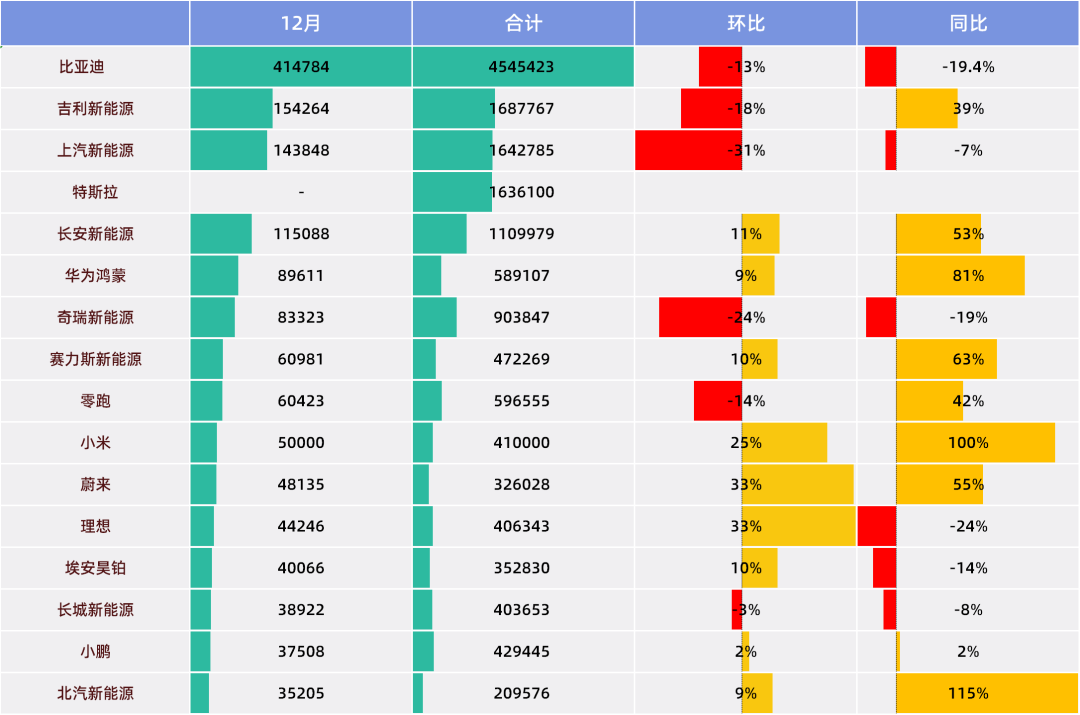
Core Insights - BYD's sales surged from 426,000 units in 2020 to 4.545 million units in 2025, achieving a compound annual growth rate of 60% [1] - Despite rapid growth, BYD faced intense competition from other automakers and did not meet its performance targets in 2025 [1] - The Chinese automotive market is undergoing significant changes, with many companies preparing for global expansion [1] Sales Performance - In December, BYD sold 414,784 units, a decrease of 13% month-over-month and 19.4% year-over-year [3] - Among 15 Chinese automakers, only five achieved both month-over-month and year-over-year sales growth [4] - The average sales volume dropped to 94,427 units in December, primarily due to declines in the first and second-tier companies [4] Market Dynamics - The Chinese government continues to support the automotive market with subsidies exceeding 1.1 billion yuan [2] - The competition is intensifying, with several brands achieving historical sales highs, particularly in the third tier [6] - The central economic work conference emphasized the importance of domestic demand, indicating ongoing support for the automotive sector [7] Company-Specific Developments - Only five out of 14 automakers met their sales targets for 2025, with companies like Li Auto and Aion falling short [8] - BYD's electric vehicle sales reached 2.2567 million units, surpassing Tesla's 1.636 million units for the first time [11] - The export volume of Chinese automobiles is expected to exceed 7 million units in 2025, with BYD emerging as a key player [14] Technological Advancements - The introduction of L3 autonomous driving technology is gaining momentum, with several companies, including BYD and Huawei, conducting road tests [17][18] - The competition for L3 autonomous driving capabilities is expected to intensify in 2026 [18] Brand Strategies - Huawei's HarmonyOS ecosystem has expanded, contributing to record sales for its vehicles [19] - Xiaomi's sales reached over 500,000 units in 2025, but the company faced a public relations crisis that may impact future products [21][23] - NIO and Xpeng have shifted to lower price segments to maintain competitiveness, with NIO achieving a record monthly sales of 48,135 units in December [24][27] Future Outlook - The automotive industry is expected to continue evolving rapidly, with companies focusing on both domestic and international markets [49] - The competitive landscape is shifting, with traditional automakers adapting to new market realities and consumer preferences [49]







小鹏AI科技智造之旅正式开放 P7+第十万台整车同步下线交付
Zheng Quan Shi Bao Wang· 2026-01-09 11:39
Core Insights - The "Xiaopeng AI Technology Manufacturing Journey" industrial tourism project was officially opened, focusing on becoming a new landmark for AI technology and travel in the Greater Bay Area [1] - Xiaopeng Motors' Chairman and CEO He Xiaopeng emphasized the importance of understanding manufacturing and innovation through firsthand experience, which inspired the creation of this project [1] - The company is positioned as a physical AI company that deeply integrates AI with manufacturing, showcasing a multi-faceted future travel experience platform [1] - The Xiaopeng P7+ reached a significant milestone with the production of its 100,000th vehicle, coinciding with the delivery ceremony for the first batch of the 2026 model [1] - The 2026 Xiaopeng P7+ features a fully renewed pure electric version and introduces a super extended range version, achieving a global longest pure electric range of 430 kilometers and a comprehensive range of 1550 kilometers [1] Global Expansion - The 2026 Xiaopeng P7+ is set to launch in 36 countries globally, marking a significant step in the company's international expansion [2] - The new model was also unveiled in Brussels, Belgium, as part of its global rollout [2]
《TopBrand 2025中国品牌人物500强》榜单发布
Xin Lang Cai Jing· 2026-01-09 10:57
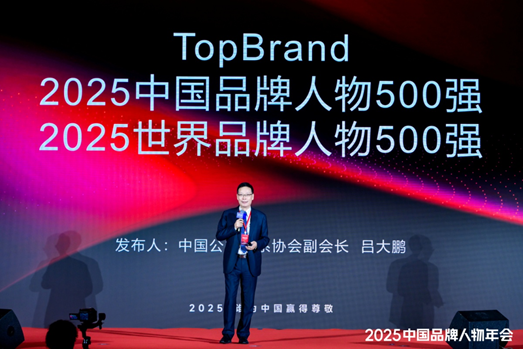
Group 1 - The 2025 China Brand Person Annual Conference will be held from December 28 to 30 in Shenzhen, focusing on the theme "Who Earns Respect for China" [1][10] - The event will include a series of activities such as an opening ceremony, main forum, honor ceremony, and closed-door discussions to review the history of Chinese brand development and explore new trends and opportunities in brand building [1][10] Group 2 - The "Top Brand 2025 China Brand Person 500" list was released by Lv Dapeng, Vice President of the China Public Relations Association, highlighting the overall characteristics and industry trends of the listed individuals [10][12] - This list has been publicly released for the seventh consecutive year, continuously recording and promoting the growth and influence of Chinese brand figures [10][12] Group 3 - The top three individuals in the 2025 China Brand Person 500 are Ren Zhengfei, Liu Qiangdong, and Yu Chengdong, with Dong Mingzhu, He Xiaopeng, Li Shufu, Wang Chuanfu, Jack Ma, Liang Wenfeng, and Wang Ning following in positions 4 to 10 [3][12] - The selection process involved analyzing over 5,000 influential brand figures based on criteria such as industry authority, social influence, sense of social responsibility, public image, and attention [3][12]


小鹏连发4款新车,用多线动作应对“巨大改变” | 电厂
Xin Lang Cai Jing· 2026-01-09 10:36
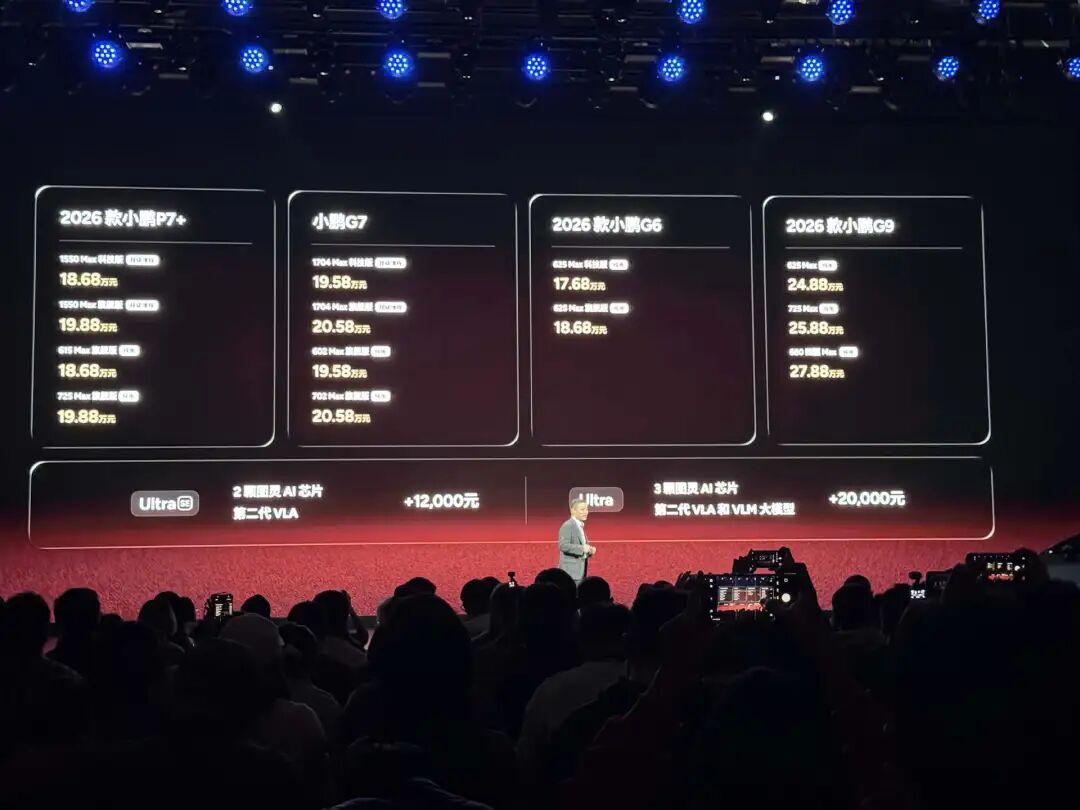
Core Insights - Xiaopeng Motors has officially entered a dual technology path of "pure electric + range extender" with the launch of multiple new models and technology updates at its 2026 Spring Product Launch, including the 2026 P7+, G7, G6, and G9 [1][2] Product Launch and Pricing - The 2026 P7+ and G7 are available in both pure electric and range extender versions, with starting prices of 186,800 RMB and 195,800 RMB respectively; the G6 starts at 176,800 RMB, and the G9 starts at 248,800 RMB [1] - The P7+ range extender version has a CLTC pure electric range of 430 km and a comprehensive range of 1,550 km, while the G7's comprehensive range reaches 1,704 km [8][10] Technological Advancements - Xiaopeng has introduced the second-generation VLA model, which eliminates the "language translation" step, allowing direct generation of control commands from visual signals, enhancing the system's ability to handle complex scenarios [2][3] - The second-generation VLA is trained on approximately 100 million real road videos, equating to thousands of years of human driving experience, and operates with a maximum computing power of 2,250 TOPS [2][3] Market Strategy and Global Expansion - Xiaopeng's "super range extender" strategy aims to expand the market reach, with the X9 super range extender achieving a record delivery of 5,424 units in December [8][12] - The company has reported a 126% year-on-year increase in global deliveries, totaling 429,400 units in 2025, and has entered 60 countries, establishing a presence in multiple European markets [12] Localization and Charging Infrastructure - Xiaopeng is focusing on local R&D and production, with nine global R&D centers and several overseas production projects underway, positioning the P7+ as the first "global car" [12] - The charging network has expanded to cover 31 countries and regions, with over 2.66 million public charging stations and a self-operated network in over 430 cities [12]
小鹏P7+第10万台整车下线;特斯拉Model 3 标准版已在英国和中东上市丨汽车交通日报
创业邦· 2026-01-09 10:11
Group 1 - XPeng Motors officially launched the 100,000th unit of the P7+ on January 9, and the first delivery ceremony for the 2026 model was held, marking the start of the "XPeng AI Technology Manufacturing Journey" project [2] - Tesla's Model 3 Standard version has been launched in the UK and the Middle East as of January 9 [2] - Zhao Changjiang, now the marketing general manager of the brand Zhijie under Chery and Huawei, predicts that the Zhijie V9 will have no competitors for at least three years [2] - General Motors announced an additional charge of approximately $6 billion due to adjustments in its electric vehicle business, following a broader reassessment of EV capacity and production layout [2]



一口气发布4款新车,何小鹏向海外要增量
Xin Lang Cai Jing· 2026-01-09 10:00
Core Insights - Xiaopeng Motors launched four new models at the 2026 global product launch, including the 2026 P7+, G7, G6, and G9, expanding its range of extended-range vehicles [1][4] - The company is adopting a "large battery + large fuel tank + ultra-fast charging" strategy for its extended-range products, with the P7+ and G7 offering significant total ranges [1][3] - Xiaopeng's second-generation VLA (Virtual Large Model) technology is set to enhance its autonomous driving capabilities, with plans for public road testing of Robotaxi soon [2][3] Product Launch Details - The 2026 P7+ is priced between 186,800 to 198,800 yuan, while the G7 is priced between 195,800 to 205,800 yuan, and the G6 ranges from 176,800 to 186,800 yuan [1] - The G9 has three pure electric versions priced between 248,800 to 278,800 yuan [1] - The P7+ and G7 both have a pure electric range of 430 km, with total ranges of 1550 km and 1704 km respectively [1] Technology Advancements - The Ultra and Ultra SE versions of the new models feature self-developed second-generation VLA and advanced AI chips, enhancing their autonomous driving capabilities [2] - The second-generation VLA eliminates the "language translation" step, allowing for direct generation of action commands from visual signals [3] - The company aims to broaden the upper limits of technology while addressing the challenges faced in the past three years [3] Market Strategy - Xiaopeng's sales in overseas markets reached 45,008 units in 2025, a 96% increase, indicating a strong push for globalization [5][6] - The company has established a presence in 60 countries and regions, with local production projects in Germany, Indonesia, and Malaysia [6][7] - The strategy includes expanding into western and northern markets, as well as lower-tier markets in China [7][8] Future Plans - In 2026, Xiaopeng plans to introduce four new global SUV models and enhance its global supply chain management [7][8] - The company anticipates that its overseas growth rate will surpass domestic growth in the coming year [7]
搭载第二代VLA系统 小鹏汽车全球首发四款新品
Yang Shi Wang· 2026-01-09 09:41
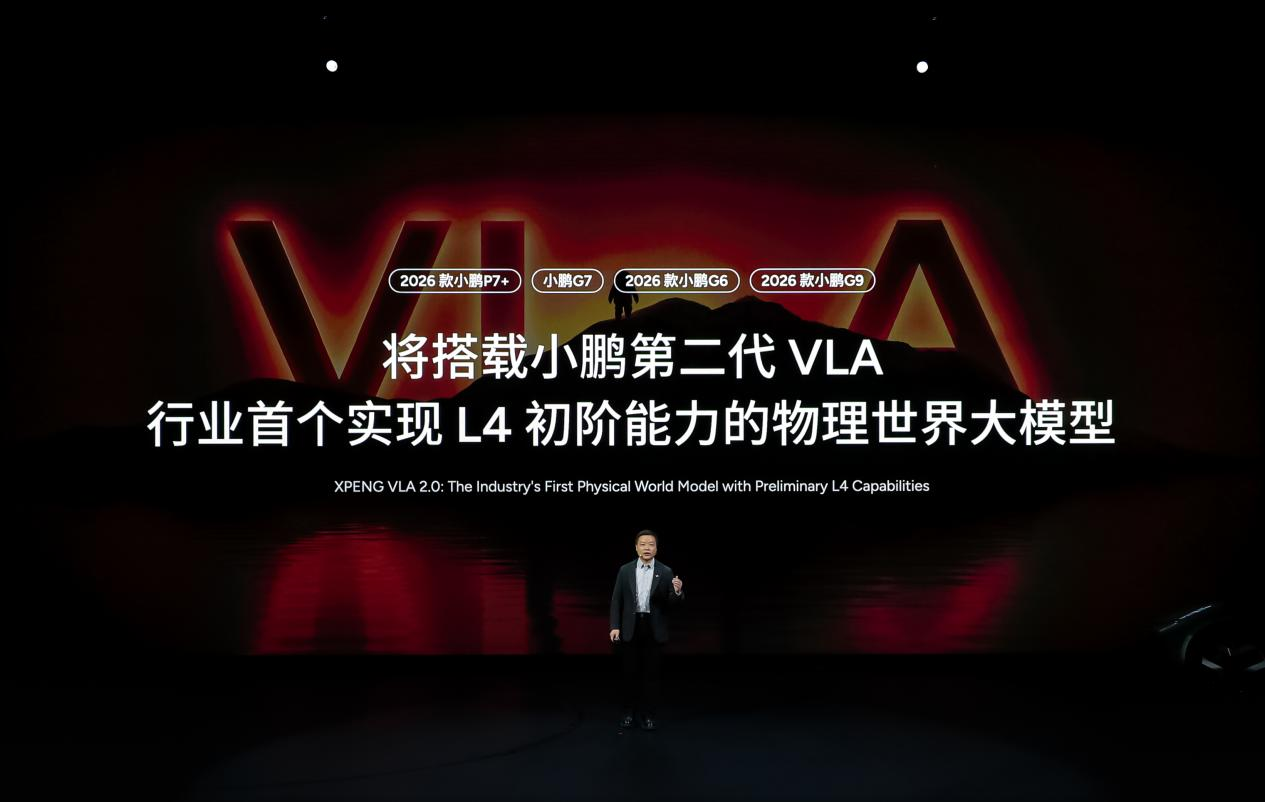
Core Insights - XPeng Motors officially launched the 2026 models including P7+, G7 Super Range, G6, and G9 at the global product launch event on January 8, 2026, with prices starting from 186,800 RMB for P7+ [1] - The new models feature the second-generation VLA developed by XPeng, which is the first in the industry to achieve L4 initial capabilities, enabling direct generation of action commands from visual signals [1][3] - XPeng's AIOS 6.0 system was introduced, marking a significant upgrade from passive response to proactive service in smart cabins, and will be equipped in the newly launched vehicles [7] Model Specifications - The 2026 P7+ offers a dual energy solution with a pure electric range of 430 km and a comprehensive CLTC range of 1550 km, featuring a space utilization rate of 88% [9] - The G7 Super Range model includes a 55.8 kWh battery and a 60L fuel tank, achieving a CLTC comprehensive range of 1704 km and a pure electric range of 430 km, with a spacious trunk capacity of 779 liters [9] - The G6 is priced from 176,800 RMB, while the G9 starts at 248,800 RMB, showcasing XPeng's diverse product offerings [1] Market Expansion - XPeng achieved a cumulative global delivery of 429,445 units in 2025, representing a 126% year-on-year growth, with products available in 60 countries and regions [7] - The global launch of the 2026 P7+ took place in Brussels, Belgium, on January 9, 2026, as part of XPeng's AI technology manufacturing journey [11]
持续深耕AI出行与全球化,2026款小鹏P7+售价18.68万起、小鹏G7超级增程售价19.58万起
数说新能源· 2026-01-09 08:35
Core Viewpoint - Xiaopeng Motors has launched four new models at the 2026 Global New Product Launch, showcasing advancements in AI technology and electric vehicle capabilities, including the P7+, G7, G6, and G9, with a focus on enhancing user experience and global market presence [1][36]. Group 1: Product Launch Details - The 2026 Xiaopeng P7+ is available in both super range and pure electric versions, with prices starting at 186,800 RMB for both variants [1]. - The 2026 Xiaopeng G7 offers four versions, with prices ranging from 195,800 RMB to 205,800 RMB, and features both super range and pure electric options [1]. - The 2026 Xiaopeng G6 is priced from 176,800 RMB, while the G9 starts at 248,800 RMB, showcasing a range of pricing and features across the models [1]. Group 2: Promotional Offers - Customers who place orders for the 2026 models by March 31, 2026, can receive various incentives, including an 8,000 RMB subsidy for the P7+, G7, and G6, and a 12,000 RMB subsidy for the G9, along with additional benefits [2]. Group 3: Technological Advancements - The second-generation VLA and AIOS 6.0 systems are introduced, enabling advanced AI capabilities for intelligent driving and user interaction, marking a significant leap in the automotive industry [4][6]. - The second-generation VLA achieves L4-level capabilities, allowing for direct generation of action commands from visual signals, enhancing the vehicle's understanding of the physical world [4]. - The AIOS 6.0 system features a redesigned interface and introduces a nationwide 3D navigation map, enhancing the user experience [6]. Group 4: Performance and Efficiency - The 2026 P7+ boasts a pure electric range of 430 km and a combined range of 1550 km, with a low energy consumption of 10.9 kWh/100 km in electric mode [12]. - The vehicle supports ultra-fast charging, allowing for a 10%-80% charge in just 12 minutes, significantly reducing range anxiety for users [12]. Group 5: Safety Features - The P7+ meets dual five-star safety standards and features a robust battery system that remains safe under extreme conditions, exceeding upcoming national standards [17]. - The vehicle's structure includes a one-piece cast aluminum floor and high-strength body, providing enhanced safety during impacts [17]. Group 6: Market Position and Global Strategy - Xiaopeng Motors has delivered 429,445 vehicles globally in 2025, marking a 126% year-on-year increase, and is expanding its presence in 60 countries [9]. - The launch of the P7+ and G7 signifies Xiaopeng's commitment to providing diverse electric mobility solutions and establishing a strong foothold in international markets [9].

从电动车到机器人:小鹏是如何做到的?——专访小鹏汽车副董事长兼联席总裁顾宏地
麦肯锡· 2026-01-09 08:07
Core Viewpoint - The core viewpoint of the article emphasizes that the future of mobility will be defined by intelligence rather than traditional mechanical or energy forms, highlighting the strategic direction of Xiaopeng Motors over the past decade [2][3]. Group 1: Company Evolution and Strategy - Xiaopeng Motors was founded by a diverse team of engineers with a vision that diverges from traditional automotive definitions, focusing on "AI-defined" mobility [3]. - The company shifted from a technology-driven approach to a consumer-centric model, recognizing the importance of understanding user needs [3]. - Global expansion has been a priority, with Xiaopeng establishing a presence in over 50 countries, differentiating itself from competitors focused solely on the domestic market [4]. Group 2: Competitive Landscape - The Chinese electric vehicle (EV) market is characterized by intense competition, which drives innovation and keeps companies competitive [5]. - Chinese consumers are more receptive to new technologies, which accelerates innovation cycles compared to Western markets [5]. - The robust supply chain in China, built over years of industrial accumulation, is a critical factor enabling Chinese EVs to stand out globally [5]. Group 3: Addressing Over-Competition - Competition is viewed as healthy and necessary for industry development, but there are concerns about extreme competitive practices leading to "involution" [6]. - Companies must focus on differentiation through innovation and strong branding to avoid being consumed by over-competition [6]. - Xiaopeng aims to establish a unique brand identity and leverage global expansion to mitigate the risks of excessive competition [6]. Group 4: Brand Differentiation - Xiaopeng focuses on aspects that are hard to replicate, such as advanced smart driving technologies, to build its brand [7]. - The company has been a pioneer in introducing features like highway autonomous driving and has positioned itself as a technology-centric brand for future mobility [7]. Group 5: Globalization Efforts - Xiaopeng began its global journey early, starting with markets in Northern Europe, and has learned to adapt its business models to different markets [8]. - The company has successfully established itself as a leader in the high-end Chinese EV segment in Europe, with a focus on long-term brand building and local partnerships [9]. Group 6: Future Outlook and Technological Expansion - The company believes that the future of mobility extends beyond vehicles to include diverse solutions like robotics and AI, which could be larger markets than the current automotive sector [13]. - Xiaopeng's capabilities in AI and autonomous driving naturally lead to opportunities in the robotics field, leveraging existing technologies [13]. Group 7: Entrepreneurial Spirit and Leadership - The entrepreneurial spirit and ambition of Chinese leaders are seen as key advantages in navigating the rapidly evolving landscape of the EV industry [15]. - Successful entrepreneurs in the EV sector often have prior experience in other industries, which provides them with confidence and resources to tackle complex challenges [15].