
XPENG(XPEV)

Search documents
小鹏获L3级自动驾驶道路测试牌照
Di Yi Cai Jing· 2025-12-16 06:47
Core Insights - Xiaopeng Motors has obtained an L3 autonomous driving road testing license in Guangzhou and has initiated regular L3 road tests [1] - The license is primarily for testing conditional autonomous driving on high-speed roads for intelligent connected vehicles in Guangzhou [1] - At the 2025 Technology Day, Xiaopeng Motors officially announced the second-generation VLA with L4 capabilities, expected to enter mass production in Q1 2026 [1] - In 2026, Xiaopeng Motors plans to launch models with both hardware and software achieving L4 autonomous driving levels [1]

异动盘点1216 |沪上阿姨涨近6%,拨康视云-B跌超11%;加密货币概念股走低,ServiceNow跌11.54%
贝塔投资智库· 2025-12-16 04:02
Group 1: Market Movements - Baoji Pharmaceutical-B (02659) surged over 3.2% amid its debut on the Hong Kong Stock Exchange, closing up 138.82% on its first day, with a market capitalization exceeding HKD 20 billion [1] - New Energy (01799) and Xinyi Solar (00968) saw declines of 3.01% and 3.67% respectively, as the photovoltaic sector faced weakness, with rumors of a 30 billion yuan investment for capacity storage by major companies [1] - Xpeng Motors-W (09868) and Li Auto-W (02015) dropped 4.88% and 2.67% respectively, following data from the China Association of Automobile Manufacturers indicating a month-on-month increase in production and sales [1] Group 2: Company-Specific News - Bolek Vision Cloud-B (02592) experienced a significant drop of nearly 15%, having previously doubled in price over 10 trading days, as it announced a new drug trial application to the FDA [2] - Hu Shang Ayi (02589) rose nearly 6% as Nayuki Tea expanded into the U.S. market, enhancing the international presence of Chinese tea brands [2] - Gold stocks fell sharply, with Zijin Mining (02899) and Shandong Gold (01787) declining by 4.29% and 4.94% respectively, following a report on the Bloomberg Commodity Index's upcoming rebalancing [2] Group 3: Cryptocurrency and Technology - Cryptocurrency ETFs faced significant declines, with notable drops in Bitcoin and Ethereum-related funds, as Bitcoin fell 3.3% from its record high, reflecting market pressures amid weak liquidity [3] - Oracle (ORCL.US) continued its downward trend, dropping 2.66% due to delays in delivering AI data centers for OpenAI, attributed to labor and material shortages [6] - Nvidia (NVDA.US) saw a slight increase of 0.73% after announcing the release of its third-generation language model, aimed at writing and programming tasks [6]



小鹏汽车20251215
2025-12-16 03:26
Summary of Xpeng Motors Conference Call Company Overview - **Company**: Xpeng Motors - **Market Position**: Transitioning from a pure automotive company to an AI technology company by 2026 [3] Key Industry Insights - **Sales Forecast**: Xpeng anticipates sales of 600,000 units by 2026, with domestic market growth of approximately 100,000 units and overseas contributions of about 15,000 units [2][4] - **Market Trends**: The overall domestic automotive market is expected to decline by around 3%, while the market share for new energy vehicles is projected to increase by 5-6 percentage points [2][4] Financial Projections - **Gross Margin**: Expected to improve in 2026, primarily due to profitability from the Volkswagen partnership, despite potential price reductions from subsidy policy changes [2][6] - **Profit Estimate**: Projected annual profit of approximately 2.5 billion RMB, with significant contributions from the Volkswagen business [2][6] - **Market Capitalization**: Current market cap is around 140 billion HKD, with expectations to reach 300 billion HKD by the end of 2026, driven by Volkswagen and Robotaxi business segments [2][8] Product Development and Launches - **New Models**: Plans to launch G7, G6, and P7+ extended-range models in Q1 2026, along with four new models including Volkswagen SUVs in Q2 and Q3 [2][7] - **Robotaxi Initiative**: Anticipated mass production of Robotaxi models in Q2 2026, with trial operations in Guangzhou later that year [2][7][12] Strategic Partnerships - **Collaboration with Volkswagen**: Development of two electric vehicles based on the G9 platform, with initial sales expectations of 100,000 units and projected revenue of 3 billion RMB from the partnership in the coming year [5][13] - **Shared Development**: Robotaxi models will share platforms with consumer models, providing cost advantages [5][12] Market Expansion - **Overseas Growth**: Significant progress in expanding overseas channels, particularly in Southeast Asia and Europe, with expectations of a 40-50% increase in overseas sales by 2026 [10] - **Local Production**: Establishment of factories in Indonesia and partnerships for localized production to mitigate trade tensions [10] Competitive Landscape - **EREV Market Outlook**: The penetration rate of extended-range electric vehicles (EREV) is expected to rise from 6-10% to 10-15% by the end of the year, with optimism about the technology's application in lower-priced models [9] - **Core Competencies**: Xpeng's strengths in intelligent driving technology, energy consumption control, and vehicle architecture platformization are seen as key competitive advantages [8] Future Outlook - **Robotaxi Development**: Positive outlook for Robotaxi operations, with expectations for advancements in autonomous driving technology and cost efficiencies [11][12] - **Industry Trends**: Overall optimism for the smart mobility industry, with potential for Xpeng to become a trillion-dollar market cap company despite current market uncertainties [15]
2026年汽车总投资策略
2025-12-16 03:26
Summary of Automotive Industry Conference Call Industry Overview - The automotive industry is transitioning from electrification to intelligence in 2026, marking a critical shift influenced by technological innovation, changing consumer demographics, and preferences [1][2] - The passenger vehicle market is expected to maintain sales at approximately 23 million units in 2025, with a projected decline of 3.5% to 22 million units in 2026 [1][5] Key Insights and Arguments - The investment strategy for 2026 is characterized as "breaking the old and establishing the new," shifting focus from electrification to smart vehicles [2] - New brands such as Xiaopeng, Leapmotor, Huawei, and Xiaomi are expected to emerge in the automotive market, competing with Tesla and BYD [1][7] - The penetration rate of advanced intelligent driving in electric vehicles is anticipated to double to 40% by 2026 [9][10] Market Predictions - The export performance in 2025 exceeded expectations, particularly benefiting from the Russian market, with a forecast of double-digit growth in 2026, especially in the new energy sector, which is expected to grow by around 40% [8] - The overall automotive export volume is projected to decline by 3% to approximately 20 million units in 2026, with new energy vehicle sales expected to increase by 11% [8] Investment Recommendations - In the components sector, companies with high earnings certainty and involvement in robotics or liquid cooling, such as Top Group, Yilun Co., and Junsheng Electronics, are recommended for potential strong performance in the next three years [1][6] - For passenger vehicles, Yutong Bus is highlighted for its strong global competitiveness and potential for high stock price innovation, with a market value expected to exceed 100 billion [3][14] - In the heavy truck sector, companies like Weichai Power are suggested for their export potential, while the bus and motorcycle sectors are expected to see continued growth in exports of 20% and 17%, respectively [11][12] Long-term Trends - The integration of intelligence and robotics is seen as a significant development area, with a focus on companies that demonstrate solid performance and commercial potential [25] - The L4 level autonomous driving technology is expected to gain traction in 2026, with a focus on establishing a pricing system suitable for this technology [22][23] - Companies such as BYD, Xiaopeng, and Horizon are identified as key players in the smart automotive sector, with significant growth potential [24] Additional Considerations - The passenger vehicle market is expected to face challenges due to the withdrawal of local subsidies, but companies will still prioritize sales to maintain competitiveness [5] - The heavy truck sector is undergoing a technological transformation, with a focus on electric and natural gas trucks as core growth points [11][18] - The motorcycle market is projected to remain a viable option, driven by stable demand for larger displacement motorcycles and strong export performance [16][17] This summary encapsulates the key points from the automotive industry conference call, highlighting the transition towards smart vehicles, market predictions, investment strategies, and long-term trends.



汽车股继续下跌 小鹏汽车-W(09868.HK)跌3.73%
Mei Ri Jing Ji Xin Wen· 2025-12-16 02:48
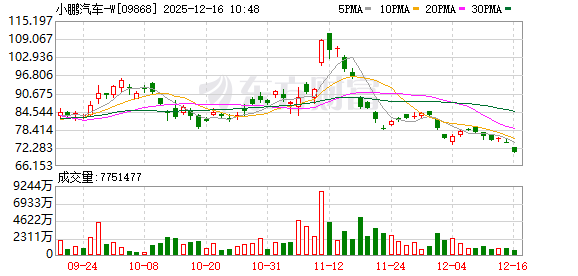
Group 1 - The automotive stocks continue to decline, with Xpeng Motors-W (09868.HK) down by 3.73%, trading at HKD 71 [2] - Li Auto-W (02015.HK) has decreased by 1.91%, currently priced at HKD 64.35 [2] - Great Wall Motors (02333.HK) fell by 1.62%, now at HKD 14.6 [2]

恒生科技指数跌2%,商汤小鹏阿里跌超3%


Cai Jing Wang· 2025-12-16 02:44
【#恒生科技指数跌2%#】恒生科技指数日内跌幅扩大至2%,恒指跌1.7%。商汤、小鹏汽车、阿里巴巴 跌超3%。(华尔街见闻) ...

2026年科技股策略:锚定恒生科技优质标的 财通证券推荐了这20只股
Ge Long Hui· 2025-12-16 02:29
Core Viewpoint - The report by Haitao Securities emphasizes the importance of identifying stocks with potential short-term or long-term performance discrepancies or surprises in AI advancements as a core task for 2026 [1] Group 1: Investment Strategy - The main investment strategy is to focus on value investing in the Hang Seng Technology Index, leveraging volatility from the Hong Kong stock market and short-selling mechanisms [1] - The key to successful operations lies in selecting fundamentally strong companies with sustainable development capabilities [1] Group 2: Recommended Stocks for 2026 - Stocks currently at the bottom or adjusting, with a high likelihood of fundamental reversal in 2026: Meituan, Xiaomi Group (planning next vehicle), BYD Electronics [2] - Stocks expected to benefit from EPS gains and potential valuation uplift: Tencent Holdings, Trip.com Group, JD Health, Lenovo Group [2] - Stocks with controllable elasticity: Alibaba, Baidu Group, SMIC, Hua Hong Semiconductor [2] - AI elastic stocks: Kuaishou, Bilibili, Kingdee International, Horizon Robotics, Xpeng Motors, Yueda Group, NetEase, Sunny Optical Technology, UBTECH [2] - Potential small-cap companies: Inspur Digital Enterprise, Xindong Company, Huiliang Technology [2] Group 3: Individual Stock Insights - Kuaishou, Bilibili, Horizon Robotics, Xpeng Motors, Sunny Optical Technology, UBTECH are highlighted as key stocks with positive outlooks [2] - Inspur Digital Enterprise and Huiliang Technology are noted as quality small-cap stocks with promising prospects [2] - Tencent Holdings is identified as a top pick due to its strong research framework [2] - Alibaba is considered a leading asset in AI technology [2] - Lenovo Group is expected to achieve profitability in its server business next year due to accelerated AIPC penetration [2] - Trip.com Group is positioned well for growth driven by domestic stability and overseas acceleration [2] - JD Health is recognized as a leading player in internet healthcare with a clear growth path [2] - Meituan is noted for its resilience and potential turning point in competitive landscape [2] - Kingdee International's growth is constrained by macroeconomic factors, but AI and overseas expansion provide additional elasticity [2] - Xiaomi Group is expected to see improvements as negative factors gradually clear [2] - SMIC is experiencing an increase in advanced manufacturing proportion and continuous technological breakthroughs [2] - Hua Hong Semiconductor is benefiting from growth driven by computing and consumer electronics [2] - Yueda Group focuses on IP as a core asset, with expectations for further expansion and monetization [2] - NetEase is anticipated to enter a new product cycle with upcoming releases [2] - BYD Electronics is expected to see growth from Apple's foldable phone production and has significant potential in the new energy vehicle and data center sectors [2] - Xindong Company is driven by gaming and Taptap, with expectations for the launch of an overseas version [2]



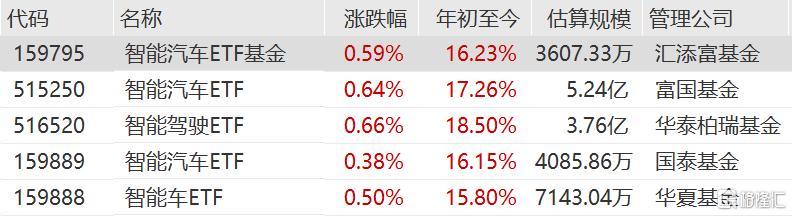
首批L3级自动驾驶车型获准入许可,智能汽车ETF基金、智能汽车ETF、智能驾驶ETF、智能车ETF上涨
Ge Long Hui A P P· 2025-12-16 02:04
Group 1 - The A-share market opened lower, while the smart driving concept stocks saw significant gains, with Wanji Technology hitting the 20% limit up and Zhejiang Shibao and Suoling Co. also reaching the limit up [1] - The smart car ETFs have shown strong performance, with year-to-date increases exceeding 15%, indicating a growing interest in the smart automotive sector [1][2] Group 2 - The Ministry of Industry and Information Technology has approved two L3-level autonomous driving vehicle models, which will be tested on specific roads in Chongqing and Beijing [3] - The approved models include a Changan electric sedan capable of autonomous driving at speeds up to 50 km/h in congested traffic and an Aiways electric sedan capable of 80 km/h on designated highways [3] - This approval marks the official entry of China into the L3 autonomous driving era, presenting new business opportunities for automotive testing and hardware sectors [4] Group 3 - The automotive industry is expected to experience high-quality development driven by policies supporting high-end, intelligent, and globalized growth, with projected sales exceeding 34 million vehicles in 2025 [4] - Domestic brands have captured 65% of the retail market share, a 5.5 percentage point increase from the previous year, with new energy vehicles accounting for a 50.7% penetration rate [4] - By 2026, the automotive market is anticipated to shift towards high-quality development, with projected passenger vehicle sales reaching approximately 31.1 million units [4]

AI技术爆发,汽车业迎智能化革命
Zhong Guo Qi Che Bao Wang· 2025-12-16 01:41
Core Insights - The automotive industry is entering an era of universal intelligent driving by 2025, with AI technology deeply integrated into smart cockpits and autonomous driving, marking a significant transformation in the industry [2][3] - "Intelligent driving equity" has emerged as a key theme, with traditional automakers and new players racing to adopt advanced driving systems, indicating a shift towards a more accessible intelligent driving experience for consumers [3][4] Industry Trends - The introduction of advanced driving systems like BYD's "Tian Shen Zhi Yan" and XPeng's XNGP system is enhancing the driving experience and supporting sales growth [3] - The overall cost of intelligent driving technology is decreasing, enabling its adoption in more affordable vehicles, thus broadening consumer access [3][4] - The VLA (Visual Language Action) model is becoming a highlight in automotive intelligence, offering better handling of complex scenarios and improving the interpretability of driving decisions [4][5] Market Dynamics - The Robotaxi market is accelerating, with companies like Pony.ai and Baidu obtaining operational licenses in major cities, indicating a rapid commercialization of autonomous taxi services [6][7] - The Chinese Robotaxi market is projected to grow from $54 million in 2025 to $47 billion by 2035, with over 50,000 Robotaxis expected to operate in more than 10 cities by 2030 [7][8] Financial Performance - Companies like Pony.ai and WeRide are reporting significant revenue growth, with Pony.ai's Robotaxi business revenue increasing by 89.5% year-over-year, reflecting the rapid commercialization of autonomous driving [8][9] Technological Innovations - The emergence of embodied intelligence, flying cars, and humanoid robots is becoming a focus for automotive companies, with significant advancements in these areas expected by 2025 [9][10] - The integration of industrial internet technologies is redefining automotive manufacturing, enhancing efficiency and quality while reducing costs [10][11] Policy and Regulation - The Chinese government is actively promoting the development of intelligent connected vehicles through various policies, which are expected to guide the industry's growth and ensure compliance with safety standards [12][13] - Recent policies emphasize the importance of a structured approach to the commercialization of intelligent driving technologies, aiming to prevent over-marketing and ensure reliability [13][14]

汽车早餐 | 多家车企积极响应《汽车行业价格行为合规指南(征求意见稿)》;小鹏第三个海外本地化生产项目落地马来西亚
Zhong Guo Qi Che Bao Wang· 2025-12-16 01:33
Domestic News - The National Bureau of Statistics reported that from January to November, the added value of the automotive manufacturing industry grew by 11.8% [2] - In the same period, the production of automobiles increased by 10.8%, indicating a steady growth in new consumption [2] - The retail volume of new energy vehicles in the passenger car market maintained rapid growth during this timeframe [2] Industry Developments - The State Administration for Market Regulation announced a recall of 244,500 vehicles from seven automotive manufacturers in November 2025 [3] - The "Yue Car Southbound" reservation system began accepting bookings on December 15, 2025, for travel from December 23, 2025, to January 31, 2026 [4] - Shenyang plans to strengthen its automotive and parts industry, focusing on the full industrial chain of smart connected new energy vehicles [5] - Luoyang aims to accelerate the bearing industry in relation to new energy vehicles and other emerging sectors [6] International News - Renault is shutting down its car-sharing business and slowing down the construction of its electric vehicle charging network to focus on more profitable segments [7] - Volkswagen will cease vehicle production at its Dresden plant after December 16, marking the first closure of vehicle production in Germany since its establishment [9] - Mercedes-Benz India will raise car prices by up to 2% starting January due to rising raw material and logistics costs [10] Corporate News - Multiple automotive companies, including Jiangqi Group and Seres Group, are responding positively to the "Automotive Industry Pricing Behavior Compliance Guidelines" [11] - GAC's flying car GOVY AirCab has entered the airworthiness certification stage, with mass production expected in 2026 [12] - XPeng Motors has initiated its third localized production project in Malaysia, aiming for mass production by 2026 [13] - NIO has established 500 charging and battery swap stations in Shanghai, providing over 10,000 battery swap services daily [14] - CATL and Transfar Group signed a strategic cooperation agreement to enhance collaboration in green and sustainable industry ecosystems [15] - Dong'an Power and Beijing Automotive Manufacturing Factory signed a strategic cooperation agreement to establish a joint innovation laboratory [16] - Taotao Automotive's subsidiary plans to acquire 100% of Racka brand company for $15 million, expanding its brand portfolio [17]
