红旗连锁

Search documents
图数室丨成本1块卖5块,冰杯比卖黄金还暴利?
Xin Lang Cai Jing· 2025-07-11 13:25
Core Viewpoint - The ice cup has transformed from a simple cooling tool into a lifestyle choice, with a significant market shift towards practical and affordable options, overshadowing high-end ice cream products [2][3]. Industry Overview - The number of ice-making companies in China has increased to 10,922, a growth of 3,338 compared to the same period last year [2]. - The ice cup market is projected to reach a scale of 63 billion yuan by 2026, attracting major brands and retailers to enter the market [2]. Product Pricing and Market Dynamics - Ice cup prices are polarized, with pre-packaged options ranging from 2 to 6 yuan for 160g to 220g, while brands like Mixue Ice City and Tea Baidao offer ice cups at a low price of 1 yuan [3]. - The production cost of a 160g ice cup is less than 1 yuan, with packaging accounting for 65% of the cost, while consumers pay five times the price of equivalent pure water [2][18]. Consumer Behavior and Trends - The popularity of ice cups is driven by their convenience and the emotional value they provide, as they are easily accessible and can be paired with various beverages [9][23]. - Social media discussions around ice cups have exceeded 100 million, highlighting their cultural significance and the trend of "DIY" drinks [9][23]. Market Expansion and Usage Scenarios - Ice cups are being utilized in various scenarios, including travel, camping, shopping, and home settings, making them a year-round product rather than just a summer trend [10][14]. - The trend of flavor innovation in ice cups is gaining traction, with brands introducing various flavored options to attract consumers [6][7]. Cost Analysis and Value Proposition - The cost of making ice cups at home is minimal, raising questions about the value of commercially sold ice cups, which are often marked up significantly [18]. - The convenience of ready-to-use ice cups is perceived as a "convenience tax," allowing consumers to enjoy immediate satisfaction without the hassle of preparation [23].

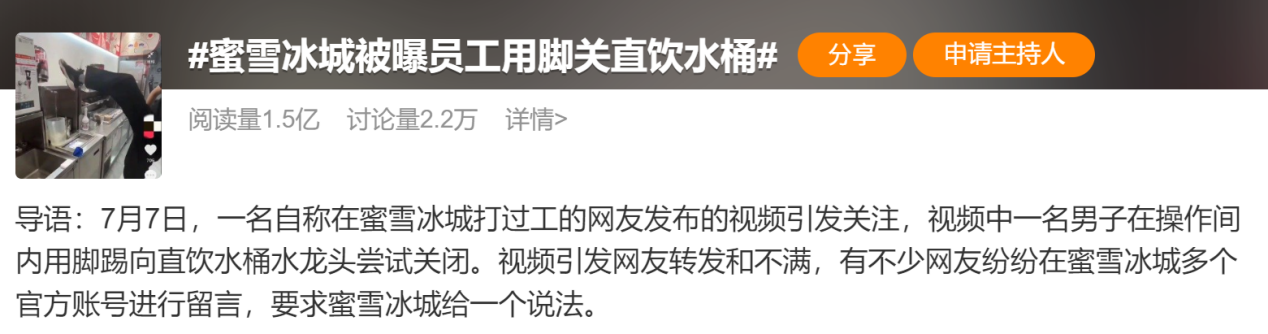
登上热搜!蜜雪冰城员工用脚关直饮水桶?当事人致歉
Xi Niu Cai Jing· 2025-07-11 13:13
Core Viewpoint - A video showing inappropriate behavior by an employee at Mixue Ice City has sparked public outrage, raising concerns about hygiene and employee management within the company [2][4][5]. Group 1: Incident Details - The video depicts a man kicking the water tap of a drinking water bucket in a Mixue Ice City store, which he later claimed was done in a moment of fun while closing the store [2][6]. - The incident occurred around July 25, 2024, and the video was initially shared by a former employee who later deleted it and cleared their account [6]. Group 2: Public Reaction - The video led to intense criticism from netizens, who expressed concerns about the hygiene implications of such actions, fearing contamination of drinking water [4][5]. - Many commenters questioned the training and management practices at Mixue Ice City, suggesting that the presence of bystanders during the incident indicates a lack of proper oversight [5]. Group 3: Company Response - On July 7, Mixue Ice City customer service acknowledged the situation and stated that it would be reported to relevant departments for verification [6]. - The video poster issued an apology, emphasizing that the store maintains strict hygiene standards and that the incident was inappropriate [8]. Group 4: Historical Context - This incident is not isolated; Mixue Ice City has faced previous scrutiny over hygiene issues, including a case where an employee was filmed washing their feet in a water tank [8]. - The company claims to have an industry-leading supply chain traceability system, yet recurring violations at the operational level highlight management execution shortcomings [8].

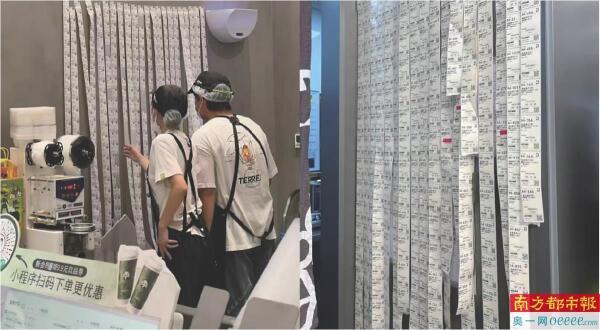
茶饮店爆单后,股价飘红但未持续
Nan Fang Du Shi Bao· 2025-07-10 23:18
Group 1 - The core event was a significant increase in sales for tea beverage brands during a weekend promotion, with one brand reporting over 630 million yuan in total sales and individual store sales reaching 54,000 yuan per day [2] - Multiple tea beverage brands reported over 1 million orders across their national stores within the same two-day period [2] - On July 7, following the sales surge, stock prices for several listed tea beverage companies rose, with increases ranging from 3.95% to 11.04% [4] Group 2 - The three major food delivery platforms (Meituan, Ele.me, and JD) collectively processed over 200 million orders on July 5, indicating a substantial rise in demand due to increased subsidies [3] - Taobao Shanguo launched a subsidy plan worth 50 billion yuan, resulting in a 190% increase in orders for restaurant chain brands during its first week [3] - Meituan reported over 1.2 million orders on July 5, with more than 1 million being restaurant orders, highlighting the peak demand during the weekend [3] Group 3 - Analysts suggest that while promotional events can temporarily boost sales, they may not contribute to long-term brand loyalty and can lead to significant operational challenges [5] - Concerns were raised about employee dissatisfaction due to increased workloads during promotional periods, which could impact food safety and service quality [5] - Some tea beverage brands did not provide specific sales data post-promotion, indicating a lack of transparency in reporting [5]
独家专访飞书 CEO 谢欣:Office 是一个伟大的产品,而我们想做新时代的 Office
晚点LatePost· 2025-07-10 12:30
Core Viewpoint - The article discusses the evolution and strategic positioning of Feishu, a collaboration tool developed by ByteDance, emphasizing its long-term vision and the challenges it faces in a competitive market. Group 1: Company Background and Development - Feishu, originally known as Lark, was initiated in 2016 as an internal efficiency tool within ByteDance and officially launched to the public in 2020 after four years of development [1][2] - The platform has evolved from having only 1/10 of DingTalk's daily active users to becoming a representative collaboration software chosen by many enterprises [2] Group 2: Product Innovations and AI Integration - On July 9, Feishu launched a series of AI-driven products, including Knowledge Q&A, AI Meeting Minutes, and Aily Smart Assistant, focusing on real organizational use cases [3] - The Knowledge Q&A tool is designed to leverage internal company data, requiring substantial prior information accumulation, which is a characteristic of Feishu's client base [3][59] - Feishu's AI Meeting Minutes can automatically summarize meeting content and identify speakers, transforming each meeting into a digital asset for the company [3] Group 3: Strategic Goals and Market Positioning - The CEO of Feishu, Xie Xin, emphasizes that the company's goals differ from competitors like DingTalk, focusing on creating a next-generation office tool rather than merely achieving high user numbers [5][15] - Feishu's growth is described as steady rather than explosive, with a focus on long-term objectives rather than immediate profitability or return on investment [5][13] - The company aims to redefine work methods and improve organizational efficiency, viewing its mission as more significant than short-term financial metrics [13][39] Group 4: Competitive Landscape and Challenges - Feishu faces challenges in acquiring large clients, with notable companies like JD and NIO still using competitors' tools [19][28] - The article highlights the difficulty of competing against established players like Microsoft Office and Google Workspace, which dominate the global market [24][35] - The CEO acknowledges that the office software sector is inherently challenging and not particularly lucrative, making it difficult for new entrants to achieve profitability [12][37] Group 5: Future Outlook and AI's Role - The company is focused on leveraging AI to enhance its product offerings, with a belief that AI can significantly improve internal information retrieval and processing [49][70] - Feishu's AI capabilities are seen as a way to accelerate organizational change, although the company recognizes the need for a cultural shift within organizations to fully realize these benefits [64][73] - The CEO expresses a cautious optimism about the future of AI in the workplace, emphasizing the importance of realistic expectations regarding its capabilities [68][69]

浙商证券25年社服行业中季报前瞻:线下调改升级 本地生活竞争加速
智通财经网· 2025-07-10 09:27
Group 1: Macro Economic Trends - The offline retail cycle is approaching, supported by macroeconomic factors, pricing, and consumer policies, with innovation driving this transformation and enhancing profitability [1] - In Q1 2025, domestic travel reached 1.794 billion trips, a year-on-year increase of 26.4%, with urban residents contributing 1.318 billion trips, up 22.4% [2] - The overall tourism market in 2025 is expected to focus on cost-effectiveness, with significant growth in lower-tier markets and county tourism [2] Group 2: Travel and Tourism Insights - Cross-border travel is rapidly recovering, with 160 million inbound and outbound trips in Q1 2025, a year-on-year increase of 15.3%, reaching 95.6% of 2019 levels [2] - A significant portion of travelers, 81%, prefer not to follow trends to popular destinations, indicating a shift towards personalized travel experiences [3] - The demand for better travel products and services is high among older travelers, with 84% expressing this desire [3] Group 3: OTA and Competition Landscape - The competitive landscape in the OTA sector remains stable, with expectations for revenue growth driven by enhanced monetization rates [4] - JD.com is increasing its investment in the hotel sector, while Tongcheng is tapping into lower-tier markets to boost revenue [4] - Ctrip is entering a rapid expansion phase, although it may impact overall profitability [4] Group 4: Retail and Consumer Behavior - Offline retail is expected to recover in Q4, with a year-on-year growth of 5% in retail sales from January to May 2025 [6] - The retail landscape is shifting from traffic acquisition to optimizing existing customer bases, with innovation being crucial for this cycle [6] - Various retail formats are showing signs of recovery, with department stores and specialty shops returning to positive growth [6] Group 5: Hospitality Sector - Hotel demand is recovering, with a projected 10% growth in GMV for Q2 2025, although supply expansion is putting pressure on RevPAR [7] - Economic hotels are performing better than mid-to-high-end hotels, reflecting ongoing trends in consumer preferences [7] Group 6: Local Lifestyle and E-commerce - Competition in local services is intensifying, with major players like Meituan, JD.com, and Alibaba increasing their market presence [8] - The instant retail market in China is projected to reach 780 billion yuan in 2024, growing at 20% year-on-year [8] - E-commerce platforms are expected to enhance their instant retail strategies to capture market share [8] Group 7: Investment Recommendations - Recommended stocks include Yonghui Supermarket, Chongqing Department Store, and Meituan for offline retail; Alibaba for e-commerce; and Ctrip for OTA platforms [9]

外卖大战的尽头,是骑手和商家的眼泪
3 6 Ke· 2025-07-10 09:26
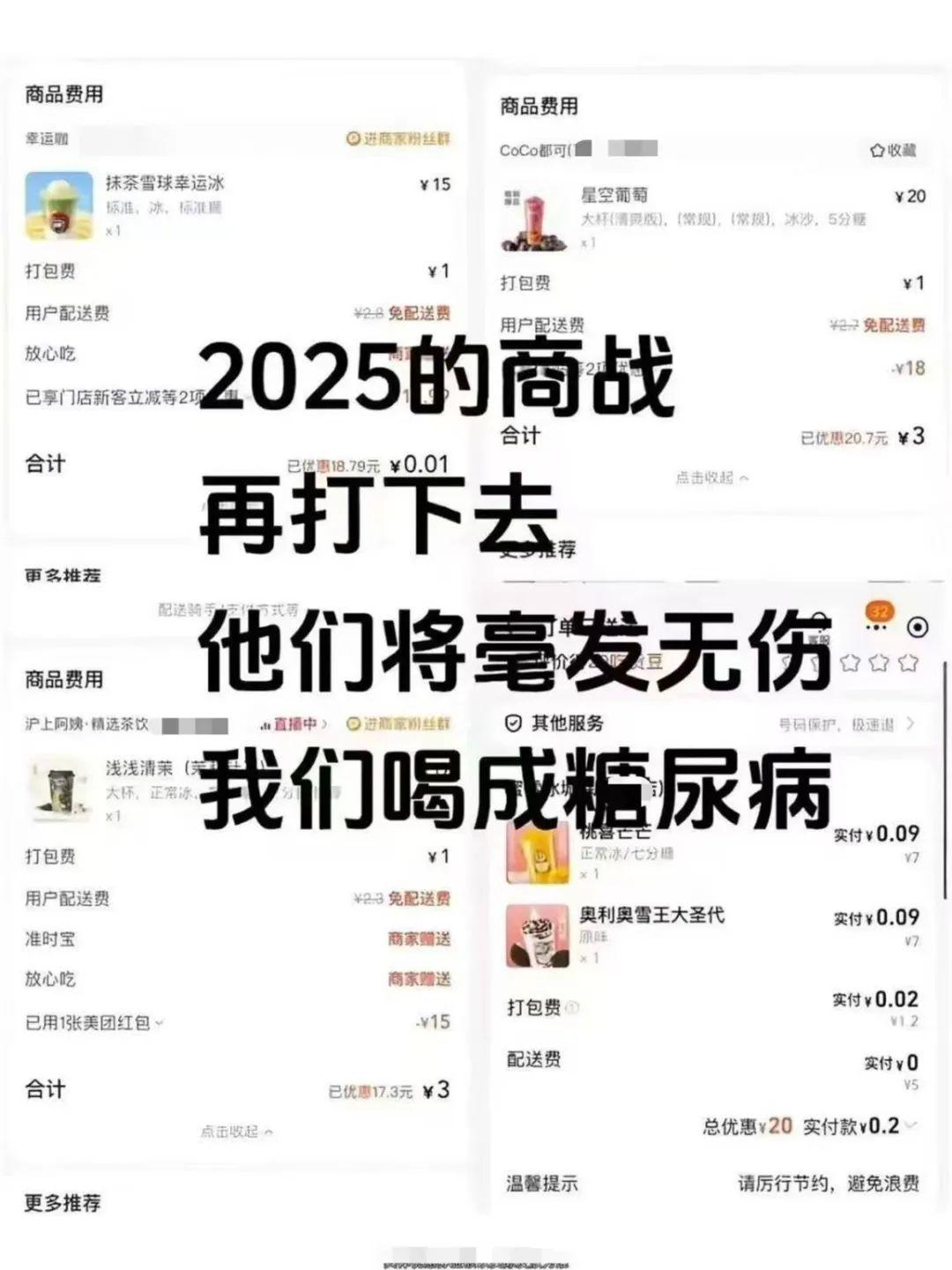
Core Viewpoint - The recent competition among food delivery platforms has led to increased consumer reliance on delivery services, but it has also resulted in delays and operational inefficiencies, particularly in the delivery of non-beverage items [1][20][32]. Group 1: Market Dynamics - The food delivery market is experiencing a new wave of competition, with platforms like Taobao and Meituan engaging in aggressive subsidy wars, reminiscent of past battles in the industry [4][16]. - Taobao has announced a substantial subsidy of 50 billion yuan over a year, significantly impacting order volumes, particularly for beverages like coffee and milk tea, which saw a surge of over 200% in order volume [4][5][17]. - The competition has led to a situation where the majority of orders are concentrated in the beverage category, causing operational strain on delivery services and restaurants [6][14][24]. Group 2: Consumer Behavior - Consumers are increasingly drawn to low-cost beverage options due to substantial subsidies, leading to a spike in orders that outstrip the capacity of many beverage outlets [14][23]. - The low price point of beverages makes them highly elastic in demand, allowing consumers to order more frequently, which exacerbates delivery delays for other food categories [14][22][26]. - The phenomenon of consumers hoarding beverages during promotional periods has been noted, indicating a shift in purchasing behavior driven by discounts [9][11]. Group 3: Operational Challenges - The influx of orders, particularly for beverages, has overwhelmed many restaurants and delivery personnel, leading to significant delays in service and a decline in on-time delivery rates [20][24][30]. - The operational inefficiencies have resulted in delivery personnel being stuck in long queues at beverage outlets, which detracts from their ability to fulfill other food orders in a timely manner [24][25]. - The competition has led to some restaurants temporarily halting their delivery services due to the inability to manage the surge in orders effectively [25][26]. Group 4: Strategic Implications - The current focus on beverage orders undermines the platforms' broader strategic goals of diversifying their offerings beyond food delivery to include instant retail [15][17]. - The heavy reliance on beverage orders may hinder the platforms' ability to establish a reputation for reliable delivery of a wider range of products, potentially limiting future growth [15][20]. - The ongoing subsidy wars may create a temporary boost in consumer engagement but could lead to long-term operational challenges and resource misallocation [19][36].


无人零售概念下跌1.34%,主力资金净流出24股
Zheng Quan Shi Bao Wang· 2025-07-10 08:58
Group 1 - The unmanned retail concept declined by 1.34%, ranking among the top declines in the concept sector, with notable declines in companies like Huijin Co., Shanjike Technology, and Shen Si Electronics [1][2] - Among the unmanned retail sector, 24 stocks experienced net outflows of main funds totaling 319 million yuan, with Huijin Co. leading the outflow at 168 million yuan [2][3] - The top gainers in the unmanned retail sector included Gongxiao Daji, Xinbeiyang, and Hongqi Lianchuan, with increases of 2.59%, 1.92%, and 1.28% respectively [1][2] Group 2 - The main funds saw a net inflow in stocks like Gongxiao Daji and Xin Kaipu, with inflows of 126 million yuan and 16.43 million yuan respectively [2][3] - The top stocks with significant net outflows included Huijin Co. (-17.70%), Kela Software (-2.48%), and Newland (-0.15%) [2][3] - The overall market sentiment reflected a mixed performance across various concept sectors, with silicon energy leading gains at 3.39% while the unmanned retail sector faced notable declines [2]





几块钱的暴利生意,又杀回来了
投中网· 2025-07-10 06:28
Core Viewpoint - The article discusses the phenomenon of consumption downgrade in summer ice products, highlighting the shift from high-priced items to more affordable options, and the emerging business opportunities within this trend [3][5][10]. Group 1: Ice Products Market Trends - The summer ice product market has seen a significant shift, with high-priced items like premium ice creams and drinks being replaced by more affordable options such as ice cups and simple homemade ice drinks [3][4][5]. - Ice cups have become a new competitive hotspot for various brands, with sales of ice cups in convenience stores like Nongfu Spring reaching 4.5 yuan per cup, which is seven times the price of bottled water [6][10]. - The market for ice cups has experienced over 300% growth for two consecutive years, with urban consumers averaging 48 cups per year, surpassing traditional beverages like coffee [6][10]. Group 2: Lemon Market Dynamics - The price of lemons has surged significantly, with reports indicating a 3-5 times increase compared to the previous year, driven by supply shortages due to adverse weather conditions [12][14]. - Major tea brands with their own lemon production bases have managed to control costs, while smaller brands are struggling to maintain profitability due to rising lemon prices [12][14]. - The upcoming harvest season in September and October is expected to bring some relief to lemon prices, although high prices may persist for the next couple of months [13][14]. Group 3: DIY Ice Drinks and Social Media Influence - The trend of DIY ice drinks has gained immense popularity on social media platforms, with over 40,000 related posts on Xiaohongshu and 40 million views on Douyin [17][18]. - Convenience stores are capitalizing on this trend by offering a variety of ice cup flavors and products, positioning themselves as key players in the DIY ice drink market [17][18]. - The synergy between ice cups, fruits like lemons, and beverages has created a thriving summer commercial ecosystem, appealing particularly to younger consumers [18][19]. Group 4: Future Opportunities - There are significant untapped commercial opportunities in the ice cup market, especially as it expands into lower-tier cities and towns [20]. - The ability to provide emotional value to consumers, similar to what ice cups offer, will be crucial for businesses looking to succeed in a saturated market [20].

银华基金焦巍,规模蒸发 150 亿背后的操盘逻辑
Sou Hu Cai Jing· 2025-07-10 01:14
Group 1 - The core viewpoint of the article highlights the challenges faced by Jiao Wei, a veteran fund manager at Yinhua Fund, whose flagship Yinhua Wealth Theme Fund has suffered significant losses over the past four years, with a total loss of 8 billion yuan and a reduction in scale by 15 billion yuan [2][3] - The Yinhua Wealth Theme Fund, established in November 2006, has seen a peak cumulative increase of 1653.50%, making it a prominent product for Yinhua Fund [3] - Jiao Wei's investment strategy initially focused on consumer and pharmaceutical sectors, particularly heavy investments in leading liquor stocks, which were considered cash cows [3][4] Group 2 - The fund's performance deteriorated due to misjudgments in the liquor market and aggressive trading strategies, leading to significant losses, particularly with stocks like Jiu Gui Jiu [4][6] - In response to the declining performance of liquor stocks, Jiao Wei shifted his investment focus to military and semiconductor sectors, but this transition also resulted in losses as the military index dropped sharply [7] - The fund's recent strategy has included investing in high-dividend stocks, which initially showed promise but ultimately led to underperformance compared to benchmarks [7][9] Group 3 - Jiao Wei acknowledged missing out on significant investment opportunities in emerging technologies like AI, which he identified as a major direction for the next decade [7][8] - The new consumption wave, characterized by companies like Pop Mart and others, has outperformed traditional consumer sectors, yet Jiao Wei's fund has remained largely absent from these opportunities [8][9] - The future of the Yinhua Wealth Theme Fund remains uncertain as it continues to focus on dividend stocks, raising questions about whether this strategy will yield better results than previous commitments to liquor stocks [9]

奖品奖项设置|2025银华基金杯新浪理财师大赛
新浪财经· 2025-07-10 01:09
Core Viewpoint - The 2025 "Yinhua Fund Cup" Sina Financial Advisor Competition is currently open for registration, aiming to provide a platform for financial elites to showcase their skills and enhance their capabilities, while also bridging communication between outstanding financial advisors and the general public [1]. Group 1: Competition Overview - The competition is co-hosted by Sina Finance and Yinhua Fund, focusing on the development of the financial advisory industry in China [1]. - The event features an upgraded reward mechanism, including exclusive lottery benefits for the champion team, enhancing the appeal of the competition [1]. Group 2: Awards Structure - The competition awards are categorized into three main types: Individual Awards, Team Awards, and Institutional Awards [3]. - Individual Awards include categories such as Champion, Runner-up, Third Place, and various titles recognizing popularity and excellence among financial advisors [3]. - Team Awards recognize top-performing teams across different regions and categories, including the Champion Team and the Most Popular Team [2][3]. - Institutional Awards focus on recognizing institutions that contribute to the cultivation of outstanding financial advisors [3]. Group 3: Additional Benefits - Participants who successfully register will receive a VIP annual card from Sina Finance, and those advancing to the semifinals can apply for the RFP international certified financial planner certificate without examination [3]. - The champion team will have access to a prize pool that includes tickets to high-profile events, opportunities for networking with top entrepreneurs, and visits to leading companies in new consumption and artificial intelligence sectors [2][3].