
中国国航

Search documents
交通运输行业周报:原油运价波动上行,前10月邮政行业收入历史首超电信行业-20251201
Bank of China Securities· 2025-12-01 02:42
Investment Rating - The transportation industry is rated as "Outperform" [2] Core Insights - The report highlights an upward trend in crude oil freight rates, with the China Import Crude Oil Index (CTFI) reaching 2520.07 points, an increase of 8.4% from November 20 [3][13] - The postal industry revenue surpassed the telecommunications industry for the first time in history, reaching 1.47 trillion yuan, compared to 1.467 trillion yuan for telecommunications [3][24] - The civil aviation sector showed growth in both passenger and cargo transport volumes in October, with international routes performing particularly well [3][17] Summary by Sections Industry Hot Events - Crude oil freight rates are rising, with the Middle East route seeing a 10.76% increase in rates [13] - Qifly Aviation signed a procurement agreement for 105 eVTOL aircraft with three companies in the Guangdong-Hong Kong-Macao Greater Bay Area, focusing on low-altitude logistics [15][16] - The postal industry revenue for January to October 2025 reached 1.47 trillion yuan, marking a significant milestone [24][25] High-Frequency Data Tracking - The Baltic Air Freight Price Index decreased month-on-month but increased year-on-year [26] - Domestic freight flights in October 2025 increased by 0.32% year-on-year, while international flights rose by 11.12% [32] - The express delivery business volume in October 2025 increased by 7.90% year-on-year, with total revenue reaching 131.67 billion yuan [50] Investment Recommendations - Focus on the equipment and manufacturing export chain, recommending companies like COSCO Shipping and China Merchants Energy [5] - Attention to low-altitude economy investment opportunities, particularly in companies like CITIC Offshore Helicopter [5] - Consider investment opportunities in the express delivery sector, recommending SF Express and Jitu Express [5]





周期论剑|跨年周期策略展望
2025-12-01 00:49
Summary of Key Points from Conference Call Records Industry Overview - **Market Outlook**: The Chinese market remains optimistic despite recent adjustments in major indices such as the Shanghai Composite, ChiNext, and STAR 50. The adjustments are comparable to historical bull market corrections, and panic selling risks have been sufficiently released. Policy catalysts are expected to increase [1][3][4] - **Investment Style Shift**: The market investment style is shifting from a barbell strategy or pure valuation expansion to a quality strategy and urgent investment strategy, driven by a decline in domestic risk-free interest rates and an increase in global liquidity [1][5] Transportation Industry - **Airline Sector**: The airline industry is expected to enter a super cycle of profitability, with rising ticket prices and profit margins over the next two years. This is driven by supply-demand recovery and increasing passenger traffic, with historical highs in passenger load factors and ticket prices observed [1][7][8][11] - **Oil Shipping Sector**: The oil shipping market is benefiting from increased crude oil production and sanctions, leading to rising freight rates. Current rates have reached over $130,000 per day, with strong demand expected to continue into 2026 [1][12][13][14] Chemical Industry - **Market Conditions**: The chemical market is currently in a bottoming phase, with some products like sulfur and PMA seeing significant price increases. The overall chemical price index is at a historical low, indicating potential for future price increases [1][15][16] - **Recommended Companies**: Companies with cost advantages and stable earnings, such as Hualu Hengsheng and Boryung Chemical, are recommended for investment [1][16] Metals Market - **Copper and Aluminum**: The copper and aluminum markets are expected to experience supply-demand mismatches, with emerging technologies driving demand. This is likely to support price increases in the long term [1][19] Gold and Lithium Carbonate - **Gold Market**: The gold market is currently volatile, but there are opportunities to invest in leading gold companies due to recent price corrections. The lithium carbonate market is expected to balance out supply and demand by 2026-2027, driven by increased storage demand [1][20] Steel Industry - **Future Trends**: The steel industry is seeing demand bottoming out, with supply-side reductions due to anti-involution policies. Capital expenditures are expected to decrease significantly in 2026, presenting opportunities for investment in leading steel companies [1][21] Coal Industry - **Long-term Contracts**: The reform of long-term coal contract pricing mechanisms is expected to enhance profitability for coal companies at the bottom of the cycle. The demand for coal is driven by emerging industries such as AI and new energy vehicles [1][24][25][26] Real Estate and Construction - **Market Movements**: The real estate sector is experiencing fluctuations due to policy changes and negative sentiment from declining data. However, there is potential for recovery in 2026-2027, particularly for leading companies [1][29][30][31] Power Generation - **Electricity Demand**: Electricity demand is expected to perform well in 2026, supported by economic growth. However, coal prices are currently high, and long-term contracts will help stabilize prices for northern power plants [1][34] Public Utilities - **Investment Opportunities**: Large state-owned enterprises in northern regions are recommended for investment due to favorable supply-demand dynamics and valuation advantages. The renewable energy sector also presents investment opportunities, although further policy support is needed [1][37]
十家航司被约谈后,消费者仍受“锁座”困扰
Nan Fang Du Shi Bao· 2025-11-30 10:34
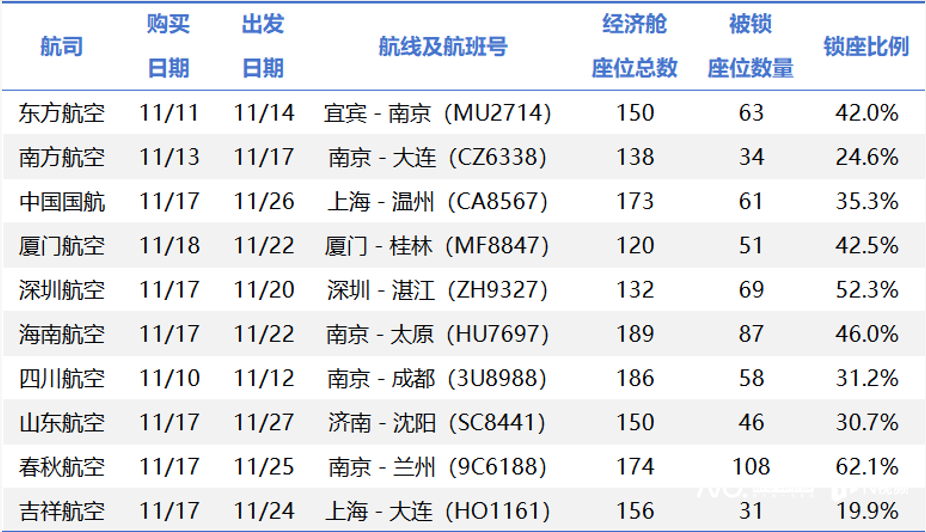
Core Viewpoint - The long-standing and controversial airline "seat locking" phenomenon is expected to undergo rectification following a special investigation by the Jiangsu Provincial Consumer Protection Committee, which has interviewed ten domestic airlines and requested written responses regarding corrective actions [1][5]. Group 1: Investigation Findings - The Jiangsu Provincial Consumer Protection Committee conducted an investigation into the "seat locking" practices of ten major airlines, revealing that the proportion of locked seats during the purchasing phase ranged from 19.9% to 62.1%, with an average of 38.7% [2][3]. - Notably, Spring Airlines' Nanjing-Lanzhou route had a seat locking rate exceeding 60%, while Shenzhen Airlines' Shenzhen-Zhanjiang route exceeded 50% [2][3]. - Other airlines like Hainan Airlines, Eastern Airlines, and Xiamen Airlines had locking rates between 40% and 46%, while Lucky Air had a relatively low rate of less than 20% [2][3]. Group 2: Reasons for Seat Locking - Airlines provided various justifications for seat locking, including reserving seats for special passengers, ensuring emergency seat availability, and maintaining flight load balance [4]. - The investigation identified common issues with the "seat locking" phenomenon, including a lack of clear communication regarding seat locking rules, vague explanations, differential resource allocation based on membership levels, and unilateral rights granted to airlines [4]. Group 3: Consumer Feedback and Reactions - Consumers expressed dissatisfaction with the differentiation of paid and free seating areas in economy class, indicating that such practices increase travel costs and lead to a frustrating experience [6][10]. - Feedback highlighted that many passengers were unaware of the specific rules regarding seat locking, leading to limited seat choices, especially for families traveling together [10][11]. Group 4: Regulatory Actions and Implications - The Jiangsu Provincial Consumer Protection Committee has mandated that the airlines submit written corrective actions within 15 working days, including self-inspections and revisions of unfair terms related to "seat locking" [5][15]. - Legal experts have commented that the "seat locking" practice infringes on consumer rights and may violate consumer protection laws, suggesting that the committee's actions could serve as a model for regulatory oversight in other regions [15][16].





干散货运价环比上涨,高速公路注入成为三资改革典型案例
SINOLINK SECURITIES· 2025-11-30 08:09
Investment Rating - The report recommends "Buy" for companies in the logistics and aviation sectors, specifically highlighting SF Holding and China Southern Airlines as key investment opportunities [2][3]. Core Insights - The logistics sector is benefiting from price increases due to reduced competition, with a notable rise in express delivery volumes during the peak season [2]. - The aviation sector is experiencing a recovery, with an increase in flight operations and passenger volumes, indicating a positive trend for airline profitability [3]. - The shipping industry shows signs of improvement, particularly in dry bulk transportation, driven by increased cargo demand and adverse weather conditions affecting vessel turnover [4]. Summary by Sections Transportation Sector Market Review - The transportation index decreased by 0.5% during the week of November 22-28, underperforming the Shanghai Composite Index, which rose by 1.6% [12]. Logistics - The express delivery sector saw a total collection volume of approximately 4.126 billion packages, a week-on-week increase of 1.65% but a year-on-year decrease of 6.63% [2]. - The report recommends SF Holding due to its valuation, operational resilience, and improved shareholder returns [2]. Aviation - The average daily flight operations increased by 4.16% year-on-year, with domestic flights up by 2.80% and international flights up by 12.41% [3]. - The report highlights the potential for profit growth in the aviation sector due to supply constraints from manufacturers and improved ticket pricing [3]. - Recommended stocks include China Southern Airlines and Air China [3]. Shipping - The Baltic Dry Index (BDI) rose to 2409 points, reflecting a week-on-week increase of 7.8% and a year-on-year increase of 62.9% [4]. - The report notes that the dry bulk market is experiencing a positive shift, with increased demand for coal and grain shipments [4]. Road and Rail - The report indicates a stable upward trend in the road transport sector, with a year-on-year increase in truck traffic on highways [5]. - The railway sector also shows positive growth, with passenger turnover increasing by 10.14% year-on-year [86].


全球约6000架A320飞机需紧急停飞 空客最新回应
2 1 Shi Ji Jing Ji Bao Dao· 2025-11-29 23:42
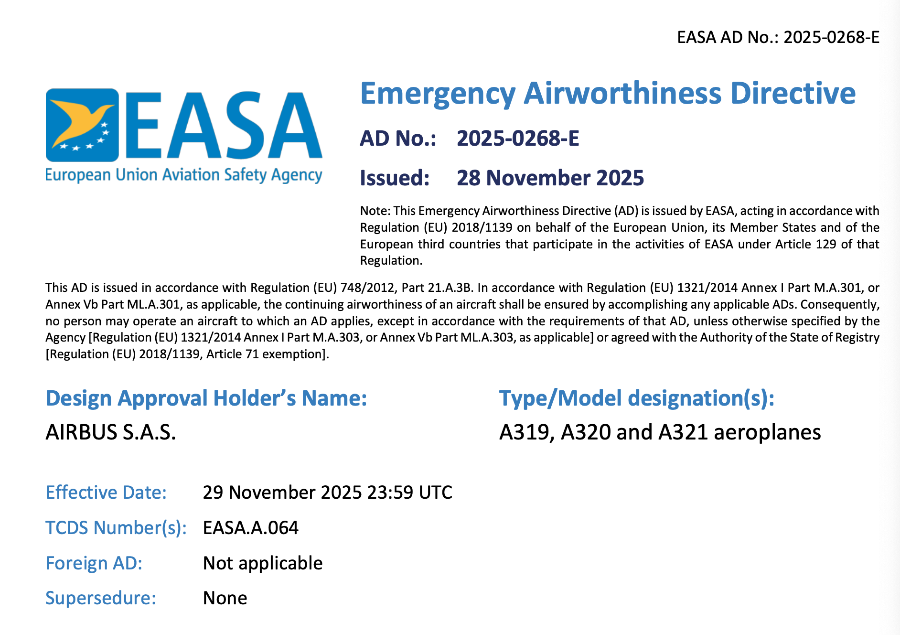
Core Viewpoint - The European Union Aviation Safety Agency (EASA) issued an emergency airworthiness directive on November 28, requiring the immediate grounding of all affected Airbus A320 aircraft due to flight control software vulnerabilities influenced by strong solar radiation, impacting approximately 6,000 aircraft [1][4]. Group 1: Emergency Airworthiness Directive - EASA's directive was prompted by Airbus reporting that a significant number of A320 series aircraft were affected by flight control software issues, necessitating urgent maintenance [1][4]. - Airbus indicated that the affected aircraft would require immediate software and/or hardware protective measures to ensure flight safety [1][4]. Group 2: Technical Assessment and Incident Background - The directive followed an incident on October 30 involving a JetBlue A320-200 that experienced an uncommanded and limited descent, leading to injuries onboard, with preliminary investigations pointing to software issues [6][4]. - Airbus's initial technical assessment identified a fault in the ELAC system as a potential contributing factor, which, if uncorrected, could lead to uncommanded control surface movements [4][6]. Group 3: Impact on Airlines - As of the end of November, there were 2,015 A320 aircraft in China, representing 48.3% of the total civil aviation fleet, distributed across 24 airlines [6][7]. - Industry experts suggest that while there will be some impact on operations, the majority of aircraft can be resolved through software updates, with minimal downtime expected [7].

全球约6000架A320飞机需紧急停飞,空客最新回应
2 1 Shi Ji Jing Ji Bao Dao· 2025-11-29 23:36
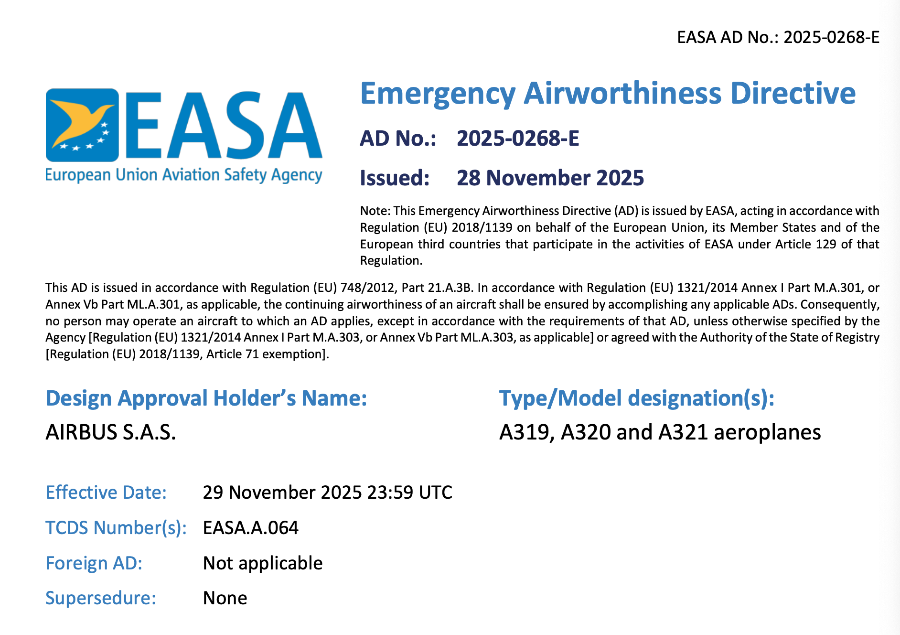
Core Viewpoint - The European Union Aviation Safety Agency (EASA) issued an emergency airworthiness directive on November 28, requiring the immediate grounding of all affected Airbus A320 aircraft due to concerns over flight control software vulnerability to strong solar radiation, impacting approximately 6,000 aircraft [1][4]. Group 1: Emergency Airworthiness Directive - EASA's directive was prompted by Airbus reporting that a significant number of A320 series aircraft were affected by flight control software issues, necessitating urgent maintenance [1][4]. - Airbus indicated that the affected aircraft would require immediate software and/or hardware protective measures to ensure flight safety [1][4]. Group 2: Technical Assessment and Incident Background - The directive followed an incident on October 30 involving a JetBlue A320-200 that experienced an uncommanded and limited descent, leading to injuries among passengers [6]. - Initial technical assessments by Airbus identified a potential ELAC fault as a contributing factor, which, if uncorrected, could lead to uncommanded control surface movements [4][6]. Group 3: Impact on Airlines - As of the end of November, there were 2,015 A320 aircraft in China, representing 48.3% of the total civil aviation fleet, distributed across 24 airlines [6]. - Industry experts suggest that while there will be some impact on operations, the majority of aircraft can be resolved through software updates, with minimal downtime expected [7].
全球约6000架A320飞机需紧急停飞,空客最新回应
21世纪经济报道· 2025-11-29 23:34
Core Viewpoint - The European Union Aviation Safety Agency (EASA) issued an emergency airworthiness directive on November 28, requiring the immediate grounding of all Airbus A320 aircraft due to flight control software vulnerabilities affected by strong solar radiation, impacting approximately 6,000 aircraft that will undergo urgent repairs [1][5]. Group 1: Emergency Airworthiness Directive - EASA mandated the grounding of multiple A320 aircraft following a report from Airbus about flight control software being susceptible to strong solar radiation, necessitating urgent maintenance [1][4]. - Airbus indicated that around 6,000 A320 aircraft are affected and will require urgent repairs, although Airbus China clarified that only local software adjustments are needed, not a recall to France [1][7]. Group 2: Incident Background - The emergency directive was prompted by an incident on October 30 involving a JetBlue A320-200 that experienced an uncontrolled descent, resulting in injuries. The investigation pointed to software issues as the cause [7]. - Airbus's preliminary technical assessment identified a fault in the ELAC system as a potential contributing factor, which, if uncorrected, could lead to unintended control movements exceeding the aircraft's structural limits [4][5]. Group 3: Impact on Chinese Airlines - As of the end of November, China has 2,015 A320 aircraft, accounting for 48.3% of the total civil aviation fleet, distributed among 24 airlines [7]. - Industry experts suggest that while there will be some impact on operations, the majority of aircraft can resolve the issue through software updates, with minimal downtime required for the process [8].

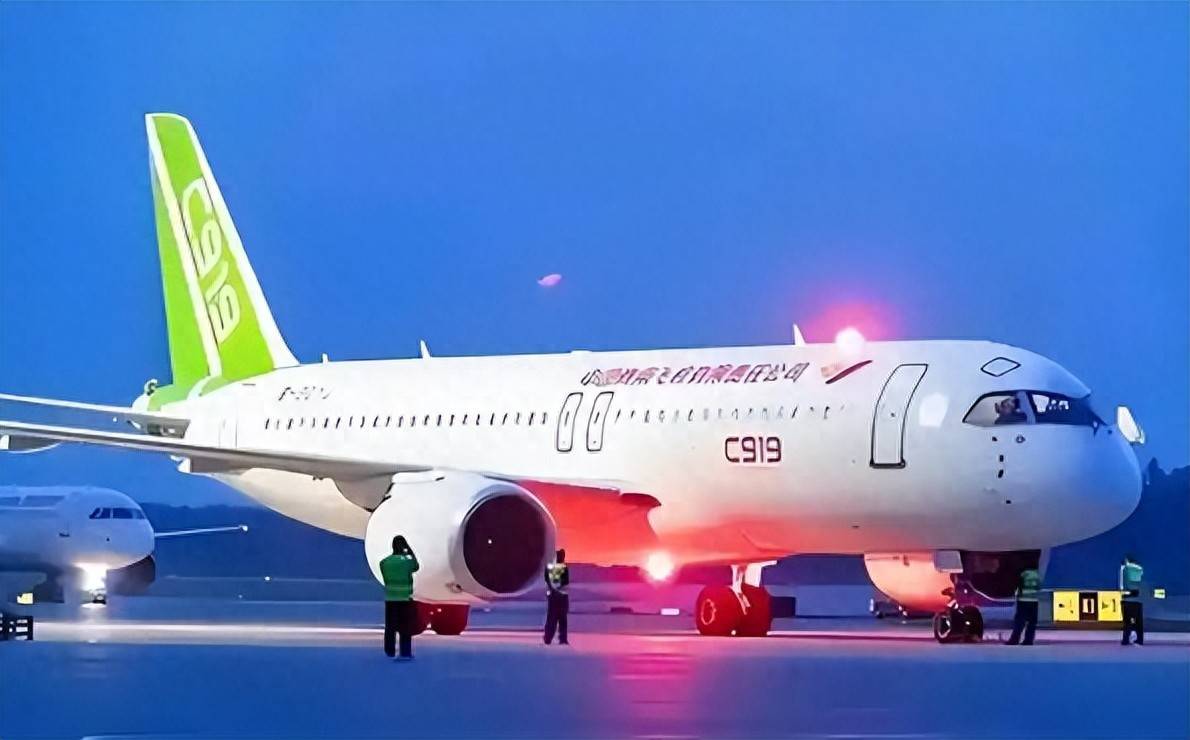
露出獠牙,欧洲终于对C919下“逐客令”,外媒:不怕断供发动机?
Sou Hu Cai Jing· 2025-11-29 16:12
Core Viewpoint - The C919 aircraft, after a challenging development process, has received its airworthiness certificate from the Civil Aviation Administration of China (CAAC) and has begun commercial operations, indicating a significant advancement in China's aviation industry [1][10]. Group 1: Development and Certification - The C919 project started in 2008, with significant efforts leading to its airworthiness certification in September 2022 and commercial operation beginning in May 2023 [1]. - The majority of C919's components, approximately 80%, are sourced from European and American suppliers, highlighting international collaboration [1]. - The C919's engine, the LEAP-1C, provided by CFM, enhances the aircraft's performance with stable operation and low fuel consumption [1]. Group 2: Market Dynamics and Competition - The C919's entry into the market could disrupt the existing aviation landscape, especially as Boeing faces delays and Airbus has a backlog extending to 2030 [3]. - The European Union Aviation Safety Agency (EASA) has indicated that C919's certification could be delayed by three to six years due to the need for re-evaluation of design and component testing [4]. - There are allegations that the certification delays are a strategic move by Europe to protect Airbus's market share, reflecting a competitive tension in the aviation sector [5]. Group 3: Future Prospects and Challenges - C919's orders are primarily from domestic airlines, with major Chinese carriers expected to place over a thousand orders by 2025, primarily for domestic routes [1][10]. - The delay in European certification could hinder C919's international sales, as many countries rely on EASA's approval [6]. - Despite the challenges, C919 has shown strong performance in domestic operations, with high passenger load factors and positive feedback on comfort and noise levels [8][10]. Group 4: Technological Advancements - The CJ-1000A engine, a domestically developed alternative, is progressing well and is expected to complete certification by 2025, which could alleviate dependency on foreign suppliers [6][12]. - The successful operation of C919 and its acceptance in markets like Brunei and Indonesia demonstrate growing recognition of Chinese aviation standards [9][10]. - The C919 symbolizes China's rising aviation technology and its potential to secure a significant position in the global aviation market [14].
申万宏源交运一周天地汇(20251123-20251128):干散运价超预期,油散新造船价格连续三周上涨,集装箱气体船回落
Shenwan Hongyuan Securities· 2025-11-29 12:38
Investment Rating - The report maintains a positive investment outlook for the shipping and logistics industry, recommending specific companies such as China Merchants Energy, COSCO Shipping Energy, and others [5][6]. Core Insights - Dry bulk freight rates have exceeded expectations, with the Baltic Dry Index (BDI) reaching a two-year high, indicating strong market conditions [5]. - The report highlights the ongoing increase in new ship prices and the high demand for second-hand vessels, suggesting a potential turning point in the shipbuilding market [5]. - The report emphasizes the resilience of rail freight and highway truck traffic, projecting steady growth in these sectors [5][6]. Summary by Sections Shipping Market - The report notes that VLCC (Very Large Crude Carrier) rates have reached historical highs, with a current average of $122,078 per day, despite a slight week-on-week decline of 3% [5]. - The report indicates that the BDI closed at 2,560 points, reflecting a 12.5% increase week-on-week, driven by strong Capesize performance [5][6]. Air Transport - The report discusses the unprecedented challenges in the aircraft manufacturing supply chain and the aging fleet, predicting significant improvements in airline profitability as demand for international flights increases [5]. Express Delivery - The report outlines three scenarios for the express delivery sector, focusing on potential price recovery and industry consolidation [5]. Rail and Highway - The report provides data showing that national railway freight volume was 81.5 million tons, with a slight week-on-week decline of 0.34%, while highway truck traffic was 56.58 million vehicles, down 2.16% [5][6]. High Dividend Stocks - The report lists high dividend stocks in the transportation sector, including companies like Bohai Ferry and Daqin Railway, with expected dividend yields ranging from 2.96% to 11.89% [21].
申万宏源交运一周天地汇:干散运价超预期,油散新造船价格连续三周上涨,集装箱气体船回落
Shenwan Hongyuan Securities· 2025-11-29 11:52
Investment Rating - The report maintains a positive outlook on the shipping industry, particularly highlighting the strong performance of dry bulk freight rates and VLCC (Very Large Crude Carrier) rates, while also noting the recent increase in new ship prices for oil and bulk carriers [5][6]. Core Insights - Dry bulk freight rates have exceeded expectations, with the Baltic Dry Index (BDI) reaching 2560 points, a 12.5% increase week-on-week. Capesize rates have surged by 22.7%, marking the highest levels in nearly two years [5][6]. - The VLCC market remains robust, with current charter rates at $57,000 per day, significantly higher than the spot market rate of $140,000 per day. The report suggests that if spot rates decline, charter rates may rise, indicating a potential seasonal trading phase [5]. - Newbuilding prices for oil and bulk carriers have seen consecutive increases over the past three weeks, with second-hand ship prices also reaching new highs, suggesting a turning point in the newbuilding market [5]. - The report emphasizes the importance of monitoring the seasonal decline in freight rates from Christmas to the Spring Festival, which could impact market dynamics [5]. Summary by Sections Shipping Market Performance - The shipping index has shown a decline of 0.47%, underperforming the CSI 300 index, which rose by 1.64%. Among the sub-sectors, the intermediate products and consumer goods supply chain services saw the largest increase of 4.20%, while the airline transportation sector experienced the most significant drop of 2.05% [6][13]. Freight Rates and Trends - The report highlights that the dry bulk freight rates have reached a two-year high, driven by increased shipments from major exporters like Australia and Brazil. The Capesize rates have particularly benefited from tight capacity and favorable weather conditions affecting vessel turnover [5][6]. - The report also notes fluctuations in oil tanker rates, with VLCC rates experiencing a slight decline of 3% week-on-week, while Suezmax rates decreased by 2% [5]. Airline and Logistics Sector - The airline industry is poised for significant improvement due to a combination of rising passenger demand and constrained supply, with recommendations to focus on major airlines such as China Eastern Airlines and China Southern Airlines [5]. - The express delivery sector is entering a new phase of competition, with potential for price recovery and improved profitability, particularly for companies like Shentong Express and YTO Express [5]. Investment Recommendations - The report recommends continued investment in companies such as China Merchants Energy Shipping, COSCO Shipping Energy Transportation, and China Shipbuilding Industry Corporation, while also suggesting a watch on companies like SITC International Holdings and Pacific Basin Shipping [5].