
美的集团

Search documents
锐珂医疗:分拆为两家独立企业,其中国际业务板块被美的收购
Cai Jing Wang· 2026-01-04 06:36
其中,国际业务板块被中国家电巨头美的集团收购。根据交易条款,锐珂医疗向美的出售了其在美国以 外多个市场运营的全资企业实体的部分资产,具体交易金额未对外披露。 (锐珂医疗官方网站) 近日,美国锐珂医疗(Carestream Health, Inc.)正式宣布完成重大战略重组,公司成功分拆为两家聚焦 不同地域市场的独立企业。 ...

2026年国补落地,关注政策接续效果:家用电器
Huafu Securities· 2026-01-04 06:05
Group 1 - The core viewpoint of the report emphasizes the implementation of the 2026 national subsidy policy for large-scale equipment updates and the trade-in of consumer goods, which is expected to stabilize the domestic consumption market and stimulate demand, particularly in offline channels and rural areas [2][3][5][14]. - The 2026 subsidy policy introduces changes compared to 2025, including a more concentrated subsidy range, with the number of household appliance categories reduced from 12 to 6, retaining only core categories such as refrigerators, washing machines, televisions, air conditioners, computers, and water heaters [4][15]. - The subsidy standards have been optimized, with a 15% subsidy on the sales price for energy-efficient or water-efficient products, and a maximum subsidy of 1,500 yuan per item for household appliances [4][15]. Group 2 - The report indicates that the 2026 policy aims to enhance the efficiency of fund utilization by focusing on core categories and avoiding imbalances in funding distribution, which is expected to positively impact leading companies in the household appliance sector such as Midea Group, Haier Smart Home, Hisense, and TCL Electronics [5][14]. - The report highlights the recent performance of the home appliance sector, noting a weekly increase of 0.7%, while specific segments like white goods and small appliances experienced declines [6][17]. - The report provides insights into raw material prices, indicating a week-on-week increase in LME copper and aluminum prices by 2.05% and 1.23%, respectively, which may impact the cost structure of household appliance manufacturers [6][17].
首轮报名2月10日截止 | 生物基行业创新评选「新叶奖」火热报名中
合成生物学与绿色生物制造· 2026-01-04 05:36
Core Viewpoint - The New Leaf Award is a prestigious global award focused on innovation in the bio-based industry, aimed at recognizing and showcasing outstanding products and companies in this sector [2][17]. Group 1: Award Overview - The New Leaf Award, organized by DT New Materials, is recognized as the "Oscar of the bio-based industry" and has awarded over 100 innovative bio-based products through a professional evaluation team [2][17]. - The award features four categories: Innovation Material Award, Innovation Application Award, Innovation Industry Solution Award, and Most Commercially Valuable Award [6][2]. Group 2: Application Timeline and Process - The application for the 2026 New Leaf Award has started, with key dates including: - Application period: December 1, 2025, to March 13, 2026 [11]. - Online voting (pre-selection): March 16 to March 22, 2026 [11]. - Online competition and expert review (final selection): March 23 to March 27, 2026 [11]. - Award ceremony: May 21, 2026, during the Bio-based 2026 Conference [3][11]. Group 3: Evaluation Criteria - The evaluation criteria for the awards include: - Innovation in technology and application, functionality, commercial value, and sustainability, with varying weightings for each award category [9]. - For the Innovation Material Award, the criteria weightings are: 30% technical innovation, 10% application innovation, 25% functionality, 20% commercial value, and 15% sustainability [9]. Group 4: Benefits of Participation - Participating companies can benefit from free publicity, leveraging DT New Materials' extensive network of over 100,000 industry followers and 100+ communication groups [10]. - Award-winning companies will receive a high-end trophy and certificate at the award ceremony, providing significant visibility and recognition in the industry [13].


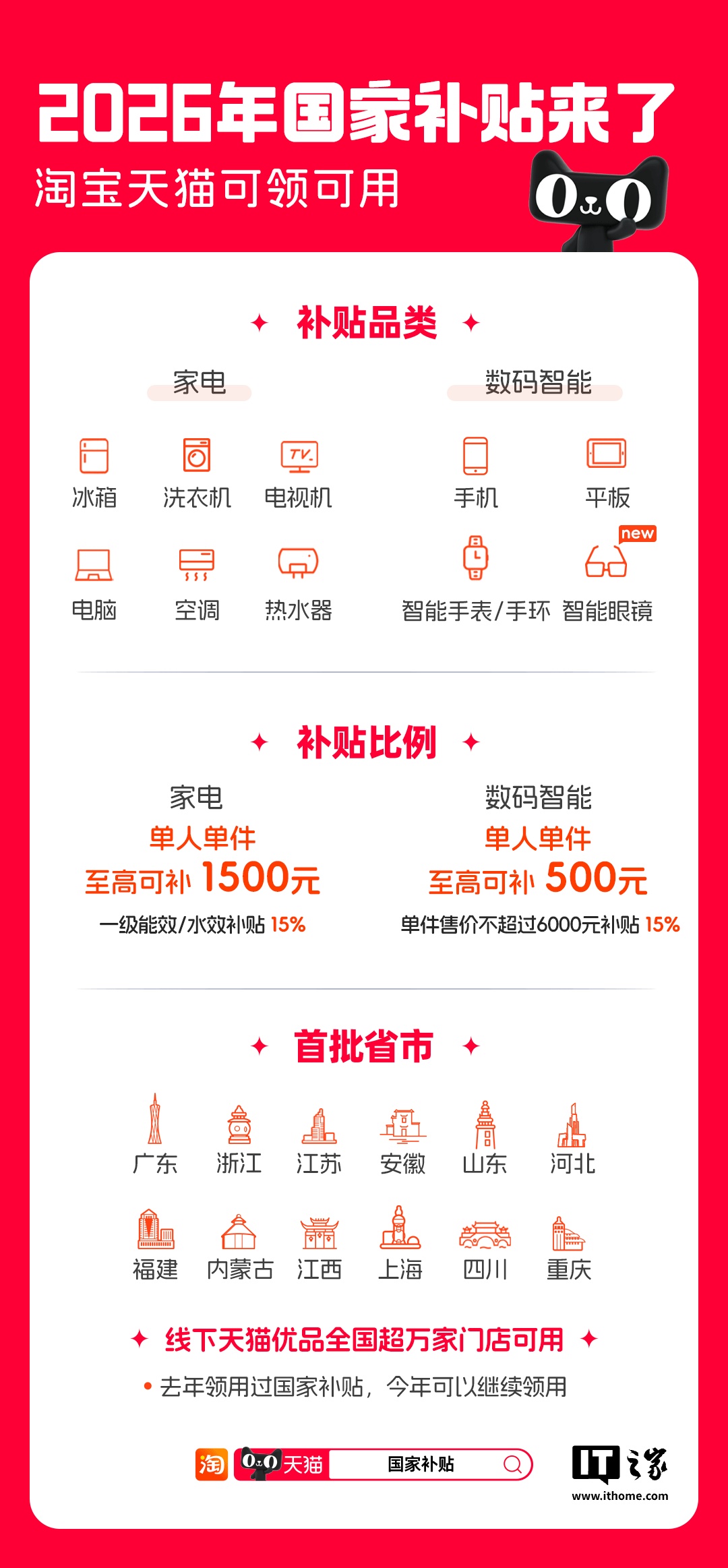
淘宝天猫开启 2026 年国补:家电数码补贴 15%、广东 / 浙江 / 江苏 / 福建多地可领
Xin Lang Cai Jing· 2026-01-04 01:29
Core Insights - The 2026 national subsidy program covers 10 categories including refrigerators, washing machines, televisions, air conditioners, computers, water heaters, mobile phones, tablets, smartwatches, and smart glasses, with smart glasses being a new addition for 2026 [3][15] - The subsidy rate is standardized at 15%, with a maximum subsidy of 1500 yuan for energy/water-efficient home appliances and a maximum of 500 yuan for digital and smart products priced under 6000 yuan [3][15] Subsidy Program Details - The "National Subsidy Renewal Season" event is launched in collaboration with brands like Haier, Midea, Huawei, and Siemens, offering consumers an additional 950 yuan coupon on top of the national subsidy, allowing home appliances to be discounted up to 50% [4][15] - The government subsidy for digital home appliances continues in 2026, with mobile phones, tablets, and 3C digital products eligible for an 8.5% discount, with a maximum reduction of 500 yuan for products priced under 6000 yuan [4][15] - Six categories of home appliances are eligible for an 8.5% government subsidy, with a maximum subsidy of 1500 yuan per item [5][15]
美的太子爷旗下小贷公司吃罚单!盈峰普惠因征信违规被罚84万
Xin Lang Cai Jing· 2026-01-04 01:29
这家公司名字听起来或许有些陌生,但其背后的资本版图却不容小觑——它的实际控制方,正是美的集团创始人何享健之子何剑锋所 掌舵的盈峰集团。 01.千亿帝国下的金融棋子 资料显示,盈峰集团已构建起一个横跨消费、环境、文化、资管、科技等多个领域的庞大投资版图。集团业务覆盖全球200多个国家 和地区,资产规模近900亿元,年营收约400亿元,员工总数超过6万人,是不折不扣的产业巨头。 临近新年,金融监管罚单并未停歇。2025年12月31日,中国人民银行广东省分行官网披露,广东盈峰普惠互联网小额贷款股份有限公 司因违反征信业务管理有关规定,被处以83.91万元罚款。这张罚单的作出日期是2025年12月26日。 此次被罚的盈峰小贷,隶属于盈峰集团旗下的科技板块——盈峰数科。盈峰数科成立于2015年,总部设在广州,手握全国互联网小 贷、商业保理等多个金融牌照,注册资本金合计超过13亿元。 | 广东盈峰普惠互联 小额贷款股份有限 公司 | 广东银罚决字 〔2025〕 51号 | 违反征信业务管理有关规定。 | 处罚款83.91万元 | 中国人民银行广东省 分行 | 12月26日2025年 | | --- | --- | --- ...

瞄准5万亿美元市场:跨界布局机器人,时代的新共识
3 6 Ke· 2026-01-04 00:26
Core Insights - The Chinese robotics industry is poised for significant growth by the end of 2025, with humanoid robots transitioning from experimental concepts to practical applications, achieving over 50% growth and indicating a trillion-yuan industry on the horizon [1] - The entry of major players from various sectors such as automotive, electronics, and the internet into the robotics field marks a shift from niche exploration to widespread competition, creating a unique trend of "cross-industry integration" [1] Group 1: Market Dynamics - In the first eight months of 2025, the primary market financing in the robotics sector reached 38.624 billion yuan, 1.8 times the total for 2024, highlighting the blue ocean effect attracting significant investment [2] - The global industrial robot sales are projected to reach 542,000 units in 2024, with China accounting for 295,000 units, representing 54% of the global market [2] - By 2025, the Chinese robotics market is expected to exceed 150 billion yuan, capturing 35% of the global market share, with predictions suggesting the market for embodied intelligence could reach 400 billion yuan by 2030 and over a trillion yuan by 2035 [2] Group 2: Industry Trends - At least 20 automotive companies have entered the humanoid robot market by the end of 2025, with notable developments including Chery's humanoid robot Mocha and BYD's production line for core robot components [3] - The automotive industry's supply chain overlaps significantly with robotics, with a 60% compatibility rate, driving car manufacturers to invest in robotics as they view vehicles as "mobile intelligent robots" [3] - Home appliance manufacturers are transitioning from traditional manufacturing to smart ecosystems, with companies like Midea establishing dedicated innovation centers for humanoid robots and developing comprehensive R&D systems [7] Group 3: Strategic Shifts - The automotive sector is seen as a key player in the transition to robotics, with companies like Geely planning to invest 5 billion yuan over three years to develop critical components and establish an ecosystem covering all robotics applications [6] - Internet giants are leveraging their technological and capital advantages to enter the robotics space, with ByteDance and Huawei making significant investments in developing advanced robotic models and systems [8] - The competition in the robotics sector is viewed as a strategic restructuring driven by technological advancements, with companies aiming to activate existing technological capabilities and build new ecosystems [9] Group 4: Challenges Ahead - Despite the enthusiasm for entering the robotics market, cross-industry players face challenges such as adapting core competencies to the robotics field, where technology paths are still being defined [10] - The high precision and stability required for industrial applications pose significant challenges for companies transitioning from other sectors, as they may struggle to meet the diverse demands of various operational environments [11] - Cost remains a critical issue, with companies like BYD and GAC aiming to reduce the production cost of humanoid robots to below 200,000 yuan, which requires overcoming substantial supply chain and process optimization challenges [11]





上海星闪开放实验室落子青浦
Ge Long Hui· 2026-01-03 23:56
Core Viewpoint - The establishment of the Shanghai NearLink Open Laboratory marks a significant step in Shanghai's autonomous innovation ecosystem in the field of wireless short-range communication, highlighting advancements in technology and collaboration within the industry [1] Group 1: Technology Development - NearLink is a new generation wireless short-range communication technology brand independently developed in China, with standards set by the Ministry of Industry and Information Technology [1] - The technology shows significant improvements in transmission performance and device compatibility compared to traditional technologies like Bluetooth, applicable in smart vehicles, industrial intelligence, and smart home scenarios [1] Group 2: Collaboration and Ecosystem - The Shanghai NearLink Open Laboratory represents a deepening collaboration between Midea and the Shanghai HiSilicon industrial chain, serving as a core platform for building an international NearLink alliance and its industrial ecosystem [1] - The laboratory integrates common technology research and development, testing certification services, and ecosystem cultivation and empowerment [1] Group 3: Regional Innovation Growth - During the 14th Five-Year Plan period, the innovation and entrepreneurship density in Qingpu District has been continuously increasing, with social R&D expenditure averaging a growth of 19.2% over the past five years, projected to exceed 6.5 billion yuan in 2024 [1]
“国际金融中心遗址论”不攻自破 港股逆袭,问鼎全球IPO募资额
Sou Hu Cai Jing· 2026-01-03 23:42
Core Viewpoint - The Hong Kong capital market has made a strong comeback, with 114 companies completing IPOs in 2025, raising approximately 286.3 billion HKD, surpassing the total fundraising of 2023 and 2024 combined, and reclaiming the top position globally for IPO fundraising [2][4]. Group 1: IPO Market Recovery - In 2023, the Hong Kong IPO market faced significant challenges, with only 70 companies listed and total fundraising dropping to 46.3 billion HKD, a 44% year-on-year decline, marking a historical low [4]. - The market showed signs of recovery in 2024, with 79 companies raising a total of 87.6 billion HKD, ranking Hong Kong as the fourth largest IPO market globally [4]. - The year 2025 saw a remarkable 227% increase in IPO fundraising compared to 2024, with the number of listed companies growing by 63%, making Hong Kong the largest contributor to the global IPO market recovery [4][5]. Group 2: Major Contributors to IPO Success - Eight large IPOs in 2025 raised over 10 billion HKD each, accounting for about 50% of the total fundraising, with CATL leading at approximately 41 billion HKD, marking the largest IPO in Hong Kong in nearly four years [4][5]. - A significant portion of the IPOs in 2025 came from mainland companies, with 89% of new listings originating from this sector, contributing to a total fundraising increase from 83.9 billion HKD to 233.1 billion HKD [9][12]. Group 3: Strengthening Financial Connectivity - The unique mutual market access mechanism between Hong Kong and mainland China is highlighted as a key advantage for the Hong Kong Stock Exchange compared to other international exchanges [6]. - The Chinese government's ongoing efforts to deepen capital market openness and enhance cross-border connectivity further solidify Hong Kong's role as a financial hub [6][7]. Group 4: Technological and Financial Integration - Hong Kong's capital market is increasingly integrating technology and finance, supporting the development of innovative enterprises, particularly in sectors like artificial intelligence and semiconductors [11][12]. - The introduction of supportive regulations for tech companies, including the 18A and 18C chapters, aims to facilitate the listing of innovative firms, enhancing the market's appeal to high-growth sectors [11][12].

2025年谁流落亏损榜?“亏损王”爱调仓折腾,多位知名老将在列
Feng Huang Wang· 2026-01-03 23:21
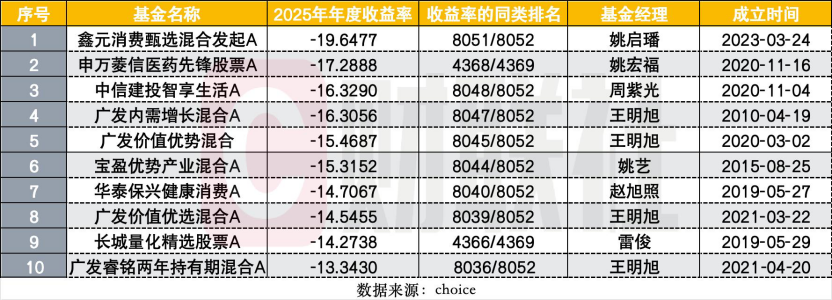
Core Viewpoint - The A-share market in 2025 exhibited a clear structural bull market, with significant performance disparities among active equity funds, highlighted by the top-performing fund achieving a record annual return of 233.29% while others faced substantial losses, including the worst performer with a -19.65% return [1][4]. Group 1: Market Performance - The Shanghai Composite Index, Shenzhen Component Index, ChiNext Index, and Sci-Tech Innovation 50 Index rose by 18.41%, 29.87%, 49.57%, and 35.92% respectively in 2025 [1]. - A total of 4888 active equity products from 160 public fund institutions reported positive returns, while 144 products from 68 institutions experienced losses [1][9]. Group 2: Fund Performance Disparities - The top-performing fund, Yongying Technology Smart Selection, achieved a record annual return of 233.29%, surpassing the previous record set by Wang Yawei in 2007 [1]. - The worst-performing fund, Xinyuan Consumption Selection, recorded a -19.65% return, marking a significant gap of 252.94% from the top performer [2][4]. Group 3: Xinyuan Consumption Selection Analysis - Xinyuan Consumption Selection's poor performance is attributed to aggressive trading strategies, frequent personnel changes, and scale challenges, leading to a lack of coherent investment logic [3][5]. - The fund's industry allocation showed erratic shifts, moving from heavy investments in pharmaceuticals to technology and later to media, missing key market trends [5][6]. Group 4: Fund Manager Insights - Notable fund managers, including Wang Mingxu and Han Weijun, saw their products listed among the worst performers, with their total managed assets shrinking by over 70% compared to previous peaks [3][9][12]. - Xinyuan Consumption Selection faced a critical challenge to meet its scale assessment, needing to grow from 0.29 billion to 2 billion within three months [7][8]. Group 5: Institutional Investment Trends - Institutional ownership in Xinyuan Consumption Selection dropped from over 95% to 42.94% by mid-2025, indicating a significant withdrawal of institutional funds [7]. - The trend of multiple products from the same fund manager appearing on the loss list highlights a broader issue within the industry, affecting even previously successful managers [9][10].
人民日报任平:为人民出政绩 以实干出政绩
Ren Min Ri Bao· 2026-01-03 22:17
(一) 踏进新的一年、迈入"十五五"时期,面对深刻复杂变化的发展环境,我们要以什么样的奋斗,把今后5 年我国发展的新蓝图变成宏阔壮美的新实景? "脚要踩在大地上。我们干任何事情都有内在规律。"2025年11月,习近平总书记在听取海南自由贸易港 建设工作汇报时强调。 "越是伟大的事业,越是充满挑战,越需要知重负重。全党同志都要保持'越是艰险越向前'的英雄气 概,保持'敢教日月换新天'的昂扬斗志,埋头苦干、攻坚克难,努力创造无愧于党、无愧于人民、无愧 于时代的业绩。" 2021年建党百年重大历史节点、"七一勋章"首次颁授仪式上,总书记这段号召全党同志不懈奋斗、永远 奋斗的重要讲话,每每读来总是让人更加清醒、更加自信,充满豪情、充满干劲。 以百姓心为心,这是党的初心,也是党的恒心。政绩为人民而创,才能赢得人民衷心拥护。 岁末年初,总书记提出一系列明确要求,"坚持为人民出政绩、以实干出政绩""主动担重、担难""书写 无愧于人民的时代答卷",这是全党同志在新的一年再启新程的奋斗号令。 胸怀"国之大者","脚踩大地",因地制宜做好工作,这是我们以科学方法把握规律、以务实作风推进落 实,实现"十五五"良好开局的方法指引。 ...