天弘基金

Search documents
基金早班车丨宽基ETF资金流出,化工通信有色ETF逆势吸金
Jin Rong Jie· 2026-02-10 00:53
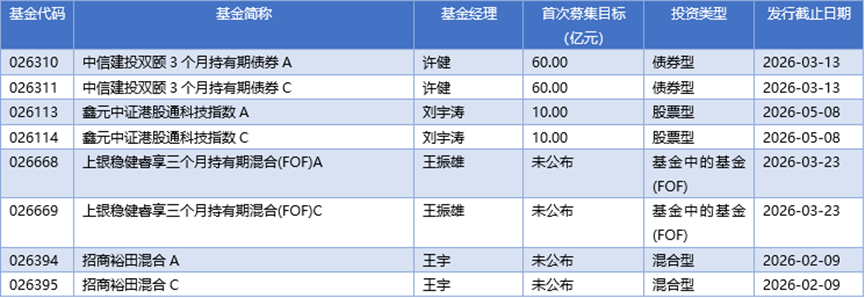
Group 1: Market Trends - In early 2026, A-share ETF fund flows have changed, with continuous net outflows from broad-based products like CSI 300 and CSI 500, while high-growth sectors such as chemicals, communications, and non-ferrous metals have seen inflows [1] - The market is experiencing a strong rebound, with the Shanghai Composite Index rising by 1.41% to 4123.09 points, the Shenzhen Component Index up 2.17% to 14208.44 points, and the ChiNext Index increasing by 2.98% to 3332.77 points [1] Group 2: Fund News - On February 9, 2026, eight new funds were launched, primarily bond funds and funds of funds (FOF), with a fundraising target of 6 billion yuan for the CITIC Securities Dual Yield 3-Month Holding Period Bond A [2] - The number of new fund accounts opened in January reached 546,300, a significant increase of 168% compared to the same period in 2025, indicating a notable rise in investor enthusiasm [2] - Credit bond ETFs have faced a "tide of withdrawal," with a cumulative reduction of over 100 billion yuan in scale over five weeks, particularly affecting the Sci-Tech Innovation Bond ETF, which shrank by more than 70 billion yuan [2] Group 3: Fund Dividends - On February 9, 2026, several funds distributed dividends, with the highest payout being 0.1330 yuan per 10 fund shares for the China Europe National Index Free Cash Flow Index A fund [5] - Other notable dividend distributions include 0.1310 yuan for the China Europe National Index Free Cash Flow Index C fund and 0.0870 yuan for the Bosera Yukun 3-Month Fixed Open Bond fund [5]

我天!百亿基金经理,突然离职了!!
Xin Lang Cai Jing· 2026-02-09 12:19
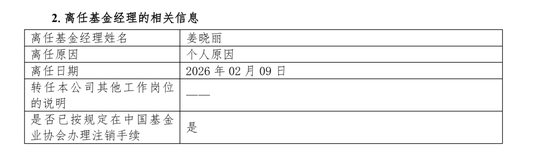
炒股就看金麒麟分析师研报,权威,专业,及时,全面,助您挖掘潜力主题机会! 来源:硬核姬老板 结果临近过节,一个公告,尘埃落地。 | 离任基金经理姓名 | 姜晓丽 | | --- | --- | | 高任原因 | 个人原因 | | 离任日期 | 2026年02月09日 | | 转任本公司其他工作岗位 | | | 的说明 | | | 是否已按规定在中国基金 | 最 | | 业协会办理注销手续 | | 一、姜晓丽离职,蛮可惜的 这个变动确实出乎所有人的意料!! 姜晓丽2009年就加入天弘基金了,在天弘呆了16年,是天弘基金呆的最久的基金经理,没有之一! 当初的天弘基金可没那么风光无限,还是属于微型基金公司,这16年来能一直陪着基金公司从种子到参 天大树,不容易的。 年末最重磅的事情,应该是天弘基金姜晓丽离职吧… 其实这个事情传了一阵了,毕竟姜晓丽之前还休了一个小长假,一些消息灵敏的人已经四处打听了,不 过当初的结论是说姜总身体不好,休息了一阵子,已经回公司了。 姜晓丽管理规模一度是超700亿的,目前合并管理规模为350亿。 从债券基金经理转型成团队领导人后,姜晓丽陆陆续续卸任了不少基金,其中依旧留下来管的主要是天 ...
“固收+”名将姜晓丽,官宣离职!
券商中国· 2026-02-09 12:13
2月9日,天弘基金公告,掌管多只"固收+"产品的基金经理姜晓丽因个人原因卸任所管基金,据了 解,姜晓丽已提交离职申请。 同日,姜晓丽在发布的《致持有人的一封信》中表示:离职主要源于长期高强度工作后希望休息、陪伴家人的 个人选择。 姜晓丽官宣离职 公开资料显示,姜晓丽拥有超16年证券从业经历与逾13年基金管理经验。她于2009年加入天弘基金,从研究员 成长为固收+体系总监,是天弘内部培养的核心骨干。 截至去年末,姜晓丽参与管理的基金合计规模高达350.24亿元,其投资风格稳健,擅长宏观判断,多次前瞻应 对债市拐点。以其代表性产品天弘永利债券B为例,据统计,姜晓丽2012年8月管理以来的13个完整年度,有 11年度录得正收益,截至2025年末,该基金近18年间累计收益率高达167.12%,超越业绩比较基准60.85%。 针对持有人顾虑,姜晓丽表示,她的接任者均为共事多年、经验丰富的基金经理,天弘基金也回应称,天 弘"固收+"业务一直采用多基金经理共管模式,接任基金经理将继续执行既定投资目标与流程,投资范围无重 大变化,投研团队将提供全面支持。如前述天弘永利债券作为市场中最具影响力的"固收+"产品之一,目前已 增聘 ...
奕瑞科技股价连续5天上涨累计涨幅10.99%,天弘基金旗下1只基金持13.4万股,浮盈赚取164.02万元
Xin Lang Ji Jin· 2026-02-09 07:08
天弘中证医药100A(001550)基金经理为贺雨轩。 截至发稿,贺雨轩累计任职时间4年225天,现任基金资产总规模112.26亿元,任职期间最佳基金回报 115.83%, 任职期间最差基金回报-61.43%。 声明:市场有风险,投资需谨慎。 本文基于第三方数据库自动发布,不代表新浪财经观点,任何在本 文出现的信息均只作为参考,不构成个人投资建议。如有出入请以实际公告为准。如有疑问,请联系 biz@staff.sina.com.cn。 责任编辑:小浪快报 数据显示,天弘基金旗下1只基金重仓奕瑞科技。天弘中证医药100A(001550)四季度持有股数13.4万 股,占基金净值比例为0.99%,位居第九大重仓股。根据测算,今日浮盈赚取约20.24万元。连续5天上 涨期间浮盈赚取164.02万元。 天弘中证医药100A(001550)成立日期2015年6月30日,最新规模6.92亿。今年以来收益2.73%,同类 排名2980/5580;近一年收益10.73%,同类排名3734/4290;成立以来亏损19.61%。 2月9日,奕瑞科技涨1.24%,截至发稿,报123.58元/股,成交3.77亿元,换手率1.54%,总 ...

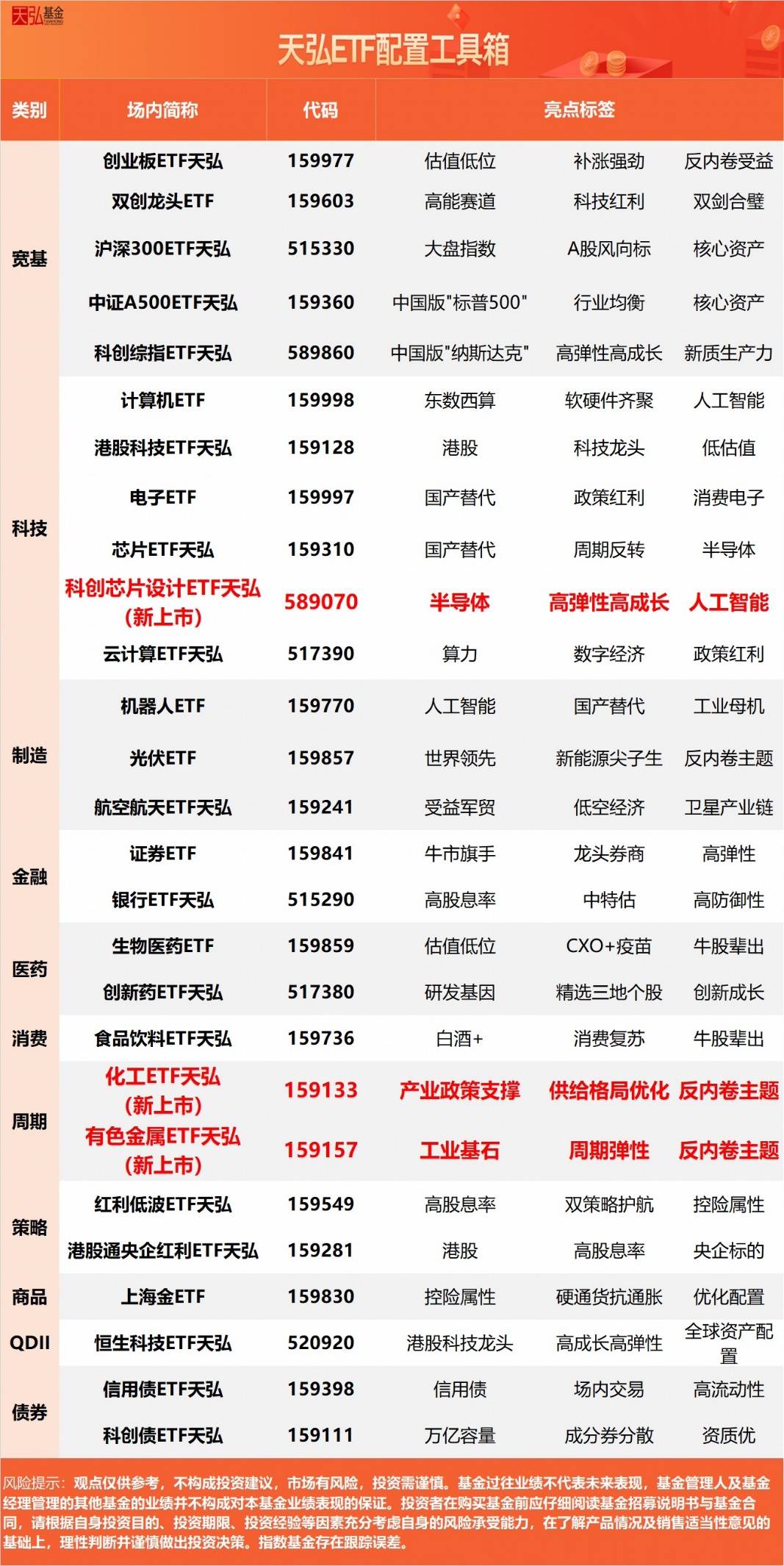
严控新增矿铜冶炼项目!有色金属ETF天弘(159157)标的指数上涨2%,盘中净申购近5000万份
Ge Long Hui· 2026-02-09 06:42
Group 1 - The non-ferrous metal sector has rebounded across the board, with the Tianhong Non-Ferrous Metal ETF (159157) index rising by 2%, and a net subscription of 46 million units during the trading session [1] - The Tianhong Non-Ferrous Metal ETF closely tracks the CSI Industrial Non-Ferrous Metal Theme Index, with the top three industries being copper (34.43%), aluminum (21.82%), and rare earths (13.60%), collectively accounting for nearly 70% [1] - The ETF is the first in the market among those tracking non-ferrous metal indices, highlighting its scarcity and investment value, and it is supported by two off-market linked funds [1] Group 2 - The US dollar index fell to its lowest level since February 4, leading to a strong rebound in gold and silver prices, which in turn contributed to the rebound in non-ferrous metals [2] - The upcoming "golden three silver four" spring construction peak season, along with policy implementations after the March Two Sessions, is expected to boost resource products and the infrastructure chain [2] - The US has initiated a $12 billion critical mineral reserve plan, covering various key minerals including rare earths, cobalt, and gallium, and has established bilateral and trilateral agreements to strengthen the critical mineral supply chain [2] - The China Nonferrous Metals Industry Association has announced measures to strictly control new copper smelting projects and promote the construction of a reserve system, while the People's Bank of China has purchased gold for the 15th consecutive month [2] - According to Founder Securities, the emphasis on critical mineral resources by major countries indicates a significant revaluation of the strategic attributes of metals, with a tight supply structure expected to maintain upward price trends in the medium to long term [2]
天孚通信20cm涨停!创业板ETF天弘(159977)标的指数大涨超3%,连续4日“吸金”超4400万元
Sou Hu Cai Jing· 2026-02-09 05:42
Core Insights - The ChiNext ETF Tianhong (159977) has seen significant trading activity, with a transaction volume of 117 million yuan and a strong increase of 3.06% in the tracked ChiNext Index (399006) [1] - The ChiNext ETF Tianhong (159977) has experienced a substantial growth of 11.76 million shares over the past six months, with a total net inflow of 44.08 million yuan in the last four days [2] Product Highlights - The ChiNext ETF Tianhong (159977) offers several advantages: it bundles a variety of ChiNext stocks, has a daily price fluctuation limit of ±20%, requires no asset or investment duration for account opening, and allows for convenient trading like stocks [3] Industry Events - The Shanghai government highlighted its strengths in the artificial intelligence sector, including collaborative industrial clusters, large market scenarios, talent supply, and a complete financial system. Shanghai accounts for nearly 10% of the national computing power and has launched various initiatives to support AI development [4] Institutional Views - Guotai Junan Securities noted that the market remains in a high volatility state before the Spring Festival, suggesting that the next wave of market activity will likely be based on logic rather than sentiment. They anticipate a potential resurgence of technology growth stocks after the Spring Festival [5]

超110亿 加仓
Zhong Guo Ji Jin Bao· 2026-02-09 04:56
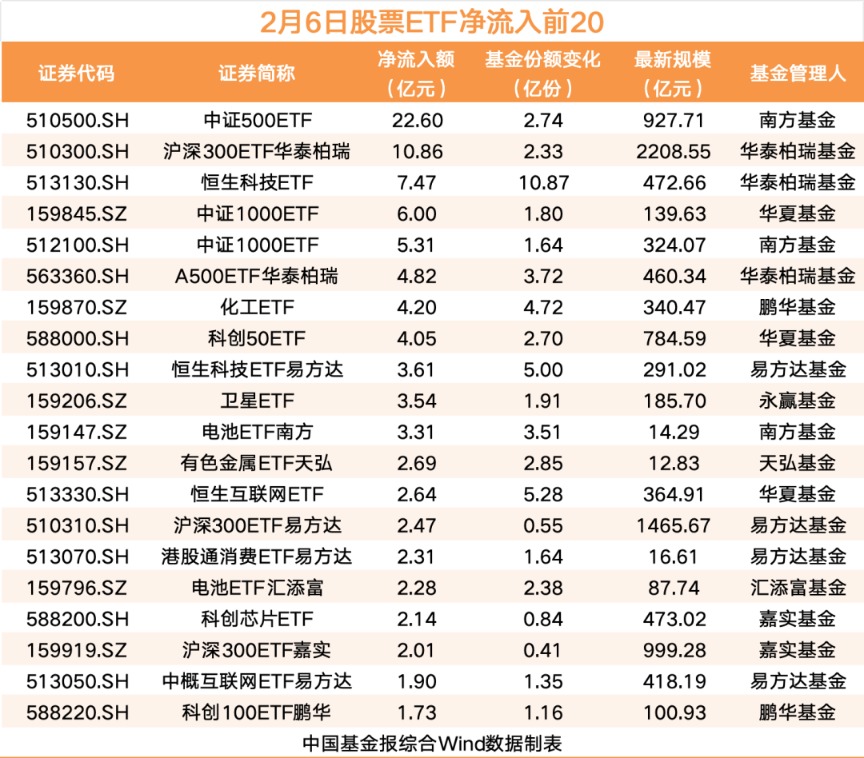
Core Viewpoint - The A-share market experienced a collective decline on February 6, with significant net inflows into stock ETFs, exceeding 11 billion yuan on that day [1]. Group 1: ETF Market Overview - As of February 6, the total scale of 1,333 stock ETFs in the market reached 4.1 trillion yuan, with a net inflow of 11.764 billion yuan and an increase of 9.347 billion fund shares [3]. - The leading categories for net inflows were broad-based ETFs and Hong Kong stock ETFs, with inflows of 7.112 billion yuan and 2.518 billion yuan, respectively [3]. - The CSI 500 Index ETF saw the highest net inflow at 2.585 billion yuan, while the Hang Seng Technology Index ETF and the Sci-Tech 50 Index ETF attracted over 11.2 billion yuan and 5 billion yuan, respectively, over the past five trading days [3]. Group 2: Top ETFs by Net Inflow - On February 6, 35 ETFs recorded net inflows exceeding 1 billion yuan, with the top three being the CSI 500 ETF (2.26 billion yuan), the CSI 300 ETF by Huatai-PB (1.086 billion yuan), and the Hang Seng Technology ETF (747 million yuan) [4]. - Notable inflows were also observed in the China Securities 1000 ETF and the Sci-Tech 50 ETF, with net inflows of 600 million yuan and 405 million yuan, respectively [5]. Group 3: ETFs with Net Outflows - The gold stock ETF experienced the largest net outflow, totaling 812 million yuan on February 6 [5]. - Other ETFs with significant outflows included the Tongwen Stock ETF (-559 million yuan), the SSE 50 ETF (-331 million yuan), and the Food and Beverage ETF (-324 million yuan) [6]. Group 4: Market Outlook - Fund managers from E Fund expressed optimism about the domestic macroeconomic outlook, expecting continued stability and progress, with emerging industries likely to see further development [7]. - Bosera Fund noted that financial conditions remain favorable for equity assets, suggesting that ETF outflows may have reached a turning point, with a potential return to growth in financing balances [7].
超110亿,加仓
Xin Lang Cai Jing· 2026-02-09 04:00
Core Viewpoint - On February 6, the A-share market saw a collective decline in the three major indices, while the stock ETF market experienced a net inflow of over 110 billion yuan, indicating continued bottom-fishing by investors [10][11]. Group 1: ETF Market Overview - As of February 6, the total scale of 1,333 stock ETFs in the market reached 4.1 trillion yuan, with a net inflow of 117.64 billion yuan on that day [2][11]. - The largest inflows were seen in broad-based ETFs and Hong Kong stock markets, with net inflows of 71.12 billion yuan and 25.18 billion yuan, respectively [2][11]. - The CSI 500 Index ETF led the inflows with 25.85 billion yuan, while the Hang Seng Technology Index ETF saw inflows exceeding 112 billion yuan over the past five trading days [2][11]. Group 2: Top ETFs by Net Inflow - On February 6, 35 ETFs had net inflows exceeding 1 billion yuan, with the top three being: - CSI 500 ETF: 22.6 billion yuan - CSI 300 ETF by Huatai-PB: 10.86 billion yuan - Hang Seng Technology ETF: 7.47 billion yuan [3][12]. - Other notable inflows included the CSI 1000 ETF and the Sci-Tech 50 ETF, which saw net inflows of 6 billion yuan and 4.05 billion yuan, respectively [13]. Group 3: ETFs with Net Outflows - The gold stock ETF experienced the largest net outflow, totaling 8.12 billion yuan on February 6 [6][14]. - Other ETFs with significant outflows included: - SSE 50 ETF: -3.31 billion yuan - Food and Beverage ETF: -3.24 billion yuan - Securities and Insurance ETF by E Fund: -2.78 billion yuan [7][14]. Group 4: Market Outlook - Fund managers from E Fund and Bosera Fund expressed optimism about the market, citing favorable financial conditions for equity assets and the potential for growth in financing balances [8][16]. - They noted that the domestic macroeconomic environment is expected to maintain a trend of "steady progress," with emerging industries likely to see further development [8][16].
光伏ETF上周领涨,太空光伏新需求获机构看好丨ETF基金周报
2 1 Shi Ji Jing Ji Bao Dao· 2026-02-09 03:21
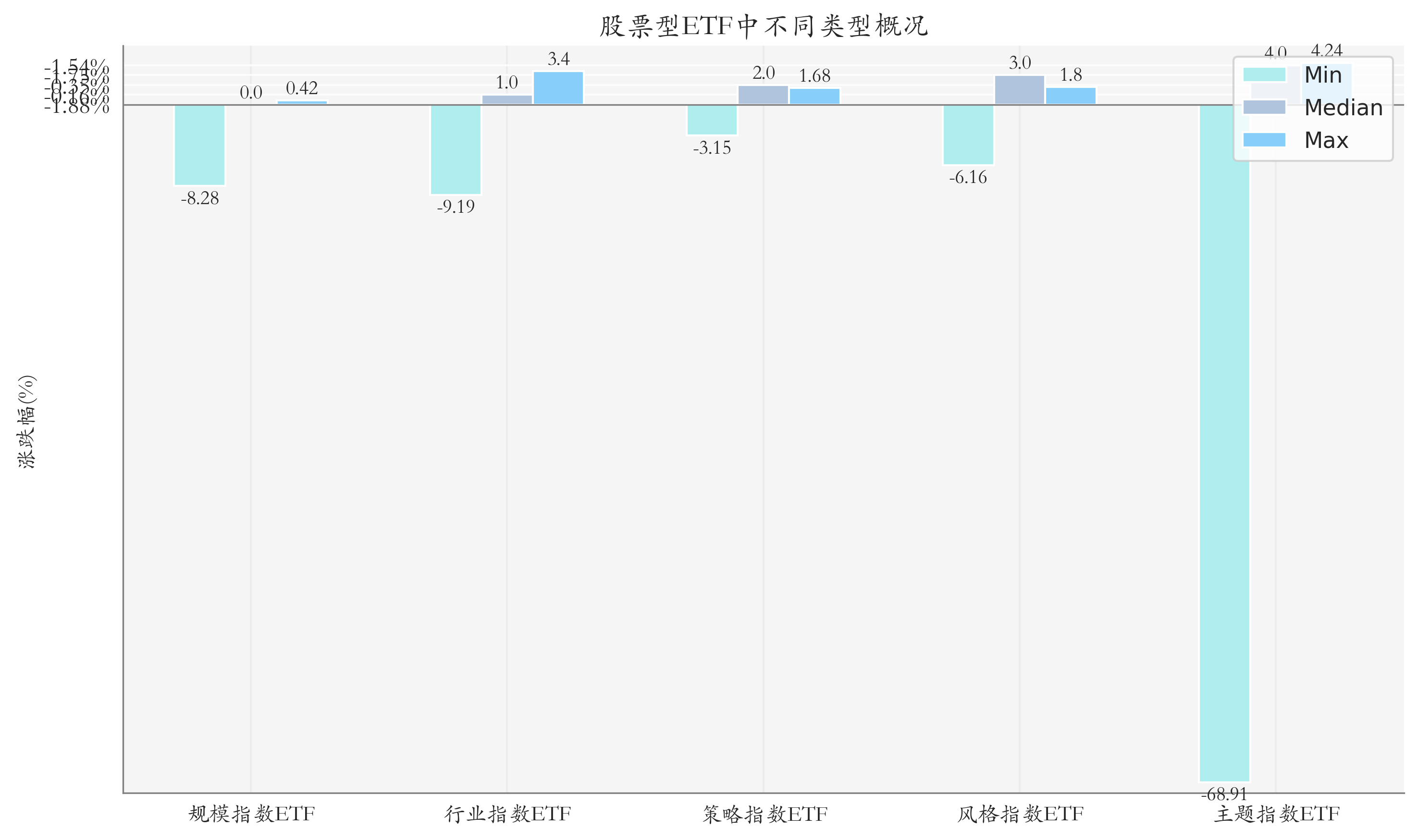
Market Overview - The Shanghai Composite Index fell by 1.27% to 4065.58 points, with a weekly high of 4104.62 points [1] - The Shenzhen Component Index decreased by 2.11% to 13906.73 points, reaching a high of 14213.61 points [1] - The ChiNext Index dropped by 3.28% to 3236.46 points, with a peak of 3390.3 points [1] - In the global market, the Nasdaq Composite Index declined by 1.84%, while the Dow Jones Industrial Average rose by 2.5% [1] ETF Market Performance 1. Stock ETF Overall Performance - The median weekly return for stock ETFs was -1.63% [2] - The highest weekly return among scale index ETFs was 0.42% for the Southern Shenzhen Main Board 50 ETF [2] - The highest weekly return in industry index ETFs was 3.4% for the China Southern Shanghai Composite Main Consumer ETF [2] 2. Stock ETF Gain and Loss Rankings - The top five performing ETFs were: - China Southern Photovoltaic Industry ETF (4.24%) - Fortune Shanghai Stock Exchange Sci-Tech Innovation Board New Energy ETF (4.09%) - E Fund Shanghai Stock Exchange Sci-Tech Innovation Board New Energy ETF (3.93%) - Penghua Shanghai Stock Exchange Sci-Tech Innovation Board New Energy ETF (3.88%) - Tianhong China Southern Photovoltaic Industry ETF (3.42%) [6] - The five ETFs with the largest declines included: - Guotai China Southern All-Index Communication Equipment ETF (-68.91%) - Guolian An Shanghai Stock Exchange Sci-Tech Innovation Board Chip Design Theme ETF (-54.59%) - Huaan China Southern Shanghai-Hong Kong Gold Industry Stock ETF (-13.25%) [6] 3. Stock ETF Liquidity - Average daily trading volume for stock ETFs decreased by 32.4%, while average daily trading volume increased by 20.9% [8] 4. Stock ETF Fund Flows - The top five ETFs with the highest inflows were: - Southern China 500 ETF (inflow of 2.26 billion) - Huatai-PB CSI 300 ETF (inflow of 1.086 billion) - Huaxia CSI 1000 ETF (inflow of 600 million) [11] - The top five ETFs with the largest outflows included: - Huaxia Shanghai 50 ETF (outflow of 331 million) - Huaxia CSI Subdivision Food and Beverage Industry Theme ETF (outflow of 324 million) [12] ETF Financing and Margin Trading - The financing balance for stock ETFs decreased from 53.0598 billion to 52.7352 billion [14] - The highest financing buy amount was for Southern China 500 ETF, totaling 845 million [14] ETF Market Size - The total market size for ETFs reached 5321.655 billion, a decrease of 135.866 billion from the previous week [17] - Stock ETFs accounted for 59.0% of the total ETF market size [19] ETF Issuance and Establishment - No new ETFs were issued last week, but nine new ETFs were established, including: - Huaan CSI Nonferrous Metal Mining Theme ETF - Wanji Guo Zheng New Energy Vehicle Battery ETF [20] Institutional Insights - CITIC Securities predicts exponential growth in space photovoltaic demand, with leading Chinese photovoltaic equipment manufacturers likely to enter the supply chains of companies like Tesla and SpaceX [21] - GF Securities anticipates that the demand for energy from space satellites and data centers will drive global photovoltaic demand, projecting a growth of 18.6% in global photovoltaic demand by 2026 [22]