奇瑞汽车

Search documents
乘联分会:9月乘用车厂商零售、出口、批发和生产均创当月历史新高
智通财经网· 2025-10-13 02:21
Core Insights - The passenger car market in China showed strong performance in September 2025, with record highs in retail, export, wholesale, and production, particularly in the new energy vehicle (NEV) sector [1][2][5] Retail Performance - In September, the retail sales of passenger cars reached 2.241 million units, a year-on-year increase of 6.3% and a month-on-month increase of 11.0% [2][4] - Cumulative retail sales from January to September reached 17.005 million units, reflecting a 9.2% year-on-year growth [2][4] - The retail penetration rate of NEVs in September was 57.8%, with a notable increase in the share of domestic brands [12][14] Export Trends - In September, the total export of passenger cars was 528,000 units, marking a year-on-year increase of 20.7% [5][15] - NEVs accounted for 40.1% of total exports, with a significant year-on-year increase of 15 percentage points [5][15] - The export of domestic brands reached 463,000 units, a year-on-year growth of 27% [5][15] Production Insights - Passenger car production in September was 2.838 million units, a year-on-year increase of 17.2% [5][6] - Cumulative production from January to September reached 20.78 million units, reflecting a 13.9% year-on-year growth [5][6] Wholesale Data - In September, wholesale sales of passenger cars reached 2.803 million units, a year-on-year increase of 12.4% [6][12] - The wholesale penetration rate of NEVs was 53.5%, with domestic brands leading at 68.3% [12][15] New Energy Vehicle (NEV) Performance - NEV production in September reached 1.501 million units, a year-on-year increase of 22.9% [8][9] - NEV wholesale sales were 1.500 million units, reflecting a year-on-year growth of 22.4% [9][12] - The cumulative retail of NEVs from January to September was 8.866 million units, a growth of 24.4% [9][12] Brand Performance - In September, domestic brands achieved retail sales of 1.5 million units, a year-on-year increase of 13% [4][17] - The market share of domestic brands in the retail sector reached 66.9%, up 3.6 percentage points year-on-year [4][17] - New energy brands like BYD, Geely, and Chery showed strong performance in both retail and wholesale segments [16][17] Market Dynamics - The market is transitioning towards a more stable environment with reduced price wars and moderate promotional activities [3][4] - The competitive landscape is evolving, with emerging brands gaining market share and traditional brands adapting to new trends [16][17]





【月度分析】2025年9月份全国乘用车市场分析
乘联分会· 2025-10-13 02:01
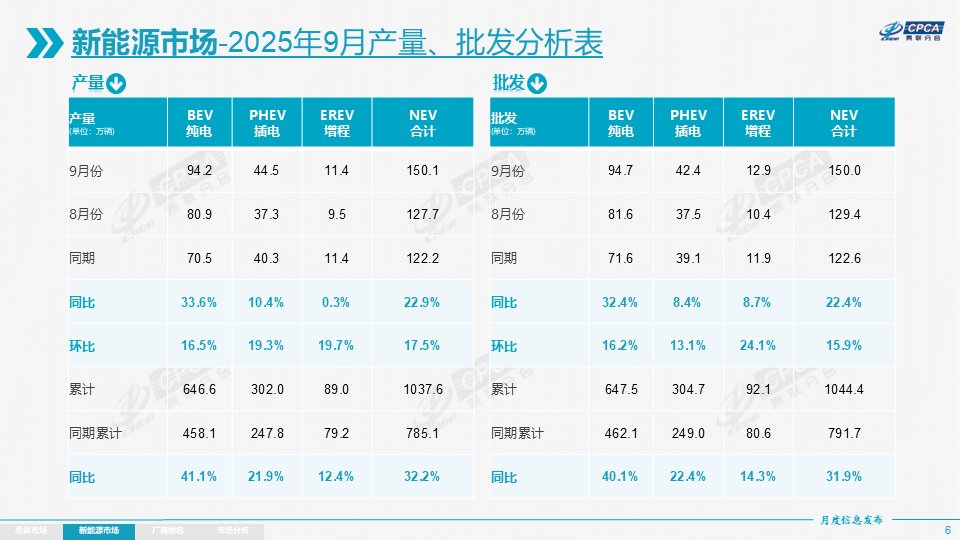
Overall Market Summary - In September 2025, the retail sales of passenger cars reached 2.241 million units, a year-on-year increase of 6.3% and a month-on-month increase of 11.0%. Cumulative retail sales for the year reached 17.005 million units, up 9.2% year-on-year [13][15][16] - The production of passenger cars in September was 2.838 million units, a year-on-year increase of 17.2% and a month-on-month increase of 15.7%. Cumulative production for the year was 20.78 million units, up 13.9% year-on-year [17][18] - The wholesale volume for September was 2.803 million units, marking a historical high for the month, with a year-on-year increase of 12.4% and a month-on-month increase of 13.0% [18] New Energy Market Summary - In September 2025, the production of new energy vehicles (NEVs) reached 1.501 million units, a year-on-year increase of 22.9% and a month-on-month increase of 17.5%. Cumulative production for the year was 10.376 million units, up 32.2% year-on-year [19] - The wholesale volume of NEVs in September was 1.500 million units, a year-on-year increase of 22.4% and a month-on-month increase of 15.9%. Cumulative wholesale for the year reached 10.444 million units, up 31.9% year-on-year [19] - The retail sales of NEVs in September were 1.296 million units, a year-on-year increase of 15.5% and a month-on-month increase of 16.2%. Cumulative retail for the year was 886.6 thousand units, up 24.4% year-on-year [19] Export Performance - In September, the export of passenger cars reached 528,000 units, a year-on-year increase of 20.7% and a month-on-month increase of 5.7%. Cumulative exports for the year were 3.999 million units, up 12.5% year-on-year [17] - NEVs accounted for 40.1% of total exports in September, a year-on-year increase of 15 percentage points. The export of NEVs reached 211,000 units, a year-on-year increase of 96.5% [24][17] Market Trends and Insights - The market is experiencing a shift towards stable pricing and reduced promotional activities, with 23 models seeing price cuts in September, compared to 36 last year [13][15] - The penetration rate of NEVs in the domestic market reached 57.8% in September, with a notable increase in the share of domestic brands [23][19] - The competitive landscape is evolving, with significant growth in domestic brands, particularly in the NEV segment, where brands like BYD and Geely are leading [27][26] Inventory and Production Dynamics - The overall industry inventory increased by 70,000 units in September, indicating a proactive approach by manufacturers to build inventory [19] - The production of luxury brands increased by 7% year-on-year, while domestic brands saw a 21% increase, reflecting strong demand [17][19] Future Outlook - The market is expected to maintain a "front low, middle high, back flat" trend, with a focus on new energy vehicles driving growth [15][29] - The upcoming months may see a more moderate growth rate due to seasonal factors and changes in consumer purchasing behavior [29][30]


信用债周策略20251012:城投债净偿还态势延续
Minsheng Securities· 2025-10-12 13:00
Group 1 - The core viewpoint of the report indicates that the net financing scale of urban investment bonds has been negative for seven consecutive months, with a net repayment scale of 693.49 billion yuan in September 2025, reflecting a tight financing rhythm and continuous contraction of net supply [1][8][11] - Only six provinces have shown positive net financing since the beginning of the year, with Guangdong being the largest at 140.21 billion yuan, while Jiangsu has the largest net repayment scale at nearly 1200 billion yuan [1][11][15] - The report highlights that Heilongjiang has the highest net repayment ratio, reaching 52.01%, indicating that over half of its outstanding urban investment bonds have been repaid [1][13][15] Group 2 - The report emphasizes the encouragement of policies to foster innovative, specialized, and unique small and medium-sized enterprises (SMEs), with a focus on expanding social capital investment in various sectors of the national economy [3][32][40] - Recent trends show an expansion in production and sales in key manufacturing sectors, with the manufacturing purchasing managers' index (PMI) rising to 49.8% in September, indicating a slight acceleration in overall economic output [32][33][34] - The report notes that the government is actively supporting SMEs through various funds aimed at nurturing and investing in distinctive and high-potential enterprises, which is expected to enhance the development of high-tech manufacturing [3][32][40] Group 3 - The report outlines investment strategies focusing on regions with strong economic fundamentals and effective debt management, particularly in major economic provinces like Guangdong, Jiangsu, and Zhejiang, suggesting a duration extension to 5 years for investments [43][46] - It also recommends paying attention to areas where significant debt resolution policies or funding have been implemented, with a suggested duration of 3-5 years for investments in regions like Chongqing and Tianjin [46][47] - The report highlights the importance of local government support and industrial foundations in cities with strong strategic significance, advising a shorter duration of 2-3 years to mitigate risks from potential interest rate fluctuations [47][48]
在马来西亚“狙击”日系的三种姿势
Hu Xiu· 2025-10-12 04:19
Group 1 - The core point of the article is that Malaysia has overtaken Indonesia to become the largest automotive market in Southeast Asia, with sales reaching 396,800 units compared to Indonesia's 390,500 units in the first half of the year [1] - Malaysia is actively promoting the development of electric vehicles, with government plans to increase the sales proportion of electric vehicles to 15% by 2030 and 38% by 2040, along with the establishment of 10,000 public charging facilities by 2025 [2] - The favorable automotive market, attractive new energy policies, and geographical advantages for exports have drawn several Chinese car manufacturers to Malaysia, including Chery, BYD, and Great Wall [3] Group 2 - Malaysia's unique characteristics include a friendly environment for the Chinese community, where 20% of the population creates 80% of the wealth, and it is the only country outside China with a complete Chinese education system [6][7] - The low fuel prices in Malaysia, due to government subsidies, make fuel vehicles the dominant choice, with 92% market share expected in the first half of 2025 [12][13] - Malaysia is the only ASEAN country with domestic automotive brands, Perodua and Proton, which hold nearly 60% of the market share, posing challenges for foreign brands [14] Group 3 - Great Wall Motors has become the fastest-growing automotive brand in Malaysia, with sales in the first half of the year surpassing the total for the previous year [18] - Great Wall's strategy includes a multi-energy approach and a focus on high-end products, targeting affluent Chinese consumers who are willing to pay premium prices for features and performance [21][22] - Chery aims to establish itself as a local brand in Malaysia, with a goal to become the third "national brand" by increasing market share and competing with established brands like Toyota and Honda [30][32] Group 4 - Proton, Malaysia's first domestic automotive brand, has successfully integrated with Geely's global strategy, launching models based on Geely's technology [41][42] - The launch of Proton's first electric vehicle, the e.MAS 7, has been well-received, significantly outperforming BYD's sales in the region [43][45] - Proton's competitive edge lies in its ability to leverage existing channel resources and supply chains to offer lower prices for its vehicles [48] Group 5 - The article highlights the importance of quality and durability for vehicles in the Malaysian market, where consumers have higher expectations compared to the Chinese market [59][63] - Historical lessons from the 1990s regarding the failure of Chinese motorcycle brands in Southeast Asia emphasize the need for car manufacturers to avoid price wars and maintain product quality [56][57]
乘联分会:9月全国乘用车市场零售223.9万辆 同比增长6%
Zhi Tong Cai Jing· 2025-10-11 10:53
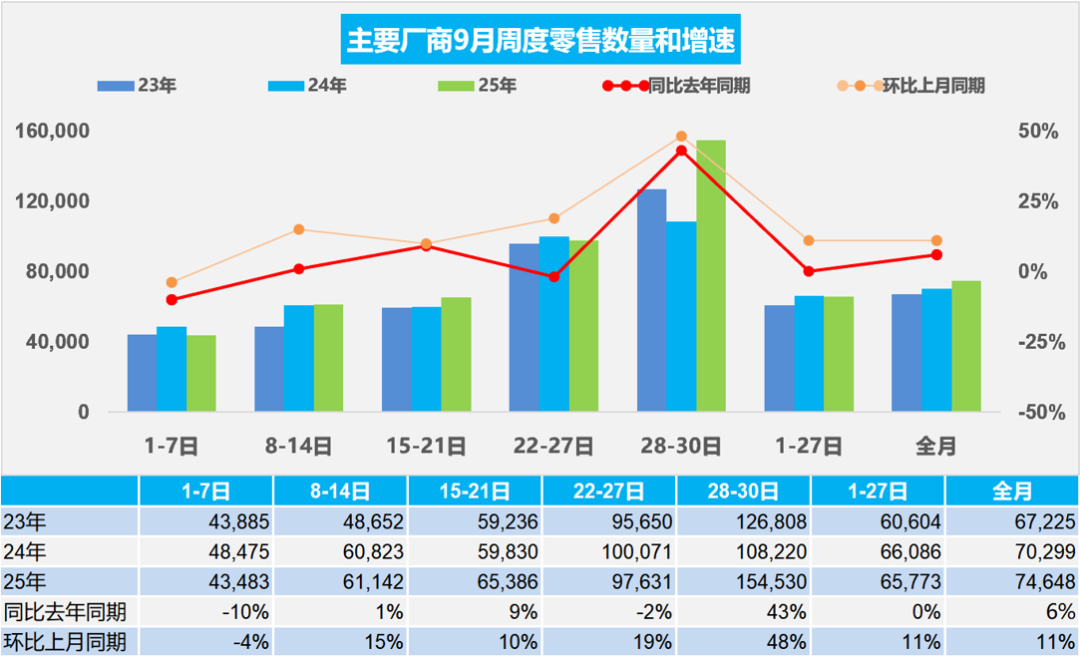
Core Insights - The retail sales of passenger cars in China for September 2025 reached 2.239 million units, representing a year-on-year increase of 6% and a month-on-month increase of 11% [1][5] - The wholesale volume for passenger cars in September 2025 was 2.770 million units, showing a year-on-year growth of 11% and a month-on-month growth of 12% [1][10] - The retail sales of new energy vehicles (NEVs) in September 2025 totaled 1.307 million units, marking a year-on-year increase of 16% and a month-on-month increase of 17% [1][10] - The penetration rate of NEVs in the passenger car market reached 58.5% in September 2025, with cumulative retail sales of 8.878 million units for the year, up 24% year-on-year [1][10] Retail Market Performance - The average daily retail sales for the first week of September 2025 were 43,885 units, down 10% year-on-year and down 4% month-on-month [4] - The second week saw an increase to 61,000 units, up 1% year-on-year and up 15% month-on-month [5] - The third week recorded 65,000 units, up 9% year-on-year and up 10% month-on-month [5] - The fourth week had a daily average of 98,000 units, down 2% year-on-year but up 19% month-on-month [5] - The fifth week experienced a significant increase to 155,000 units, up 43% year-on-year and up 48% month-on-month [5] Wholesale Market Performance - The average daily wholesale volume for the first week of September 2025 was 44,000 units, down 5% year-on-year but up 9% month-on-month [9] - The second week saw a slight decline to 67,000 units, down 1% year-on-year but up 26% month-on-month [10] - The third week recorded 76,000 units, up 6% year-on-year and up 13% month-on-month [10] - The fourth week had a daily average of 132,000 units, up 2% year-on-year and up 13% month-on-month [10] - The fifth week experienced a substantial increase to 222,000 units, up 57% year-on-year and up 37% month-on-month [10] Industry Trends - The automotive industry in China is benefiting from government policies such as trade-in subsidies, which have stimulated demand [6] - The market is entering a traditional peak season, with local subsidies encouraging consumer purchases, particularly for high-priced models [6] - The overall profit margin for the automotive industry was reported at 4.5% for the first eight months of 2025, indicating a slight decline compared to previous years [12] - China's share of the global automotive market reached 34% in the first eight months of 2025, with a notable increase in the share of new energy vehicles [13][15]
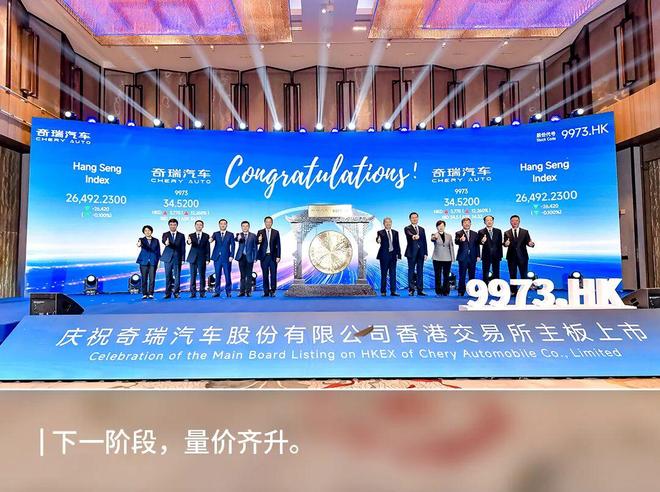
港股敲完钟的奇瑞,还藏了好几手
Xin Lang Cai Jing· 2025-10-11 09:53
Core Insights - Chery Automobile (9973.HK) is undergoing a transformation towards new energy and smart technology, with its sales scale, brand, and performance ranking among the top private car manufacturers in China, yet its market value is considered undervalued [3][4] - The company’s overseas advantages and stable cash flow from its traditional fuel vehicles could support a significant revenue and profit growth from 2025 to 2027 if fundraising is effectively invested in the new energy sector [3][4] Sales Performance - Chery has sold over 15 million vehicles, predominantly fuel cars, but is now leveraging its established brands to enter the new energy vehicle market [4] - From January to September, Chery Group's new energy vehicle sales increased by 77.1% year-on-year to approximately 588,000 units [6][15] - The company aims to achieve a revenue peak of approximately 269.9 billion RMB in 2024, prompting a strategic IPO in 2025 [3] Global Expansion - Chery has established a global production and sales network, exporting over 936,000 vehicles in the first three quarters of 2025, a 12.9% increase year-on-year [7] - The brand has successfully entered several European markets, including Spain, Italy, and the UK, with a notable sales increase of 145,000 units in Europe from January to September [8][9] Product Innovation - Chery is focusing on enhancing its brand and product offerings, transitioning from a technology-centric approach to a more market-oriented strategy [11][13] - The launch of the new model, the Jietu Zongheng G700, featuring amphibious capabilities, has generated significant attention and is expected to be a highlight in Chery's product lineup [14][15] Market Position - Chery's cumulative new car sales exceeded 2 million units from January to September, reflecting a 14.5% year-on-year growth, supported by its classic IPs, global network, and innovative competitiveness [15]
【周度分析】车市扫描(2025年9月28日-9月30日)
乘联分会· 2025-10-11 09:38
Market Overview - In September 2025, the retail sales of passenger cars in China reached 2.239 million units, a year-on-year increase of 6% and a month-on-month increase of 11%. Cumulatively, retail sales for the year reached 17.004 million units, up 9% year-on-year [1][4] - The wholesale volume of passenger cars in September 2025 was 2.770 million units, representing an 11% increase year-on-year and a 12% increase month-on-month. Year-to-date wholesale volume reached 20.812 million units, up 13% year-on-year [1][9] New Energy Vehicle (NEV) Market - Retail sales of new energy vehicles in September 2025 were 1.307 million units, a 16% increase year-on-year and a 17% increase month-on-month, with a penetration rate of 58.5%. Year-to-date retail sales reached 8.878 million units, up 24% year-on-year [1][4] - Wholesale volume of new energy vehicles was 1.489 million units in September 2025, a 21% increase year-on-year and a 15% increase month-on-month, with a penetration rate of 53.8%. Year-to-date wholesale volume reached 10.433 million units, up 32% year-on-year [1][9] Weekly Sales Trends - The average daily retail sales for the first week of September 2025 were 43,885 units, down 10% year-on-year and down 4% month-on-month [3] - The average daily retail sales for the fifth week of September 2025 surged to 155,000 units, a 43% increase year-on-year and a 48% increase month-on-month [4] Manufacturer Wholesale Trends - The average daily wholesale volume for manufacturers in the first week of September 2025 was 44,000 units, down 5% year-on-year but up 9% month-on-month [8] - The average daily wholesale volume for the fifth week of September 2025 reached 222,360 units, a 57% increase year-on-year and a 37% increase month-on-month [9] Industry Profitability - From January to August 2025, the automotive industry reported a profit margin of 4.5%, with total revenue of 680.49 billion yuan, an 8% year-on-year increase. However, profits decreased by 0.3% year-on-year to 30.35 billion yuan [12] - In August 2025, the automotive industry revenue was 88.56 billion yuan, a 7.5% increase year-on-year, but profits fell by 10% year-on-year to 2.98 billion yuan, indicating a decline in profitability [12] Global Market Share - In the first eight months of 2025, China accounted for 34% of the global automotive market, with 21.1 million units sold, a 12% increase year-on-year [13] - China held a dominant 68% share of the global new energy vehicle market in the same period, with significant growth in both pure electric and plug-in hybrid vehicles [14][16]

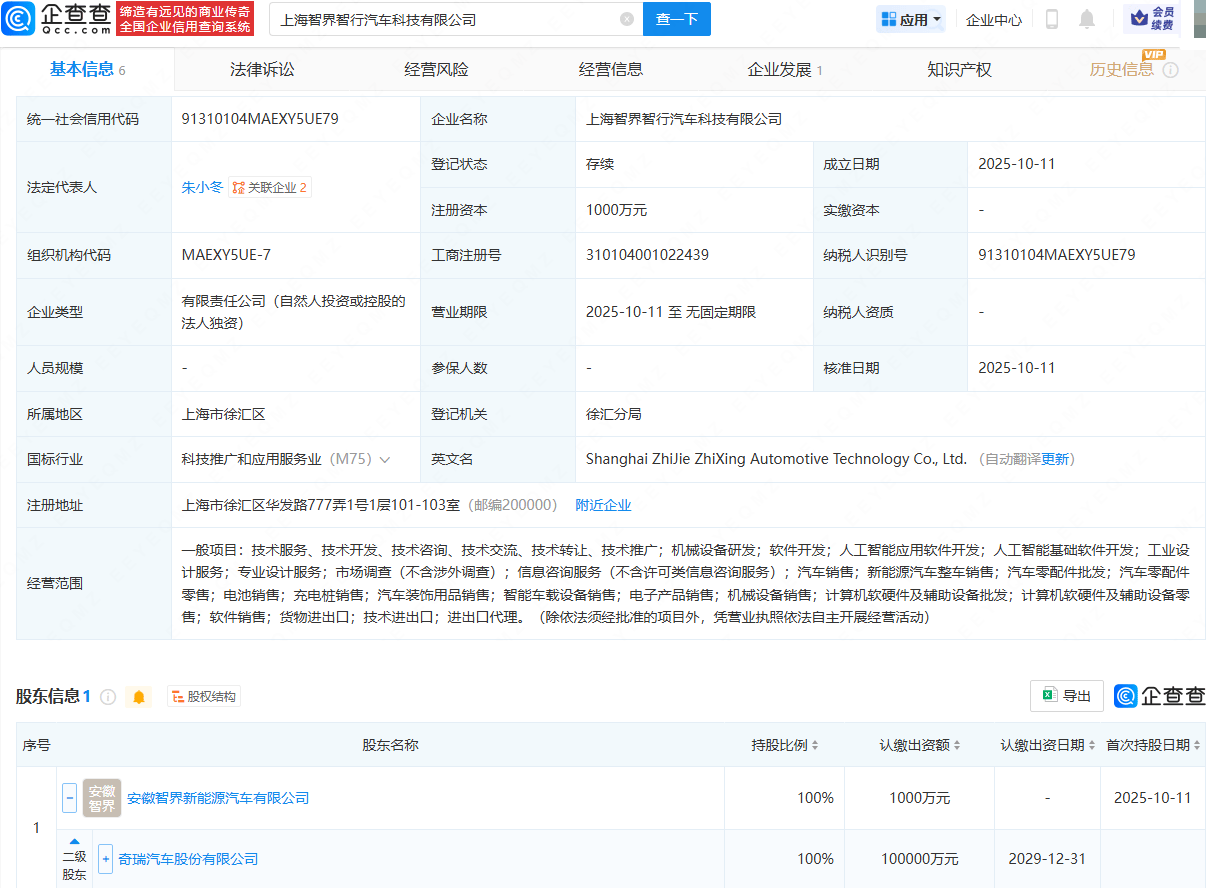
奇瑞投资成立智界智行汽车科技公司
Sou Hu Cai Jing· 2025-10-11 09:21
Core Points - Shanghai Zhijie Zhixing Automotive Technology Co., Ltd. has been established with a registered capital of 10 million yuan, focusing on software development, artificial intelligence applications, and the sale of new energy vehicles [1][2] - The company is wholly owned by Chery Automobile Co., Ltd. through an indirect stake [1][2] Company Information - The legal representative of the company is Zhu Xiaodong, and it is registered in Xuhui District, Shanghai [2] - The company was established on October 11, 2025, and has no fixed business duration [2] - The business scope includes technology services, software development, and sales of electric vehicle components and related products [2] Shareholder Structure - The sole shareholder is Anhui Zhijie New Energy Automobile Co., Ltd., which holds 100% of the shares with a subscribed capital of 10 million yuan [2] - Chery Automobile Co., Ltd. is the ultimate parent company, holding 100% of the shares in Anhui Zhijie New Energy Automobile Co., Ltd. with a subscribed capital of 100 million yuan [2]
车企新能源目标完成率:传统车企向好 新势力仅小鹏、零跑达标
Sou Hu Cai Jing· 2025-10-11 06:13
Core Insights - In September, 10 out of 12 new energy vehicle (NEV) companies reported sales growth, indicating a positive trend for the first three quarters of the year [2] - However, only two new energy vehicle companies achieved over 75% of their annual sales targets, with nine companies falling below 50%, highlighting significant pressure to meet targets in the fourth quarter [2][5] - Traditional automakers showed a more optimistic performance, with three companies achieving over 70% of their sales targets, suggesting a better chance of meeting annual goals [2][8] New Energy Vehicle Companies - Among new energy vehicle companies, only Xiaopeng Motors and Leap Motor reached or exceeded a 75% target completion rate, with Xiaopeng selling 313,000 units (up 218%) and Leap Motor selling 396,000 units (up 129%) in the first nine months [4][6] - Xiaomi Motors also exceeded a 70% completion rate, selling 250,000 units (up 279%) [4] - Other companies, including Hongmeng Zhixing and Li Auto, faced challenges, with Hongmeng achieving only 34% of its target despite selling 344,000 units (up 10%) [6][10] - NIO sold 201,000 units (up 35%) but only reached 45% of its annual target [6][7] Traditional Automakers - BYD led traditional automakers with 3.219 million units sold (up 18%), achieving a 70% completion rate of its annual target of 4.6 million units [10] - Geely followed with 1.168 million units sold (up 114%) and a completion rate of 78% [10][11] - Changan and SAIC-GM-Wuling also exceeded 70% completion rates, with Changan selling 724,000 units (up 60%) [10][11] - Other traditional automakers like Chery and Great Wall Motors reported significant growth, with Chery selling 588,000 units (up 77%) [10][12]



港股IPO热潮奔涌:年内65家新股上市,迎300亿美元全球第二大IPO
Sou Hu Cai Jing· 2025-10-11 01:45
Core Insights - The Hong Kong IPO market is experiencing significant activity, highlighted by Zijin Mining's spin-off, Zijin Gold International, which aims for a valuation exceeding $30 billion and is set to be the second-largest IPO globally this year, following CATL [2] - As of now, 65 new IPOs have been listed in the Hong Kong market, raising approximately HKD 156.3 billion, solidifying Hong Kong's position as the leading global IPO financing hub [2] Group 1: Market Dynamics - The efficiency of the IPO process has reached record levels, with large IPOs demonstrating a capital aggregation effect. Notably, CATL's IPO took just over three months from application to listing, raising a net amount of approximately HKD 35.3 billion and achieving a 120 times oversubscription [4] - Recent listings, such as Chery Automobile, have further fueled market enthusiasm, with its market capitalization surpassing HKD 190 billion, marking it as the largest car company IPO in Hong Kong this year [4] Group 2: Sector Diversity - The IPO landscape is characterized by a diverse industry distribution, with a significant number of companies from healthcare and biotechnology, as well as consumer sectors like food and daily consumer goods, participating in the market [6] - International companies are increasingly listing in Hong Kong, with four overseas firms from Singapore, Thailand, Indonesia, and the U.S. raising a total of HKD 5.4 billion in the first three quarters of the year, compared to only two international listings in the same period last year [6] Group 3: Market Regulation and Environment - The Hong Kong market is undergoing a healthy cycle of entries and exits, with 64 companies going public while 42 companies have delisted, primarily due to financial compliance issues and governance failures [7] - The Hong Kong Stock Exchange has implemented a "fast-track delisting" mechanism to enhance market efficiency, and regulatory bodies are intensifying accountability measures for executives of delisted companies [7] Group 4: Future Outlook - The support from the China Securities Regulatory Commission for mainland leading companies to list in Hong Kong, along with optimized listing processes, is expected to sustain the momentum in the IPO market [9] - With over 230 listing applications currently under review and the anticipated influx of international funds due to the Federal Reserve's interest rate cuts, Hong Kong is projected to maintain its status as the global leader in new stock financing throughout 2025 [9]