
奔驰

Search documents
群友分析售价20万元以上品牌/车型销量市场
理想TOP2· 2025-07-18 14:10
Core Viewpoints - The main competitors in the new energy vehicle market over the next five years will still be fuel vehicles, with the core competitive point being the differentiated product matrix supply capability for models priced above 200,000 yuan, which currently has significant room for improvement in supply [2][3] - The market share of vehicles priced above 200,000 yuan is expected to exceed 60% in the next 5-10 years, up from the current 30%. The leading brand in this price segment is likely to exceed a 25% market share, potentially surpassing 30%, indicating annual sales exceeding 3 million units [2][3] - The new energy vehicle market is awaiting its "iPhone 4 moment," where technology and blockbuster products mature, leading to a significant increase in market concentration [2][4] Market Analysis - In 2024, the domestic passenger car sales are projected to be approximately 22.6 million units, with fuel vehicles accounting for about 11.5 million units, representing a market share of around 51%. The sales of models priced above 200,000 yuan are estimated at about 6.6 million units, making up 30% of total sales, with fuel vehicles contributing approximately 4.2 million units [3][6] - The market share of fuel vehicles in the 200,000 yuan price range remains substantial, currently at 64%. Despite significant price reductions in the past year to maintain market share, the trend is set, and the market is awaiting the arrival of the "iPhone 4 moment" [3][4] iPhone 4 Moment - The "iPhone 4 moment" refers to two key turning points: the maturity of 3G technology, which allowed smartphones to surpass traditional computers in user experience, and the decline of traditional phone brands' flagship models, which led to a loss of cash flow for R&D and ultimately market exit. This parallels the potential decline in sales of fuel vehicles priced above 200,000 yuan [4][5] Price Segment Analysis - The market share of vehicles priced above 200,000 yuan has increased from 9% in 2019 to 30% in 2023. It is anticipated that this segment will exceed 60% in the next five years, corresponding to sales of at least 12 million units domestically [6][7] - The brands and products in this price segment are crucial for generating sufficient profits to support R&D, branding, and market promotion, creating a flywheel effect. Additionally, this price segment attracts a broad customer base, enhancing brand momentum [6][7] Brand Market Share - In the segment of vehicles priced above 200,000 yuan, the top six fuel vehicle brands hold a market share of approximately 55%, while the top four new energy brands account for about 26-27% [16][17] - The future market structure is expected to resemble the smartphone industry, where a few brands dominate the high-end market. The leading brand in the new energy vehicle segment could capture around 25% of the market share, with annual sales exceeding 3 million units if the overall passenger car sales reach 20 million [17][29] Sales Performance - The average monthly sales of models priced above 200,000 yuan that exceed 10,000 units are defined as "blockbuster products." Currently, only six major fuel vehicle brands and four new energy brands have this capability, with these models accounting for 65% of the overall sales in this price segment [18][19] - The performance of Li Auto is particularly notable, as achieving a market share of 25-30% in the SUV segment priced above 200,000 yuan would significantly enhance its market position before expanding into the sedan market [29][30]


当海外Tier 1开始讲中国故事
远川研究所· 2025-07-18 13:11
Core Viewpoint - The article discusses the significant shift in the automotive supply chain, particularly focusing on the challenges and transformations faced by Tier 1 suppliers in the context of electric vehicle (EV) adoption and the increasing importance of the Chinese market [3][4][34]. Group 1: Industry Trends - Toyota has announced the "Chief Engineer in China" system, transferring R&D decision-making power from Japan to China, indicating a strategic shift towards local empowerment [3]. - Major Tier 1 suppliers like ZF and Bosch are relocating R&D centers to China, reflecting a trend of decentralization and increased focus on the Chinese market [4]. - The automotive supply chain is experiencing a structural change, with traditional suppliers facing pressure to adapt to the electric vehicle market while maintaining profitability [9][10]. Group 2: Profitability Challenges - Panasonic's automotive business, despite being a top contributor to revenue, has low profit margins, leading to a strategic reevaluation of its operations [6][8]. - The average EBIT margin for the global automotive parts industry is projected to be around 4.7% in 2024, with Chinese suppliers achieving a higher margin of 5.7% compared to 3.6% for European suppliers [13]. - Bosch's EBIT margin is expected to drop significantly, highlighting the financial pressures faced by traditional suppliers in the evolving market [13][14]. Group 3: Strategic Responses - Tier 1 suppliers are compelled to balance maintaining existing business advantages while investing heavily in new technologies to avoid falling behind [11][12]. - Companies like Continental and ZF are restructuring to focus on high-margin segments, such as tires, while divesting less profitable divisions [12][13]. - The shift towards electric vehicles has led to a reevaluation of customer relationships, with suppliers needing to select clients strategically, akin to stock selection [15][21]. Group 4: Market Dynamics - The article highlights the disparity in electric vehicle sales between traditional automakers and new entrants, with established companies struggling to meet their ambitious EV targets [27][28]. - Chinese electric vehicle sales have consistently outpaced those in Europe and the U.S., prompting Tier 1 suppliers to reposition themselves as R&D centers in China rather than just manufacturing hubs [29][32]. - The emergence of new technologies is disrupting traditional market dynamics, forcing established players to adapt or risk losing relevance [30][32]. Group 5: Future Outlook - The article suggests that the current window of opportunity for Tier 1 suppliers to rebuild competitiveness in the Chinese market may be their best chance to thrive amid the shifting landscape [34].

超豪华小汽车税改影响几何
2 1 Shi Ji Jing Ji Bao Dao· 2025-07-18 12:49
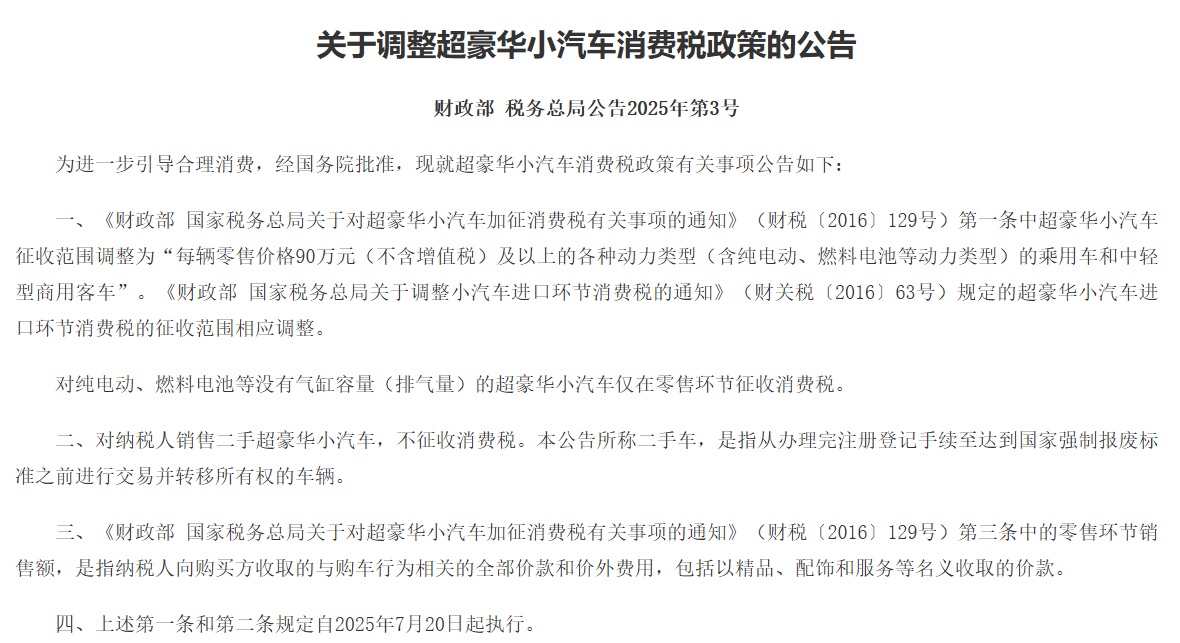
Core Viewpoint - The adjustment of the consumption tax policy for ultra-luxury vehicles in China is a significant change aimed at promoting reasonable consumption and environmental sustainability, with a limited impact on overall luxury car sales [1][2][5]. Group 1: Policy Changes - The new consumption tax policy for ultra-luxury vehicles, effective from July 20, 2025, lowers the taxable threshold to vehicles priced at 900,000 yuan (excluding VAT) and above [1][2]. - The policy exempts the sale of second-hand ultra-luxury vehicles from consumption tax, marking a major shift since the establishment of the tax system in 2016 [2][5]. - The previous threshold for taxation was set at 1.3 million yuan (including tax), which has now been adjusted to reflect market changes [4][5]. Group 2: Market Impact - In the first half of 2025, approximately 20,000 new vehicles fell within the taxable range, representing a small fraction of the total luxury car sales of 1.45 million units during the same period [1][5]. - The luxury car market is experiencing a decline, with sales of new vehicles priced above 900,000 yuan dropping significantly, particularly in fuel and plug-in hybrid models [3][4]. - The market share of imported luxury vehicles has been decreasing, with a notable drop in imports from a peak of 1.43 million units in 2014 to an estimated 700,000 units in 2024 [3][4]. Group 3: Consumer Behavior - The adjustment in tax policy is expected to have a limited effect on the purchasing behavior of ultra-luxury vehicle consumers, who are characterized by strong purchasing power [6]. - There has been an increase in promotional activities among luxury car brands, with discounts reaching up to 30% on certain models, indicating a competitive market environment [4][5]. - The urgency to complete transactions before the new tax implementation has led to a noticeable increase in sales activity in the days leading up to the policy change [5]. Group 4: Tax Revenue and Regulation - The consumption tax is a significant revenue source for the government, with a reported collection of 772.9 billion yuan in the first five months of the year, reflecting a 1.6% year-on-year growth [5]. - The new policy aims to enhance tax regulation by closing loopholes that allowed for tax evasion through price manipulation and multiple invoicing [6].
消费税起征点降至90万元 哪些超豪华车要“涨价”?
Xin Hua Cai Jing· 2025-07-18 06:27
Core Viewpoint - The adjustment of the consumption tax policy for ultra-luxury cars in China is expected to reshape the market dynamics, particularly affecting the pricing and sales of new vehicles in the 90-130 million yuan range [1][4][7]. Group 1: Policy Changes - The new policy lowers the consumption tax threshold for ultra-luxury cars from a retail price of 130 million yuan to 90 million yuan, effective from July 20 [1][5]. - The policy includes all types of powertrains, such as pure electric and fuel cell vehicles, and exempts second-hand ultra-luxury cars from consumption tax [3][4][7]. Group 2: Market Impact - The adjustment is projected to impact the sales of new cars priced between 90 million and 130 million yuan, which previously did not incur the tax [5][6]. - The luxury car market, particularly for imported brands, may face significant challenges as the competition landscape shifts due to the new tax structure [5][8]. Group 3: Sales Data and Projections - In the first half of 2025, approximately 20,000 new cars in the 90-130 million yuan range are expected to be sold, which is a small fraction of the overall luxury car sales of 1.45 million units [5][6]. - The market share for brands in the new tax range shows that Mercedes holds 48%, Land Rover 23%, and Porsche 18%, indicating a concentrated market [6]. Group 4: Long-term Trends - The policy is seen as a move towards promoting sustainable consumption and may benefit the second-hand car market in the long run [7]. - The import car market is anticipated to continue shrinking, with a projected decline in import volumes from 80 million units in 2023 to 70 million in 2024 [9].
都市车界|买豪车要“加价”了?超豪华车消费税大调整:90万元成新门槛,电动车不再“例外”
Qi Lu Wan Bao· 2025-07-18 02:38
Core Viewpoint - The adjustment of the consumption tax policy for ultra-luxury cars aims to refine consumption guidance and align tax policies with the automotive industry's transition towards electrification and intelligence [2][7] Tax Policy Changes - The starting point for the consumption tax on ultra-luxury cars has been significantly lowered from 1.3 million yuan to 900,000 yuan, effective from July 20, 2025 [1][2] - The new policy covers all types of passenger cars and light commercial vehicles, including electric and fuel cell vehicles, while exempting second-hand ultra-luxury cars from consumption tax [1][2] Consumer Behavior Impact - The new tax policy increases the cost of purchasing ultra-luxury vehicles, leading potential buyers to reconsider their purchasing decisions [3][4] - There is a noticeable increase in consumer inquiries about the policy, indicating a rush to purchase before the new tax takes effect [4] Manufacturer Response - Luxury car manufacturers are facing direct impacts on their product strategies and pricing due to the new tax threshold of 900,000 yuan [4][5] - Brands are likely to adjust their product configurations and pricing strategies to remain competitive, with some considering offering more localized options or flexible packages [5][6] Market Dynamics - The luxury car market is expected to undergo structural changes, with the 800,000 to 900,000 yuan price range becoming a new battleground for high-end and entry-level ultra-luxury models [6][7] - The reduction in transaction costs for second-hand ultra-luxury cars is anticipated to enhance market liquidity and attract more players into the high-end used car market [6][7] Long-term Industry Implications - The policy adjustment is seen as a move towards more refined tax regulation in the context of national goals for carbon neutrality and common prosperity, pushing manufacturers to focus on genuine innovation and user experience rather than merely increasing product features [7]
最新调整!这些超豪华车即将征收消费税→
第一财经· 2025-07-18 01:57
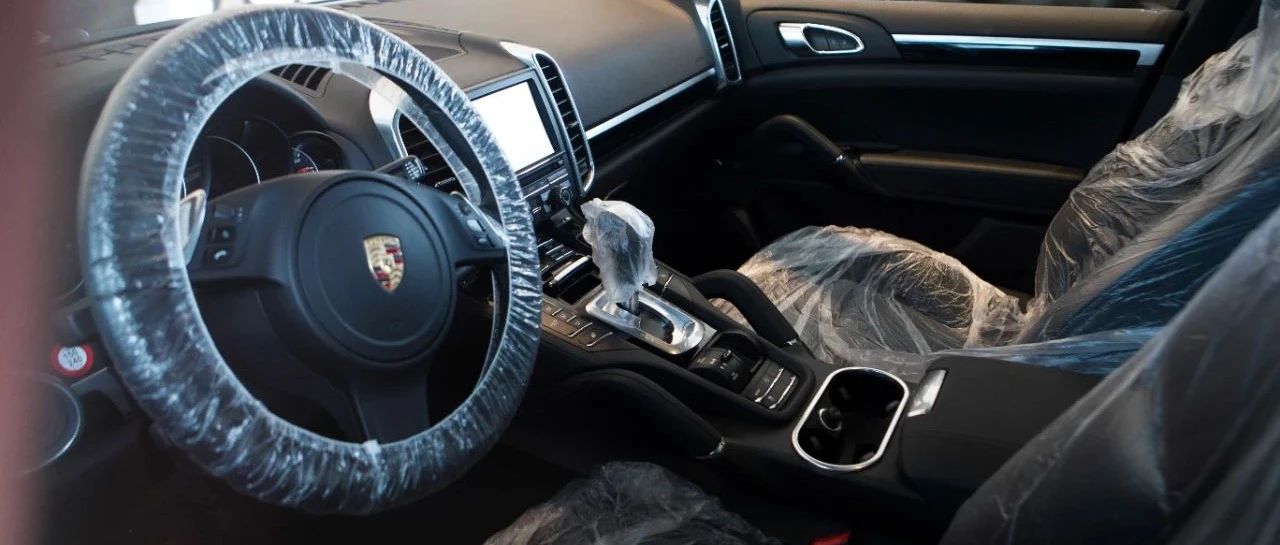
Core Viewpoint - The adjustment of the consumption tax policy for ultra-luxury cars in China is expected to impact the market significantly, particularly for traditional fuel vehicles, which dominate the ultra-luxury segment [1][2]. Group 1: Policy Changes - The consumption tax threshold for ultra-luxury cars has been lowered from a retail price of 1.3 million yuan (excluding VAT) to 900,000 yuan, effective from July 20, 2025 [1]. - The new policy includes various types of vehicles, such as pure electric and fuel cell cars, expanding the scope of the tax [1]. Group 2: Market Impact - In the first half of 2025, sales of ultra-luxury cars priced above 1.017 million yuan saw a 49% year-on-year decline, with total sales of 37,000 units [1]. - Traditional fuel vehicles accounted for nearly 90% of ultra-luxury car sales, indicating a heavy reliance on this segment, which will be directly affected by the new tax policy [1][2]. - Major brands like Mercedes-Benz, Land Rover, and Porsche hold significant market shares, with Mercedes-Benz leading at 48% [1]. Group 3: Consumer Behavior - The adjustment is expected to increase the purchase cost for consumers by tens of thousands of yuan, potentially leading to delayed purchasing decisions or a shift towards lower-priced models among price-sensitive consumers [2]. - There are reports of significant discounts on certain models from brands like Porsche and Maserati, indicating a competitive response to the new tax policy [3]. Group 4: Emerging Competition - Several domestic brands are targeting the million-yuan luxury car market, launching new products such as BYD's Yangwang U8 and Hongqi's Jin Kuihua Guo Ya, although these models have yet to gain significant market traction [3][4].
超豪华车消费税起征点降至90万元,哪些品牌受影响最大?
Di Yi Cai Jing· 2025-07-18 00:53
Group 1 - The Chinese Ministry of Finance and the State Taxation Administration announced a change in the consumption tax policy for ultra-luxury cars, lowering the retail price threshold from 1.3 million yuan to 900,000 yuan [1][2] - The new policy will take effect on July 20, 2025, and will include various types of vehicles, such as pure electric and fuel cell cars, expanding the scope of the consumption tax [1] - In the first half of 2025, sales of ultra-luxury cars priced above 1.017 million yuan fell by 49%, with traditional fuel vehicles making up nearly 90% of sales, indicating a heavy reliance on this segment [1][2] Group 2 - Major brands in the ultra-luxury car market, such as Mercedes-Benz, Land Rover, and Porsche, will face direct pressure from the policy adjustment, with Mercedes-Benz holding a 48% market share [2] - The previous consumption tax threshold was based on a new car price of 1.3 million yuan, and the adjustment will primarily affect vehicles priced between 1.017 million and 1.469 million yuan [2] - The adjustment is expected to increase consumer costs by several tens of thousands of yuan, potentially leading price-sensitive consumers to delay purchases or shift to lower-priced models [2] Group 3 - There have been significant discounts on certain ultra-luxury models, such as those from Porsche and Maserati, indicating market adjustments in response to the new tax policy [3] - Several domestic brands have targeted the million-yuan luxury car market, launching new products like BYD's Yangwang U8 and Hongqi's Jin Kuihua Guo Ya, although these models have yet to gain significant market traction [3]


欧洲汽车巨头抱团补“软肋” 开源联盟能否挽救转型之困?
Jing Ji Guan Cha Wang· 2025-07-17 15:22
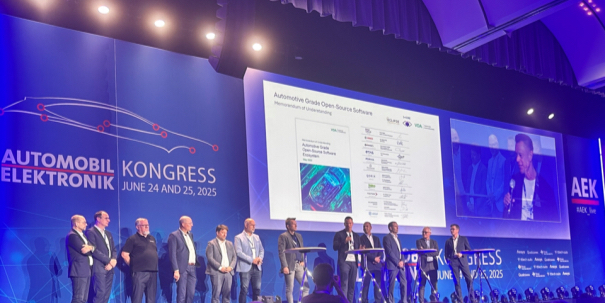
Core Insights - A significant automotive collaboration agreement has been signed in Europe, aiming to enhance the region's "soft power" through the development of a shared automotive software platform called "S-CORE" [2][3] - The alliance includes major automotive players such as Volkswagen, BMW, and Mercedes-Benz, and aims to accelerate the transition to software-defined vehicles (SDVs) by creating an independent and open software ecosystem [2][4] - The initiative is a response to Europe's lagging software ecosystem and aims to address the challenges faced by European automakers in software development [7][10] Group 1: Collaboration and Objectives - The S-CORE project is based on an open-source model, differing from traditional standards-based approaches, and aims to reduce basic software development costs by 30% [3][5] - The alliance plans to release a production-ready software architecture by 2026 and achieve full vehicle-level open-source software integration by 2030 [2][5] - The collaboration seeks to establish a unified software foundation for European automakers, enhancing their competitive edge against U.S. and Chinese companies [10][12] Group 2: Challenges and Concerns - Despite the potential benefits, there are concerns regarding the efficiency of collaboration among major automakers and the risk of stifling innovation due to the complexity of the software issues [10][11] - The software development landscape in Europe has been marked by failures, such as Volkswagen's Cariad, which has faced significant delays and challenges in delivering software solutions [7][8] - The alliance's success may be hindered by the long-standing hardware-centric approach of European automakers and the shortage of software talent [10][11] Group 3: Market Implications - The establishment of the S-CORE alliance reflects a growing consensus that digital services and software revenues will become a primary source of profit for automakers [8][9] - The alliance's outcomes may not significantly impact the Chinese market, as many European automakers have already begun developing independent software ecosystems tailored to local needs [12][13] - In contrast to Europe's approach, China's automotive industry is rapidly advancing in software open-source initiatives, focusing on market-driven solutions and faster implementation [13][14]
【深度分析】2025年6月份全国乘用车市场深度分析报告
乘联分会· 2025-07-17 09:07
Overall Market - The narrow passenger car production and sales situation for June 2025 shows a total production of 2,400,137 units and wholesale of 2,490,237 units, with retail sales reaching 2,085,119 units [6][10] - Year-on-year growth for narrow passenger cars is 12.4% in production, 15.1% in wholesale, and 18.2% in retail [10][12] - The broad passenger car market also reflects similar trends, with total production of 2,422,641 units and retail sales of 2,110,404 units in June 2025 [10][12] Model Category Segmentation - The market share changes among different vehicle categories indicate that sedans, MPVs, and SUVs are experiencing varying growth rates, with SUVs showing a retail growth of 18.5% [6][14] - The total market for narrow passenger cars in the first half of 2025 shows a significant increase in sales across all categories, particularly in SUVs and MPVs [19][32] Country Segmentation - The market share changes by country indicate that domestic brands are gaining traction, with a notable increase in sales for SUVs and sedans [22][23] - The cumulative retail sales for June 2025 show a year-on-year growth of 10.8% for the overall market, with domestic brands leading in several categories [22][30] Brand Positioning Segmentation - The market share for various brands shows that mainstream joint ventures and domestic brands are performing well, with a year-on-year growth of 18.2% in total retail sales [27][30] - Luxury brands, including BMW and Audi, are also experiencing fluctuations in market share, with some brands showing a decline in sales [27][30] Price Positioning Segmentation - The market segmentation by price indicates that vehicles priced below 300,000 yuan dominate the market, accounting for 87% of total sales, while high-end vehicles (≥300,000 yuan) represent 13% [35][36] - The retail sales for high-end vehicles show a year-on-year growth of 10.3%, indicating a growing interest in premium offerings [35][36]

每日投资策略-20250717
Zhao Yin Guo Ji· 2025-07-17 05:40
Industry Insights - The Chinese fiscal and tax digitalization industry is experiencing growth driven by both government and enterprise initiatives, with the implementation of the fourth phase of the Golden Tax Project expected to connect approximately 300,000 medium and large enterprises to the tax bureau's direct connection system, leading to continuous industry expansion [3] - The market size for digitalized fiscal and tax-related transactions is projected to grow from 5.1 billion RMB in 2019 to 34.3 billion RMB by 2028, representing a CAGR of 36.5% from 2023 to 2028, significantly higher than the 9.2% CAGR from 2019 to 2023 [3] - The report highlights the potential for leading service providers to increase market share as the fourth phase of the Golden Tax Project accelerates in 2024, with Baiwang Co., Ltd. positioned as a leader in the industry [3] Company Analysis - Tongcheng Travel (780 HK) is expected to achieve revenue of 4.6 billion RMB in Q2 2025, a year-on-year increase of 9.3%, with non-GAAP net profit projected at 738 million RMB, up 12.4%, aligning with previous forecasts and Bloomberg consensus [4][5] - Anta (2020 HK) has seen retail growth in July 2025 improve compared to Q2, although the brand's performance remains below expectations, with management maintaining a high single-digit growth target for FY25 despite potential short-term impacts from business reforms [6][7] - The company anticipates a controlled cost environment in FY25, aided by reasonable advertising and marketing expenditures, as well as increased bargaining power in rental negotiations due to rising vacancy rates [6] - Shengyi Technology (600183 CH) expects a net profit increase of 50%-56% to 1.4-1.45 billion RMB in H1 2025, driven by strong sales of copper-clad laminate products and PCB sales, which are projected to grow by 85%-97% year-on-year [9] - Zhongji Xuchuang (300308 CH) forecasts a net profit of 3.6-4.4 billion RMB for H1 2025, reflecting a year-on-year growth of 53%-87%, supported by strong demand for AI infrastructure and improved product mix [10]

